Table of Contents
- The Twilight of the Horde: Setting the Stage for the Great Stand
- The Ugra River: Geography and Strategic Importance
- Ivan III’s Ambition: The Making of a Muscovite Tsar
- The Golden Horde in Decline: A Fragmented Empire
- The Prelude to the Stand: Political Tensions and Military Movements
- The Arrival of Akhmat Khan: Last Flint of the Tatar Flame
- The Great Stand on the Ugra River: A Stalemate of Titans
- Psychological Warfare and the Role of the Environment
- The Boyars, the Clergy, and the People: Internal Muscovite Dynamics
- A War of Nerves: The Lengthening Standoff and Its Toll
- The Withdrawal of the Horde: A Quiet End to Domination
- Aftermath: The Fall of the Tatar Yoke and Muscovy’s Rise
- The Symbolic Power of the Stand in Russian Consciousness
- European Reactions and Shifting Alliances in Eastern Europe
- The Legacy of 1480: National Identity and Imperial Aspirations
- Historical Interpretations: Myth, Memory, and Modern Scholarship
- The Ugra River Today: Site of Remembrance and Reflection
- Voices from the Past: Chronicles and Testimonies
- Conclusion: The End of an Era, the Dawn of a Nation
- FAQs
- External Resource
- Internal Link
The Twilight of the Horde: Setting the Stage for the Great Stand
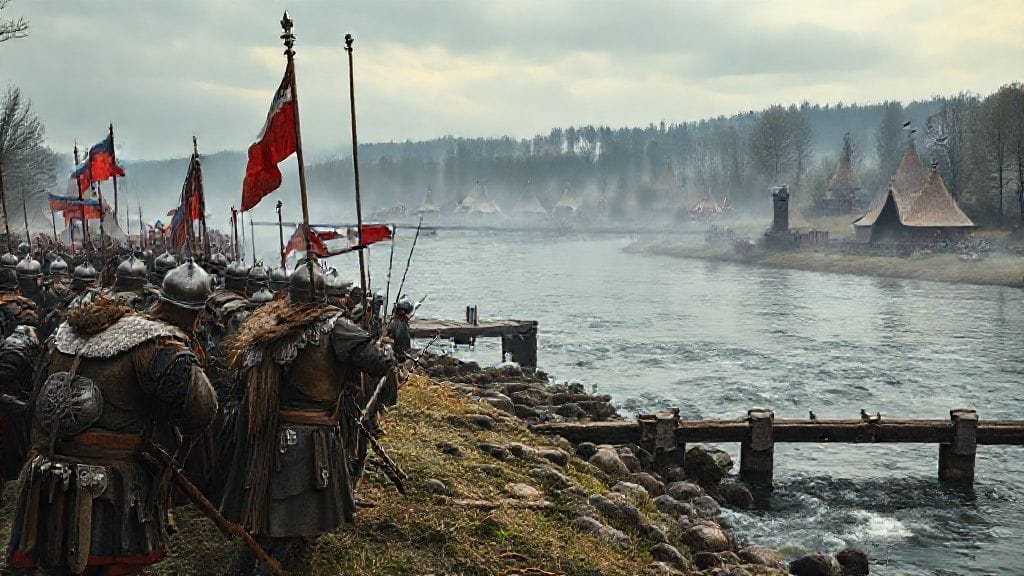
On a mist-laden autumn morning in 1480, the banks of the Ugra River bore witness to an unprecedented standoff. Two great powers — the dwindling Golden Horde and a rising Muscovy — faced each other across the cold waters, their armies tense but hesitant, swords glinting under a fading sun, yet no clash would come that day. Instead, this confrontation would mark the silent end of nearly two centuries of Tatar domination over the Russian principalities. But it was not merely military might or tactical genius that brought about this turning point; it was a complex weave of political savvy, cultural shifts, and sheer stubborn will. This was the Great Stand on the Ugra River — an event that echoes through history as the decisive moment when Muscovy began to carve out its future free from the shadows of the Mongol-Tatar yoke.
The Ugra River: Geography and Strategic Importance
The Ugra River, winding quietly through the dense forests of what is now western Russia, was more than a natural barrier; it was both a line of defense and a symbol of territorial ambition. For Ivan III, Grand Prince of Moscow, control over its banks meant securing the western frontier against the steppe nomads. For Akhmat Khan, leader of the remnant forces of the Golden Horde, it was a last stand to preserve centuries of supremacy. The river’s terrain favored neither side conclusively but presented enough natural obstacles to thwart a swift crossing, thus compelling patience over aggression — a trait that would define the standoff.
Ivan III’s Ambition: The Making of a Muscovite Tsar
Ivan III, known as Ivan the Great, was a towering figure marked by his unyielding desire to consolidate the fragmented Russian lands under his dominion. His reign, beginning in 1462, was punctuated by political marriages, territorial annexations, and a subtle but inexorable break from Tatar influence. Refusing to pay tribute to the Horde was a bold declaration of independence, but it was a gamble — one that risked plunging his realm into ruin if the Horde responded with overwhelming force. Still, Ivan’s vision of a united Russia, with Moscow as its heart, drove him to defy the centuries-old order.
The Golden Horde in Decline: A Fragmented Empire
Once a vast empire that shook the foundations of medieval Europe, the Golden Horde had by the late 15th century shrunk into fractured khanates, torn by internal strife and external pressures. Its control over the Rus’ principalities had waned, reduced to a heavy-handed tribute collection and occasional military interventions. Akhmat Khan, its last powerful leader, struggled to restore Gordian unity in a realm beset by rivalries and rebellion, pulling the Horde into desperate moves to reassert dominance before its unraveling became irrevocable.
The Prelude to the Stand: Political Tensions and Military Movements
Tensions between Muscovy and the Horde had intensified in the years preceding 1480, fueled by Ivan’s refusal to acknowledge the traditional supremacy of the khan and his growing alliances with neighboring powers like the Grand Duchy of Lithuania. Akhmat Khan, perceiving defiance as rebellion that threatened clan honor and power, marshaled his forces to enforce submission. The resulting advance toward the Ugra River was not merely a military expedition but a statement on the fragile balance between subservience and sovereignty.
The Arrival of Akhmat Khan: Last Flint of the Tatar Flame
Akhmat Khan’s arrival on the banks of the Ugra was marked by a display of force and ritual. His army of mounted archers and heavy cavalry, seasoned by decades of steppe warfare, established camps and scouted for vulnerable crossing points. Yet, unlike previous incursions marked by swift raids and fiery destruction, this was a protracted campaign — the Horde was weary, its power eroded but its pride unyielding.
The Great Stand on the Ugra River: A Stalemate of Titans
For months, the two armies faced each other without engaging. The Ugra became a frozen battlefield of anticipation and anxiety. Ivan’s forces fortified their positions, relying on natural defenses and watchful patience, while Akhmat’s cavalry prowled the opposite bank, seeking weaknesses. Skirmishes were rare and small, as both commanders calculated risks amid dwindling supplies and harsh weather. The atmosphere was tense, a chess match where every move might signal war or retreat.
Psychological Warfare and the Role of the Environment
As the standoff dragged on, psychological strain afflicted both sides. Muscovite chroniclers hint at rumors, false flags, and spies playing roles in unsettling the decrepit Horde and emboldening Ivan’s resolve. Meanwhile, the onset of a harsh winter chilled the morale and tested the endurance of all soldiers. The river itself, once an obstacle to battle, turned into a waiting room where fate hung precariously in the balance.
The Boyars, the Clergy, and the People: Internal Muscovite Dynamics
While the armies paused at the Ugra, Moscow was alive with tension and debates among its elite. The boyars, traditional Russian nobles, worried about the cost of defiance. The Orthodox Church, under Metropolitan Gerontius, wielded moral authority, framing the struggle as a sacred fight against pagan rule. The peasantry's support, less documented but no less vital, sustained the logistical backbone of Ivan’s forces. This convergence of political, religious, and popular will forged an unyielding front against the Horde’s shadow.
A War of Nerves: The Lengthening Standoff and Its Toll
Days turned into weeks, and weeks into months. Supply lines stretched thin, provisions dwindled, and uncertainty bred desperation. Reports from scouts became the currency of hope or dread. Yet, no assault came. Both sides recognized the futility of forced conflict amid such conditions. The war of attrition was psychological, each waiting for the other to falter first. It was a testament to Ivan’s resolve and Akhmat’s pragmatism that neither chose to gamble on a bloody crossing.
The Withdrawal of the Horde: A Quiet End to Domination
Then, as the first snows began to fall, Akhmat Khan ordered a withdrawal. No single battle had decided this epic face-off; instead, exhaustion, supply shortages, and dwindling morale had tilted the scales. The Golden Horde’s retreat was the end of a chapter that had defined Russian history since the early 13th century. For Ivan III, it was a bittersweet triumph — freedom without combat, but also a call to prepare for the challenges ahead in a no longer subjugated but still vulnerable realm.
Aftermath: The Fall of the Tatar Yoke and Muscovy’s Rise
The Great Stand on the Ugra did not just signify a military disengagement; it marked the disintegration of Mongol-Tatar power over the Russian lands. Tribute payments ceased, symbolically and practically freeing Muscovy to expand. Ivan III began to style himself “Tsar,” a title evoking imperial continuity with the Byzantine emperors and asserting Russia’s destiny as a great power. The subsequent decades saw the absorption of rival principalities and increasing centralization of authority, laying foundations for the Russian Empire.
The Symbolic Power of the Stand in Russian Consciousness
In Russian memory and historiography, the Ugra stand transcended its tactical nature to become an epic symbol of national liberation. Celebrated in chronicles, artwork, and later nationalist narratives, it embodied the triumph of perseverance and unity over foreign subjugation. This event helped forge a collective identity that linked the modern Russian state with its medieval past—casting the steppe nomads as the eternal “other” against which Muscovy defined itself.
European Reactions and Shifting Alliances in Eastern Europe
Beyond Russian borders, the diminishing reach of the Golden Horde shifted the geopolitical balance in Eastern Europe. Neighboring states watched cautiously as Muscovy’s influence grew, recalculating alliances and rivalries. The weakening Horde allowed for the rise of the Crimean Khanate and other successor states, but none could replicate the authority once wielded from Sarai. This fluidity contributed to a new map of power relations, with Muscovy poised as an emerging continental actor.
The Legacy of 1480: National Identity and Imperial Aspirations
The Great Stand on the Ugra River became a foundational myth legitimizing Russian claims to spiritual and political heirship of the Orthodox East. Ivan’s rejection of the Horde’s supremacy was intertwined with ideas of Moscow as the “Third Rome,” destined to protect Orthodoxy and assert imperial dominion. This narrative influenced Russian policy, culture, and ideology for centuries, underscoring 1480 as a moment when myth and reality fused to shape future ambitions.
Historical Interpretations: Myth, Memory, and Modern Scholarship
Modern historians have revisited the Great Stand with a critical eye, separating myth from fact while appreciating its monumental importance. Some emphasize the tactical stalemate and lack of large-scale battle, questioning earlier heroic exaggerations. Others highlight the nuanced political maneuvering and symbolic resonance. This diversity of perspectives enriches understanding and invites reflection on how history is recorded, remembered, and employed.
The Ugra River Today: Site of Remembrance and Reflection
Today, the Ugra River flows quietly, its banks dotted with monuments and commemorative plaques honoring the decisive 1480 moment. It remains a place of historical pilgrimage, reflection, and education. Public ceremonies and scholarly conferences convene to renew awareness of the event’s significance, bridging past and present in a dialogue about identity and sovereignty.
Voices from the Past: Chronicles and Testimonies
Contemporary accounts from Russian chroniclers such as the Nikonian chroniclers and foreign observers provide vivid glimpses into the tense atmosphere of the stand. Their descriptions of troop deployments, negotiations, and the wary patience of commanders lend humanity to the otherwise grand narrative. These voices remind us that history unfolds not just in grand events but in the lived experiences of individuals caught between tides of fate.
Conclusion: The End of an Era, the Dawn of a Nation
The Great Stand on the Ugra River in 1480 was more than a military encounter; it was the fulcrum upon which the destiny of Eastern Europe tipped. The silent withdrawal of Akhmat Khan’s forces marked the end of Mongol-Tatar dominance and heralded the emergence of Muscovy as a powerful, independent state. Through stoicism, prudence, and unwavering resolve, Ivan III set the stage for centuries of Russian expansion and imperial identity. Yet, beyond kings and khans, generals and armies, this event is also a testament to the enduring human spirit confronting the tides of history — an epic of patience and perseverance that reminds us how sometimes the most potent victories are those won without a single sword swung.
FAQs
What was the Tatar Yoke?
The Tatar Yoke refers to the period from the early 13th century to the late 15th century when various Russian principalities were under the suzerainty of the Mongol-Tatar Golden Horde, paying tribute and acknowledging its political supremacy.
Why was the Great Stand on the Ugra River significant?
It marked the end of Mongol-Tatar domination over Muscovy, symbolized by the Horde’s withdrawal without battle, thus effectively liberating Russian lands from nearly two centuries of foreign control.
Who was Ivan III?
Ivan III, also known as Ivan the Great, was the Grand Prince of Moscow who consolidated Russian lands, refused to pay tribute to the Golden Horde, and laid foundations for the centralized Russian state and future empire.
What role did the geography of the Ugra River play in the stand?
The Ugra River provided a natural defensive barrier that complicated crossing and forced a prolonged stalemate between the two armies, emphasizing endurance and strategic patience over direct conflict.
How did the Great Stand affect the broader region?
It shifted power dynamics in Eastern Europe, diminishing the Golden Horde's influence, leading to the rise of Muscovy and altering alliances and conflicts among neighboring states like Lithuania and the Crimean Khanate.
Is there historical debate about the scale of the conflict?
Yes. Some scholars argue the stand was largely a psychological and strategic standoff without major battles, challenging earlier heroic narratives while still recognizing its immense political significance.
How is the Great Stand remembered in Russia today?
It is commemorated as a pivotal moment of national liberation and state formation, celebrated through monuments, historical studies, and cultural narratives emphasizing Russian resilience and sovereignty.
What sources provide information about the event?
Primary sources include Russian chronicles such as the Nikonian Chronicle, foreign travelers’ reports, and later historical interpretations based on archaeological and textual evidence.

