Table of Contents
- The Dawn of Greek Freedom: A Historical Moment in London
- The Ottoman Shadow: Greece under Imperial Rule
- Stirring the Flames: The Causes Behind the Greek Revolution
- The Spark of Rebellion: Outbreak of the Greek War of Independence
- Heroes and Martyrs: The Faces of the Greek Struggle
- The Role of Philhellenism: Europe’s Emotional Engagement
- The Great Powers on the Chessboard: Britain, France, and Russia
- Blood and Diplomacy: The Battlefields and Conference Halls
- The Battle of Navarino: A Pivotal Clash at Sea
- The Rising Tide for Recognition: Early Diplomatic Overtures
- The London Protocol of 1830: The International Endorsement
- The Text and Terms: Greece’s Sovereignty in Diplomatic Language
- Reactions in the Ottoman Empire: From Defiance to Acceptance
- The Greek Kingdom Emerges: Ioannis Kapodistrias and New Beginnings
- Cultural Renaissance: How Independence Shaped Greek Identity
- A Nation Found: Human Stories from War to Peace
- The Legacy of the London Protocol in Modern Diplomacy
- Reflections on Freedom: The Global Impact of Greek Independence
- Memory and Myth: How Greece Commemorates 1830
- The Continuing Journey: Greece’s Path Beyond Recognition
The Dawn of Greek Freedom: A Historical Moment in London
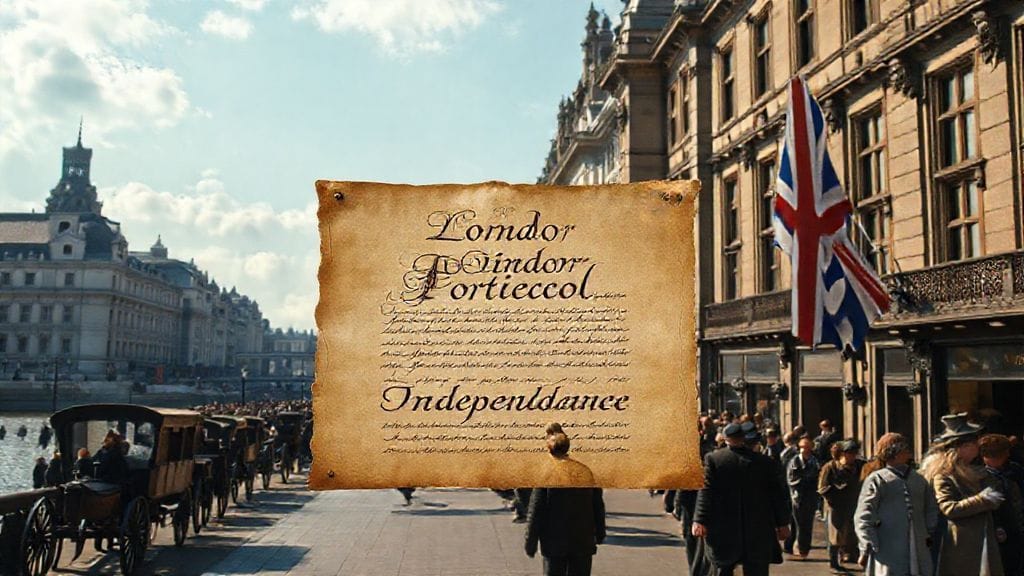
February 3, 1830. In a stately room within London's diplomatic heart, amid polished mahogany tables and fluttering silk draperies, the fate of a nation was quietly sealed. It was an unassuming date on the calendar but a thunderous moment in the long saga of the Greek people. The London Protocol, signed by the Great Powers of Britain, France, and Russia, recognized the independence of Greece after nearly four centuries of Ottoman dominance and almost a decade of brutal conflict.
Imagine the atmosphere — diplomats in top hats and frock coats dispensing with customary courtesies to focus on the gravity of what this meant for Europe’s map. Behind the silk curtains lay the restless Thames, symbolic of Britain’s naval might and political reach. The air held a curious mixture of relief, triumph, and cautious optimism. For the Greek nation, fractured and bloodied by war, this was more than a document; it was a breath of life, a first official acknowledgment of their right to self-determination.
But this victory was not born overnight nor without sacrifice. The London Protocol was the culmination of turbulent years, fierce battles, passionate heroic sacrifices, and complex geopolitical rivalries. To understand the profound significance of this document, we must delve into the depths of the conflict that preceded it, the actors involved, and the wider European context that enabled the birth of modern Greece.
The Ottoman Shadow: Greece under Imperial Rule
For nearly 400 years, the land that had once given rise to philosophers, poets, and democracy had languished beneath the Ottoman crescent. Since the mid-15th century, following the fall of Constantinople in 1453, Greece was encased within an empire characterized by a mosaic of peoples yet marked by often harsh and discriminatory rule against its Orthodox Christian population.
Cities and villages bore the weight of heavy taxes, the arbitrary rule of Ottoman beys, and periodic repression. The glories of ancient Hellenic civilization were memory rather than reality; the Greek language persisted, but political autonomy was a dream just beyond reach. Though pockets of semi-autonomy appeared occasionally, the Greek lands were largely integrated into an empire that, while tolerant by some standards of the age, offered little scope for national identity to flourish.
However, Ottoman control was not steady or uncontested. The empire faced internal strains and external pressures, and the fabric of its rule was under constant tension. These would prove critical as the 19th century dawned, when nationalist ideas gained steam across Europe and ideas of popular sovereignty began corroding empires.
Stirring the Flames: The Causes Behind the Greek Revolution
What lighted the fuse that would explode into the Greek War of Independence in 1821? The causes were manifold—longstanding social grievances combined with a powerful new ideological wave washing over Europe.
The Enlightenment had fostered new ideas about liberty, equality, and governance inspired by the American and French Revolutions. Greek intellectuals rediscovered their classical heritage and linked it to modern visions of nationhood. Philhellenism—admiration for Greek culture and history—found fertile soil among Western intellectuals and politicians sympathetic to the Greek plight.
Economic hardships, exacerbated by the heavy tax burdens and Ottoman corruption, drove many into despair and rebellion. Moreover, the decline of Ottoman military might in the late 18th and early 19th centuries suggested an era of weakening imperial control.
Amid this backdrop, secret societies like the Filiki Eteria (Friendly Society), founded in 1814, prepared the way for revolt, plotting to coordinate an uprising that would reclaim Greek independence. Patriotism, religious fervor, and hopes for a reborn nation fused in a combustible mixture.
The Spark of Rebellion: Outbreak of the Greek War of Independence
On March 25, 1821, the revolt erupted in the Peloponnese with a fervent declaration of war against Ottoman rule — a symbolic date now commemorated annually as Greek Independence Day.
The insurgents, poorly armed but fiercely determined, sought to unshackle centuries of oppression. Early victories inspired many across the scattered Greek territories: from the islands of the Aegean to the mainland villages, the struggle spread swiftly.
Yet, the Ottoman response was unforgiving. Massacres, sieges, and reprisals escalated into a brutal, often savage conflict marked by great heroism and profound suffering. The famous siege of Tripolitsa in 1821 will forever symbolize both the pain and the hope that fueled the revolution.
This was no simple war. It was civil strife, a religious war, and a national awakening all intertwined. The rebels were a patchwork of local chieftains, fishermen, peasants, intellectuals, and mercenaries — united by a dream yet divided by ambitions and rivalries.
Heroes and Martyrs: The Faces of the Greek Struggle
From the first spark of revolt, legendary figures emerged—each embodying a fragment of the nation’s soul.
Theodoros Kolokotronis, the rugged warlord of the Peloponnese, became synonymous with military prowess and indomitable will. His guerrilla tactics and leadership were vital in numerous battles.
Georgios Karaiskakis, a guerrilla leader and charismatic figure, fought with relentless passion, dying at Phaleron in 1827 but etching his name into Greek lore.
Women also played crucial roles, often overlooked by history. Laskarina Bouboulina, a wealthy shipowner and naval commander from Spetses, defied conventions by arming her own fleet and participating directly in naval battles.
Yet, alongside heroes were tragic martyrs—tens of thousands of civilians and soldiers who died during sieges, massacres, and the tragic Chios massacre in 1822, which horrified Europe and galvanized support.
The Role of Philhellenism: Europe’s Emotional Engagement
The Greek cause resonated deeply far beyond its borders, becoming a cause célèbre that captivated Europe and America alike.
Philhellenism, a cultural and political movement championing Greece’s fight for freedom, engaged poets, writers, and artists. Lord Byron—the iconic English poet—became a living symbol of international solidarity, ultimately dying in Missolonghi in 1824, a martyr for the Greek cause.
Artists like Delacroix immortalized the struggle in evocative works, while intellectuals and politicians lobbied governments and publics.
European volunteers flooded into Greece, and public opinion created pressure on governments to intervene, albeit cautiously. The Greek revolution became not only a war of independence but a touchstone for 19th-century liberal nationalism.
The Great Powers on the Chessboard: Britain, France, and Russia
The Greek Revolution was not merely a regional conflict but quickly entangled the major powers of the era.
Britain, wary of Ottoman collapse but sympathetic to Greek aspirations, sought strategic advantages in the Eastern Mediterranean.
Russia, bound by Orthodox Christianity and shared religious ties, saw an opportunity to weaken Ottoman influence and expand its own reach southward.
France, recovering from Napoleonic defeat, aimed to reassert military and diplomatic prestige.
As the war dragged on, the Great Powers oscillated between supporting the Ottomans to maintain balance and backing the rebels under public pressure. This geopolitical dance set the stage for the eventual intervention that would render Greek independence unavoidable.
Blood and Diplomacy: The Battlefields and Conference Halls
The conflict witnessed fierce battles both on land and at sea. The uprising’s survival was often precarious — victories were followed by crushing defeats.
By 1827, after years of stalemate and attrition, naval engagement became decisive. The Battle of Navarino, fought on October 20, 1827, saw the combined fleets of Britain, France, and Russia destroy the Ottoman-Egyptian fleet in a fierce maritime combat.
This moment underscored the Great Powers’ commitment shifting decidedly towards Greek independence. Yet, it was in the conference halls of Europe where decisions on Greece’s fate were forged — complex negotiations blending diplomacy, power politics, and ideals.
The summit in London crystallized these efforts into the London Protocol signed in early 1830.
The Battle of Navarino: A Pivotal Clash at Sea
Navarino Bay was transformed into a cauldron of gunfire and smoke. The allied fleets, though outnumbered, used superior naval tactics and firepower to annihilate the Ottoman fleet.
This battle was not just a decisive military victory; it sent a clear message: the Great Powers would no longer tolerate Ottoman attempts to crush Greek independence by force.
Navarino altered the strategic landscape. It forced the Ottomans to reckon with a new reality and propelled diplomatic momentum.
The Rising Tide for Recognition: Early Diplomatic Overtures
Following military victories, the Greek provisional government sought international legitimacy.
The London Conference of 1830 was the third major attempt by European powers to negotiate the terms of peace and Greece’s status.
Big questions loomed: What borders would Greece have? Would it be a full kingdom or a protectorate? What of the Ottoman claims? Each demanded careful balancing of power, principle, and pragmatism.
The London Protocol emerged as an agreement among Britain, France, and Russia that the Greek state would be recognized as independent, albeit within limited territorial boundaries.
The London Protocol of 1830: The International Endorsement
Signed on February 3, 1830, the London Protocol formally recognized Greece as an independent sovereign nation.
The document was diplomatic finesse — cautiously worded but firm in its affirmation of Greek autonomy. It specified territorial limits including the Peloponnese, the Cyclades islands, and parts of Central Greece.
While the Ottoman Empire was compelled to accept these terms, the treaty also set conditions involving the withdrawal of Ottoman forces and the establishment of a Greek government under European supervision.
This recognition, backed by three major powers, bestowed Greece with unprecedented legitimacy and offered a path toward lasting peace.
The Text and Terms: Greece’s Sovereignty in Diplomatic Language
The Protocol is a fascinating artifact — deliberate, precise, and yet open-ended enough to allow future adjustments.
It avoided inflammatory language to maintain cautious diplomacy, yet the weight of its recognition was unmistakable. The safeguard clauses aimed to maintain balance and alert all parties to the fragile nature of the new order.
For Greeks, reading the document was a profound affirmation after years of struggle—a legal birth certificate of their nationhood. But it also underscored the ongoing complexities: Greece was independent but still under the watchful eyes of its powerful protectors.
Reactions in the Ottoman Empire: From Defiance to Acceptance
The Ottoman leadership, stung but pragmatic, was forced to accept the London Protocol.
Their reaction mixed bitter resentment with a reluctant acknowledgment of geopolitical realities. Sultan Mahmud II is said to have regarded the loss as a humiliating blow yet recognized the inevitability given Great Power pressure.
Within the empire, the treaty was debated intensely: What did this mean for other regions? Could this seed further nationalist movements? The recognition of Greek independence became a turning point, signaling the start of a long unraveling of Ottoman dominion in Europe.
The Greek Kingdom Emerges: Ioannis Kapodistrias and New Beginnings
The diplomatic success set the stage for Greece to move beyond war and into statehood.
Ioannis Kapodistrias, a seasoned diplomat and former Russian foreign minister, was appointed the first Governor of Greece in 1828. His role was to stabilize a fractured society, instill order, and build institutions.
Kapodistrias worked tirelessly to lay the foundation of a modern state, balancing traditional local power structures with central authority.
Yet, challenges abounded: economic ruin, fragmented governance, and social divisions threatened the nascent kingdom's unity.
Cultural Renaissance: How Independence Shaped Greek Identity
Independence was not only political but cultural — a renaissance of Greek heritage, language, and arts.
Education reforms rekindled classical studies, literature flourished, and new symbols of national identity emerged. National heroes were celebrated in poetry, and the Orthodox Church played a critical role in forging spiritual unity.
The memory of the struggle and victory became a cornerstone of modern Greek identity, celebrated annually and immortalized in museums, monuments, and folklore.
A Nation Found: Human Stories from War to Peace
Behind the grand narratives lay countless personal tales — of soldiers, peasants, women, and children whose lives were irrevocably changed.
Villages destroyed, families displaced, and lives lost became the silent testament of the independence war. Yet, amid despair, stories of resilience and solidarity shone—communities rebuilding and forging hope for the future.
The London Protocol was a beacon assuring these survivors that their pain bore fruit.
The Legacy of the London Protocol in Modern Diplomacy
The recognition of Greece marked one of the first instances where the concert of Great Powers actively shaped the fate of a nationalist revolution.
It set precedents in international law regarding state recognition, sovereignty, and protectorates. The Protocol also highlighted the complex interplay between self-determination and great power interests—a dynamic that resonates in many diplomatic issues today.
Reflections on Freedom: The Global Impact of Greek Independence
Greek independence struck a resonant chord worldwide.
It inspired other nationalist movements throughout Europe and beyond. It proved that centuries-old empires were vulnerable in the face of modern nationalist fervor and diplomacy.
For the burgeoning modern world, Greece’s emergence was a hopeful sign that freedom and identity could triumph.
Memory and Myth: How Greece Commemorates 1830
Today, Greece celebrates its independence with vibrant ceremonies on March 25th, linking religious tradition and national pride.
The London Protocol remains a symbol not only of legal freedom but of collective endurance and unity.
Monuments, museums, and festive parades perpetuate the memory, ensuring that each generation understands the price and promise of sovereignty.
The Continuing Journey: Greece’s Path Beyond Recognition
Recognition was not an end but a beginning.
Greece’s journey through late 19th and 20th centuries, with wars, territorial expansions, and modern challenges, was shaped by the foundations laid in 1830.
The London Protocol was the cornerstone, the legal and moral fulcrum on which the modern Greek state balanced its precarious early years.
As the nation continues evolving, the story of 1830 remains an eternal reminder of hope, courage, and the enduring human quest for freedom.
Conclusion
The London Protocol of February 3, 1830, was far more than a diplomatic document signed in the drawing rooms of London. It was the culmination of a dramatic saga of courage, suffering, and unyielding aspiration. It reflected a turning point where the dreams of an oppressed people met the realities of international politics—and where the ideals of national self-determination began their long, complex journey into the modern world.
Against the backdrop of Ottoman decline and European power struggles, Greece seized its moment. The Protocol bore witness to the heroism of countless individuals and the power of ideas that transcend borders. It was a beacon for other nations seeking freedom and a testament to the enduring human spirit.
Today, when we reflect on that snowy day in London, we see not just the formal recognition of a new state, but a monumental human story—the birth of a nation out of centuries of darkness, and the promise that liberty, though hard-fought, can prevail.
FAQs
Q1: What was the London Protocol of 1830?
A: The London Protocol was an international agreement signed by Britain, France, and Russia that formally recognized the independence of Greece from the Ottoman Empire, establishing its borders and sovereignty.
Q2: Why was Greek independence significant in 1830?
A: It marked one of the first successful nationalist revolutions recognized by major powers, signaling the decline of Ottoman imperial control in Europe and inspiring future independence movements.
Q3: Who were the main actors involved in the Greek War of Independence?
A: Key figures included Greek leaders like Theodoros Kolokotronis and Ioannis Kapodistrias, Ottoman rulers, Great Powers diplomats, and European Philhellenes such as Lord Byron.
Q4: How did the Battle of Navarino influence the recognition of Greek independence?
A: The victory of the allied British, French, and Russian fleets over the Ottoman navy in 1827 cripplingly weakened Ottoman resistance and boosted diplomatic pressure leading to Greek independence.
Q5: What role did Philhellenism play in the Greek struggle?
A: Philhellenism mobilized cultural, intellectual, and material support across Europe, attracting volunteers and shaping public opinion in favor of Greek independence.
Q6: How did the Ottoman Empire react to the London Protocol?
A: Though resistant and resentful, the Ottomans ultimately accepted the new status quo under external pressure, marking a reluctant step toward recognizing Greek sovereignty.
Q7: What challenges did Greece face after its recognition?
A: Greece struggled with political instability, economic devastation, and internal divisions while building a modern nation-state structure.
Q8: How is Greek independence commemorated today?
A: It is celebrated annually on March 25 with national ceremonies, parades, and public remembrance of the revolutionary struggle and its heroes.