Table of Contents
- A Winter Decision in Rome: Hadrian’s Fragile Empire
- The Making of an Emperor: Hadrian Before the Adoption
- An Empire at a Crossroads in 136 CE
- Who Was Lucius Ceionius Commodus?
- In the Shadow of Death: Hadrian’s Illness and Fear of Chaos
- Behind Closed Doors: Why Hadrian Adopts Lucius Ceionius Commodus
- The Ceremonial Day: Adoption and the Making of a Caesar
- Whispers in Marble Halls: Reactions of Senate, Army, and People
- Family, Blood, and Betrayal: The Human Cost of Hadrian’s Choice
- From Lucius Ceionius Commodus to Lucius Aelius Caesar
- An Heir in Name: Policies, Promises, and Public Image
- The Sudden Death of the Heir and the Crisis of Succession
- From Aelius to Antoninus and Marcus: The Long Echo of One Adoption
- The Politics of Image: Hadrian, Aelius, and the Art of Legitimacy
- Tension at the Top: Hadrian, the Senate, and the Military
- Private Agonies: Illness, Regret, and the Emperor’s Final Years
- Historians at War: Ancient Voices on Hadrian’s Motives
- The Long View: Succession, Stability, and the Golden Age That Almost Wasn’t
- Legacy of a Choice: Rethinking Hadrian and His Chosen Heir
- Conclusion
- FAQs
- External Resource
- Internal Link
Article Summary: In the winter of 136 CE, amid illness and political uncertainty, Emperor Hadrian makes a decision that will reshape Rome’s future: hadrian adopts lucius ceionius commodus as his successor. This article traces the world around that choice—an empire stretched from Britain to Syria, a Senate both honored and humiliated, and an emperor haunted by the specter of civil war. Moving through the life and character of Lucius Ceionius Commodus, later known as Lucius Aelius Caesar, it reveals how ambition, health, family alliances, and public image intertwined in a single fateful act. The narrative follows the ceremonies of adoption, the celebrations and suspicions that followed, and the shock of Aelius’s untimely death. It then explores how this failed succession opened the path to Antoninus Pius and Marcus Aurelius, creating what later generations would remember as a golden age. By weaving together ancient sources and modern interpretations, the article asks whether Hadrian’s controversial choice was folly, necessity, or foresight. In doing so, it places the moment when hadrian adopts lucius ceionius commodus at the very heart of the Roman imperial story, where personal fear and public destiny collided under the winter skies of Rome.
A Winter Decision in Rome: Hadrian’s Fragile Empire
On a cold day in early 136 CE, Rome did not look like a city on the edge of crisis. The markets bustled, the smoke from countless hearths hung above the tiled roofs, and the marble of imperial monuments shone pale beneath a washed-out winter sun. Yet behind the façades of temples and basilicas, behind the ritual calm of state business, a single question gnawed at the heart of the empire: who would rule when Hadrian was gone?
The emperor was not an old man by ordinary measures—he was nearing sixty, respectable but hardly decrepit for a Roman aristocrat—but power wears the body down with a particular cruelty. Years of travel, stress, and chronic illness had left him weakened. At his villa in Tibur, he coughed blood into linen cloths and stared too long into the fire, drifting between memories of distant provinces and calculations of the future. One decision loomed above all others, the decision on which everything else depended: the choice of an heir.
This is the setting in which hadrian adopts lucius ceionius commodus as his successor, an act that stunned contemporaries and even now baffles historians. To many Romans, Lucius was a surprising, even shocking, choice. He was brilliant but untested, elegant but rumored to be delicate in health, connected through marriage alliances rather than direct blood. The empire, resting on the uneasy balance of emperor, Senate, and army, would now be asked to entrust its destiny to this man.
But this was only the beginning. The adoption was not a simple private arrangement; it was a carefully staged piece of political theater, a gamble taken by a weary ruler, and a turning point whose consequences would ripple through the next half-century of Roman history. To understand how and why hadrian adopts lucius ceionius commodus, we must first step back from that winter day in 136 and watch the longer story of Hadrian’s life unfold.
The Making of an Emperor: Hadrian Before the Adoption
Hadrian did not arrive at power as a provincial upstart or a desperate usurper. He was a man of good birth, a cousin and protégé of Emperor Trajan, steeped in aristocratic culture and fluent in Greek philosophy and poetry. Born in Italica in Hispania, raised partly in Rome, he grew up amid two worlds: the Latin tradition of stern republican virtue and the Hellenic world of beauty, dialectic, and art. This duality shaped him—and, eventually, the sort of successor he would seek.
As a young man he served in the army, commanded legions, and learned firsthand that the loyalty of the soldiers was the true shield of imperial power. Yet Hadrian’s temperament was not that of a perpetual campaigner. When he inherited Trajan’s mantle in 117 CE—a succession itself clouded by rumor and rumor’s shadow—he quickly abandoned many of his predecessor’s conquests in Mesopotamia. He preferred stability to expansion, walls to frontiers endlessly pushed forward. He traveled tirelessly throughout the empire, inspecting legions, reforming administration, commissioning buildings, and projecting imperial presence at the empire’s edges.
All of this mattered when the question of succession arose. Hadrian had seen what happened when emperors died without a clear heir: turbulent years after Nero, bloody civil war in 69 CE, pretenders rising from frontier legions. He was determined that Rome would not again be thrust into a year of four emperors. His reign had been built on a kind of controlled equilibrium—between Greek and Roman, soldier and civilian, emperor and Senate—and he needed an heir who could somehow continue that balancing act.
In the background of his personal calculations lay the broader imperial system that Augustus had shaped a century and a half earlier. Adoption, not simple blood inheritance, had become a recognized mechanism of succession. Augustus himself had adopted Tiberius; later, Nerva adopted Trajan, creating the precedent that a capable outsider could be formally brought into the imperial familia. Hadrian knew this precedent by heart. He knew, too, that the fiction of family—encoded through adoption, marriage, and titles—could be wielded as a powerful political tool.
When his own health began to fail in the 130s, he looked at his relatives, his friends, and the aristocratic youth rising in Roman politics. Somewhere among them, he needed to find both a son and a political guarantee. The choice would be Lucius Ceionius Commodus—but it was far from obvious that it had to be so.
An Empire at a Crossroads in 136 CE
By 136 CE Rome’s empire reached from the windswept moors of northern Britain to the date groves of the Euphrates valley. It was, as later historians would say, near the height of its territorial expanse. But the sense of unshakeable security that might appear in a modern textbook did not exist for those who lived inside it. The empire felt less like an immovable monument and more like a vast, delicately balanced machine, its moving parts constantly in danger of grinding against one another.
In the east, the great Jewish revolt known as the Bar Kokhba uprising had recently shaken Roman control in Judaea. Suppressing it had cost enormous resources and, more important, had exposed limits in Rome’s power to assimilate fiercely distinct populations. Elsewhere, tensions simmered—Germanic tribes watched the limes, Parthia eyed the borders, and local aristocrats across the provinces weighed loyalty against the allure of autonomy. An emperor’s death, especially an unexpected or contested one, could encourage ambitious generals or discontented populations to test Rome’s resolve.
In Rome itself, the Senate was at once dignified and trapped. It retained immense prestige, providing the class from which governors, senior officers, and key administrators were drawn. Yet ultimate authority rested with one man. Hadrian had managed to mollify and sometimes charm this body, but he had also antagonized many senators by executing four ex-consuls early in his reign on charges of conspiracy. The memory of those executions still lingered like a bitter aftertaste. Any misstep in arranging the succession could bring that bitterness back to the surface.
Add to this the emperor’s failing health and the absence of a natural adult heir, and the picture in 136 becomes unmistakably tense. Rumors swirled: would the Praetorian Guard impose their favorite? Would some general in the Rhine or Danube provinces march on Rome? Was the Senate quietly coalescing around a candidate of its own? It is in this anxious atmosphere that hadrian adopts lucius ceionius commodus, not as an act done from comfort and dominance, but as a move played under pressure, with both internal and external audiences watching.
Who Was Lucius Ceionius Commodus?
Lucius Ceionius Commodus did not spring suddenly into public life the day Hadrian chose him. He was born into an old and distinguished senatorial family, the Ceionii, whose lineage had been woven into the Roman aristocracy for generations. Aristocratic boys like Lucius grew up surrounded by tutors, slaves, and expectations. From the moment he could speak, he would have been trained to recite lines of Virgil, discuss points of law, and memorize names and deeds of consuls past. The very walls of his family home would have been lined with ancestor masks, stares of wax and ivory silently commanding him to excel.
By the time he met Hadrian in any meaningful way, Lucius had already demonstrated talent. He moved with practiced ease through the corridors of senatorial politics. Charming, articulate, and cultivated, he represented a type of Roman noble that Hadrian, with his own love of Greek culture, found attractive: more philosopher-king in aspiration than blood-soaked general. Yet there was an element of fragility about him. Ancient sources, such as the Historia Augusta, hint that he was not in robust health, and later commentators have pointed to this as one of the great ironies of his elevation.
There were also ties of alliance. Lucius was connected by marriage and patronage to powerful circles close to Hadrian. His father had enjoyed the emperor’s favor; the family had, some say, shown him loyalty in earlier political storms. It is entirely possible that Hadrian’s affection for the Ceionii was a factor, that gratitude and familiarity bent the scales.
At the same time, Lucius was not an obvious heir in the eyes of many Romans. Others, like the respected senator Titus Aurelius Fulvus Boionius Arrius Antoninus—known to us as Antoninus Pius—seemed more reliable and experienced. Hadrian’s choice would therefore be perceived as personal, perhaps too personal, rather than the safe consensus pick. That sense of surprise and skepticism would become one of the defining reactions when hadrian adopts lucius ceionius commodus.
In the Shadow of Death: Hadrian’s Illness and Fear of Chaos
Illness is never just a physical state for a ruler; it becomes a political condition, a forecast of storms. By the mid-130s, Hadrian was visibly deteriorating. His beard, once carefully trimmed in emulation of Greek philosophers, grew more unkempt. He complained of constant pain, struggled with breathing, and depended on physicians whose remedies offered little more than temporary relief. The emperor who had walked the frontiers and toured the provinces had become, increasingly, a prisoner of his own body.
Yet behind the symptoms lay something more corrosive: fear. He had seen how emperors could be abandoned by their own guards, how pretenders could be hailed by distant legions. The memory of 69 CE—when Galba, Otho, Vitellius, and Vespasian fought in quick succession for the purple—was not remote history but a cautionary tale, kept alive in senatorial speeches and family stories. Hadrian knew that if he left the world without naming a successor, he would bequeath to Rome not just his monuments and laws, but a potential civil war.
As news of his declining health spread, so too did the quiet positioning among the elite. Guests at banquets watched each other closely, searching for new alliances in offhand remarks or raised goblets. Provincial governors wrote carefully worded letters, professing loyalty while subtly advertising their military achievements. The Praetorian Guard, stationed just outside the city in their great camp, listened more intently than usual to rumor.
Against this background, the emperor’s private agony took on a cruel edge. Friends and attendants later recalled him raging against fate, erupting in harsh words against those he felt had disappointed him, and then collapsing into guilt and melancholy. The stakes of his decision weighed heavily. It is in this personal darkness that the thought congealed into action: hadrian adopts lucius ceionius commodus not merely as a legal maneuver, but as his attempt to stare down the chaos he dreaded.
Behind Closed Doors: Why Hadrian Adopts Lucius Ceionius Commodus
We will never know precisely what words were spoken in the private meetings between Hadrian and his closest advisers in late 135 and early 136 CE. The marble walls of the imperial palace do not repeat conversations. But from the sparse hints in our sources and the logic of Roman politics, we can reconstruct the forces that likely guided the emperor’s hand.
There were, first, the personal factors. Lucius Ceionius Commodus was someone Hadrian seems to have liked. He was cultured, elegant, and perhaps reminded the emperor of his own younger, more hopeful self. To adopt a man in whom one recognized an echo of one’s own aspirations would have been emotionally satisfying. Beyond emotion, there were likely debts of loyalty owed to the Ceionii and to those in their circle. In Rome, gratitude was as political as ambition.
There were also strategic reasons. Lucius came from a powerful senatorial family, and by elevating him, Hadrian could knit that family’s fortunes irreversibly to the imperial project. By giving them everything, he also made them vulnerable—if Lucius failed, the Ceionii would lose all. In Hadrian’s calculus, that might ensure extra loyalty. Lucius also had a family of his own; his young son, Lucius Verus, could represent a continuity beyond the first generation, offering the empire the promise not just of one successor but of a dynasty-in-the-making.
Finally, there was the question of alternatives. Why not Antoninus Pius, already respected and proven? Why not some rising military star? Here Hadrian’s suspicion likely intervened. A man too close to the army might become independent, capable of challenging the emperor himself even before his death. A man too anchored in senatorial networks might subtly sideline Hadrian’s own memory. Lucius, by contrast, was ambitious but still moldable, elevated enough to command respect but young enough to be guided.
So, sometime around January of 136, a decision hardened into certainty: hadrian adopts lucius ceionius commodus. The emperor resolved to make Lucius his Caesar, his designated successor, and to present that choice to the world not as a desperate improvisation but as a carefully weighed, almost inevitable, act of imperial foresight.
The Ceremonial Day: Adoption and the Making of a Caesar
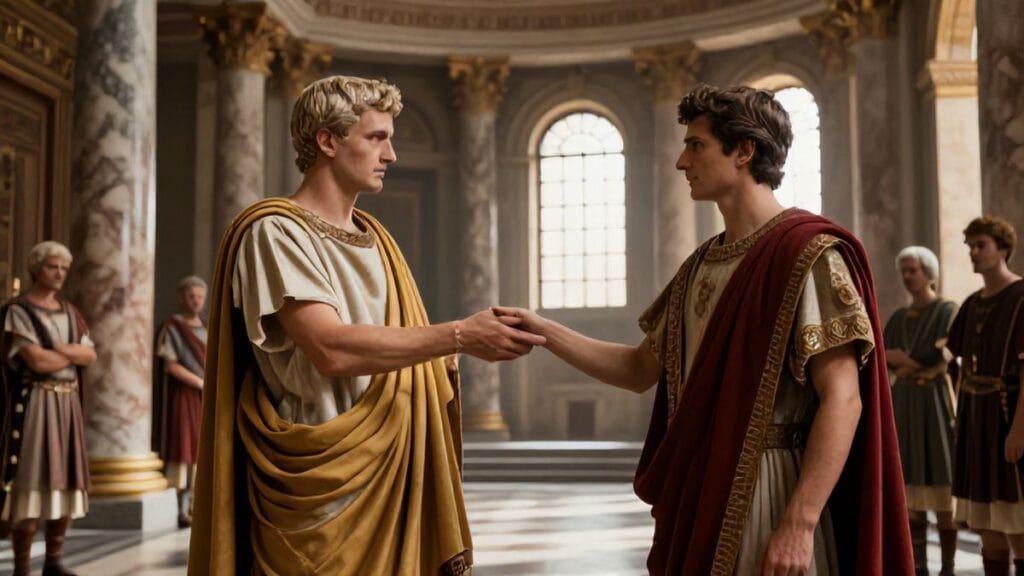
Adoption in Rome, especially at the level of emperors, was not a quiet legal formality conducted over scrolls and seals. It was theater. When the day came for Hadrian to adopt Lucius Ceionius Commodus, the capital moved in a choreography of power: messengers hurried through the streets, lictors polished their fasces, and senators donned fresh togas, ready to play their part in a carefully staged drama.
The ceremony itself likely unfolded in stages. First, a private legal act—the adoptio—would have been completed, in which Hadrian formally took Lucius into his familia. With this, the heir gained a new name and a new status: Lucius Ceionius Commodus became Lucius Aelius Caesar, signaling not just adoption but designation as successor. Then came the public announcement, perhaps in the Senate, perhaps before the assembled people in a meeting of the comitia or a grand address.
Imagine the Senate meeting: the curia filled with rows of white-clad nobles, the air heavy with incense and expectation. Hadrian—ill, perhaps carried in a litter, but still emperor—announces his intent. Some senators might have nodded, others stiffened, a few exchanged quick glances. When the herald declared Lucius Aelius Caesar, applause followed—duty demanded it—but the sound may have been uneven, enthusiasm mingling with surprise.
In the streets afterward, the news spread fast. Graffiti artists etched the new name on walls; money-changers speculated on the impact for provincial appointments and tax policies; merchants wondered what this meant for their contracts and investments. The common people, less informed about the nuances of senatorial politics, reacted more simply: another heir meant continuity, a guarantee that the bread dole and the games would continue under a new ruler when Hadrian’s time was over.
For Lucius himself, the day must have felt unreal. This was the moment when his life swerved from that of an ambitious noble to that of a future emperor. Cloaked in a new title, saluted by the guard, honored by decrees, he walked out of the curia or palace as someone different from the man who had entered. The world around him had recalibrated—friends became clients, rivals, or conspirators; each smile now had to be read carefully.
Thus, in full view of the Roman world, hadrian adopts lucius ceionius commodus and inscribes that decision into law, ritual, and memory.
Whispers in Marble Halls: Reactions of Senate, Army, and People
A decision of such magnitude could not pass without comment, and the Roman empire excelled at commentary. It moved through three great channels—Senate, army, and urban populace—each interpreting the adoption through its own priorities.
The Senate’s reaction was complex. Publicly, senators hailed the wisdom of the emperor, voted honors to Lucius Aelius Caesar, and composed flattering decrees extolling his virtues and the foresight of Hadrian. Privately, some fumed. To men of long service and proven administrative talent, the elevation of Lucius, not especially distinguished in war or governance, seemed an affront. “Hadrian has chosen a favorite, not a successor,” one might imagine a senior senator muttering over wine to trusted friends. Others, however, glimpsed opportunity: new networks might form around Aelius, fresh chances for influence and office.
The army’s reaction was perhaps more cautious than enthusiastic. Soldiers cared above all about pay, discipline, and victory. They evaluated emperors and heirs by whether they appeared capable of leading men in war and maintaining the flow of donatives. Lucius’s reputation did not scream “soldier’s emperor.” Still, Hadrian’s own popularity with many legions, built during his travels and reforms, helped smooth the way. If the old emperor believed this man fit, many centurions were willing to wait and see—especially when promises of future largesse accompanied the announcement.
The people of Rome, in turn, responded with the logic of the crowd. They watched for signs: were there sacrifices and celebrations? Did the new Caesar sponsor games or public distributions? Hadrian, conscious of the symbolic importance of his decision, ordered coinage minted bearing the new heir’s image, inscriptions identifying him as Caesar. Festivals marked his elevation. Bread and spectacle did their familiar work, binding the masses emotionally to the imperial household.
Yet behind the celebrations, whispers persisted. Why hadrian adopts lucius ceionius commodus and not another? Was the emperor in his right mind, or had his illness clouded his judgment? Rumor, that most Roman of forces, began to weave alternative narratives: some claimed Empress Sabina—though their marriage was strained—had influenced him; others suggested hidden debts or unspeakable promises. By the end of that winter, every marble hall in Rome had hosted some variation of these conversations.
Family, Blood, and Betrayal: The Human Cost of Hadrian’s Choice
Imperial succession is often presented as an abstract matter of policy, but for those within the imperial and senatorial families, it was deeply personal. When Hadrian chose Lucius, he simultaneously did not choose many others. Each of those unchosen men and their households felt the sting.
Consider the perspective of young Marcus Annius Verus—later Marcus Aurelius—watching from the periphery of power. He was already in Hadrian’s eye as a promising youth, a future leader of some kind. The adoption of Lucius Aelius Caesar rearranged the lines of possibility. Marcus’s family, tied to Hadrian through kinship, might have wondered if they had been passed over, if some flaw in their loyalty or capability had disqualified them.
For Antoninus Pius, respected and middle-aged, the adoption must have been a clear sign: Hadrian looked elsewhere for the next Augustus. And yet, as fate would have it, the elevation of Lucius would later open the path for Antoninus himself. In the immediate aftermath, however, there was no such clarity—only a sense that the game of imperial favor had been lost.
Even within the Ceionii, the adoption brought tension. The sudden transformation of Lucius into Aelius Caesar meant that siblings, cousins, and in-laws now found their lives set against a new horizon. Some delighted; others felt overshadowed. Rivalries sharpened around access to the heir; old resentments were revisited in the new context of proximity to power. The promise that Lucius’s son, Lucius Verus, might one day reach the purple created its own web of hopes and fears.
And what of Hadrian’s own emotions? To adopt someone as a son in Roman law was no formality. It implied affection, duty, and the reconfiguration of family memory. In a way, hadrian adopts lucius ceionius commodus not only as an emperor choosing a tool, but as a man trying to ensure he will not be forgotten. An adopted son, now Aelius Caesar, would be obliged to honor Hadrian’s name, complete his projects, and guard his posthumous reputation. In that bond lay both comfort and the potential for betrayal. Many emperors had been cursed by successors who wanted to distinguish themselves. Hadrian could only hope Lucius would not be one of them.
From Lucius Ceionius Commodus to Lucius Aelius Caesar
Names in Rome were never mere labels; they were compressed biographies. The shift from Lucius Ceionius Commodus to Lucius Aelius Caesar was, therefore, far more than a change in how clerks wrote on wax tablets. With his new name, Lucius stepped into a new genealogy—symbolically a son of Hadrian, and by extension, an heir to the prestige of the Aelian family from which the emperor took his own gentilicium.
The title “Caesar” carried particular weight. Originally the family name of Julius Caesar, it had, by the second century, become the standard designation for the emperor’s heir. To be called Caesar was to be placed in the line of power, a step below “Augustus” but vastly above any normal mortal. Coin portraits began to appear with Lucius’s features framed by laurel wreaths and imperial inscriptions. His image, carefully idealized, circulated from Britain to Egypt, silently teaching millions of subjects to recognize their future ruler.
He was given additional honors. The tribunician power, consular commands, memberships in key religious colleges—all the traditional rungs on the ladder of dignity were presented to him, sometimes hastily, to shore up his position. When he walked through the Forum now, it was under a forest of salutes and respectful nods. Guards made way; petitioners took note of his preferences; poets composed flattery to be recited at dinners.
But this transformation also brought burdens. Every misstep, every rumor of weakness or excess, now carried imperial implications. If Lucius lingered too long at a banquet, tongues wagged. If his health faltered, whispers redoubled. The very grandeur that the adoption had conferred now exposed him to relentless scrutiny. The man who had been Lucius Ceionius Commodus, one aristocrat among many, stood irreversibly on a precipice as Lucius Aelius Caesar.
An Heir in Name: Policies, Promises, and Public Image
Once the initial shock of the adoption passed, Rome began to ask a more practical question: what kind of ruler would Aelius Caesar be? Hadrian, though increasingly confined by illness, did not intend to vanish immediately from governance. Instead, he appears to have planned a gradual transition in which Aelius would gain experience and visibility while the emperor still lived.
Key to this strategy were future military commands. Among the most significant was the assignment of Aelius to govern Pannonia, a crucial Danubian frontier province. This appointment, whether fully executed or more aspirational, signaled to the army that their future emperor would not be a stranger to the northern frontiers. It was a gesture toward martial legitimacy, even if Lucius’s reputation remained more polished than hardened.
At the same time, propaganda began to sketch an image of concord and continuity. Inscriptions honored both Hadrian and Aelius together; dedications in the provinces invoked them as joint guarantors of peace and prosperity. The imperial mint produced coins representing the harmony of the imperial household and the promise of a stable future. From the perspective of an ordinary provincial townsman, these images and inscriptions might have been the first concrete sign that hadrian adopts lucius ceionius commodus and that this act now shaped imperial reality.
Promises, too, floated in the air. Senators close to Aelius hinted that he favored certain legal reforms or administrative adjustments; military men heard assurances of fair donatives and continued security of veterans’ privileges. How many of these promises truly originated from Lucius, and how many were projections of those eager to see him rise, is impossible to know. But in politics, perception often outruns fact. Like a king-in-waiting in any era, Aelius quickly became the focal point of hopes, fears, and speculative agendas.
The Sudden Death of the Heir and the Crisis of Succession
Then, almost as suddenly as he had risen, Lucius Aelius Caesar vanished from the stage. On the first day of 138 CE, only two years after his adoption, the heir died—reportedly of an illness, perhaps a hemorrhage, though details are scant. The man whose portrait had been spread across the empire as the face of the future was gone before he ever wore the purple.
The shock in Rome was profound. The empire had barely adjusted to the fact that hadrian adopts lucius ceionius commodus, had scarcely finished reweaving its expectations around Aelius, when the thread snapped. Senators and soldiers alike were thrown into uncertainty. If Hadrian’s health had been robust, the death of his heir would have been a misfortune, but not a crisis. Yet the emperor himself now stood perilously close to the grave.
In those first days of January 138, the apparatus of state scrambled. Official mourning was declared; honors were voted for the dead Aelius Caesar; funeral ceremonies wrapped his brief glory in the solemnity of Roman tradition. Behind the scenes, however, the hunt for a new solution began with renewed urgency. The empire could not endure another drawn-out period of ambiguity.
For Hadrian, the psychological blow must have been immense. The man he had chosen, shaped, and presented to Rome as his son in law and policy had vanished, making the emperor’s judgment look tragically flawed. Doubts he had managed to push aside now returned sharp and vindictive. Had he misread Lucius’s health? Had he relied too much on affection and family ties? In the twilight of his life, these questions gnawed at him.
Yet power leaves no time for extended grieving. Within weeks, Hadrian would adopt another man, Antoninus Pius, charging him in turn to adopt both Marcus Aurelius and Lucius Verus. The complicated “double adoption” that followed was, in many ways, born from the failure of the earlier one. The fact that hadrian adopts lucius ceionius commodus, and that Aelius dies before becoming emperor, indirectly created the unique succession arrangement that defined the next generation.
From Aelius to Antoninus and Marcus: The Long Echo of One Adoption
The story did not end with Aelius’s death; in some respects, it only began. When Hadrian turned to Antoninus Pius as his new heir and required him to adopt both Marcus Aurelius and Lucius Verus, he was trying to cement a long-term dynastic solution in the brief time left to him. Ironically, Aelius’s brief tenure as Caesar formed an essential bridge to this arrangement.
Lucius Aelius Caesar had left behind a son, Lucius Verus, who was now symbolically tied to the imperial line through his father’s adoption. By insisting that Antoninus adopt Verus alongside Marcus, Hadrian ensured that the Ceionii blood would not be entirely erased from the imperial future. It was a gesture of continuity, a posthumous reward to the family of the man he had once chosen, and perhaps a way to ease his own sense of failure.
Antoninus, once emperor, proved to be a prudent, steady ruler, so gentle in temperament that later historians dubbed him “Pius.” Under his long reign, Marcus Aurelius and Lucius Verus were prepared for leadership, eventually ruling as co-emperors after Antoninus’s death. In other words, the line of succession that later generations would praise as nearly ideal—the peaceful transfers from Hadrian to Antoninus to Marcus—rested, paradoxically, on the unstable choice that hadrian adopts lucius ceionius commodus.
If Aelius had lived and ruled, we might have spoken instead of an “Age of Aelius and Verus,” and Marcus Aurelius could have been relegated to a footnote in the history of promising but bypassed princes. History’s golden ages often hide roads not taken. The story of Lucius Ceionius Commodus is one such hidden road—a path briefly illuminated, then plunged into darkness, yet still casting a faint glow on what followed.
The Politics of Image: Hadrian, Aelius, and the Art of Legitimacy
Roman emperors ruled not just through armies and laws, but through images. Statues, coins, reliefs, and inscriptions combined to create a language of power. Hadrian understood this language intimately. He commissioned the rebuilding of the Pantheon, adorned cities with his likeness, and left a trail of monuments across the provinces. When he selected Aelius as his heir, he deployed that same visual apparatus to craft legitimacy.
Coins minted after the adoption show Aelius with a carefully composed portrait: youthful, dignified, with a fringe of beard echoing Hadrian’s own Hellenizing style. Inscriptions praised his virtues—pietas, virtus, clementia—even when he had had little opportunity to demonstrate them in practice. The mere fact that he was chosen by Hadrian was treated as proof of his worth: the emperor’s judgment became the heir’s primary credential.
In the provinces, statues pairing Hadrian and Aelius began to appear in forums and temples. Dedications in cities from North Africa to Asia Minor invoked them together as guarantors of civic well-being. To a provincial worshipper entering a local temple, the notion that hadrian adopts lucius ceionius commodus was conveyed not by a Senate decree they’d never read, but by the physical presence of two marble figures, father and son, ruler and successor.
This propaganda did not erase skepticism among the elite, but it did naturalize the adoption in the broader imperial imagination. When Aelius died, this visual record forced a rapid pivot. Statues were repurposed, inscriptions updated, new coins minted for Antoninus Pius. Yet traces of the aborted succession remained, a palimpsest of power visible to the careful eye. As modern historians like Anthony Birley have noted, the very need to overwrite Aelius’s imagery testifies to how seriously Hadrian had committed to making him the future of Rome.
Tension at the Top: Hadrian, the Senate, and the Military
The adoption of Aelius must also be read against the longer arc of Hadrian’s uneasy relationship with Rome’s traditional centers of power. From the beginning of his reign, he had walked a tightrope between asserting imperial authority and honoring senatorial dignity. His early execution of four distinguished ex-consuls on suspicion of treason left scars that never entirely healed. Though he later sought reconciliation, some senators never trusted him fully again.
By choosing Lucius Ceionius Commodus, Hadrian made a move that partly appeased, partly irritated this body. On the one hand, he selected a man from their own ranks, reinforcing the principle that emperors should emerge from the senatorial aristocracy. On the other hand, he ignored other candidates with arguably stronger records, reminding them that their collective judgment remained subordinate to his personal will. The Senate’s formal ratification of the adoption thus concealed a lingering sense of injured pride.
The military, too, had to be carefully managed. Hadrian had reformed and inspected the legions, winning considerable respect. But he had also drawn back from Trajan’s aggressive expansionism, a choice some officers may have viewed as overly cautious. The adoption presented a chance to reassure them that continuity, not sharp reversal, would define the next reign. Assigning Aelius to Pannonia, placing him in proximity to frontier troops, and emphasizing his role in defense rather than conquest were all part of this balancing act.
Yet, as we have seen, Aelius’s own physical fragility may have undermined these efforts. A future emperor who seemed unhealthy stirred doubts in men whose lives depended on the vigor of their commander. The fact that hadrian adopts lucius ceionius commodus despite these concerns has been read by some modern historians as evidence that the emperor prioritized personal and dynastic considerations over purely military ones. Whether that choice was wise depends on how heavily we weigh the stability that eventually came through Antoninus and Marcus, a stability ironically enabled by Aelius’s failure.
Private Agonies: Illness, Regret, and the Emperor’s Final Years
In his final years, Hadrian was not the serene, all-seeing lord that official portraits depicted. Pain erodes patience, and proximity to death throws past decisions into harsh relief. After Aelius’s death, the emperor’s mood darkened. Sources suggest that he grew increasingly irritable, sometimes vindictive. His relationship with the Senate deteriorated further, as he demanded divine honors for himself and struggled to secure the posthumous arrangements he desired.
It is tempting—though impossible to prove—to imagine him replaying the adoption in his mind. The evenings at Tibur, once filled with cultivated conversations and Greek readings, may have turned into long, sullen silences. Servants and courtiers learned to measure his temper before speaking. Those closest to him would later describe a man tormented by his own mortality, unsure whether he had truly anchored Rome’s future or merely delayed its next storm.
There is a deeply human dimension here: an aging ruler who had spent a lifetime controlling events suddenly confronted with forces beyond his command. Disease, death, and the unpredictable interplay of personalities had upended what he once thought a masterstroke. That hadrian adopts lucius ceionius commodus and then watches him die must have felt like a cosmic mockery, a reminder that even emperors cannot mold history to their precise preferences.
In 138, not long after arranging the adoption of Antoninus Pius and the further adoption of Marcus and Lucius Verus, Hadrian died at Baiae. His body eventually returned to Rome, to be placed in the grand mausoleum still known today—though under a later name—as Castel Sant’Angelo. On the Tiber’s banks, beneath the weight of his tomb, lay a story of hopes, errors, and careful constructions of power, with the brief life of Aelius Caesar folded like a lost page within it.
Historians at War: Ancient Voices on Hadrian’s Motives
Ancient sources do not agree on why Hadrian chose Lucius Ceionius Commodus. The Historia Augusta, a notoriously unreliable but fascinating late antique collection of imperial biographies, hints that the choice was strange and perhaps purely based on favor. It depicts Hadrian as capricious, led more by whims than by sound judgment—an assessment modern historians treat with caution. Cassius Dio, writing in the third century, is more restrained but still conveys an undercurrent of skepticism about the emperor’s decision.
These ancient disagreements have echoed into modern scholarship. Some contemporary historians view the adoption as evidence of Hadrian’s declining capacities, a miscalculation born of illness and isolation. Others, like the historian Paul Veyne, suggest a more calculated dimension: that Hadrian was trying to bind multiple aristocratic houses together, using Aelius as the central knot in a web of alliances, and that the apparent imprudence of the choice hides a complex political logic.
There is also debate about Lucius’s health. Was Hadrian ignorant of its seriousness, or did he underestimate its importance? One school of thought proposes that he believed Aelius’s frailty could be outweighed by the stability his family connections offered; another, more cynical interpretation is that he preferred a potentially weaker heir who would not overshadow him during his own lifetime. As Anthony Birley notes in his biography of Hadrian, the scarcity of clear evidence forces us to move carefully between conjecture and humility.
What is clear is that hadrian adopts lucius ceionius commodus in a context of limited options and intense pressure. Whether seen as tragic mistake or understandable gamble, the adoption reflects both the strengths and vulnerabilities of the imperial system. Emperors were expected to see further than other men, yet they too were constrained by incomplete information, personal affections, and the opaque motives of those around them. In the end, the adoption tells us as much about the structural fragility of Roman monarchy as it does about Hadrian’s individual character.
The Long View: Succession, Stability, and the Golden Age That Almost Wasn’t
To many modern readers, the second century of the Roman empire looks like a plateau of calm between earlier turbulence and later decline. The sequence of “good emperors”—Nerva, Trajan, Hadrian, Antoninus Pius, Marcus Aurelius—has often been celebrated as a golden age of relative stability and enlightened rule. In this narrative, the smooth transfers of power achieved through adoption, rather than bloodline or civil war, are central.
Yet when we examine the episode in which hadrian adopts lucius ceionius commodus, the supposed smoothness appears more like a series of narrow escapes. The system worked, but only just. Hadrian’s first chosen heir died before taking power; his second choice, Antoninus, succeeded beyond expectations but depended heavily on the subsequent rise of Marcus Aurelius. The adoption of Lucius Verus alongside Marcus introduced further complexity. Far from being a straightforward model of rational succession, the period looks more like a continuing improvisation around a fragile principle: that a living emperor could, through adoption, defuse the crisis of his own mortality.
Hadrian’s decision, then, stands at the center of a larger story about how Rome tried to solve the problem that haunts all monarchies: how to change rulers without changing regimes. Adoption was Rome’s ingenious solution, but genius does not guarantee permanence. The successions of the second century depended on the particular virtues and accidents that shaped individual lives. A few different twists—a surviving Aelius with disastrous policies, an ambitious general exploiting confusion after his death—could have turned the same mechanism into a source of chaos.
That the system held tells us something important about the underlying resilience of Roman institutions and elites at this time. The Senate, though marginalized, remained committed to continuity. The army, professional and disciplined, needed the empire more than it needed civil war. Provincial elites had too much to lose in a breakdown. All of these forces helped absorb the shock when Aelius died and when Hadrian himself passed away soon afterward. In this sense, his controversial adoption, while individually a failure, tested and indirectly confirmed the broader imperial structure’s capacity to survive a failed plan.
Legacy of a Choice: Rethinking Hadrian and His Chosen Heir
Today, visitors to Rome typically know Hadrian as the builder of a wall in distant Britain, the patron of the Pantheon, or the grieving lover of Antinous whose statues still haunt museums. Lucius Ceionius Commodus—Lucius Aelius Caesar—rarely features in public imagination. His life was too short, his direct impact too muted. Yet his adoption, brief prominence, and sudden death form a crucial hinge in the history of Rome’s greatest century.
Through the lens of this episode, Hadrian appears not as an omniscient architect of a golden age, but as a mortal ruler improvising under duress. The fact that hadrian adopts lucius ceionius commodus, a man with evident strengths but serious vulnerabilities, reminds us that even “good emperors” made risky, arguably flawed decisions. The long-term success of the empire during and after his reign owed as much to the adaptability of Roman society as to the wisdom of its rulers.
For Lucius himself, the legacy is more elusive but no less poignant. He became emperor in waiting, then emperor in memory, without ever ruling. His face, stamped on coins and carved in stone, stands as a symbol of paths history almost took. His son, Lucius Verus, would later share the throne with Marcus Aurelius, carrying forward in diluted form the imperial promise that his father’s adoption had once embodied.
In the end, the story invites a humbler view of power. Grand strategies can be undone by a single illness; carefully crafted images can be overwritten in a year. What endures are the structures that transform even failed plans into opportunities for renewal. In that sense, Hadrian’s troubled choice of Aelius Caesar becomes less an anomaly and more a concentrated expression of Rome itself: bold, improvisational, precarious, and, for a remarkable span of centuries, astonishingly resilient.
Conclusion
In early 136 CE, when Emperor Hadrian chose to adopt Lucius Ceionius Commodus as his heir, he did far more than settle a dynastic question; he exposed the fragile machinery of imperial succession to the full force of chance and mortality. The adoption, carried out amid illness, political tension, and lingering senatorial resentment, briefly placed Lucius Aelius Caesar at the heart of Rome’s future, only for his sudden death two years later to reopen the very crisis Hadrian had tried so desperately to avoid. Yet from this apparent failure emerged the arrangements that would bring Antoninus Pius and Marcus Aurelius to power, shaping what we remember as a high point of Roman governance. The story of how hadrian adopts lucius ceionius commodus thus reveals a paradox: an error in judgment that ultimately contributed to long-term stability, a personal gamble that the empire’s institutions managed to absorb and transform. By tracing the lives, ambitions, and anxieties behind this single act, we see Rome not as an abstract colossus, but as a living society continually negotiating the dangerous passage from one ruler to the next. In that negotiation, as in all human affairs, foresight walked hand in hand with blind luck.
FAQs
- Who was Lucius Ceionius Commodus before his adoption by Hadrian?
He was a member of the ancient senatorial family of the Ceionii, an ambitious and cultured aristocrat who had held traditional offices but had not yet distinguished himself with major military or administrative achievements. His connections to powerful circles close to Hadrian, along with the emperor’s personal favor, positioned him as a surprising but plausible candidate for elevation. - Why did Hadrian choose Lucius Ceionius Commodus instead of Antoninus Pius or Marcus Aurelius?
Hadrian seems to have valued Lucius’s aristocratic pedigree, cultural refinement, and family alliances, particularly the potential of his young son Lucius Verus. While Antoninus Pius and Marcus Aurelius were both respected and promising, they were ultimately brought into the succession plan only after Aelius’s death, via the double adoption arrangement that Hadrian imposed on Antoninus. - How was the adoption of Lucius Ceionius Commodus carried out?
The adoption involved a formal legal act by which Hadrian took Lucius into his family, renaming him Lucius Aelius Caesar and declaring him his heir. This was followed by a public announcement, honors voted by the Senate, and a coordinated propaganda campaign of coins, inscriptions, and statues presenting Aelius as the designated successor. - Did Lucius Aelius Caesar ever rule as emperor?
No. Although he received the title Caesar and was recognized across the empire as Hadrian’s chosen heir, Lucius Aelius Caesar died on January 1, 138 CE, before Hadrian himself. His death prevented him from ever assuming the title Augustus or exercising full imperial power. - What impact did his death have on the Roman empire?
His death plunged the succession into renewed uncertainty, forcing the ailing Hadrian to select another heir quickly. This led to the adoption of Antoninus Pius, along with Hadrian’s requirement that Antoninus in turn adopt Marcus Aurelius and Lucius Verus. The arrangement produced decades of relatively stable rule, but it emerged directly from the failure of the original plan centered on Aelius. - How did the Senate react to Hadrian’s choice of Aelius as heir?
Officially, the Senate ratified the adoption and conferred honors on Aelius, but many senators were privately skeptical or resentful. They viewed the choice as overly influenced by personal favor and family ties, especially given the availability of more seasoned candidates. The adoption therefore both acknowledged senatorial status and reminded senators of their limited real power. - What role did Lucius Aelius Caesar’s health play in the story?
Ancient sources suggest that Aelius was not in robust health, and modern historians regard his physical fragility as a key factor in the failure of Hadrian’s succession plan. Whether Hadrian underestimated this problem or believed it could be managed, Aelius’s health ultimately proved decisive when he died before taking the throne. - How is this episode viewed by modern historians?
Opinions differ. Some see Hadrian’s adoption of Lucius Ceionius Commodus as a major misjudgment, evidence of declining judgment during his final years. Others interpret it as a rational, if risky, attempt to build a dynastic coalition among leading aristocratic houses. Most agree that the adoption and its failure highlight both the strengths and vulnerabilities of Rome’s system of imperial succession by adoption.
External Resource
Internal Link
Other Resources
- Encyclopaedia Britannica – general search for the exact subject
- Google Scholar – academic search for the exact subject
- Internet Archive – digital library search for the exact subject