Table of Contents
- Dawn over Constantinople: The Vision of a Heavenly Church
- The Byzantine Empire at the Crossroads: Politics and Religion in 6th Century
- Emperor Justinian I: The Architect of a New Era
- From Fire and Ruins to Glory: The Legacy of the Previous Hagias
- The Master Builders: Anthemius of Tralles and Isidore of Miletus
- A Race Against Time: The Construction in Record Speed
- The Ambition of Justinian: A Symbol Beyond Faith
- The Architectural Marvel: The Dome that Defied Gravity
- Intrigues and Innovations: Engineering Challenges and Solutions
- December 27, 537: The Consecration Day Unfolds
- The Liturgy and Ceremony: A Celebration of Earthly and Divine Power
- Voices from the Past: Procopius and the Chronicles of Hagia Sophia
- The Church as a Political Statement: Power, Faith, and Identity
- The Hagia Sophia’s Role in Imperial Ceremonies and Public Life
- A Beacon of Orthodoxy: Theology and Symbolism in the Design
- From Basilica to Mosque: The Transformation Through Centuries
- The Enduring Legacy: Hagia Sophia’s Influence on Architecture Worldwide
- The Emotional Heartbeat of a City: Hagia Sophia in the Soul of Constantinople
- The Modern Reverberations: Controversies, Restorations, and Global Heritage
- Conclusion: Beyond Stone and Mortar, the Eternal Spirit of Hagia Sophia
- FAQs
- External Resource
- Internal Link
1. Dawn over Constantinople: The Vision of a Heavenly Church
The early winter light in Constantinople on December 27, 537, fell softly over the bustling city, casting a golden luminescence on the freshly completed Hagia Sophia. The air vibrated with a sense of grandeur and divine promise, as throngs gathered in the vast new basilica. Here, beneath the magnificent dome that seemed to defy the very heavens, voices rose in hymns, echoing through the cavernous nave—smoke from incense blending with the scent of beeswax candles. This moment was not just the consecration of a church; it was the birth of a new symbol meant to encapsulate, exalt, and immortalize the Byzantine Empire's spiritual and imperial might.
One could feel the pulse of history itself; the culmination of wars, visions, and dreams, forged into stone and mosaic. Exultation mingled with awe as citizens, clergy, and aristocrats witnessed the transformation of their city’s skyline—and their world.
2. The Byzantine Empire at the Crossroads: Politics and Religion in 6th Century
To grasp the full magnitude of Hagia Sophia’s consecration, we must first immerse ourselves in the volatile heartbeat of the mid-6th century Byzantine Empire. Nestled between two continents, Constantinople stood at the crossroads of ancient traditions and emerging powers. Christianity, having stepped from its persecuted past to become the state religion under Constantine a century earlier, was now entwined with imperial identity.
The reign of Justinian I, who ascended the throne in 527, marked a renewed zeal for restoring the Roman world both physically and spiritually. His aim was not merely conquest or administration but to rebuild an empire united under one God and one Empire. This was a time when theology, politics, and war were inseparable, each fueling the other with tension and purpose.
3. Emperor Justinian I: The Architect of a New Era
Behind the massive stones and glittering mosaics stood the vision of a single man: Justinian I, often described as the last Roman emperor with a mission to restore the grandeur of old Rome. His relentless ambition was fueled by faith, an imperial ideology, and a political calculus that understood the power of sacred architecture as an emblem of divine and earthly rule.
Justinian's plans for Hagia Sophia went beyond constructing a mere church; he wanted a monument that would proclaim his reign as the second coming of the Roman Empire’s glory—a physical embodiment of harmony between heaven and earth under his hand. “Solomon, I have surpassed thee!” the emperor boasted, referring to the biblical temple in Jerusalem.
4. From Fire and Ruins to Glory: The Legacy of the Previous Hagias
The site of Hagia Sophia held deep resonance. Previous churches had stood and been destroyed by fire or riots—symbols of the fragile yet persistent faith of Constantinople’s citizens. The second Hagia Sophia, under Emperor Theodosius II, had lasted for centuries but burnt down during the Nika Riots of 532, a brutal rebellion that almost toppled Justinian’s regime.
This destructive event became a catalyst, ushering in the new imperial project. Rising from the ashes was a vision of renewal and dominion—one that declared resilience in the face of chaos, aiming to immortalize a religious and imperial destiny.
5. The Master Builders: Anthemius of Tralles and Isidore of Miletus
To realize Justinian’s dream, two brilliant minds were summoned: Anthemius of Tralles and Isidore of Miletus, a mathematician and a physicist respectively, whose expertise stretched beyond conventional architecture into the realm of scientific wonder.
They faced a challenge of unprecedented scale: create a structure large enough to awe the empire and innovative enough to withstand nature’s forces. The solution was a daring hybrid of basilica and centralized plan crowned with a massive dome that seemed to float miraculously above the congregation—a feat invisible to contemporaries and still studied by experts today.
6. A Race Against Time: The Construction in Record Speed
Construction proceeded feverishly, propelled by imperial urgency. In just five years—remarkably short for such an ambitious project—Hagia Sophia took shape. This deadline-driven work demanded thousands of laborers, artisans, and materials from all corners of the empire. Marble was imported from faraway quarries; mosaics were crafted by artists who transformed religious icons into windows of light and color.
But the speed did not come without cost. Some contemporary sources whisper of corners cut, structural difficulties, and even divine anger. Yet the urgency itself speaks of Justinian’s determination to dominate history with a single defining moment.
7. The Ambition of Justinian: A Symbol Beyond Faith
Justinian’s vision transcended mere religious function. Hagia Sophia was also a bullet point in his propaganda campaign, reinforcing the notion that the emperor was the divinely ordained ruler ordained to bring peace and justice.
The church’s enormity and opulence dazzled visitors and citizens alike, serving as a constant reminder of imperial power. The emperor’s procession through the great doors was akin to a sacred rite, blending temporal and spiritual authority into a single spectacle. This was the empire dazzling in its own reflection.
8. The Architectural Marvel: The Dome that Defied Gravity
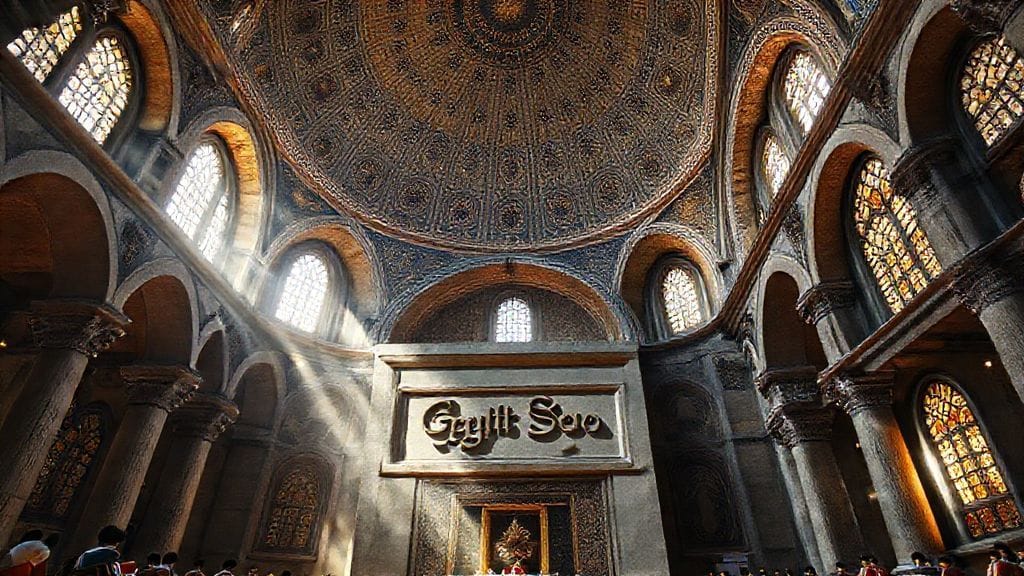
At the heart of Hagia Sophia’s splendor resided its dome—an engineering marvel that seemed to levitate above the vast nave, supported by pendentives that transferred the immense weight to the structure’s four massive piers.
This daring innovation allowed the interior to open like a heavenly canopy, suffusing the space with light and a sense of the infinite. The dome’s shimmering gold mosaics reflected sunlight, creating the illusion of the heavens themselves descending upon the faithful below.
9. Intrigues and Innovations: Engineering Challenges and Solutions
The building was not without its perils. Early on, the dome partially collapsed due to seismic activity and structural weaknesses, prompting major reinforcements by Isidore the Younger decades later.
Behind the scenes, the architects grappled with balancing aesthetics, stability, and symbolism—innovating with half-domes, buttresses, and extensive use of light to animate the sacred space. The result was not just a building but an experience crafted meticulously to inspire a tangible connection to the divine.
10. December 27, 537: The Consecration Day Unfolds
On the chilly morning of December 27, 537, Constantinople’s citizens poured into Hagia Sophia. The clergy, robed in shimmering vestments, began the complex liturgical ceremony, steeped in the rich traditions of the Orthodox faith.
Bells tolled, chants rose, incense coiled, and candles flickered against the gold mosaics depicting Christ, the Virgin Mary, and the saints. Emperor Justinian stood among the crowd but also above it all—a bridge between heaven and earth—his presence affirming the unity between church and empire.
11. The Liturgy and Ceremony: A Celebration of Earthly and Divine Power
The consecration was more than ritual. It was a maestro’s performance of power, faith, and artistry. Patriarchs recited prayers invoking divine blessing upon the structure and its patron. The liturgy intertwined with public ritual, reinforcing social order and spirituality.
The sound of voices in the cavernous space created a near-mystical atmosphere, as if the very building spoke in echoes of faith, history, and power.
12. Voices from the Past: Procopius and the Chronicles of Hagia Sophia
Much of what we know about Hagia Sophia’s construction comes from the writings of Procopius, Justinian’s court historian. His work “Buildings” alternates between admiration and critique—reflecting both the awe inspired by the church and the human struggles behind its creation.
His vivid descriptions immortalize the soaring spaces and the emperor’s boastful pride, providing a human lens into the monumental endeavor.
13. The Church as a Political Statement: Power, Faith, and Identity
Hagia Sophia was not just a sanctuary; it was an instrument of political theology. It asserted Byzantium’s claim as the rightful heir of Rome and the earthly domain of God’s representative.
The intertwining of church and state here set a precedent for centuries, where religious symbolism underpinned imperial authority and legitimacy—a paradigm that shaped the medieval world.
14. The Hagia Sophia’s Role in Imperial Ceremonies and Public Life
Throughout Byzantine history, Hagia Sophia hosted imperial coronations, processions, and public proclamations. It was a stage upon which emperors projected their power and people found moments of sacred unity.
Its grandeur fostered a collective identity among the diverse inhabitants of Constantinople, a city forever caught between Europe and Asia, history and destiny.
15. A Beacon of Orthodoxy: Theology and Symbolism in the Design
Every element within Hagia Sophia was heavy with meaning. From mosaics depicting visionary theology to architectural choices meant to represent celestial harmony, the church embodied Orthodox Christian doctrine.
The light filtering through its windows was understood as a metaphor for divine enlightenment, while the dome symbolized the heavens, linking the earthly sanctuary directly with the cosmos.
16. From Basilica to Mosque: The Transformation Through Centuries
The fortunes of Hagia Sophia would wax and wane with history’s tides. In 1453, Constantinople fell to the Ottoman Turks. Hagia Sophia was converted into a mosque—imbued with Islamic religious symbols without erasing its Byzantine spirit.
This transformation reflected the city’s complex legacy, where layers of faith and empire overlapped in one magnificent structure.
17. The Enduring Legacy: Hagia Sophia’s Influence on Architecture Worldwide
The architectural innovations pioneered by Hagia Sophia resonated across continents and centuries. Its dome inspired countless Orthodox, Muslim, and even Western Renaissance structures.
The church’s blend of functionality, symbolism, and technical prowess remains a pinnacle of architectural achievement—studied and revered to this day.
18. The Emotional Heartbeat of a City: Hagia Sophia in the Soul of Constantinople
Beyond stone and mortar, Hagia Sophia lived in the hearts of Constantinople’s people. It was the site of prayers, hopes, fears, and political drama—a constant witness to a city’s triumphs and tragedies.
Its illuminated mosaics and soaring spaces moved countless souls, creating an intimate connection between the sacred and the everyday.
19. The Modern Reverberations: Controversies, Restorations, and Global Heritage
In recent decades, Hagia Sophia’s status has sparked international debate—between museum, mosque, and place of worship—reflecting broader tensions of cultural heritage, identity, and politics.
Restoration projects strive to preserve its complex history, underscoring its role not just as a monument but as a living symbol bridging civilizations.
20. Conclusion: Beyond Stone and Mortar, the Eternal Spirit of Hagia Sophia
To describe Hagia Sophia merely as a building is to diminish its power. It is a story of human ingenuity, imperial ambition, religious devotion, and cultural fusion—a testament to a city’s beating heart and a civilization’s soul.
On December 27, 537, in the flickering candlelight amid chants and incense, the stones took on meaning beyond themselves. They became an enduring symbol of mankind’s striving for the divine, forever suspended beneath a luminous dome in the city where East meets West.
Conclusion
The consecration of Hagia Sophia on that wintry day in 537 was far more than the inauguration of a religious edifice. It was a narrative of empire, faith, and vision made manifest—a declaration carved in marble and mosaic that Empire and Heaven were intertwined. Through wars, fires, transformations, and controversies, the spirit of Hagia Sophia has transcended epochs, shaped identities, and inspired awe.
As you walk beneath its vast dome, it is impossible not to feel the echo of those ancient voices—of artisans, emperors, priests, and believers—united by a dream to touch the divine. Beyond the grandeur and the stone lies a story of human aspiration that continues to resonate across centuries, a beacon of hope and a mirror of civilization’s complex soul.
FAQs
Q1: Why was the Hagia Sophia consecrated in 537 particularly significant?
A: It marked the completion of a groundbreaking architectural and religious project commissioned by Emperor Justinian I to symbolize Byzantine imperial and spiritual power after the destruction of the previous church.
Q2: Who were the main architects behind Hagia Sophia?
A: Anthemius of Tralles and Isidore of Miletus, renowned for their expertise in geometry and physics, designed the church’s innovative dome and structure.
Q3: How did Hagia Sophia influence future architecture?
A: Its massive dome, use of pendentives, and integration of light and space inspired countless Orthodox churches, Ottoman mosques, and even Renaissance buildings across Europe and Asia.
Q4: What role did Hagia Sophia play in Byzantine political life?
A: It was a ceremonial center where emperors were crowned and religious festivals were held, symbolizing the fusion of church and empire.
Q5: How did the 532 Nika Riots affect the building of Hagia Sophia?
A: The riots destroyed the previous Hagia Sophia, prompting Justinian to commission the new and more magnificent structure as a symbol of renewal.
Q6: How did Hagia Sophia’s function change over time?
A: Originally a cathedral, it was converted into a mosque after the Ottoman conquest of Constantinople in 1453 and later became a museum in the 20th century before being reconverted into a mosque in the 21st century.
Q7: What challenges did the architects face during construction?
A: They had to invent new engineering solutions to support the dome’s weight, achieve stability after seismic damage, and complete an enormous project under political pressure.
Q8: What is the symbolic meaning behind the Hagia Sophia’s dome?
A: The dome represents the heavens covering the earth, symbolizing the divine presence and the emperor’s role as God’s representative on earth.

