Table of Contents
- A New Dawn in American Diplomacy: The Signing of the Hay–Pauncefote Treaty
- The Twilight of British Hegemony in the Americas
- From Clayton-Bulwer to Hay–Pauncefote: The Protracted Quest for Canal Control
- The Geopolitical Stakes of the Panama Isthmus
- Key Figures Behind the Treaty: John Hay and Lord Pauncefote
- The American Ambition: Manifest Destiny Meets Maritime Strategy
- Britain's Changing Global Priorities and Imperial Realignment
- Negotiation Dynamics: Diplomacy in the Roosevelt Era
- The Legal Innovations of the Treaty: Open Canal Policy and Neutrality Clauses
- Reactions Across the Atlantic: British and American Public Opinion
- Latin American Responses and the Seeds of Pan-American Relations
- The Role of the Hay–Pauncefote Treaty in Shaping U.S. Naval Power
- Abandoning the Clayton-Bulwer Treaty: A Shift in Anglo-American Relations
- The Impact on Panama and the Future Panama Canal Zone
- Prelude to the Panama Canal Construction: Engineering Dreams and Political Realities
- The Treaty’s Influence on International Law and Maritime Commerce
- Controversies, Critics, and Celebrations: Voices from the Era
- The Legacy of the Hay–Pauncefote Treaty in 20th-Century Global Politics
- Roosevelt’s Vision Realized: The Treaty’s Place in His Foreign Policy
- Conclusion: The Hay–Pauncefote Treaty as a Turning Point in American Great Power Status
- FAQs about the Hay–Pauncefote Treaty
- External Resource
- Internal Link
1. A New Dawn in American Diplomacy: The Signing of the Hay–Pauncefote Treaty
On a crisp autumn day, November 18, 1901, within the solemn halls of Washington, a quiet but seismic event unfolded. The Hay–Pauncefote Treaty was signed—a document that would decisively redraw the map of imperial ambition and maritime strategy in the Americas. It was a moment pregnant with possibility and fraught with the legacies of colonial competition. The treaty marked the end of decades of Anglo-American tension over the construction and control of a transoceanic canal—an eternal dream of empires thirsting for control over global trade routes and military mobility. In signing, Britain tacitly ceded a claim over the future isthmian canal to the relentless tide of American aspiration.
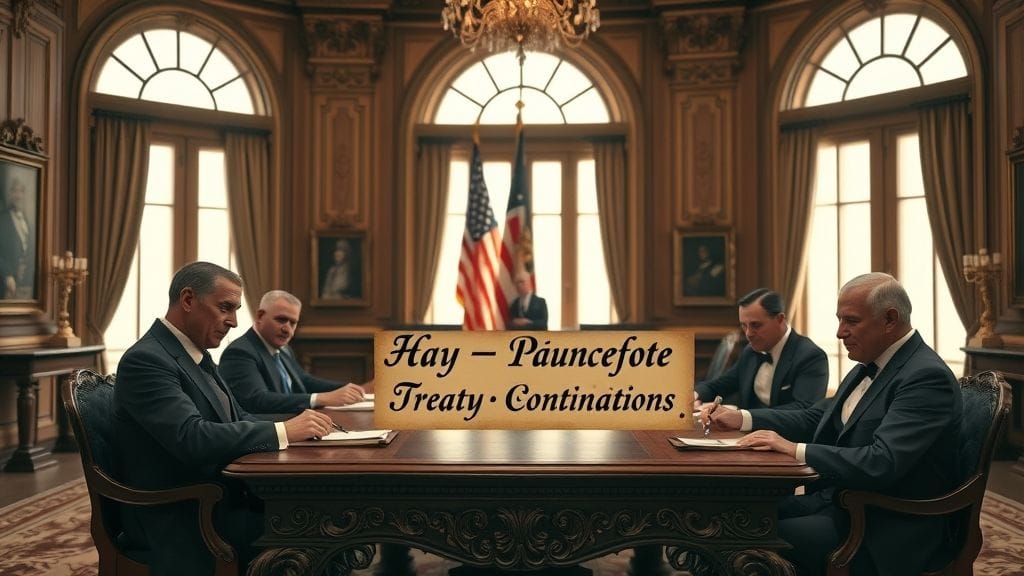
As John Hay, the U.S. Secretary of State, affixed his signature alongside that of Lord Julian Pauncefote, British Ambassador to the United States, it was not merely ink on parchment, but the crystallization of a new order. The implications would echo far beyond Washington’s marble corridors—setting the stage for the Panama Canal, altering Anglo-American relations, and reshaping the destiny of the Western Hemisphere. This was the dawn of unabashed American ascendancy.
2. The Twilight of British Hegemony in the Americas
The signing of the Hay–Pauncefote Treaty symbolized more than an infrastructural agreement; it signaled a shift in imperial power. For over a century, Britain had dominated global sea lanes and wielded unrivaled influence in the Americas. The Clayton-Bulwer Treaty of 1850 sought to ensure that neither Britain nor the United States would have exclusive control over any inter-oceanic canal in Central America, reflecting the era’s mutual suspicion and diplomatic caution.
By the dawn of the 20th century, however, Britain's imperial commitments were stretching thin. The rise of other global powers and the immense colonial responsibilities, especially after the Second Boer War, forced London to reassess priorities. Conceding canal rights to the United States was not merely a practical decision—it was an implicit acknowledgment that the future western hemisphere leadership was American.
3. From Clayton-Bulwer to Hay–Pauncefote: The Protracted Quest for Canal Control
The road from the Clayton-Bulwer Treaty to Hay–Pauncefote was long and winding. In 1850, anxieties revolved around ensuring that no single power achieved technological and commercial dominance by controlling a canal uniting the Atlantic and Pacific Oceans. Both powers agreed on neutrality principles that, paradoxically, limited American ambitions and frustrated British strategic aims alike.
Yet economic growth and technological advances reinvigorated American interest in a canal. Advocates in Washington saw in the canal not just a commercial shortcut but a way to assert U.S. influence across the globe. Years of diplomatic wrangling ensued—at times fraught, sometimes amicable—until the Hay–Pauncefote Treaty emerged as a pragmatic compromise freeing the U.S. hand while assuaging British wariness.
4. The Geopolitical Stakes of the Panama Isthmus
The significance of the canal was not just economic; it was geopolitical electricity flowing through the narrow spine of the Americas. A canal would allow the U.S. Navy to pivot rapidly between oceans, a capability indispensable in an era when naval power equated directly to international clout.
At 50 miles wide, the Panamanian isthmus was the optimal site for such a canal—a strategic corridor linking maritime arteries. Control over this passage promised to rewrite trade routes, shorten journeys by thousands of miles, and offer decisive advantages in conflict. The stakes were nothing less than control over the gateways of the New World.
5. Key Figures Behind the Treaty: John Hay and Lord Pauncefote
Behind the treaty were two figures whose skillful diplomacy and vision shaped its final form. John Hay, a former private secretary to Abraham Lincoln, was a man of letters turned statesman, embodying the American spirit of progress. His vision saw the canal as an essential step toward a new American century.
On the British side, Lord Julian Pauncefote, a seasoned diplomat with a deep understanding of both London’s imperial sensibilities and the pragmatic realities of dealing with an assertive America, steered Britain toward accommodation. His approach helped prevent what might have been a tense confrontation, instead ushering in an era of Anglo-American cooperation.
6. The American Ambition: Manifest Destiny Meets Maritime Strategy
For the United States, the Hay–Pauncefote Treaty was more than diplomacy—it was the fulfillment of Manifest Destiny’s maritime chapter. The 19th-century doctrine, which had driven continental expansion from coast to coast, found a new frontier in the oceans.
With the treaty, the U.S. shed the shackles of British consent and openly claimed the right to construct and control a canal. This left little doubt: America was now a global player, destined to project power far beyond its shores. The canal would become both a symbol and instrument of that power, sharpening U.S. strategic influence.
7. Britain’s Changing Global Priorities and Imperial Realignment
Across the Atlantic, Britain grappled with changing tides. The Pax Britannica that had governed a century was being challenged by new peers—Germany was rapidly industrializing, and the United States was flexing muscles anew.
The British Empire’s global commitments now demanded recalibrated focus. The onerous maintenance of all colonial fronts compelled London to make concessions—and the canal issue was one such strategic retreat. By facilitating American control, Britain aimed to maintain friendly relations while concentrating resources elsewhere.
8. Negotiation Dynamics: Diplomacy in the Roosevelt Era
Though signed in 1901, the Hay–Pauncefote Treaty came amid the rise of Theodore Roosevelt, a president whose exuberant foreign policy would embody "speak softly and carry a big stick." The treaty reflected Roosevelt’s ambition to wield American power not just diplomatically, but physically—through modern naval strength enabled by waterways like the proposed canal.
The negotiations were careful, at times tense, but remarkably efficient. Neither London nor Washington wanted confrontation. The treaty struck a delicate balance, preserving British rights to navigation while guaranteeing U.S. freedom to build and control the canal.
9. The Legal Innovations of the Treaty: Open Canal Policy and Neutrality Clauses
One of the most forward-looking aspects of the Hay–Pauncefote Treaty was its insistence on the canal being open to all nations on equal terms, preventing monopolistic control that could trigger international conflicts.
The treaty mandated neutrality of the canal in times of war, an important legal innovation aiming to prevent its use as a military bargaining chip against non-US powers. This principle sought stability in an increasingly multi-polar world, although future wars and politics would test these clauses.
10. Reactions Across the Atlantic: British and American Public Opinion
In the United States, the treaty was hailed as a triumph of diplomacy and strategic ingenuity. Newspapers lauded Hay as a master negotiator, while political leaders saw the treaty as opening a path to American greatness.
In Britain, reactions were mixed. Imperial hardliners lamented the retreat, seeing it as a concession to unwarranted American expansionism. Yet many politicians and media outlets recognized the practical necessity. The treaty was framed as a sign of “special friendship” amidst a complex world.
11. Latin American Responses and the Seeds of Pan-American Relations
For Latin American nations, the treaty carried ambivalent messages. While it promised potential economic integration through increased trade, it also rang alarms about growing American interventionism.
The treaty foreshadowed the increasing American role in regional affairs—in some eyes protective, in others neo-colonial. It accelerated Pan-American dialogue but also raised questions about sovereignty and independence, laying groundwork for future contentious diplomacy.
12. The Role of the Hay–Pauncefote Treaty in Shaping U.S. Naval Power
The canal promised to revolutionize naval logistics—allowing the U.S. Navy to redeploy fleets between oceans in a matter of days instead of months. As the 20th century ushered in great power rivalries, this capability became indispensable.
The treaty’s success emboldened expansion of the U.S. Navy, underpinning Roosevelt’s Great White Fleet and signaling an era when American sea power would influence global outcomes far from its shores.
13. Abandoning the Clayton-Bulwer Treaty: A Shift in Anglo-American Relations
By abrogating the Clayton-Bulwer Treaty’s restrictions, Hay–Pauncefote marked an unparalleled moment of legal and diplomatic transformation. The older treaty had been a symbol of uneasy parity; the new treaty symbolized American ascendancy and British acquiescence.
This shift proved a cornerstone of the emerging "special relationship," moving from rivalry and suspicion to cooperation—a diplomatic pivot that would endure through tumultuous decades ahead.
14. The Impact on Panama and the Future Panama Canal Zone
Though the treaty granted permission for the canal construction, it would be Panama—not Nicaragua or other alternatives—that became the chosen site. The treaty’s legal framework paved the way for later agreements securing American control over the Panama Canal Zone after Panama’s independence in 1903.
This new political geography irrevocably altered Panama’s fate, entangling its sovereignty with global power struggles and economic modernization.
15. Prelude to the Panama Canal Construction: Engineering Dreams and Political Realities
The treaty cleared diplomatic obstacles, but the canal's construction would confront immense technical, health, and financial challenges. It inspired one of the era’s greatest engineering feats—but also controversies over labor conditions, disease, and environmental impact.
Still, the treaty’s legal foundation ensured that the canal project became a symbol of human ingenuity and the American vision of technological progress as a tool of national destiny.
16. The Treaty’s Influence on International Law and Maritime Commerce
By codifying principles of neutrality and open access, the treaty set precedents influencing later international maritime law. It affirmed that critical waterways were to serve international commerce, not just national ambitions.
This legal framework resonated well into the 20th century, shaping multilateral diplomacy on trade routes and influencing treaties over strategic choke points worldwide.
17. Controversies, Critics, and Celebrations: Voices from the Era
The treaty was not without its detractors. Some American isolationists feared entanglement in foreign affairs; radical voices decried imperial overreach. British imperialists mourned the retreat from hemispheric dominance.
Conversely, visionaries and reformers celebrated it as a beacon of American progress. Historical figures like Roosevelt viewed it as a necessary step in the nation’s maturation into a global giant.
18. The Legacy of the Hay–Pauncefote Treaty in 20th-Century Global Politics
In retrospect, the treaty was a foundational pivot from old 19th-century diplomacy to new 20th-century realities. It remodeled Anglo-American relations, bolstered U.S. naval power, and shaped hemispheric geopolitics.
Its legacy reverberated through two world wars and the Cold War, as control over the canal remained a potent symbol of influence in Latin America and beyond.
19. Roosevelt’s Vision Realized: The Treaty’s Place in His Foreign Policy
The treaty was a crucial component of Theodore Roosevelt’s "Big Stick" diplomacy. It demonstrated a blend of subtle negotiation backed by unmistakable power—a formula Roosevelt championed throughout his presidency.
His dynamic vision sought an America ready to assert itself globally, and the treaty was a diplomatic corollary to his robust naval expansion and interventionist policies in the Western Hemisphere.
20. Conclusion: The Hay–Pauncefote Treaty as a Turning Point in American Great Power Status
The Hay–Pauncefote Treaty was more than a bilateral agreement; it was the herald of a new era. It marked the United States’ emergence as an unquestioned power in the Americas and a decisive player on the global stage.
By paving the way for the Panama Canal, the treaty transformed trade, military strategy, and international law. It is a testament to the subtle art of diplomacy and the inexorable tides of history that few moments of ink so profoundly shaped the modern world.
Conclusion
Looking back from our vantage point a century later, the Hay–Pauncefote Treaty emerges as a defining milestone—a quiet accord whose ripples reshaped oceans and empires alike. It was a moment when diplomacy met destiny, when pragmatic statesmanship bridged old rivalries, and when the tides of history lifted a rising power onto the stage of global leadership.
Beyond the legal text lay human stories of ambition, compromise, and vision. John Hay and Lord Pauncefote navigated treacherous waters of imperial rivalry with grace; Theodore Roosevelt seized the opportunity to propel his nation forward. Meanwhile, the people of Panama and Latin America found themselves at the crossroads of newfound global attention—often as spectators, sometimes as players, in a drama far larger than themselves.
The treaty reminds us that the map of power is not drawn solely on battlefields but also in the drafting rooms of diplomats and the minds of leaders who dare to imagine futures beyond the horizon. It is an enduring symbol of America’s coming of age on the world stage—a transition filled with promise, contradictions, and the ceaseless ebb and flow of geopolitical tides.
FAQs about the Hay–Pauncefote Treaty
Q1: What was the primary purpose of the Hay–Pauncefote Treaty?
A1: The treaty’s main objective was to permit the United States to build and control an interoceanic canal through Central America, primarily across Panama, while ensuring the canal remained neutral and open to all nations.
Q2: How did the treaty change Anglo-American relations?
A2: It marked a significant shift from competition to cooperation, ending the restrictions imposed by the Clayton-Bulwer Treaty and acknowledging America’s emerging leadership role in the Western Hemisphere.
Q3: Why was Britain willing to concede canal control to the United States?
A3: British global commitments, rising costs, and the desire to maintain good relations with an increasingly powerful United States motivated Britain to pragmatically accept American dominance over the canal project.
Q4: What role did Theodore Roosevelt play in the treaty?
A4: Although the treaty was signed just before Roosevelt became president, his administration fully embraced its opportunities, using it as the legal foundation to support the construction of the Panama Canal and strengthen American naval power.
Q5: How did Latin American countries view the treaty?
A5: Views varied; some saw economic opportunities, while others feared increased U.S. interventionism and loss of regional autonomy, concerns that later fueled pan-American and nationalist sentiments.
Q6: In what ways did the treaty influence international law?
A6: It codified principles of neutrality and free access to strategic waterways, shaping future international treaties governing the governance and operation of global maritime chokepoints.
Q7: What was the relationship between this treaty and the Clayton-Bulwer Treaty?
A7: The Hay–Pauncefote Treaty effectively superseded and nullified the Clayton-Bulwer Treaty, removing its restrictions on unilateral canal construction and control by either Britain or the United States.
Q8: How did the Hay–Pauncefote Treaty pave the way for the Panama Canal?
A8: By securing legal rights for the U.S. to build and operate the canal and ensuring international acceptance of American control, the treaty removed major diplomatic obstacles to the project’s commencement and completion.