Table of Contents
- The Death of William II and the Rise of Henry I: A Kingdom Poised for Change
- England at the Dawn of the Twelfth Century: Political Fragility and Noble Ambitions
- Henry I’s Early Reign: Consolidation Amidst Uncertainty
- The Charter of Liberties: A Radical Promise in a Time of Power Struggles
- The Content of the Charter: Between Justice and Royal Authority
- The Barons' Role: Expectation and Demand for Reform
- The Church’s Influence: Balancing Sacred and Secular Power
- The Charter’s Immediate Reception in London and Beyond
- Political Repercussions: How the Charter Shaped Henry’s Kingship
- Legal and Administrative Innovations: Laying Foundations for Governance
- The Impact on Feudal Relations and Noble Rights
- The Broader European Context: Monarchs and the Rule of Law
- The Charter’s Echoes in Later English Documents: Magna Carta’s Forerunner
- Human Stories: Nobles, Clergy, and Commoners under the Charter's Promise
- The Legacy of Henry I’s Charter: A Turning Point in Medieval Kingship
- Conclusion: Liberty and Authority in the Balance
- FAQs: Understanding Henry I’s Charter of Liberties
- External Resource
- Internal Link
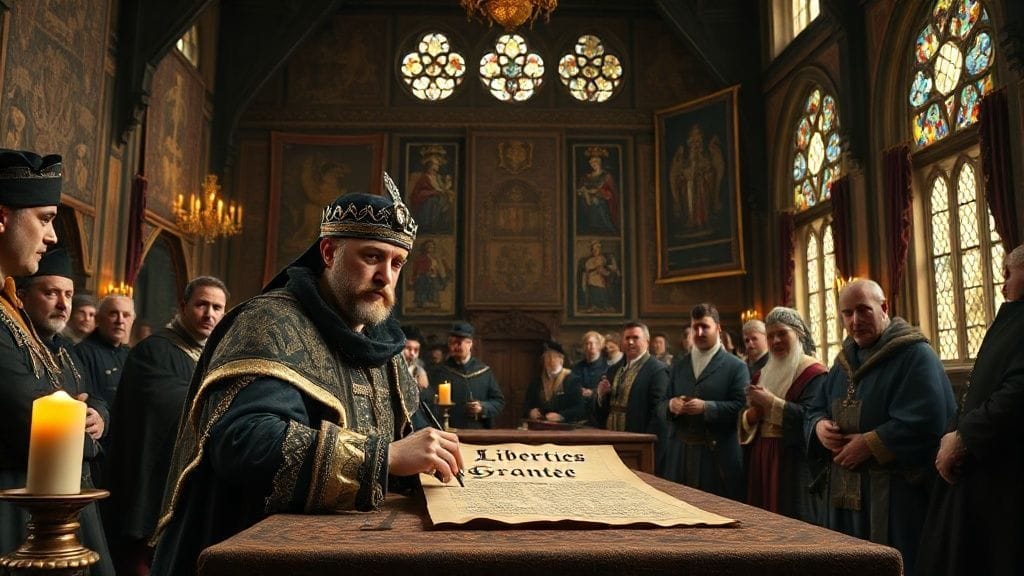
When the heavy drapes of night fell over Westminster on the evening of August 2, 1100, a different kind of light seemed to shine within the great hall—one of urgent resolve and cautious hope. Henry I, newly crowned king of England, stood before his court, his voice steady but filled with the gravitas of a man who had just seized the crown amidst chaos and loss. The death of his brother, William II, on a hunting expedition mere days before, had left the kingdom in turmoil; justice, order, and legitimacy now hung in the balance. It was within this crucible that Henry issued the Charter of Liberties—a document that would quietly but profoundly reshape the nature of kingship and governance across England, casting long shadows over medieval and modern political thought.
The Charter of Liberties was more than a list of promises; it was Henry I’s bid to restore faith in the monarchy and to recalibrate the turbulent relationships between ruler and ruled. At a time when royal power was often unchecked and arbitrary, Henry sought to bind himself to the law and to address grievances — particularly those raised by the barons and the church. It was a remarkable document because it acknowledged, for the first time, that royal authority must be exercised within certain limits, a tacit contract that placed kingship under a framework of rights and responsibilities.
But why, and how, did this document come to be? What forces shaped its content? And how did its legacy linger long after Henry’s reign, influencing future generations and the very notion of liberty? To understand the Charter of Liberties is to peek into the fragile heart of medieval England and to witness the birth of concepts that resonate still today.
1. The Death of William II and the Rise of Henry I: A Kingdom Poised for Change
The sudden death of William II, also known as William Rufus, struck like thunder across England. The circumstances were suspicious—shot by an arrow during a mysterious hunt in the New Forest on 2 August 1100. His unexpected demise opened the door for his brother, Henry, to claim the throne swiftly, outpacing his elder brother Robert Curthose who was away on the First Crusade.
Henry’s rise was marked by urgency and pragmatism. Knowing the fragile balance of power within the realm, he wasted no time in being crowned king in Westminster Abbey, just two days after William’s death. Yet, Henry faced daunting challenges: an aristocracy emboldened by decades of Norman conquest, a church that had grown increasingly assertive, and a populace wary of royal excess. His reign needed legitimacy and stability, urgently.
2. England at the Dawn of the Twelfth Century: Political Fragility and Noble Ambitions
England in 1100 was a kingdom at crossroads. The Norman Conquest of 1066 had turned England into a land ruled by Norman lords, with the Anglo-Saxon population adapting to new governance and customs. Under William I and William II, the monarchy had exercised increasingly forceful control, often through heavy taxation, arbitrary fines, and the expansion of royal courts.
This created simmering tensions, especially among the barons who held vast lands and sought to protect their privileges. The church, too, had emerged as a powerful institution, championing reforms and seeking to limit secular interference. Into this intricate web stepped Henry I, a ruler known for his administrative talent and shrewd political instincts.
3. Henry I’s Early Reign: Consolidation Amidst Uncertainty
With the crown secured, Henry I needed to shore up his authority quickly. He convened his first court at Westminster, surrounded by nobles, bishops, and clerks, to demonstrate his command and to reassure them that justice and order would return. However, his legitimacy remained somewhat contested—Robert Curthose, his elder brother, was still alive and might seek to claim his birthright.
Henry’s solution was to tackle what none had dared to fully address before: the abuses and grievances that festered among his subjects. His experience as a younger son, who had managed royal affairs and governed Normandy before, had taught him the value of well-run administration and the dangers of arbitrary rule.
4. The Charter of Liberties: A Radical Promise in a Time of Power Struggles
It was shortly after his coronation that Henry unveiled the Charter of Liberties, often called the Coronation Charter, a groundbreaking document that promised to reform royal governance. The charter pledged to end excessive taxation, curb the misuse of royal forests, restore liberties to the church, and respect the rights of his barons.
This was not simply a political maneuver but a response to a deep-seated demand for fairness and restraint. Henry recognized that to win lasting loyalty, he needed to bind his kingship within certain laws—something practically radical in an era where royal power often seemed absolute.
5. The Content of the Charter: Between Justice and Royal Authority
The Charter enumerated specific promises: it declared an end to unjust fines and the seizure of baronial lands without due process; it vowed to respect church rights and the freedom of electing bishops without interference; it promised to safeguard the rights of heirs and widows, reinforcing aspects of inheritance and property law; and it sought to limit the exploitation of royal forests, a source of conflict between king and subjects.
This delicate balance—affirming royal authority while promising legal and moral constraints—reinforced Henry’s image as a lawful monarch. The charter underscored his awareness that limitless power could provoke rebellion and weakness.
6. The Barons' Role: Expectation and Demand for Reform
The charter was as much a political pact as a royal decree. The barons, powerful nobles who controlled much of the kingdom’s wealth and military strength, had been critical of the previous reign’s high taxes and arbitrary justice. Many saw the Charter as a victory—an unprecedented acknowledgment that even a king was subject to limits.
The document was intended to ease tensions, to build a coalition of supporters, and to prevent a fractious nobility from challenging Henry’s authority. It was a promissory note to the realm’s most influential men: obey the king, and the king will respect your rights.
7. The Church’s Influence: Balancing Sacred and Secular Power
The church played an essential role in shaping and legitimating royal authority in medieval England. Henry’s charter explicitly addressed church concerns, promising to free ecclesiastical appointments from royal interference and to protect church lands and rights.
This alignment with the church was both pragmatic and strategic. By winning the support of the church, Henry strengthened his claim to the throne and reinforced the moral weight of his promises. The church, for its part, could count on greater autonomy, which was critical during a decade marked by the wider Investiture Controversy erupting across Europe.
8. The Charter’s Immediate Reception in London and Beyond
News of the Charter spread quickly among England’s elites and its capital, London, was abuzz with anticipation. For many, especially those weary of William II’s harsh rule, the promise of liberties was a hopeful sign of change.
Yet popular reception was mixed. Some skeptics doubted a king’s sincerity; others hoped the Charter would genuinely restore fairness. For the first time, subjects of the realm found their grievances articulated in a royal document, binding on the crown.
9. Political Repercussions: How the Charter Shaped Henry’s Kingship
The Charter helped Henry to consolidate his reign by reaffirming the social contract between king and subjects. It disarmed immediate opposition by acknowledging past abuses and promising reform.
However, Henry remained vigilant, understanding that political survival meant balancing firmness with generosity. The Charter was less about relinquishing power and more about legitimizing it through law—a calculated step shaping the nature of monarchy for the next century.
10. Legal and Administrative Innovations: Laying Foundations for Governance
Beyond its promises, Henry’s governance reforms shaped the future of England’s legal system. The Charter’s commitments paved the way for improved administration of justice, fostering courts with more consistent laws, and affording greater protection to rights of the nobility.
Many historians see the Charter as an early blueprint for constitutional monarchy—a model where law and custom tempered royal prerogative, anticipating developments in English common law.
11. The Impact on Feudal Relations and Noble Rights
By addressing feudal abuses, particularly around inheritance and the treatment of wards and widows, the Charter articulated principles that structured noble life. It curbed royal exploitation and ensured a measure of stability in the highly personalized and hierarchical feudal society.
This promoted loyalty from nobles who, although still powerful, recognized that their privileges and responsibilities were now part of a negotiated order.
12. The Broader European Context: Monarchs and the Rule of Law
Henry’s Charter did not emerge in isolation. Across Europe, monarchs grappled with the tension between royal authority and emerging demands for legal constraint, amplified by church reformers and restless nobles.
Henry’s Charter fits into a broader trend of monarchs seeking to codify rights and govern with justice—an early sign of constitutionalism that would later influence rulers from the English Plantagenets to continental sovereigns.
13. The Charter’s Echoes in Later English Documents: Magna Carta’s Forerunner
The 1215 Magna Carta is often heralded as the landmark in limiting royal power. Yet Henry I’s Charter of Liberties was a clear precursor, setting a precedent for the idea that kings were bound by law.
Many clauses and themes in Magna Carta — protection from arbitrary fines, rights of inheritance, church liberties — echo Henry’s 1100 promises, making the Charter a foundational moment in English constitutional history.
14. Human Stories: Nobles, Clergy, and Commoners under the Charter's Promise
Beyond politics, the Charter touched the lives of many. For a widowed noblewoman, it meant protection of her dower rights; for a baron, assurance that his lands would not be seized capriciously; for a bishop, freedom to appoint his clergy.
Though the common serf or peasant saw less immediate impact, these reforms trickled down over time, embedding ideas of justice and protection that would evolve over centuries.
15. The Legacy of Henry I’s Charter: A Turning Point in Medieval Kingship
Ultimately, Henry I’s Charter of Liberties stands as a milestone in the evolution of governance. It represents a moment when a king consciously limited his own power to secure the realm, when law and liberty began to shape kingship rather than fear and brute force alone.
Its echoes persist in modern conceptions of limited government and rule of law, reminding us that liberty was born in the flickering halls of medieval courts.
Conclusion: Liberty and Authority in the Balance
Henry I’s Charter of Liberties was a bold promise cast into a kingdom fraught with danger and ambition. It was a contract written in hope but tempered by political necessity—a landmark that wrestled with the eternal tension between authority and freedom.
As we look back, it is striking to see how this eleventh-century charter laid the groundwork for centuries of political evolution. It taught us that kingship could be reimagined not as domination but as stewardship bound by law. The Charter’s legacy invites us to reflect on the balance of power, rights, and responsibility—a balance that remains at the heart of governance across the world.
Indeed, Henry’s promise was revolutionary because it acknowledged a simple truth: authority, to endure and inspire loyalty, must be just.
FAQs: Understanding Henry I’s Charter of Liberties
Q1: Why did Henry I issue the Charter of Liberties?
Henry issued the Charter soon after his coronation to address the grievances caused by his predecessor’s harsh rule, consolidate his authority, and reassure the nobles and church that he would govern justly by limiting royal abuses.
Q2: What were the main promises made in the Charter?
The Charter promised to end excessive taxation, restore the rights of the church, protect baronial inheritances, limit the exploitation of royal forests, and ensure royal justice would be lawful and fair.
Q3: How did the Charter affect the power of the nobility?
The Charter curbed some of the king’s powers to levy arbitrary fines and seize lands, offering nobles assurances about their rights and inheritance, which increased their support for Henry’s rule.
Q4: What role did the church play in the Charter?
The church influenced the Charter’s content significantly, securing promises to restore freedoms concerning ecclesiastical appointments and protect church lands, reflecting the period’s wider church-state conflicts.
Q5: Is the Charter of Liberties the same as Magna Carta?
No, the Charter of Liberties predates Magna Carta by over a century but is considered its forerunner. Both documents sought to limit royal power and protect subjects’ rights, with Magna Carta building upon earlier principles found in Henry’s Charter.
Q6: Did the Charter of Liberties immediately change England?
While its immediate effect was limited, primarily serving political purposes, the Charter set important legal and political precedents that influenced English governance and legal traditions for centuries.
Q7: How is Henry I’s Charter relevant today?
The Charter is an early example of a ruler voluntarily accepting constraints on power, a concept foundational to modern constitutional monarchy and the rule of law principles that govern many democracies today.
Q8: Where was the Charter issued, and why is the location significant?
The Charter was issued in London, likely at Westminster, the political heart of England. Its issuance there underscored Henry’s claim to legitimate kingship and aimed to resonate with the realm’s most influential stakeholders.