Table of Contents
- An April Departure from Wexford: A Turning Point in Two Kingdoms
- Ireland Before the Angevin Shadow: A Fragmented Island
- A King in Crisis: The Road from Becket’s Murder to Irish Intervention
- Mercenaries, Lords, and a Fallen High King: How the Invasion Began
- Across the Stormy Sea: Henry II Lands to Claim Authority
- Waterford, Dublin, and the Crown: A New Architecture of Power
- Synods, Oaths, and Penance: Church and Crown in a Shaken Christendom
- The Court at Wexford: Waiting for the Wind and Watching the Horizon
- April 1172: The Morning Henry II Departs Ireland
- After the Sails Vanish: Anglo-Norman Lords and the Irish Response
- From Wexford to Winchester: A King’s Return to European Diplomacy
- Torn Clans and New Castles: Social Change in the Shadow of the Departure
- Remembering and Forgetting: How Chronicles Framed the Irish Venture
- Echoes Through Centuries: Colonial Precedent and the Idea of Empire
- On the Quayside of History: Imagining the Human Drama of Wexford
- Conclusion
- FAQs
- External Resource
- Internal Link
Article Summary: In April 1172, as Henry II departs Ireland from the harbor at Wexford, a brief but decisive chapter in medieval history quietly closes and another, far longer one, begins. The English king’s stay on the island had lasted only months, yet it rearranged the political map of Ireland, reshaped his own damaged reputation after Thomas Becket’s murder, and set the foundations for centuries of English involvement. This article traces the world into which Henry sailed, the fractured Irish kingdoms and the ambitious Anglo-Norman adventurers who preceded him. It follows the arc from crisis in England and Normandy to royal landings, church reform, and martial display, culminating in the moment when henry ii departs ireland and leaves his agents to hold what he had claimed. Yet behind this simple act of departure lay unresolved tensions: resentful Gaelic lords, restless Norman barons, and a king still under papal suspicion. By blending narrative reconstruction with analysis, we will explore how a single voyage from Wexford became a hinge between local struggles and broader imperial designs. The story does not end on the Irish coast; instead, the wake of Henry’s ships spreads outward into European diplomacy, Irish memory, and the slow formation of a colonial relationship that would endure into modern times.
An April Departure from Wexford: A Turning Point in Two Kingdoms
At first glance, the scene could almost be ordinary: a king’s ships at anchor in a sheltered harbor, crews shouting across the water, horses skittish at the edge of wooden gangways, the tang of tar and salt on the air. Yet on that April day in 1172, when Henry II prepared to leave Wexford and sail back across the Irish Sea, something far from ordinary was unfolding. Observers on the quayside—Anglo-Norman knights, Irish chieftains, clerics in dark wool robes—might not have known it, but the day would echo down the centuries. The instant henry ii departs ireland, the island enters a new phase of its history, one in which local rivalries and foreign ambition are woven into a single, uneasy tapestry.
Wexford, on Ireland’s southeastern coast, was no random point of departure. It had been an early bridgehead for Norman power, a small but significant port seized by Cambro-Norman adventurers years before the king himself ever set foot on Irish soil. Its harbor now offered the safest way out for Henry and his royal entourage. Above the restless water, banners fluttered in the sea breeze: the royal lions of England, the personal devices of great lords, the rougher pennons of lesser knights who had followed fortune across the channel. On the roads leading into town, carts creaked under supplies, and local traders hovered in the shadow of all this movement, wondering how much would change once the king was gone.
For Henry’s followers, the departure carried a mixture of relief and apprehension. The campaign had not been a grand conquest in the classical sense; there had been no single decisive battle, no triumphant march over a defeated foe. Instead, there had been submissions, negotiations, the delicate balancing of old Irish kings and new Norman captains. But this was only the beginning of a much longer story. As the harbor filled with the sound of sailors hauling lines and the scrape of hull against pier, questions hung in the salt air: Would the Irish pledges of loyalty hold once the royal ships faded into the mist? Would the Norman adventurers, their appetite whetted, seize more than the king intended? And what would Henry’s enemies in England and on the Continent make of this Irish interlude, now closing as henry ii departs ireland and turns his face back to Europe?
To understand why this departure mattered, we must reconstruct not only the few months Henry spent on the island, but the world that existed before his sails appeared on the horizon. The April voyage from Wexford was the culmination of years of conflict, ambition, and negotiation—beginning long before the royal fleet first caught sight of the Irish coast, and continuing long after its hulls cut again through the waters of the Irish Sea.
Ireland Before the Angevin Shadow: A Fragmented Island
In the decades before Henry’s arrival, Ireland was no blank slate awaiting conquest. It was a mosaic of kingdoms, alliances, kin-groups, and rival dynasties, each jostling for land, honor, and overlordship. High kingship existed as an aspiration more than an enduring institution: a powerful ruler could momentarily hold sway over much of the island, but the centrifugal pull of regional loyalties and fierce local identities always threatened to tear this fragile supremacy apart.
In the mid-twelfth century, the dominant figure was Ruaidrí Ua Conchobair (Rory O’Connor), the king of Connacht who claimed the high kingship with varying degrees of recognition and resistance. Yet his authority did not extend into every glen and river valley; in Munster, Leinster, and Ulster, strong provincial kings guarded their prerogatives. Law and custom were administered through the Brehon system, a dense web of traditional judgments and compensations. Laws spoke of honor prices, cattle, fosterage, and compensation for injury rather than the codified, written statutes that would later accompany Norman rule. Monasteries, too, were centers of power, sheltered within stone walls but deeply enmeshed in territorial politics.
In such a landscape, kingship was personal and kinship-based. Authority rested on the charisma and military success of individuals as much as on institutional continuity. Succession followed tanistry—selection from a wider pool of potential male heirs within a kin-group—fostering competition and blood feuds. This was a world of cattle raids, hostage-taking, and shifting alliances, in which a ruler might be a powerful high king one year and, after a reversal or a betrayal, a hunted fugitive the next.
From the sea, Ireland did not look isolated. Its coasts connected it to a wider Atlantic world of trade and war: Norse-Gaelic towns like Dublin, Waterford, Wexford, and Limerick thrived as ports, their harbors busy with vessels from the Hebrides, the Isle of Man, Wales, and beyond. Merchants traded slaves, furs, wine, and fine cloth. The legacy of earlier Viking settlement lingered in the fortified towns and in the hybrid cultures of these coastal enclaves. It’s astonishing, isn’t it, how a place often portrayed as remote and insular was in fact plugged into a bustling maritime network.
Yet this complexity also made the island vulnerable. Local rivalries could tempt ambitious rulers to seek outside help, and external powers were more than willing to answer such calls—especially when they saw an opportunity to extend their influence. It was through one such invitation that Henry II’s path to Wexford and his eventual departure from it was first laid.
A King in Crisis: The Road from Becket’s Murder to Irish Intervention
Far to the east, across the Irish Sea and the narrower waters of the Channel, Henry II of England stood at the pinnacle of secular power in Western Europe. By the 1170s he ruled not only England but also Normandy, Anjou, Maine, Touraine, and, through his marriage to Eleanor of Aquitaine, much of southwestern France. Chroniclers spoke of an “Angevin Empire,” a patchwork of lands held together by personal lordship and relentless royal energy. Henry was known for his tireless itinerant kingship, his keen legal reforms, and his capacity for controlled fury.
Yet Henry’s authority masked a deep wound: the murder of Archbishop Thomas Becket in Canterbury Cathedral on 29 December 1170. Four knights, likely misunderstanding or exploiting the king’s outbursts against his troublesome prelate, had ridden to the cathedral and hacked Becket down near the altar. The shock rippled through Christendom. Henry, already in conflict with the papacy over the boundaries of ecclesiastical and royal jurisdiction, found himself suspected—if not of direct command, then of dangerous complicity. His enemies whispered of a king who killed a saint; his allies urged him to seek forgiveness and make amends.
This crisis shaped every move he made in the following years. A king who had long asserted his will over bishops and barons had to cultivate a new image: that of a penitent, a restorer of church rights, a sponsor of reform. It is within this delicate dance that Ireland emerges, no longer a distant island but an opportunity. The papal bull Laudabiliter, attributed to Pope Adrian IV and later confirmed by Pope Alexander III, had granted Henry the right—at least in theory—to bring order and reform to the Irish church. Whether this document was fully authentic or partially opportunistic, it became a powerful justification.
Henry, facing papal scrutiny and the need to demonstrate obedience to church reform, could present an Irish expedition as a moral and ecclesiastical mission, not simply a territorial grab. At the same time, it offered him a practical tool: by personally intervening in Ireland, he could rein in his own barons, who had already launched their own conquests there, and prevent a semi-independent power base from forming on his western flank. When we later watch as henry ii departs ireland from Wexford, we are seeing the closing act of a carefully staged performance designed to address a crisis in both church and state.
Mercenaries, Lords, and a Fallen High King: How the Invasion Began
The story of how Henry came to Ireland does not begin with royal ships but with a dispossessed Irish king and a restless Welsh Marcher lord. Diarmait Mac Murchada (Dermot MacMurrough), king of Leinster, had been driven from his lands around 1166 by a coalition led by High King Ruaidrí Ua Conchobair. Exiled and desperate, Diarmait crossed to Henry’s court, perhaps meeting the king in Aquitaine or England, and begged for help. Henry, preoccupied elsewhere but intrigued, granted him permission to recruit aid among his subjects without committing royal forces.
Diarmait turned to the Marcher lords of Wales, men accustomed to hard fighting and opportunistic expansion on the shifting frontier between Norman England and the Welsh principalities. Chief among them was Richard de Clare, known to history as Strongbow, an earl whose fortunes had waned and who saw in Ireland a chance to regain status and wealth. In a marriage bargain that would reshape Irish politics, Diarmait promised his daughter Aoife—along with the succession to Leinster—to Strongbow in return for military assistance. The first contingents of Cambro-Norman knights and archers began to cross the sea in 1169.
These forces were small in number but devastatingly effective. Armed with mail hauberks, kite shields, and powerful longbows, and fighting in tight formations, they cut through the looser war-bands of Diarmait’s enemies. Wexford, Waterford, and eventually Dublin fell into their hands. Diarmait regained much of his old authority, and, upon his death in 1171, Strongbow moved to claim Leinster as his own. At this moment, the specter Henry had long feared loomed into view: a great semi-autonomous Norman lord raising his own principality in Ireland, linked to the English realm by loyalty but not by tight royal control.
The high king, Ruaidrí, sought to respond, mustering Irish forces to hem in the newcomers, but the situation was fluid and uncertain. For Henry, the risk was clear. If he did nothing, the island might become the power base of ambitious barons whose loyalty could not be guaranteed. If he acted, he could assert overlordship both over the Normans and, potentially, over the Irish kings themselves. From these calculations emerged the plan that would end, for a time, at Wexford’s harbor when henry ii departs ireland, leaving behind the provisional settlement he had crafted.
Across the Stormy Sea: Henry II Lands to Claim Authority
In October 1171, Henry gathered one of the largest expeditionary forces an English king had yet sent overseas. Chroniclers spoke of some 4,000 men, including several hundred knights, infantry, and support crews—an armada of perhaps four hundred ships leaving the ports of south Wales. Winter seas in the Irish Sea were notoriously treacherous, but Henry could not wait for gentler weather. The spectacle of his power had to be overwhelming and immediate.
His destination was the southeast coast, the region already seeded with Norman footholds. After battling rough waters, the fleet anchored near Waterford, and the king came ashore in a campaign carefully choreographed to awe both his own men and the watching Irish. Trumpets blared, banners rippled, and lines of armored knights gleamed in the grey light. One chronicler, Gerald of Wales (Giraldus Cambrensis), later wrote admiringly of “a king whose power stretched from the Pyrenees to the borders of Scotland,” arriving now in Ireland to bring order where, in his view, there had been only disorder.
This royal arrival marked a new phase. Strongbow and his companions hurried to present themselves, anxious to demonstrate loyalty and secure their holdings under direct royal authority. Irish rulers, too, began to weigh their options: submit to this formidable newcomer and hope to retain their lands under his overlordship, or resist and risk facing not merely scattered Norman raiders but the concentrated force of a European monarch. Over the winter of 1171–1172, Henry moved between Waterford, Dublin, and other strongpoints, receiving submissions, granting charters, and laying down the framework of his rule.
The landscape of the Irish winter formed a stark backdrop to these negotiations. Rain and wind battered the encampments; supply lines from Wales strained. Yet the king’s presence itself was a weapon. When we imagine the scene months later, as henry ii departs ireland from Wexford, it is important to remember that his authority on the island had been less about pitched battles and more about this heavy, visible, and continuous royal presence—a presence now about to vanish over the horizon.
Waterford, Dublin, and the Crown: A New Architecture of Power
Henry’s stay in Ireland was characterized by a series of political acts that would reverberate long after his departure. He took direct control of key coastal cities—Waterford and Dublin most notably—designating them as royal possessions rather than leaving them in the hands of over-mighty subjects. These urban centers, with their harbors and merchant communities, would become anchors of English influence.
In Dublin, Henry established what might be called a provisional court-in-exile: a small version of his itinerant government transplanted onto Irish soil. Royal writs began to circulate, charters were issued, and English law was carefully extended to certain communities, especially to the incoming settlers. Fortifications were strengthened, wooden palisades rising where Viking and Irish defenses had stood before. Markets continued to operate, but under a new legal and fiscal regime that funneled profits and authority back to the king.
For the Anglo-Norman lords like Strongbow, the message was ambiguous. On the one hand, Henry confirmed many of their conquests under royal authority, securing them against both Irish counterattack and royal displeasure. On the other, they now held these lands as fiefs from the king, not as independent territories carved out purely by their own sword. The Irish kings who came to submit—to “become the king’s men,” in the language of feudal homage—encountered a similar duality. Some hoped to enlist Henry’s protection against their local rivals. Others saw such submission as a necessary evil, a temporary accommodation with a powerful foreign overlord.
These arrangements were, by their nature, fragile. They depended on Henry’s personal capacity to enforce obedience and arbitrate disputes. As long as the king himself remained in Ireland, his physical presence acted as a stabilizing weight on the scales of power. Once henry ii departs ireland, the carefully constructed architecture of authority would be tested in his absence. Wexford, the port from which he would later embark, had itself become part of this network—a bridge between the old Irish world and the encroaching Anglo-Norman one.
Synods, Oaths, and Penance: Church and Crown in a Shaken Christendom
Henry’s program in Ireland was never solely military or political; it had a deeply ecclesiastical dimension. The stain of Becket’s murder hung over him, and he knew that his dealings with the Irish church would be scrutinized by Rome. In early 1172, he oversaw the Synod of Cashel, a church council that sought to align Irish religious practice more closely with Roman norms and, by extension, with English reforms.
The decrees of Cashel touched on matters that might seem mundane but carried symbolic weight: clerical celibacy, the standardization of marriage laws, the payment of tithes, the administration of sacraments. In effect, the synod signaled a willingness among many Irish ecclesiastical leaders to recognize and cooperate with the structures of the wider Latin West. Gerald of Wales, with a predictably partisan eye, would later claim that the Irish church had been lax and that Henry’s presence brought long-needed reform. This was, of course, an exaggeration, but it captures the rhetoric Henry wanted: himself as reforming monarch, not brutal conqueror.
At the same time, the king engaged in acts of visible piety—public devotions, generous donations to churches and monasteries, and respectful dealings with bishops and abbots. All of this was ammunition in his ongoing negotiation with Pope Alexander III, who waited to see whether the king truly deserved reconciliation after Becket’s death. When, later in 1172, Henry would perform dramatic public penance at Canterbury—walking barefoot, submitting to scourging—it would be against the backdrop of this Irish campaign, already concluded when henry ii departs ireland and returns to his other dominions.
For Irish churchmen, the new order presented opportunities and risks. Some monasteries and bishoprics gained royal patronage and protection; others feared encroachment on lands and privileges. Ordinary believers might have noticed little immediate change in their daily devotions, but the alignment of their bishops with a distant foreign king subtly shifted the island’s spiritual geography. The church, like the land and its fortresses, became part of the contested terrain Henry reorganized before stepping back onto a ship in Wexford’s harbor.
The Court at Wexford: Waiting for the Wind and Watching the Horizon
By the early spring of 1172, the immediate objectives of Henry’s Irish campaign had been met, at least on paper. Strongbow and the other Norman captains had bent the knee. Key cities were in royal hands. Several Irish kings had offered homage, and the synod had spoken reforms into being. But Ireland was also proving a harsh country in which to maintain a large royal host, especially as winter turned to a damp, uncertain spring.
Supplies were stretched thin; ships bringing grain and wine from England and Wales were delayed or scattered by storms. Men grumbled about the climate and the unfamiliar terrain. The Irish political situation, though quieter on the surface, remained far from settled. Rumors carried on the wind—whispers of local chieftains plotting revolt once the king’s back was turned, of old rivalries rising anew in the shadows of Norman fortresses.
It was in this atmosphere that Henry moved his court toward Wexford, a port already accustomed to the bustle of foreign weavers, sailors, and merchants. The town’s streets narrowed between timber-framed houses and workshops, emptying suddenly onto the open quays lined with moored vessels. Here the king’s household set up a temporary command center. Clerks copied documents; messengers came and went with news from England and the Continent. One can imagine a royal clerk—perhaps a young man who later contributed notes to chroniclers like Roger of Howden—watching the ceaseless movement of men and goods and wondering how this outpost would look in ten or twenty years.
Henry did not leave abruptly. He waited for a favorable wind, watching the weather as carefully as he watched his barons. The knowledge that henry ii departs ireland soon must have hung in the air, subtly altering the behavior of everyone around him. Norman lords pressed for final confirmations of their charters. Irish envoys sought assurances, or one last audience, hoping to secure the king’s word—though they knew that his word, from across the sea, might be harder to enforce. The harbor itself became a kind of stage upon which the drama of departure unfolded, each actor aware that the curtain was about to fall.
April 1172: The Morning Henry II Departs Ireland
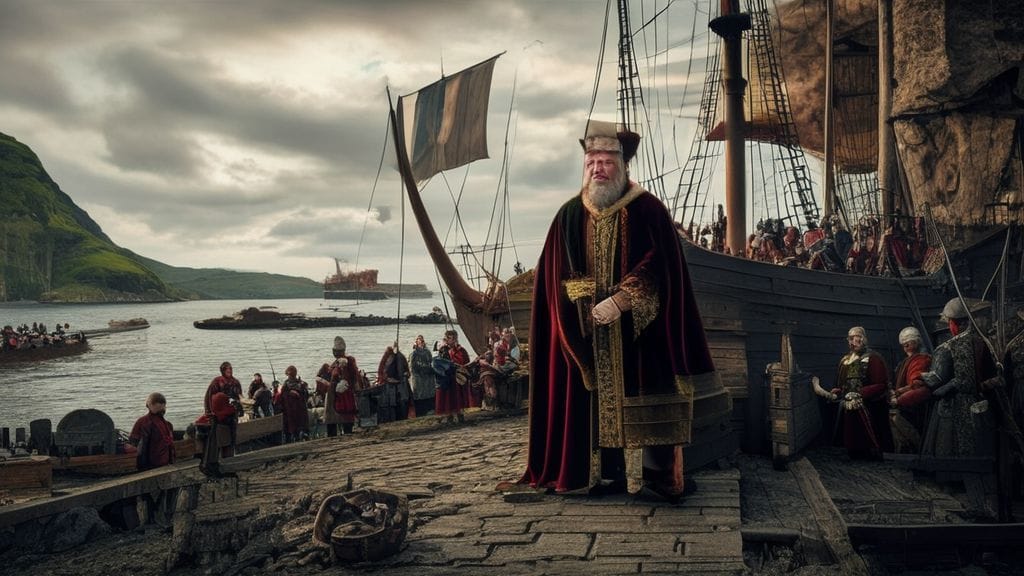
Try to picture the morning itself. The sky above Wexford is streaked with low, fast-moving clouds, the light wavering between grey and muted gold as the sun struggles through. The smell of wet earth mixes with sea brine. On the shore, a dense knot of armed men forms a buffer between the royal household and the rest of the world. Beyond them, townsfolk and travelers cluster in small groups, craning their necks for a glimpse of the king’s party.
Henry moves with a determined briskness. He is in his late thirties, still vigorous, his hair already thinning but his eyes sharp. In his cloak he carries the chill of the morning, but also the weight of unfinished business—from the unresolved conflicts among his sons to the still-raw wound of Becket’s martyrdom. As henry ii departs ireland, he is not leaving behind a conquered land in the model of a Roman province. Instead, he is stepping away from a delicate, partially improvised framework of power and obligation that will require constant attention from afar.
Nearby stand the great lords who will remain to implement that framework: Strongbow, whose fortunes now rest on his ability to hold Leinster not as an almost independent conqueror, but as a vassal tightly bound to royal favor; Hugh de Lacy, who will soon receive the lordship of Meath and begin planting castles on the central plains; and other captains whose names are less familiar but whose local actions will determine daily life for many Irish communities. To them, the king’s departure is both a test and an opportunity. They will no longer live under his immediate gaze, but neither will they be able to plead ignorance of his wishes.
Voices carry across the water: orders shouted by shipmasters, the groan of oars aligning, the flapping of canvas. Henry pauses, perhaps, to exchange a final word with an Irish cleric or noble who has come to see him off. The chroniclers do not record these last conversations, but they must have been charged with a mix of hope, fear, and calculation. Some may have thought that once henry ii departs ireland, the pressure of English power would slacken. Others sensed, more accurately, that this was only the first act in a longer, more grinding engagement.
At last, the king boards his ship. Gangplanks are pulled away; the vessel edges from the quay. For a moment, the harbor holds its breath. Then, as the wind catches the sails, the royal standard leans into the sky, and the ship begins to move more confidently toward open water. One by one, the accompanying vessels follow, until the harbor that had for months been crowded with royal ships empties out, leaving only a few stragglers and the everyday traffic of local traders. The line of hulls recedes toward the horizon, their masts shrinking against the shifting light. The moment henry ii departs ireland passes into memory, leaving behind an unsettled silence on the quayside.
After the Sails Vanish: Anglo-Norman Lords and the Irish Response
As soon as the royal sails vanish into the mist, Ireland shifts subtly into a new phase. The immediate awe inspired by Henry’s presence begins to fade, and with it the restraining force that had, however imperfectly, held Norman ambition and Irish resistance in check. Now the island belongs—practically, if not legally—to those who remain: the barons, bishops, and chieftains who must navigate a reality in which appeals to the distant king must cross a stormy sea.
For Strongbow, the stakes are high. He must secure Leinster in the king’s name, pacifying local opposition while avoiding the appearance of carving out too independent a domain. For Hugh de Lacy, Meath offers both opportunity and danger. His building of castles, often of earth and timber hastily thrown up and then strengthened, marks the landscape with new nodes of authority. These fortresses, rising from the earth like blunt, angular hills, signal to nearby Irish communities that a new pattern of control is settling in, one that claims permanence even as it relies on vulnerable garrisons.
The Irish response varies region by region. Some kings who had submitted to Henry remain cautiously cooperative, testing how committed the absent monarch is to honoring promises made at Dublin or Waterford. Others, emboldened by his departure, begin probing the Normans’ defenses, raiding outposts or encouraging local resistance. The high king Ruaidrí remains a pivotal figure, his capacity to coordinate opposition hampered by the same centrifugal forces that had always plagued Irish high kingship.
Disputes flare along borders where land has changed hands. Farmers find their fields subject to new rents or obligations, administered by stewards who speak French or English rather than Irish. Monasteries negotiate with both sides, trying to preserve their lands and privileges. Stories begin to circulate of harsh treatment, of broken agreements, of acts of courage and betrayal in equal measure. In this turbulent environment, the memory of the winter months of 1171–1172—when Henry himself had walked among these towns and strongholds—takes on a new hue. As one later chronicler might have summarized it, with a hint of grim irony: “While the king was in Ireland, there was a semblance of peace; after he left, each man sought his own advantage.”
From Wexford to Winchester: A King’s Return to European Diplomacy
For Henry, the voyage from Wexford was not an ending but a transition. The problems awaiting him in England and on the Continent were urgent and complex. The Becket affair still demanded resolution; his sons—Henry the Young King, Richard, Geoffrey, and John—were growing into ambitious men likely to chafe under their father’s control. The French king, Louis VII, ever watchful for weakness, stood ready to exploit any hint of discord within the Angevin dominions.
By the time Henry’s ships made landfall in Wales or England, he was already mentally shifting focus. The Irish campaign had given him several things he badly needed: a public role as reforming monarch in a land portrayed as needing order, a tangible demonstration of obedience to papal designs, and an assertion of control over freebooting barons who might otherwise have created a semi-independent power. Now these gains had to be converted into diplomatic capital. Within months, he would negotiate terms with Pope Alexander III to resolve the Becket crisis, culminating in his dramatic penance at Canterbury in 1174, when he submitted to scourging at the shrine of the murdered archbishop.
Yet Ireland did not disappear from his agenda. Reports from his officials and barons filtered back, detailing both progress and problems: a town secured, a rebellion flaring, a castle begun or destroyed. The machinery of Angevin government, though stretched, could process such information, issuing commands and confirmations, though always at a distance. The royal court—perhaps assembled at Winchester, or Rouen, or another of Henry’s favored centers—would periodically turn its attention west, adjusting grants, resolving disputes, or planning further interventions.
In this way, the moment when henry ii departs ireland becomes a hinge between two stages of his reign: the crisis-driven, reputation-conscious monarch seeking to repair his standing after Becket, and the older, more embattled king who, in the 1170s and 1180s, would face rebellion from his own sons and pressure from the Capetian crown. Ireland, while never the central theater of his rule, remained a persistent, sometimes troublesome, frontier in his broader strategy—a frontier first personally touched in 1171–1172 and then mostly managed at arm’s length after he sailed away from Wexford.
Torn Clans and New Castles: Social Change in the Shadow of the Departure
The long-term consequences of Henry’s brief sojourn, and particularly of his departure, were most deeply felt not in royal courts but in the daily lives of people on the ground. Over the following decades, the Anglo-Norman presence solidified in certain regions, transforming patterns of landholding, justice, and social hierarchy. New families, often descended from the original wave of adventurers, took root alongside older Gaelic lines, sometimes intermarrying, sometimes clashing violently.
On territories directly under English influence, manorial structures began to appear. Fields were reorganized, rents and dues recalibrated. Peasants—some Irish, some newly arrived settlers from England or Wales—found themselves bound by legal concepts drawn from the king’s courts rather than from Brehon custom. Markets grew in importance, their rhythms set by regional and transnational trade. In the towns, especially Dublin and Waterford, an urban culture took shape that mingled languages and customs, though native Irish often found themselves excluded from full civic rights in favor of the “English” community.
In more remote regions, the impact was uneven, filtered through local accommodations and resistance. Some Irish lords became, effectively, frontier princes, negotiating between the king’s representatives and their own kin-groups. Others were pushed back into less fertile lands, their authority eroded by encroaching castles and parish boundaries. Poetry and oral tradition preserved a sense of loss and grievance, remembering a time before foreign rule when, in idealized form, each tuath (territory) ordered its own affairs. Centuries later, when Irish chroniclers looked back on the twelfth century, the moment when henry ii departs ireland was often framed as the moment when colonization truly began to crystallize. As one seventeenth-century writer paraphrased earlier sources, England’s king had come “under pretence of reforming religion, but with intent to conquer the land.”
Social changes also rippled through the church. Some monasteries benefited from royal and baronial patronage, receiving endowments and new stone buildings. Others saw their independence curtailed as diocesan structures tightened and links to English ecclesiastical authority deepened. Education, manuscript production, and liturgical practice all felt the pull of this new orientation. The island’s old monastic networks, which had once looked primarily to their own traditions and to connections with Scotland and the Continent, increasingly interacted with a church system whose hierarchy and law were shaped in Canterbury, York, and Rome, mediated through the person of a foreign king.
Remembering and Forgetting: How Chronicles Framed the Irish Venture
Our knowledge of Henry’s Irish campaign and his departure from Wexford comes largely from a handful of chroniclers, each with their own perspective and agenda. Gerald of Wales, for example, wrote with the zeal of a man who saw in Ireland a field for English reforming energy and Norman martial glory. His “Topographia Hibernica” and “Expugnatio Hibernica” mix ethnographic curiosity, blunt prejudice, and heroic narrative, casting Henry’s intervention as part of a wider civilizing mission. In Gerald’s telling, the moment when henry ii departs ireland is not a retreat but a confident withdrawal of a sovereign who has successfully imposed order.
Other sources, such as the annals compiled by Irish monastic communities, offer a more laconic but telling view. They record landings, battles, submissions, and deaths with a terse economy, often placing the Irish perspective—the fall of kings, the loss of territories—at the center. Where Gerald might dwell on a royal ceremony or the virtues of Norman knights, the annals might simply note: “This year the foreigners came to such a place, and a king was expelled, and many were slain.” Between these brief entries, however, we can read an undercurrent of anxiety and sorrow.
English royal chroniclers like Roger of Howden framed Henry’s Irish sojourn within the broader narrative of his reign, linking it to the Becket crisis and to his efforts to maintain control over his sprawling domains. For them, the Irish chapter was significant but not dominant—a subplot in the larger drama of Angevin politics. When they mention that henry ii departs ireland in 1172, it is often as one event among many, noted alongside diplomatic missions and internal reforms.
This layering of perspectives matters. History, after all, is not only what happened but how it was remembered and recorded. The relatively short period of Henry’s direct presence in Ireland acquired symbolic weight because later generations—Irish and English alike—looked back on it as the hinge between two eras: one in which Irish kings still largely controlled their own destinies, and another in which foreign lordship grew increasingly pervasive. The harbor at Wexford, rarely mentioned in sweeping political narratives, becomes a focal point when we try to ground these abstract shifts in concrete human experience.
Echoes Through Centuries: Colonial Precedent and the Idea of Empire
In retrospect, historians have often treated Henry’s Irish adventure as the opening act of a much longer story: the English—and later British—domination of Ireland. The structures put in place around 1171–1172 were rudimentary and sometimes fragile, but they created precedents. A king of England had now claimed overlordship over Irish rulers, had granted lands in Ireland to his barons, and had integrated parts of the island into his legal and ecclesiastical orbit. These claims would be invoked, expanded, and contested over the following centuries.
When later English monarchs sought to tighten their grip on Ireland—think of Edward I in the thirteenth century, or the Tudor monarchs in the sixteenth—they could look back to Henry II’s charters and the papal bulls as a kind of legal and moral warrant. The idea that England had a rightful, even divinely sanctioned role in “reforming” and “ordering” Ireland took root here, in the narrative frames crafted by men like Gerald of Wales and in the diplomatic correspondence between kings and popes. Even when the reality on the ground bore little resemblance to orderly governance—when Anglo-Norman lords fought each other, when Irish resistance flared, when royal authority on the western fringe weakened—the theoretical claim persisted.
From a broader perspective, Henry’s departure from Wexford in 1172 can be seen as a moment of early imperial projection. His dominions already stretched across large swathes of Western Europe, but Ireland represented a different kind of frontier: an island neighboring his core territories yet culturally and politically distinct. By intervening there, installing loyal lords, and then withdrawing his person while maintaining his claims, Henry tested a model that would become familiar in later empires: direct conquest followed by indirect rule, mediated through local elites and transplanted settlers.
The resonance of this moment for later Irish history is profound. Debates about sovereignty, legitimacy, and colonization have often looped back to the twelfth century, to Diarmait’s appeal for help, to Strongbow’s marriage, to Henry’s landings and his subsequent withdrawal. Modern scholars, sifting through these layers of memory and myth, continue to argue over the exact nature of the papal authorization, the extent of Henry’s control, and the experiences of ordinary Irish people in the shadow of these large events. Yet on one point there is broad agreement: when henry ii departs ireland from Wexford, he leaves behind not a settled province, but an unresolved, contested, and deeply consequential new relationship between two islands.
On the Quayside of History: Imagining the Human Drama of Wexford
History often focuses on kings and battles, charters and synods. But to fully grasp the meaning of Henry’s departure, it is worth returning once more to the quayside at Wexford and imagining the smaller lives caught up in that moment. Consider a local fisherman, whose family has plied these waters for generations. To him, the king’s visit has meant better prices for fish when the royal kitchens were well supplied, but also disruptions: commandeered boats, restrictions on access to certain parts of the harbor, foreign soldiers with strange accents crowding the taverns.
As the royal ships pull away, he might feel a flicker of relief. Perhaps trade will normalize; perhaps the taxes and requisitions will ease. But he has also heard tales of new laws, of English lords claiming rights along the coast, of displaced Irish families seeking refuge. The emptying of the harbor does not erase these tensions; it merely shifts their center of gravity inland, into the fields and forests where new castles are rising.
Or think of an Irish cleric—a young monk from a nearby monastery—standing a little way back from the press of the crowd, his woolen habit damp from the sea spray. He has copied Latin texts that speak of the obedience due to kings and the spiritual authority of Rome. At the synod, perhaps, his abbot supported closer alignment with the wider church, seeing in Henry a protector against local warlords who had threatened monastic lands. Now, as henry ii departs ireland, the monk wonders: will those promises be kept? Will the royal writs that guarantee his monastery’s holdings be worth the parchment they are written on once the king is across the sea?
Among the Norman knights, too, there is a spectrum of feeling. One man, second son of a minor lord in Wales, has found in Ireland the chance to hold land of his own. He watches the ships leave with a sense of exhilaration: with the king gone, the game is more dangerous but also more open. Another, older and war-weary, feels only dread. He has seen frontiers before, knows how quickly they can erupt into violence, and suspects that the real struggle is just beginning. The king’s departure, for him, is not a triumphal closing chapter but the opening of a more uncertain, less glorious story.
Even Henry himself, had he looked back at the shrinking line of the Irish coast, might have felt a complex mix of satisfaction and nagging concern. He had achieved what he came to do—assert royal supremacy, tame his barons, curry favor with the church. Yet he must have known that none of this was secure. The world he ruled was one of constant motion, where loyalty and power were always in flux. As Wexford faded into the distance and the spray soaked the ship’s rails, perhaps he thought briefly of the oaths sworn in dark halls, the winter rains over Dublin, the anxious faces of Irish kings weighing submission against defiance. Then, perhaps, he turned his mind to the next council, the next rebellion, the next negotiation with a pope or a prince. Such was the life of an Angevin king: always departing, always arriving, never fully at rest.
Conclusion
The departure of Henry II from Wexford in April 1172 was a relatively brief episode in a long and tumultuous reign, but its significance far exceeded its duration. In the few months before henry ii departs ireland, the king had inserted himself into a complex web of Irish politics, Norman ambition, and ecclesiastical reform. He had turned a series of private ventures by barons into a royal project, claimed overlordship over Irish kings, and presented himself to the papacy as a reformer and protector of the church. Yet the settlement he left behind was provisional, contested, and unevenly enforced, dependent on the loyalty of men whose interests did not always align with his own.
The moment the royal fleet slipped away from Wexford’s harbor crystallizes the ambiguous nature of this new relationship between England and Ireland. For the Anglo-Norman lords, it was a signal that they now bore the burden of holding and expanding their territories without the immediate presence of the king. For Irish rulers and communities, it was both a respite from overwhelming royal power and a harbinger of deeper entanglement, as foreign structures of law, lordship, and ecclesiastical authority continued to take root. Over time, this moment would be reinterpreted by chroniclers and historians as the starting point of colonization, the genesis of centuries of conflict and negotiation between two unequal neighbors.
Seen against the wider canvas of Henry’s life, the voyage from Wexford marks a turning point between his crisis over Becket and the later rebellions of his sons and vassals. It also reflects a broader medieval pattern: the extension of royal authority into new frontiers through a combination of military force, legal innovation, and religious justification. In that sense, the scene at Wexford belongs not only to Irish or English history but to the history of European statecraft and early imperialism. To stand imaginatively on that quayside is to witness the birth of a relationship that would shape the destinies of millions. The king’s ship sails away, the harbor quiets, but the wake it leaves behind continues to ripple through the centuries.
FAQs
- Why did Henry II decide to intervene in Ireland in the first place?
Henry II intervened in Ireland for a combination of strategic, political, and religious reasons. He wanted to prevent Anglo-Norman barons like Strongbow from creating an independent power base that could threaten his authority, and the fragmented Irish political landscape made such a project tempting. The papal bull Laudabiliter gave him a theoretical mandate to “reform” the Irish church and align it more closely with Roman and English practices, which he could present as a pious motive. After Thomas Becket’s murder, Henry also needed to repair his standing with the papacy, and leading a reforming mission in Ireland helped him project the image of a penitent, church-friendly monarch. - What exactly happened when Henry II departed from Wexford in April 1172?
Henry’s departure from Wexford marked the end of his personal presence in Ireland after several months spent consolidating royal control. He had received submissions from Irish kings, confirmed and limited the gains of Anglo-Norman barons, taken key ports like Dublin and Waterford into royal hands, and overseen the reforming Synod of Cashel. In April 1172, he embarked with his household and a portion of his army, leaving trusted lieutenants such as Strongbow and Hugh de Lacy to enforce his policies. The departure was not a retreat from defeat but a deliberate withdrawal once he felt his immediate objectives had been met. - How did Henry’s departure affect the Anglo-Norman lords in Ireland?
For the Anglo-Norman lords, Henry’s departure was both liberation and burden. While he was present, they had been closely supervised and, in some cases, forced to surrender strategic towns directly to the crown. Once he left, they enjoyed greater autonomy in day-to-day affairs but also had to defend and expand their holdings without immediate royal backing. Their fortunes now hinged on their ability to balance aggression and diplomacy with local Irish rulers, and on maintaining favor with a king who ruled from across the sea. The years after 1172 saw both consolidation of their territories and periodic crises as local resistance and inter-baronial rivalries flared. - Did Irish rulers willingly accept Henry II’s overlordship?
Irish responses varied. Some rulers, facing local enemies or Norman pressure, saw advantage in acknowledging Henry as overlord, hoping to use his authority as a counterweight. Others offered submission reluctantly, judging resistance impossible while the king’s army was on the island. A few remained openly hostile or largely unaffected in remote areas. In many cases, homage to Henry was a tactical move rather than wholehearted acceptance; once henry ii departs ireland, several Irish leaders tested the limits of these obligations, seeking to reclaim lost ground or renegotiate terms under less intimidating circumstances. - What role did the church play in Henry II’s Irish campaign?
The church was central to both the justification and the implementation of Henry’s campaign. The papal bull Laudabiliter and its later confirmations framed his intervention as a reforming mission, inviting him to bring Irish religious practice into closer conformity with Roman standards. In practice, this meant convening the Synod of Cashel, promoting clerical celibacy, standardizing marriage and tithe practices, and strengthening diocesan structures. Irish bishops and abbots had to decide whether to align with the foreign king’s reforming agenda or resist encroachment on traditional privileges. Many cooperated, hoping for protection and order, thereby helping embed English influence within Ireland’s ecclesiastical infrastructure. - Was Henry II’s time in Ireland a full-scale conquest?
No, Henry’s Irish venture in 1171–1172 was not a complete military conquest of the island. Large parts of Ireland remained under the control of native kings and lords, and there was no single, decisive battle that broke Irish power. Instead, Henry focused on consolidating earlier Norman gains, securing coastal towns, receiving submissions, and establishing a framework of overlordship. His strategy relied on controlling key nodes—ports, lordships, church structures—rather than occupying every region. Only in later centuries, through gradual expansion and renewed campaigns, did English control push deeper into the island. - How did Henry’s actions in Ireland connect to the Thomas Becket affair?
Henry’s Irish policy was shaped by his need to recover from the scandal of Thomas Becket’s murder. By presenting his intervention as a response to papal approval and a vehicle for church reform, he could demonstrate obedience to Rome and a commitment to ecclesiastical order. The Synod of Cashel and his respectful treatment of Irish bishops helped create a narrative of the king as a reforming Christian monarch rather than a persecutor of churchmen. Later, when he performed public penance at Becket’s shrine, the Irish episode formed part of the broader story of his attempts at reconciliation with the church. - What long-term impact did Henry II’s departure have on Irish-English relations?
Henry’s departure did not end English involvement in Ireland; it formalized and legitimized it. His claims of overlordship, the grants he made to his barons, and the church reforms he endorsed created precedents that later English kings used to justify deeper intervention. Over the centuries, these early structures evolved into more entrenched forms of colonial rule, contributing to cycles of conquest, plantation, and resistance. The memory of this foundational moment—when a powerful foreign king came, imposed a new order, and then returned across the sea—became embedded in Irish historical consciousness as the origin point of a fraught and unequal relationship.
External Resource
Internal Link
Other Resources
- Encyclopaedia Britannica – general search for the exact subject
- Google Scholar – academic search for the exact subject
- Internet Archive – digital library search for the exact subject

