Table of Contents
- The Deadly Awakening: Hibok-Hibok’s Fiery Roar in 1951
- The Island of Camiguin: A Volcanic Heart in the Philippines
- A Sleeping Giant: Geological and Historical Background
- The Calm Before the Storm: Life on Camiguin Before the Eruption
- Early Warnings: Nature’s Foreboding Signs
- November 1951: The Day the Mountain Roared
- The Initial Blasts: Shattering the Quiet of Camiguin
- The Ash and Steam: Transforming the Landscape and Lives
- The Horror Unfolds: Lava, Pyroclastic Flows, and the Death Toll
- Communities in Peril: The Struggle for Survival
- Human Stories from the Ashes: Courage, Loss, and Resilience
- Government and Scientific Response: Emergency Measures and Research
- The Aftermath: Economic and Social Devastation
- Rebuilding Amid Ruins: The Road to Recovery
- Long-term Impact on Camiguin’s Environment and Inhabitants
- Hibok-Hibok in Philippine Volcanic History: Lessons Learned
- Global Perspectives: Influence on Volcanology and Disaster Preparedness
- Oral Traditions and Memory: How Hibok-Hibok Lives On
- The Myth and Reality of Volcanic Power
- Epilogue: Hibok-Hibok Today—A Mountain of Contrasts
- Conclusion: Nature’s Fury and Human Endurance
- FAQs: Understanding the Hibok-Hibok Eruption
- External Resource
- Internal Link
The Deadly Awakening: Hibok-Hibok’s Fiery Roar in 1951
The morning of November 10, 1951, was etched forever into the soul of Camiguin—an island cradled in the warm seas of the Philippines. What began as a mild rumble beneath the earth’s crust swiftly escalated into a devastating eruption from Hibok-Hibok volcano, shaking the very foundations of this peaceful community. The air grew thick with ash, day turned abruptly into night, and once-fertile fields were buried under searing lava and choking clouds. For thousands, life changed irreparably in moments that blurred fear, awe, and desperation. This was nature’s unyielding reminder: even the gentlest lands may harbor sleeping giants.
The Island of Camiguin: A Volcanic Heart in the Philippines
Nestled north of Mindanao, the compact island of Camiguin is famed for its natural beauty and tranquil existence. Known as the “Island Born of Fire,” it is dotted with seven volcanoes, of which Hibok-Hibok is the youngest and most feared. For centuries, this volcanic island sustained vibrant communities, whose way of life was intimately tied to the fertile soils nourished by past eruptions. But the island’s volcanic history was a double-edged sword—a generator of prosperity and destruction.
A Sleeping Giant: Geological and Historical Background
Hibok-Hibok had long slumbered, its last known eruption recorded in the 19th century. The volcano is part of the Pacific Ring of Fire, the notorious horseshoe-shaped zone where tectonic forces produce some of the most violent eruptions on Earth. The island’s geology is dominated by andesitic to dacitic lava flows and explosive activity, a type known for sudden and catastrophic events. Although local folklore told stories of monstrous fires and molten rivers, the modern scientific community viewed Hibok-Hibok as dormant but active, a volcano that had potential but had been quiet long enough to lull residents into complacency.
The Calm Before the Storm: Life on Camiguin Before the Eruption
In the decades preceding 1951, Camiguin was a patchwork of coastal villages and agricultural communities reliant on coconut farming, fishing, and small-scale cultivation. Life moved at an unhurried pace. The volcanic soil was rich, enabling abundant harvests. Villagers held festivals celebrating both faith and nature, unaware that this peace was fragile. Warnings from the mountain’s whispers—small tremors and steam emissions—were often dismissed or misunderstood as routine behavior of the sleeping volcano.
Early Warnings: Nature’s Foreboding Signs
As early as mid-1951, subtle signs hinted at the volcano’s restlessness. Earthquakes became more frequent and severe, rattling windows and unsettling livestock. Warm steam began to vent from fumaroles on the mountain’s slopes, and the sulfurous smell permeated the air. Some villagers recalled witnessing strange rumblings or feeling the ground pulse beneath their feet. Yet, despite these ominous warnings, official attention was limited. The Philippines’ post-war government was preoccupied with reconstruction following World War II, and volcanology as a science was still developing.
November 1951: The Day the Mountain Roared
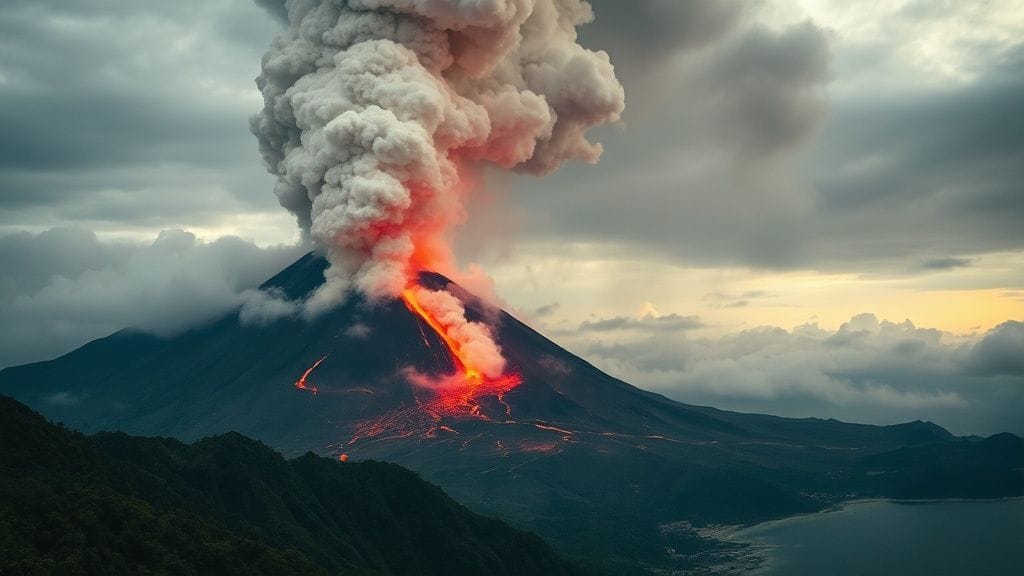
Then came November. The earth’s trembling became violent. On the 10th, Hibok-Hibok erupted with a ferocity that captured the attention of the entire archipelago. Explosions blasted ash and rocks kilometers into the atmosphere, darkening skies and blotting out the sun. Fierce pyroclastic flows surged down the slopes, incinerating everything in their path. The eruption was not a single event but a series of powerful blasts punctuated by lava fountains and torrents. It was as if the volcano had unleashed decades of pent-up rage—and the island was caught in the crossfire.
The Initial Blasts: Shattering the Quiet of Camiguin
Eyewitnesses recounted the volcanic blasts as ear-splitting and terrifying. Windows shattered; homes trembled on their foundations. Villagers fled, some caught unprepared, others making desperate attempts to save livestock and belongings. Ash began to fall like black snow, covering roofs and fields. Roads were blocked, cutting off communication and isolating communities. For many, the mountain had become a monstrous presence—unpredictable and unstoppable.
The Ash and Steam: Transforming the Landscape and Lives
Within days, eruptions rained down tons of volcanic ash, blanketing Camiguin in a thick, suffocating layer. Villages became ghost towns submerged under debris. Wells and streams became polluted with sediments and chemicals, threatening freshwater supplies. Agriculture— the lifeblood of the island—was devastated. The fiery steam from fissures hissed ominously, a reminder that the empire of fire was not yet spent. The landscape was carved anew, reshaped by the volcano’s dynamic power.
The Horror Unfolds: Lava, Pyroclastic Flows, and the Death Toll
The aftermath was grim. Pyroclastic flows, hot avalanches of gas and ash capable of obliterating entire villages, accounted for much of the heavy death toll. Estimates vary, but hundreds perished in the eruption, and countless others were injured or displaced. Entire communities vanished or had to be abandoned. For survivors, the eruption was more than a natural disaster; it was a profound trauma, imprinting itself on memory as a nightmare etched in stone and ash.
Communities in Peril: The Struggle for Survival
Those who survived faced immediate challenges: shelter, food, clean water, and medical care. The eruption had destroyed crops and residences alike, pushing many toward starvation and disease. Relief efforts were hampered by the island’s isolation and the ongoing volcanic activity. Families were torn apart, and entire social networks were disrupted. Yet amid devastation, there were acts of remarkable courage—neighbors sharing what little they had, elders guiding the young, and communities coming together to rebuild fractured lives.
Human Stories from the Ashes: Courage, Loss, and Resilience
Accounts from survivors reveal the profound human dimensions of the crisis. One woman described carrying her children through ash-laden forests, her feet blistered and bleeding but her will unbroken. Another recounted how a local priest held masses amid the ruins, offering solace and hope. These stories elevate the disaster beyond statistics and geology, rendering it a testament to human endurance in the face of nature’s fury.
Government and Scientific Response: Emergency Measures and Research
The Philippine government, though initially slow to respond due to post-war resource constraints, eventually mobilized the military and civil defense teams to assist survivors and establish evacuation points. Scientific teams were dispatched to study Hibok-Hibok’s activity, leading to enhanced monitoring techniques and renewed focus on volcanic hazards in the region. These efforts laid groundwork for future disaster preparedness, fostering collaboration between local communities and scientists that would prove vital during subsequent eruptions.
The Aftermath: Economic and Social Devastation
Economically, the eruption was a catastrophe. Coconut plantations, once the backbone of Camiguin’s economy, were decimated. Fisheries were disrupted by sediment-laden waters. Infrastructure needed to be rebuilt from scratch, straining already thin government budgets. Socially, communities struggled to maintain cohesion amid displacement and loss. Migration from the island increased, and demographic shifts altered the island’s future trajectory.
Rebuilding Amid Ruins: The Road to Recovery
Recovery was a slow and painful process. Reforestation efforts began to restore slopes vulnerable to erosion. New housing developments emerged on safer grounds. Agricultural programs introduced resilient crop varieties. Schools and churches were reconstructed, symbolizing the rebirth of communal life. The resilience of Camiguin’s people, their deep connection to the land, and the lessons learned from the eruption forged a cautious respect for the island’s volatile nature.
Long-term Impact on Camiguin’s Environment and Inhabitants
The environmental scars of the 1951 eruption persisted for decades. Soil composition changed, hydrology was altered, and some areas remained barren. Yet, ecological succession eventually restored much of the vegetation, and wildlife adapted to the new landscape. Culturally, the eruption entered local folklore, shaping festivals, oral histories, and identity. For many, Hibok-Hibok became both a symbol of destruction and a source of spiritual reverence.
Hibok-Hibok in Philippine Volcanic History: Lessons Learned
The eruption of 1951 marked a turning point in how the Philippines approached volcanic hazards. It underscored the need for improved monitoring, public education, and emergency planning. The Disaster Preparedness system gradually evolved, informed by the painful lessons of Hibok-Hibok. In hindsight, the catastrophe was a brutal but necessary catalyst for modernization in volcanic risk management.
Global Perspectives: Influence on Volcanology and Disaster Preparedness
Internationally, the eruption contributed valuable data to the science of volcanology. It illustrated how island communities with limited infrastructure are particularly vulnerable to volcanic calamities. The Hibok-Hibok event influenced broader discussions on disaster resilience, early warning systems, and the integration of traditional knowledge with scientific approaches, resonating far beyond Philippine shores.
Oral Traditions and Memory: How Hibok-Hibok Lives On
Years after the eruptions, stories pass down from survivor to child—legends of the mountain’s fury, the ash that fell like darkness, and the spirits who dwell in the fiery depths. These oral histories help communities cope and create meaning from suffering. They shape cultural identity and preserve memory, reminding future generations of the delicate dance between life and the volatile Earth beneath.
The Myth and Reality of Volcanic Power
Hibok-Hibok’s eruption stands as a dramatic reminder that natural forces defy human control. Volcanoes embody paradox: creators of life through fertile soils and destroyers through violent explosions. Understanding this duality pushes humanity to strike a balance—a respect for nature’s power coupled with scientific vigilance and social solidarity.
Epilogue: Hibok-Hibok Today—A Mountain of Contrasts
Today, Hibok-Hibok reposes quietly, yet vigilant sensors and watchful eyes monitor every tremor. Camiguin thrives with tourism drawn by its dramatic landscapes and warm people. The story of 1951 endures as a lesson and memorial—a story of tragedy transformed into hope, of destruction woven into resilience. The mountain stands, a somber witness to history, reminding us that beneath every calm horizon lies the potential for profound change.
Conclusion
The Hibok-Hibok eruption of 1951 was more than a geological event; it was a profound human drama played out on the rugged stage of Camiguin Island. It revealed the fragility of life amidst natural splendor and the courage embedded in the human spirit. From the depths of darkness and ash rose a renewed understanding—of both the power of the earth and the resilience of those who inhabit it. Today, as we reflect on that fiery chapter, we are reminded that history is not merely a record of destruction but a source of enduring lessons, hope, and the unyielding desire to rebuild.
FAQs
Q1: What caused the 1951 Hibok-Hibok eruption?
The eruption was caused by increased volcanic activity from the Hibok-Hibok volcano, driven by tectonic movements along the Pacific Ring of Fire, which created pressure in the magma chamber leading to explosive eruptions.
Q2: How many people died during the eruption?
Estimates vary, but it is believed that several hundred people lost their lives due to pyroclastic flows, ashfall, and related hazards during the 1951 eruption.
Q3: Were there any early warnings before the eruption?
Yes, there were signs such as increased seismic activity, steam emissions, and ground deformation, but limited scientific monitoring and awareness meant warnings were not adequately acted upon.
Q4: How did the eruption affect the local economy?
The eruption severely damaged agriculture, especially coconut plantations, contaminated water sources, and disrupted fishing activities, leading to long-term economic hardship.
Q5: What was the government’s response to the disaster?
The post-war Philippine government eventually deployed emergency relief, military assistance, and sent scientific teams to monitor the volcano and aid recovery efforts, though initial response was challenged by resource constraints.
Q6: Why is Hibok-Hibok significant in Philippine volcanic history?
It highlighted the need for improved volcanic monitoring, risk education, and disaster preparedness, influencing future policies and scientific research in the Philippines.
Q7: How do local communities remember the eruption today?
Through oral histories, folklore, and cultural practices, communities keep the memory alive, using it as both a cautionary tale and a symbol of resilience.
Q8: What impact did the eruption have on volcanic science?
Hibok-Hibok’s eruption provided crucial data on andesitic explosive eruptions, contributing to better understanding of volcanic hazards and prompting development of early warning systems worldwide.

