Table of Contents
- A Chilling Dawn: January 30, 1933, Berlin Comes to Life
- The Weimar Republic’s Fraying Edges: Political Turmoil in 1932
- Adolf Hitler: From Outsider to Political Force
- The Großer Fehler: Paul von Hindenburg’s Calculated Risk
- Behind Closed Doors: The Machinations of Berlin’s Elites
- Propaganda and Promise: The Nazi Narrative Before Seizure of Power
- Storm Clouds Gather: The Reichstag and Political Violence
- The Appointment Day: A Moment Frozen in Time
- Reaction in Berlin: The City’s Pulse After the Announcement
- The International Stage: Responses from Abroad
- The First Days of Power: Hitler’s Early Moves as Chancellor
- The Enabling Act Looms: From Chancellor to Dictator
- Political Opponents Silenced: The Fall of Democracy
- Society Under Siege: The Jewish Community and Other Minorities
- The Myth of Legitimacy: Hitler’s Legal Path to Total Control
- Economic Hopes and Reality: Germany’s Struggle with Depression
- Culture Under the Swastika: Art, Media, and Censorship
- The Long Shadow: How January 30 Reshaped the 20th Century
- Remembering the Day: Collective Memory and Historical Debate
- Lessons from Berlin: Democracy’s Fragility in Dark Times
- Conclusion: The Price of Political Miscalculation
- FAQs: Understanding Hitler’s Appointment and Aftermath
- External Resource
- Internal Link
1. A Chilling Dawn: January 30, 1933, Berlin Comes to Life
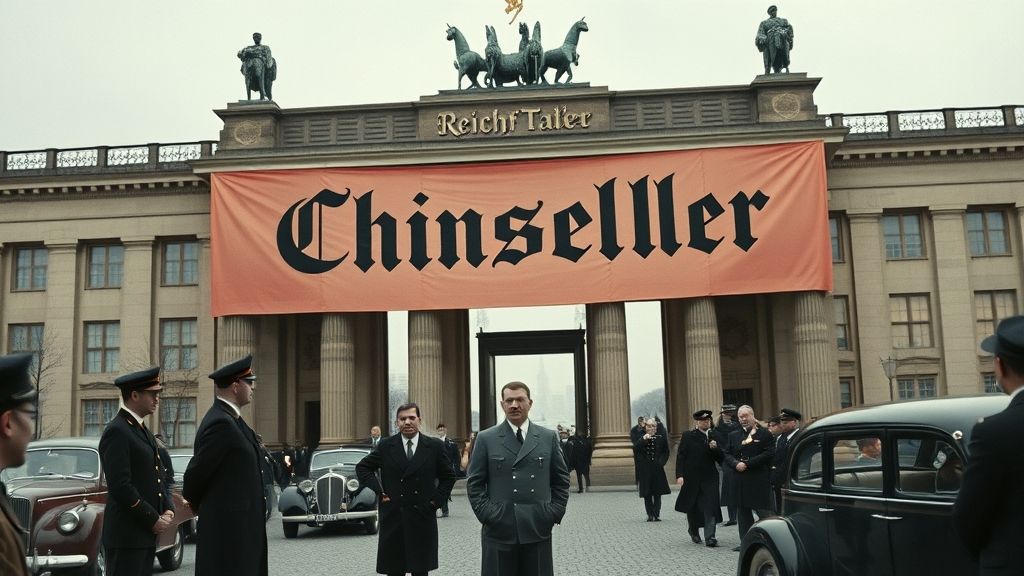
Berlin wakens on a pale, cold January morning. The grey skies hang low, shadows creeping across the cobbled streets like ghosts of the past. It was 8:00 a.m. when Adolf Hitler, a man once dismissed by many as a fringe agitator, touched the threshold of the Reich Chancellery. The towering building, heart of German executive power, would soon echo with footsteps that would plunge the nation—and the world—into an abyss.
The air was thick with anticipation and dread, yet few could grasp the magnitude of this moment. In these silent dawn hours, the slow fracture of a fragile democracy solidified into a terrifying reality. Berlin did not yet know it, but the Republic it revered was on its deathbed.
2. The Weimar Republic’s Fraying Edges: Political Turmoil in 1932
Germany in early 1933 was a land of contradictions. The Weimar Republic, born from the ashes of the First World War and the abdication of Kaiser Wilhelm II, was an ambitious experiment in democracy. Yet by the early 1930s, it teetered on the brink.
The Treaty of Versailles had left fresh wounds—deep economic hardship, national humiliation, and polarized political factions. The Great Depression plunged millions into unemployment, despair, and radicalized politics. Paralyzed governments gave way to ineffective chancellors; the Reichstag became a battleground of ideologies.
Coalition governments dissolved, extremist parties surged. The Communists on the left and the Nazis on the right repelled moderation with venomous hatred. The Weimar Constitution’s promise of democratic stability was being shredded by political violence and public disillusionment. In late 1932, the nation was desperate for a savior—or something that looked like one.
3. Adolf Hitler: From Outsider to Political Force
Adolf Hitler, born in Braunau am Inn in 1889, had risen from relative obscurity. A failed artist turned charismatic orator, he cultivated a narrative of German rebirth. His National Socialist German Workers’ Party (NSDAP) blended fierce nationalism, anti-Semitism, and anti-communism with promises of revival.
Once a crumbling fringe, the Nazi Party capitalized on economic desperation and fear of communism. In the July 1932 Reichstag elections, it became the largest party—yet without a majority. Hitler’s fiery rhetoric electrified crowds but alienated many elites and moderates. He was still seen by many as a hothead, a demagogue dangerous but manageable.
Yet beneath this facade, Hitler’s shadow grew long. His ability to manipulate mass media, harness paramilitary violence through the Sturmabteilung (SA), and project himself as the embodiment of Germany’s future became increasingly undeniable.
4. The Großer Fehler: Paul von Hindenburg’s Calculated Risk
The conservative President Paul von Hindenburg, a World War I hero and towering figure of the old order, held the power to appoint the Chancellor. For months, he resisted Hitler. The military and aristocratic elites feared the Nazi leader’s instability and ideological threats.
Instead, Hindenburg appointed a series of short-lived chancellors—Heinrich Brüning, Franz von Papen, Kurt von Schleicher—none able to restore calm or command parliamentary majorities. As the political vacuum widened, pressure mounted.
Von Papen, a wheeler-dealer with aristocratic connections, devised a plan: if Hitler could be co-opted, controlled within a cabinet of conservative ministers, he could be tamed and used to stabilize the country. This gamble was what many now call the “Großer Fehler” — the great mistake.
5. Behind Closed Doors: The Machinations of Berlin’s Elites
The weeks leading to January 30 were filled with secret meetings and pact-making in the opulent chambers of Berlin’s political elite. In whispered conversations, conservative politicians promised that Hitler’s ambitions could be curtailed.
Von Papen famously boasted that he had “Hitler in a bottle,” convinced the man’s vulgar populism could be bottled up and used solely to implement conservative policy.
But Hitler wasn’t fooled. He understood the necessity of legal authority, and the appointment as Chancellor would unlock the machinery he needed—not merely a figurehead role.
6. Propaganda and Promise: The Nazi Narrative Before Seizure of Power
Propaganda had become the heartbeat of the Nazi rise. Joseph Goebbels, Hitler’s masterful but ominous propaganda chief, worked tirelessly to paint Hitler as the nation’s destined leader.
Through potent symbols, rallies charged with emotion, and calculated media campaigns, the Nazis promised to restore German pride, defeat defeated politicians, and create jobs. “Ein Volk, ein Reich, ein Führer” echoed in streets and squares.
This intoxicating message resonated deeply with many citizens—exhausted by years of crisis, fearful of communism, freed from hope.
7. Storm Clouds Gather: The Reichstag and Political Violence
The Reichstag was no longer a house of debate but a battleground. Fistfights broke out between Nazi and Communist deputies. Public violence spilled onto streets with brutal SA clashes. Fear became pervasive.
The Reichstag fire, only weeks later in February 1933, would be a dramatic spark. But even before then, Hitler’s paramilitaries terrorized opponents. The Nazis understood that the façade of legality would only last if they wielded force alongside.
8. The Appointment Day: A Moment Frozen in Time
January 30, 1933, was a bitterly cold day. Shortly before noon, Adolf Hitler was summoned to the Reich Presidential Office at the Berliner Wilhelmstraße. President Hindenburg, stoic and frail, signed the document appointing Hitler as Chancellor.
Historians recount Hitler’s controlled joy and tight composure as he emerged from the building—a man now officially at the summit of power. Crowds gathered; some cheered, others watched in silence, fear, or disbelief.
The press responded with cautious headlines. Yet few grasped the impending storm unleashed.
9. Reaction in Berlin: The City’s Pulse After the Announcement
Berlin’s streets revealed a city divided. Nazi supporters hailed a new beginning; they flooded beer halls and shouted slogans. Yet pockets of resistance simmered beneath the surface.
Workers’ unions, communists, socialists, and many liberals knew they faced a threat to democracy, even if they could not yet fully comprehend its magnitude.
10. The International Stage: Responses from Abroad
News of Hitler’s appointment sent shockwaves beyond Germany. Across Europe, opinions varied from alarm to cautious optimism that the new Chancellor might stabilize Germany.
In Britain and France, political leaders expressed concern but lacked unified response. The United States viewed this as a specter on the horizon but focused inward on its own recovery.
For many, Hitler was yet another unknown factor in an unpredictable European landscape.
11. The First Days of Power: Hitler’s Early Moves as Chancellor
Hitler’s initial cabinet was deliberately small and included conservative ministers who believed they could guide him. But the Führer wasted no time consolidating power.
He quickly forged alliances, demanded loyalty, and began purging political adversaries.
His public speeches grew bolder. The careful veneer of democracy began to crack.
12. The Enabling Act Looms: From Chancellor to Dictator
Less than two months after his appointment, Hitler pushed for the passage of the Enabling Act—a law giving him plenary powers and bypassing parliamentary approval.
The Act passed in March 1933, crushing democratic institutions under legal cover. Opposition parties were banned; dissent was criminalized.
The dictatorship was no longer hidden—it was the new reality.
13. Political Opponents Silenced: The Fall of Democracy
Communists were arrested en masse; socialists fled or were detained. Trade unions were disbanded. The rule of law was replaced by terror.
The Nazi police state—Gestapo and SS—laid the groundwork for systemic oppression that would engulf Germany and beyond.
14. Society Under Siege: The Jewish Community and Other Minorities
The early months saw the inception of policies targeting Jews and minorities—discrimination became legalized persecution. Synagogues were vandalized; careers destroyed.
The social fabric, rich and diverse, began to unravel under ideological hatred.
15. The Myth of Legitimacy: Hitler’s Legal Path to Total Control
Despite the brutal repression, Hitler styled his rule as lawful, framed within constitutional procedures. The Volksgemeinschaft—the people’s community—was preached as inclusive to “true” Germans but violently exclusionary to others.
This legalistic disguise proved devastatingly effective.
16. Economic Hopes and Reality: Germany’s Struggle with Depression
The Nazis promised economic revival. Massive public works, rearmament, and employment programs were launched.
For many Germans, these initiatives offered relief and renewed pride. Yet they were inseparable from militarization and aggressive nationalism that led Europe to catastrophe.
17. Culture Under the Swastika: Art, Media, and Censorship
Artistic expression was commandeered as propaganda. Degenerate art was banned, authors censored, filmmakers directed toward national mythmaking.
The regime’s cultural policy was an instrument of control and indoctrination.
18. The Long Shadow: How January 30 Reshaped the 20th Century
The appointment did not merely change Germany—it altered the course of history. Within a decade, the world was engulfed in war and genocide, whose roots trace directly back to this decision.
The horrors of the Holocaust and the devastation of World War II are bitter legacies born from that Berlin morning.
19. Remembering the Day: Collective Memory and Historical Debate
Over decades, historians have debated responsibility—Hindenburg’s error, conservative elites’ miscalculations, society’s acquiescence.
Germany remembers with solemnity, museums, and education ensuring vigilance against similar darkness.
20. Lessons from Berlin: Democracy’s Fragility in Dark Times
The fall of Weimar underscores how fragile democracy can be when undermined by internal divisions, economic hardship, and extremist ideologies.
The world watches Berlin 1933 as a cautionary tale—how legal procedures can become tools of tyranny and how complacency enables disaster.
21. Conclusion: The Price of Political Miscalculation
January 30, 1933, was more than an appointment; it was a profound turning point. A succession of misjudgments and ambitions paved the way for one of humanity’s darkest chapters.
Yet, within this tragedy lies a human story of fear, hope, failure, and unrealized warnings. Remembering this moment is a call to defend democratic values with vigilance and courage.
22. FAQs: Understanding Hitler’s Appointment and Aftermath
Q1: Why did President Hindenburg appoint Hitler Chancellor despite reservations?
A1: Hindenburg and his advisors believed Hitler could be controlled and used to stabilize the government. They underestimated his political skill and the threat he posed.
Q2: How did the Nazi Party gain so much popular support?
A2: Economic despair, fear of communism, effective propaganda, and promises of national revival drew many Germans to the Nazis.
Q3: What role did conservative elites play in Hitler’s rise?
A3: They enabled Hitler by believing they could manipulate him, helping legitimize his appointment and participation in government.
Q4: How did Hitler use legal means to establish dictatorship?
A4: Through laws like the Enabling Act, which gave him legislative powers, Hitler dismantled democracy while maintaining a façade of legality.
Q5: What immediate changes occurred after January 30, 1933?
A5: Political opponents were targeted, censorship increased, and the Nazi Party began consolidating power rapidly.
Q6: How did international leaders react to Hitler's appointment?
A6: Responses were mixed, ranging from alarm to cautious hope for stability; no immediate unified action was taken.
Q7: Why is January 30, 1933, significant historically?
A7: It marks the legal start of Nazi dictatorship, leading to catastrophic consequences for Germany and the world.
Q8: How is this event remembered in Germany today?
A8: With solemn remembrance, education on the perils of extremism, and commitment to democratic principles.