Table of Contents
- A Dawn Like No Other: The Birth of Human Flight
- France on the Eve of Innovation: Society and Science in 1783
- The Montgolfier Brothers: Visionaries of the Skies
- Igniting the Flame: From Paper and Cloth to the Heavens
- The Annonay Experiment: The First Man’s Flight in a Balloon of Hot Air
- The Crowd Gathers: Public Awe and Skepticism
- The Mechanics of Ascent: How the Balloon Took to the Air
- A New Chapter for Mankind: The Impact of the Maiden Voyage
- Scientific Curiosity and Royal Patronage: The French Monarchy’s Role
- From Balloons to Empires: The Military and Communication Potential
- The Breath of Fire and Humanity’s Awe: Cultural Ripples Across Europe
- From Fright to Fascination: Public Perceptions and Myths
- The Legacy of 1783: How Annonay Changed Human Imagination
- Science, Art, and the Skies: Inspiring the Enlightenment and Beyond
- Technological Lineage: How the Hot-Air Balloon Paved Paths for Aviation
- Remembering the Flight: Commemorations and Historical Memory
- The Human Element: Courage, Curiosity, and the Spirit of Discovery
- Conclusion
- FAQs
- External Resource
- Internal Link
A Dawn Like No Other: The Birth of Human Flight
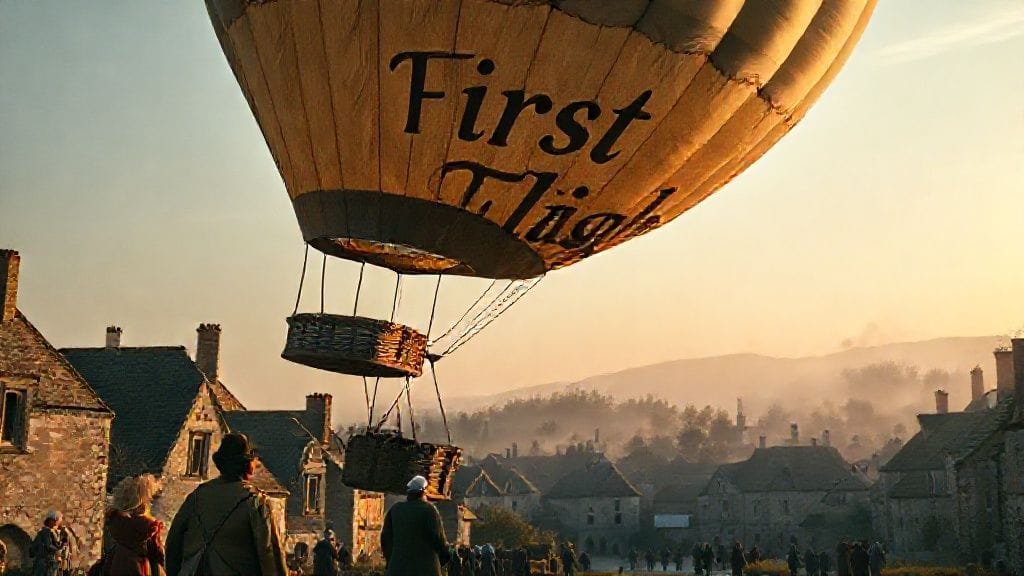
The morning of June 4, 1783, in the small French town of Annonay was nothing short of magical. The air was thick with anticipation and the aromas of early summer — fresh earth, blooming flowers, and the faint scent of burning straw. Crowds gathered in the town square, their voices rising in a chorus of wonder and disbelief. They watched as an extraordinary creation, gigantic yet delicate, slowly inflated against the still air: a balloon made of paper and fabric, heated by the smoke of a roaring fire. And then, as if summoned by the collective breath of the crowd, it began to rise — the very first flight of a hot-air balloon, a dream dreamed by humanity for centuries.
It was a moment of joy, terror, and wonder, simultaneously. The balloon drifted skyward, carried by warm air that defied gravity itself and touched the heavens as it hovered above Annonay’s rooftops. It was more than an experiment; it was the birth of humanity’s yearning to break free, to explore the skies — a landmark in the story of human flight.
France on the Eve of Innovation: Society and Science in 1783
The late 18th century in France was a crucible of transformation. Amidst the shining salons of the Enlightenment, scientific inquiry raced forward with unprecedented momentum. Philosophers and inventors alike sought to unravel the mysteries of nature with reason and experimentation. Meanwhile, France was also a society on the brink — socially stratified, politically tense, and rife with new ideas challenging old orders.
Science and spectacle intertwined. The appetite for discovery fascinated not only academics but also common folk, courtiers, and kings. It was within this atmosphere of intellectual fervor and social upheaval that the Montgolfier brothers conceived an invention that would forever alter humanity's understanding of its place on Earth.
The Montgolfier Brothers: Visionaries of the Skies
Joseph-Michel and Jacques-Étienne Montgolfier were not typical scientists; they were paper manufacturers from Annonay, artisans with a curious blend of practical knowledge and flights of imagination. The brothers became obsessed with the power of fire to lift objects — a principle they had noticed in billowing smoke and hot air rising.
After much trial and error, and amid cautious skepticism from their contemporaries, they unveiled a balloon constructed from sackcloth lined with paper and equipped to harness the power of heated air. Their invention was no mere curiosity: it became a symbol of human aspiration to reach beyond earthly confinements.
Igniting the Flame: From Paper and Cloth to the Heavens
The technical challenges were daunting. How to create a lightweight, airtight vessel to contain hot air? How to generate sustained heat without burning the fragile fabric? The brothers experimented with fireplace stoves and straw fires. Their first tests sent aloft small balloons, sometimes crashing, sometimes floating but always teaching.
Finally, on June 4, they were ready to show their creation to the public. The balloon, towering over fifteen meters high and nearly the size of a modest house, rested tethered on the ground, its thin paper walls trembling with anticipation. A fire roared beneath it, coils of smoke curling skyward. As the air warmed inside, a magical transformation occurred — the beast lifted.
The Annonay Experiment: The First Man’s Flight in a Balloon of Hot Air
Actually, the first flight on June 4, 1783, was unmanned — it carried a live cargo of animals instead: a duck, a rooster, and a sheep. Their ascent had profound symbolic meaning: could life survive above the Earth, in the unknown?
But even this unmanned flight was historic, marking the first recorded journey of a hot-air balloon soaring above the landscape. The balloon rose 1,600 feet, drifted for about 10 minutes, and landed several kilometers away.
Within months, the Montgolfiers progressed to manned flights, but it was the Annonay launch that sparked imagination and proved the concept.
The Crowd Gathers: Public Awe and Skepticism
On the day of the launch, townspeople, visitors, and curiosity-seekers filled the streets and fields. The event was more than scientific; it was communal and dramatic. The low flames, the sighing cotton-paper envelope, the rising shape — all became part of a spectacle that blurred the lines between theater and science.
Some onlookers whispered fears of hubris, calling it folly to challenge the skies; others celebrated the spectacle like a festival, imagining the new possibilities unfolding. The heat rising into the soft blue summer gave hope that humanity could someday float freely in the sky — beyond the constraints of earthbound life.
The Mechanics of Ascent: How the Balloon Took to the Air
The principle was simple yet revolutionary. The fire beneath heated the air inside the balloon, causing the air’s molecules to move faster and spread apart, making the air inside less dense than the cold outside air. This created buoyancy, and with a large enough volume, a gigantic balloon could lift its own weight plus cargo.
But practical mastery of this science was formidable: the fuel had to burn consistently, the fabric had to hold without tearing or igniting, and the pilot’s fate hung tethered to the whims of the wind.
The Montgolfiers’ genius lay as much in craftsmanship and experimentation as in theory — an alchemy of knowledge and luck.
A New Chapter for Mankind: The Impact of the Maiden Voyage
The first balloon flight in Annonay was more than a technical milestone; it reset humanity’s cosmic perspective. For centuries, the sky had been an impassable dome, a sacred boundary between Earth and the stars.
Now, in the heat of that summer morning, the invisible walls seemed to dissolve before eager eyes. Human beings could float, glide, and perhaps someday travel freely above green fields and silver rivers. The flight was a symbol of the Imagination unleashed and the coming age of exploration — no longer bold only on land or sea but in the skies as well.
Scientific Curiosity and Royal Patronage: The French Monarchy’s Role
The spectacle reached the ears of Versailles, and King Louis XVI took notice. The crown, intrigued both by the scientific promise and the political theater, sponsored further flights, seeing the balloons as symbols of France’s enlightened progressiveness.
Jacques Alexandre César Charles soon entered the scene, developing hydrogen gas balloons, which lifted higher and longer than hot-air models. The monarchy's patronage meant more than money: it lent prestige, turning ballooning into a national project.
Yet, as the monarchy gambled on this new frontier, France was simultaneously brewing political storms that would soon eclipse even the loftiest of dreams.
From Balloons to Empires: The Military and Communication Potential
It did not take long for the military to recognize potential uses. Balloons offered unprecedented vantage points for reconnaissance and signaling, especially in the turbulence of the Revolutionary Wars.
The French army established the first balloon corps, deploying aerial observers to monitor enemy movements. These early balloons, though fragile and dangerous, laid the foundations for modern military aviation.
Here was science touching the battlefield, transforming spectacle into strategic instrument — yet the skies still held many mysteries and perils.
The Breath of Fire and Humanity’s Awe: Cultural Ripples Across Europe
News of the flight traveled rapidly beyond France’s borders. Across Europe, artists painted balloon flights, poets composed odes, and philosophers debated the implications.
People imagined not only conquest of the skies but a profound transformation of human existence: mobility, freedom, perspective. Ballooning inspired the Romantic imagination and grounded Enlightenment ideals, symbolizing both the power and fragility of progress.
From Fright to Fascination: Public Perceptions and Myths
Not all reactions were admiring. Folklore sprouted around the new flying machines: tales of spirits, fear of the unknown, and rumors of flights into realms beyond human comprehension.
Skeptics questioned safety and practicality; some believed the balloons were dangerous harbingers or punishments from the heavens. Fear mingled with wonder, a tension that made ballooning sociologically fascinating as much as technically significant.
The Legacy of 1783: How Annonay Changed Human Imagination
That June day in Annonay did not simply launch a balloon — it launched an era. The first flight sparked a global craze, leading to rapid advancements, public exhibitions, and scientific inquiry.
In many ways, it was a point of no return: the dream of human flight, long considered fantasy or divine privilege, now had a tangible beginning. The balloon became a metaphor for human daring and ingenuity.
Science, Art, and the Skies: Inspiring the Enlightenment and Beyond
Ballooning was a crossroad where science met public fascination. Enlightenment thinkers debated the physics of flight while artists captured its ethereal beauty.
The balloon entered literature and visual arts, symbolizing liberty and exploration, themes that resonated deeply as Europe approached revolutionary times. It was science made visible and poetry made real.
Technological Lineage: How the Hot-Air Balloon Paved Paths for Aviation
Of course, the Montgolfier flight was just the beginning. It inspired inventors from the Wright brothers to modern astronauts, setting a technological lineage tracing back centuries.
The principles developed in 1783 informed thermodynamics, aerodynamics, and human-machine interaction. Ballooning's legacy is found in every plane that crosses skies and every spacecraft that pierces atmospheres.
Remembering the Flight: Commemorations and Historical Memory
Today, Annonay honors the Montgolfiers with museums, plaques, and festivals. Each year, balloonists and enthusiasts retrace the first flight’s fragile path.
Memory of that day hangs as a beacon of human courage, curiosity, and the timeless desire to rise and explore — a testament to the spark that ignited a thousand journeys.
The Human Element: Courage, Curiosity, and the Spirit of Discovery
Behind all the science and spectacle were human qualities—boldness, optimism, and the sheer will to transcend boundaries. The Montgolfier brothers, the crowd in Annonay, the animals lifted skyward—each embodied what it means to dream.
Their story is a reminder: every leap in civilization begins with someone daring to stare at the sky and say, “What if?”
Conclusion
The hot-air balloon’s first flight from Annonay on June 4, 1783, was a moment charged with magic and meaning. It was the culmination of daring experimentation and the dawn of a new era where the sky no longer confined human imagination.
This flight redefined humankind’s relationship with the world and inspired centuries of innovation, artistry, and exploration. Yet, beyond the science and spectacle, it spoke to something deeper—our innate desire to rise above, to seek the unknown, and to believe in the impossible.
To stand beneath a rising balloon is to feel, even centuries later, the breath of human hope lifting us all toward the heavens.
FAQs
Q1: What was the key scientific principle behind the Montgolfier brothers’ hot-air balloon?
A1: The principle was buoyancy created by heating air inside the balloon, making it less dense than the surrounding cooler air, allowing the balloon to rise.
Q2: Why was the first flight in 1783 unmanned and carried animals instead?
A2: The first flight tested safety and viability; animals were sent up to observe if life could survive the ascent and conditions at altitude.
Q3: How did the French monarchy contribute to the development of early balloon flights?
A3: King Louis XVI and the royal court sponsored further flights, providing funding and prestige, which helped refine the technology and publicize ballooning.
Q4: What were some early military applications of hot-air balloons?
A4: Balloons were used for aerial reconnaissance, giving armies visual advantage on battlefields during the Revolutionary Wars.
Q5: How did the first flight from Annonay influence European culture?
A5: It inspired art, literature, and philosophy, fueling hopes of freedom and exploration while stirring myths and fears about flight.
Q6: What made the Montgolfier brothers’ approach unique compared to earlier attempts at flight?
A6: Their combination of practical craftsmanship and scientific experimentation, especially using lightweight materials and hot air, distinguished their success.
Q7: How is the first hot-air balloon flight commemorated today?
A7: Through museums, festivals, ballooning events in Annonay, and global recognition of the flight’s historic significance.
Q8: In what ways did the hot-air balloon flight pave the way for modern aviation?
A8: It established fundamental aerodynamic principles, inspired further inventions, and marked the transition from earthbound travel to flight.