Table of Contents
- Islands of Fire: Setting the Stage for Ambrym’s 2018 Awakening
- A Volcano with a Memory: The Deep Past of Ambrym
- Life on the Edge: Communities Before the 2018 Eruption
- Whispers from the Crater: The Months of Restless Rumbling
- December 2018: The Day the Lava Lakes Vanished
- Cracks in the Earth: Fissures, Ash, and the Sudden Transformation of Ambrym
- The Night of Evacuation: Boats, Prayers, and Radio Messages
- Science in the Ash: How Volcanologists Tracked the Crisis
- Government on Alert: Decisions, Declarations, and the State of Emergency
- Displaced on Neighboring Shores: Shelters, Tents, and Uncertain Tomorrows
- Faith, Custom, and Fire: Cultural Meanings of the 2018 Ambrym Eruption
- Economy Interrupted: Gardens, Tourism, and the Cost of Ash
- Images that Traveled the World: Media, Drones, and Global Attention
- After the Lava: Environmental Scars and Slow Healing
- Lessons in Preparedness: What the Pacific Learned from Ambrym 2018
- Returning Home: Resettlement, Ruins, and Resilience
- Ambrym in the Long Arc of Volcanic History
- Conclusion
- FAQs
- External Resource
- Internal Link
Article Summary: In December 2018, the South Pacific island of Ambrym in Vanuatu was shaken by one of the most consequential volcanic crises in its recorded history. This article follows the ambrym eruption 2018 from the first tremors and gas plumes through the dramatic opening of fissures, the sudden draining of famous lava lakes, and the emergency evacuations that followed. It explores the deep geological and cultural background of Ambrym, a volcano feared, revered, and woven into local custom for centuries. Through narrative scenes, eyewitness accounts, and scientific analysis, the story traces how villagers, scientists, and officials confronted a landscape that was literally splitting apart beneath their feet. The social and economic shock—abandoned villages, disrupted gardens, tourism losses—is set against the astonishing resilience of Ni-Vanuatu communities. The article also places the ambrym eruption 2018 within the wider history of Pacific volcanism and modern disaster management. In doing so, it reveals how a remote island crisis became a case study in early warning, cultural sovereignty, and climate-era vulnerability. Ultimately, this is a chronicle of fire and ash, but also of endurance and adaptation on the edge of one of the world’s most active volcanic arcs.
Islands of Fire: Setting the Stage for Ambrym’s 2018 Awakening
On maps of the South Pacific, Ambrym appears as a small green shape in a vast blue emptiness, one island among the many that make up the Republic of Vanuatu. From space, however, its secret is harder to hide: a broad, brooding shield, its dark interior scarred by ash plains and craters, its outline more volcanic than tropical. Long before the world heard of the ambrym eruption 2018, sailors and traders knew Ambrym as an island of fire, sometimes glimpsing orange glows above the clouds on clear nights. It was a place where the earth seemed thinner, where invisible forces, ancient and violent, pressed against the surface of daily life.
In December 2018, those forces surged to the surface in a way that would alter the island’s geography and the lives of its people. What began as an escalation in seismic tremors soon became a full-scale volcanic crisis: lava lakes that had burned steadily for decades suddenly vanished, vents ripped open across the island’s southeast, ash and gas billowed toward the sky, and hundreds of families were ordered to leave their villages. For a short but unforgettable time, Ambrym became the focus of volcanologists, journalists, and disaster officials around the globe. The phrase “ambrym eruption 2018” appeared in scientific bulletins, humanitarian reports, and viral drone videos as the story of a remote Pacific island’s ordeal spread far beyond Vanuatu’s borders.
Yet to appreciate what happened that month—what it meant for those who watched their land crack apart—you must begin with the island itself: its ancient eruptions, its colonial encounters, its myths of fire spirits, and its long adaptation to living beside one of the Earth’s most restive volcanoes. Ambrym’s 2018 awakening was not an isolated accident. It was another chapter in a deep, ongoing dialogue between people and volcano, played out over generations, through songs, scars, and stories passed down in smoke-filled meeting houses.
A Volcano with a Memory: The Deep Past of Ambrym
Ambrym is no ordinary mountain. Geologically, it is a large basaltic shield volcano, rising from the seafloor of the New Hebrides island arc, where the Australian Plate dives beneath the Pacific Plate. Over hundreds of thousands of years, magma has welled up along this tectonic boundary, layering thick fluid lava flows one upon another, building a broad, low-slung edifice rather than a single sharp peak. At its center yawns a great caldera, roughly 12 kilometers wide, formed when the roof of an earlier magma chamber collapsed in a truly colossal eruption long before written history.
The island’s recorded eruptive history reaches back to at least the late 18th century, when Captain James Cook sighted the nearby islands and European observers began noting strange lights and “smoke” from Ambrym. Missionaries in the 19th century wrote in their journals about “mountains of fire” that sometimes disturbed their nights with dull roaring sounds and ash fall. But of course, Ambrym’s true memory stretches far deeper in the oral traditions of its Indigenous Ni-Vanuatu inhabitants. Stories collected by anthropologists in the 20th century speak of ancestral figures who tamed or offended the volcano, of spirits that dwell in the craters, and of taboos surrounding certain highland areas.
One particularly powerful eruption in 1913 showered ash across large swaths of the island, contaminating water and burying gardens. Later, in 1951 and again in the 1980s and 1990s, Ambrym produced sizable eruptions that sent ash plumes skyward and lava flows crawling across the caldera floor. Yet even during its quieter periods, the volcano remained dramatically active. Within its central caldera, two main craters—Benbow to the west and Marum to the east—hosted persistently active lava lakes, among the few in the world to burn almost continuously. For decades, they pulsed and bubbled, emitting a constant plume of gas that could be seen from ships offshore.
By the early 21st century, Ambrym had become something of a pilgrimage site for volcanologists and adventurous travelers. Photographers hiked for hours across the ash desert to peer into the glowing pits, capturing scenes that looked like portals to the planet’s interior. Scientific expeditions documented the chemistry of Ambrym’s gas emissions, which were known to be among the largest continuous sources of volcanic sulfur dioxide on Earth. One researcher later recalled in a conference paper, “To stand on the rim of Marum at night was to feel the pulse of the Earth itself, a ceaseless roar of degassing magma only a few hundred meters below your feet.” The volcano, for all its ferocity, presented a kind of predictable danger—steady, constant, almost familiar.
The ambrym eruption 2018 would break that familiarity. Unlike the slowly churning lava lakes that tourists had come to see, the 2018 episode involved deep structural changes within the volcano, a wholesale reorganization of magma and fractures. To understand the scale of what happened, it is useful to see Ambrym not just as a mountain, but as a living, dynamic system—a system with a long memory and a capacity for sudden change.
Life on the Edge: Communities Before the 2018 Eruption
In the years leading up to 2018, daily life on Ambrym followed rhythms that might seem, at first glance, timeless. The majority of the island’s roughly 7,000–8,000 inhabitants lived in small villages scattered along the coast, where coconut palms, breadfruit trees, and gardens of taro and yams supported a largely subsistence lifestyle. Wooden outrigger canoes lined the black-sand beaches, and in some places, gentle plumes from the central caldera could be seen rising inland, a hazy backdrop to the routines of fishing, farming, and church services.
People had grown used to the volcano’s constant background presence. They knew that ash might fall on their roofs after a particularly restless night in the caldera, and that acid rain might sometimes nip at the leaves of their crops. In the southeast of the island, especially in villages like Paamal, Endu, and Fonah, people were acutely aware that they lived closer to the active rifts that sliced through the island’s interior. But Ambrym had not seen wide-scale evacuations in decades. In a sense, the calm of the early 2010s felt like a truce between the people and the mountain.
Politically, Ambrym was part of Malampa Province within Vanuatu, a young nation that had only gained independence from joint British-French colonial rule in 1980. Its administration was modest, its budget limited, and its disaster-management capacities still evolving. Yet Vanuatu had one great advantage: experience. The country sat, quite literally, in one of the world’s most dangerous neighborhoods—the Pacific “Ring of Fire.” Earthquakes, cyclones, and eruptions were, regrettably, part of life. Community-based disaster committees existed in many villages, and National Disaster Management Office (NDMO) training workshops had brought basic concepts of risk awareness even to remote islands.
Still, preparedness is one thing in theory, and another when the ground beneath your feet begins to split open. In 2017 and early 2018, Ambrym’s people tended their gardens, sent their children to school, and watched occasional tourists tramp past on their way up to the lava lakes. Few suspected that a fundamental change was brewing beneath them, that the volcano’s internal plumbing was working toward a dramatic reconfiguration. The ambrym eruption 2018 would not just test the physical resilience of the island but also the resilience of its social and political systems.
Whispers from the Crater: The Months of Restless Rumbling
Every major eruption writes its prelude in small, technical signals—most of them detectable only by sensitive instruments. On Ambrym, a sparse but crucial network of seismometers and gas sensors provided windows into the volcano’s moods. In the months before December 2018, these instruments began to murmur.
By mid-2018, volcanologists at Vanuatu’s Geo-Hazards Observatory in Port Vila were already tracking signs of unrest. Seismographs registered increasing numbers of small earthquakes beneath Ambrym, many of them too faint for villagers to feel. Sulfur dioxide emissions fluctuated, at times spiking above normal background levels. Satellite data hinted at subtle ground deformation—tiny millimeter-scale uplifts and tilts across the island’s surface—that suggested magma was moving, pressurizing the system from within.
Field teams made periodic visits to the island, hiking into the caldera to take gas measurements and thermal readings. Some locals, guiding these teams, remarked on changes they sensed but could not quantify: a deeper roar in the vents, more aggressive belching of ash from Marum and Benbow. One observer described how, on certain nights, “the glow seemed bigger, and the sound of the volcano came down like a drumbeat over the village.” Even so, there was no singular moment when everyone agreed: “This is it.” Volcanic crises often creep forward in increments until, abruptly, the line is crossed.
In late November and early December, the data sharpened. Seismicity intensified, indicating that magma was forcing its way through the crust. The government raised the official alert level for Ambrym, issuing advisories that warned people to stay away from the summit caldera and to prepare for possible escalation. Yet at the coasts, life went on. Fishing trips continued. Children played soccer on dusty clearings, squinting a little against the haze drifting from the interior. The volcano had rumbled before, they reasoned; why should this time be different?
It was, as later reports would show, very different. Magma was not simply churning in its usual reservoirs beneath Marum and Benbow. It was migrating sideways, infiltrating fractures that extended toward the southeast of the island. The stage was being set for a kind of eruption Ambrym had not seen in living memory: fissure eruptions along rift zones far from the familiar lava lakes, threatening villages that had thought themselves at a safe distance.
December 2018: The Day the Lava Lakes Vanished
The turning point came with an almost surreal event: the sudden disappearance of Ambrym’s famous lava lakes. In early December 2018, as tremors mounted, observers began noticing that the levels of molten lava within Marum and Benbow were dropping. Over days, the once-cachelike pools of incandescent rock slumped lower and lower in their conduits, exposing dark, cooling walls inside the craters.
Then, around December 15, as seismic swarms intensified and deformation data showed rapid changes, the lakes effectively drained away. Photographs and drone footage captured eerie scenes: vents that had glowed for years now yawning as black, gas-fuming pits. The roar of degassing magma was replaced by a more intermittent growl, punctuated by explosions as rocks collapsed into the empty spaces below. To volcanologists, this was a chilling sign. The magma had not vanished; it had migrated.
The ambrym eruption 2018 was entering a new phase. As the lava lakes receded, the magma they once contained was being pushed out along cracks in the island’s southeast rift zone. Beneath villages and forests, molten rock forced its way toward the surface, prying apart the crust like a wedge. GPS instruments recorded rapid ground movements—some areas uplifting, others subsiding—as the island flexed around its new, pressurized intrusions.
Residents began to feel the change in their bones. Earthquakes, once distant rumbles, now shook houses and rattled dishes on shelves. Some people reported strange sounds—dull booms, like far-off thunder—that seemed to come from underground. One village elder would later tell a journalist, “It was as if the island was becoming hollow under us.” The volcano, which had long telegraphed its power via the visible spectacle of glowing lava lakes, was now working in secret, deep below fields and footpaths.
By mid-December, the Geo-Hazards Observatory raised Ambrym’s alert level higher, and emergency planners began sketching worst-case scenarios: fissures opening in or near villages, lava fountains igniting forests, ash columns disrupting regional air travel. The realization dawned that this was not merely a caldera-top spectacle but an island-wide emergency in the making.
Cracks in the Earth: Fissures, Ash, and the Sudden Transformation of Ambrym
The surface finally yielded around the same time that the lava lakes went dark. Along the southeastern part of Ambrym, near the villages of Paamal and Endu, the ground split open. New fissures—long, jagged tears several kilometers in length—raced across the landscape, some wide enough to swallow tree roots and fence posts. From these fissures, vents of ash, gas, and in some places lava, burst into the open air.
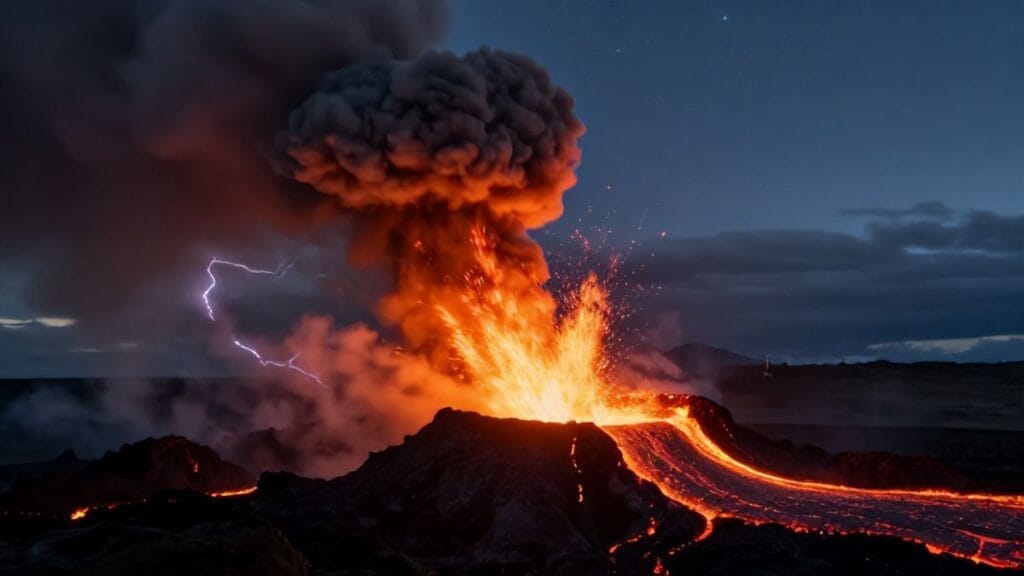
Witnesses described the first hours with a mix of awe and terror. A crack appeared in a garden, widening with each tremor. In one area, hot steam and volcanic gases hissed from a newly formed vent only meters from a cluster of houses. Fountains of spatter—molten rock tossed into the sky—lit the night, painting the clouds in flickering reds and oranges. The familiar silhouette of Ambrym’s interior ridgelines vanished behind rapidly thickening plumes of ash.
The eruption produced not just lava but dramatic ground deformation. Satellite radar images later released by the European Space Agency’s Sentinel-1 mission showed that parts of the island had subsided by more than a meter, while other regions had risen, warped like a flexed muscle. Roads buckled, water tanks tilted, and cracks marched through the walls of concrete buildings. One schoolroom found its floor bisected by a jagged seam, the chalkboard still hanging at a slight angle, as if the children had only just left.
Air quality deteriorated rapidly. Sulfur dioxide emissions soared, mixing with moisture to create acidic mists that irritated eyes and lungs. Ashfall, though not as monumental as in some historic eruptions, was thick enough in affected areas to coat roofs and damage crops. Cocoa trees, a valuable cash crop for many Ambrym families, found their leaves speckled with gray dust. For villagers downwind, the smell of the eruption was inescapable—a harsh, metallic tang carried into homes and churches alike.
And yet, in other corners of the island, life at first seemed strangely normal. On the sheltered northwest coast, fishermen still launched their canoes, glancing uneasily at the new plumes twisting above the southeastern horizon. The patchiness of the impact was both a blessing and a curse; it allowed some communities to remain functional, but it also complicated messaging. Was it truly necessary to evacuate when your own shoreline still looked serene? The volcano, indifferent to such questions, continued to deform the island at a geological pace that, in December 2018, felt frighteningly human.
The Night of Evacuation: Boats, Prayers, and Radio Messages
As the fissures lengthened and seismicity remained intense, officials in Port Vila faced a grave decision: whether to order evacuations from the most threatened zones. The data spoke clearly: the southeast part of Ambrym was undergoing major structural changes. Houses had cracked apart, water sources were compromised, and new vents were still opening. The ambrym eruption 2018 had become too dangerous for people to remain in its immediate path.
The decision was made to evacuate hundreds of residents from several villages, particularly in the southeastern area. Word spread rapidly by radio and by word of mouth. Local leaders, many of whom had been trained in basic disaster response, called community meetings beneath mango trees and church roofs. Some elders hesitated, remembering older eruptions weathered in place; others, seeing the fissures creeping toward their homes, needed no convincing.
Evacuation on an island like Ambrym is a logistical feat. There are no highways, no airports that can handle large aircraft, only small airstrips and boats. In the span of hours and days, provincial authorities, church organizations, and families themselves organized fleets of vessels—small inter-island ferries, cargo ships, wooden boats—to ferry people and possessions to safer islands, including nearby Pentecost and Malekula. The harbors grew frantic: sacks of rice, bundles of clothing, chickens in woven cages, and jerrycans of water jostled for space alongside crying children and anxious elders.
On one such night, as recalled later in interviews, dozens of people from a village near Paamal gathered on the beach in near-total darkness, lit only by flashlights and the glow of the eruption inland. The ocean, mercifully calm, reflected distant orange flares each time a vent hurled fresh spatter into the sky. Above, stars fought for visibility through a haze of ash. Some villagers knelt together in prayer, voices rising and falling in Bislama and local languages, while others negotiated with boat captains about space on the next crossing.
Radio broadcasts from the Vanuatu Broadcasting and Television Corporation carried updates: the alert level, safe routes, the names of ships en route to Ambrym’s shores. NDMO announcements, voiced in clear, measured tones, urged calm but emphasized urgency. Volunteers from the Red Cross and local NGOs prepared shelters on receiving islands, where school buildings and churches would soon serve as temporary homes. The evacuation, while tense and at times chaotic, unfolded with remarkable speed given the isolation and limited infrastructure.
By the time the main phase of evacuations was complete, hundreds—by some estimates over a thousand—people had left their villages behind, not knowing when, or if, they would be able to return. The ambrym eruption 2018 had torn not only at the crust of the island but at the emotional fabric of its communities.
Science in the Ash: How Volcanologists Tracked the Crisis
While boats crisscrossed the channels around Ambrym, scientists worked feverishly to understand what the volcano was doing and what it might do next. The Vanuatu Meteorology and Geo-Hazards Department (VMGD), supported by regional partners such as the New Zealand and French geological services, pulled data from every available source.
Seismic networks traced the march of earthquakes as magma forced its way along the southeast rift. Patterns of tremor suggested that dykes—sheetlike intrusions of magma—were propagating through the crust. Satellite imagery, from missions such as Sentinel-1 and Himawari-8, provided near-real-time views of ash plumes and ground deformation. Interferometric Synthetic Aperture Radar (InSAR) analysis revealed intricate warping of the island’s surface, a fingerprint of where magma had accumulated and where voids had opened beneath.
Gas measurements were perhaps the most urgent. Ambrym is known as a prodigious source of sulfur dioxide; in ordinary times, it can emit thousands of tons per day. During the ambrym eruption 2018, emissions spiked, confirming that large volumes of magma were degassing near the surface. Scientists warned that these gases, when blown toward populated areas, could cause respiratory distress, damage crops, and acidify rainwater. Observers on the ground, including local monitoring teams, sent in reports of “burning” sensations in throats and eyes, corroborating the instrument readings.
One post-crisis scientific report noted, “The 2018 Ambrym event represents one of the most significant recent examples of rapid lateral magma transport in an oceanic island setting,” highlighting how a volcano’s plumbing can shift dramatically in a matter of days. Another volcanologist, quoted in a regional conference, remarked almost with disbelief, “We watched, almost in real time, as one of the world’s most persistent lava lakes disappeared and the magma reappeared 13 kilometers away along a rift zone. It’s astonishing, isn’t it?”
Despite this analytical clarity, the scientists’ task was not to predict precise outcomes—that remains beyond current capabilities—but to bracket possibilities. Could the fissure eruptions escalate into larger lava flows that might reach the coast? Was there a risk of explosive phreatomagmatic activity if magma interacted with groundwater? The balance of probabilities, based on Ambrym’s history and the observed intrusion style, suggested a mainly effusive, fissure-dominated event. But from a humanitarian perspective, the ongoing ground cracking and gas release were already enough to justify keeping people away from the most affected areas.
In this way, the scientific narrative of the ambrym eruption 2018 intertwined constantly with the human one, each influencing the other. Data informed decisions; decisions shaped which observations could be made safely. Out of the ash and noise, a clearer picture of Ambrym’s internal architecture emerged—a silver lining, perhaps, to an otherwise disruptive crisis.
Government on Alert: Decisions, Declarations, and the State of Emergency
For the government of Vanuatu, the 2018 crisis on Ambrym became an intense test of disaster governance. The country was no stranger to emergencies: Cyclone Pam in 2015 had devastated large swaths of the archipelago, prompting massive international relief operations. But volcanic crises unfold differently. They can accelerate or decelerate unexpectedly, affecting scattered communities with unequal severity.
The National Disaster Management Office convened coordination meetings in Port Vila, drawing in representatives from VMGD, the Ministry of Health, the police, provincial authorities from Malampa, and international partners. Alert levels, issued for Ambrym on a scale familiar to Ni-Vanuatu after years of hazard education, were raised to reflect the seriousness of the fissure eruptions and ground deformation. At one point, the volcano’s alert level was placed at 3 or higher—indicating a severe state of unrest and potential for dangerous activity.
A state of emergency was declared for affected parts of Ambrym, freeing up resources and giving legal backing to evacuation orders. Funding was allocated for food, shelter materials, and transport; however, as in many small island states, the available budget was limited. International humanitarian agencies, including the Red Cross and UN organizations, offered support, but Vanuatu’s government was keen to keep responses grounded in local structures and knowledge. Custom chiefs and church leaders were invited into planning discussions, ensuring that messages to communities would resonate culturally as well as technically.
The ambrym eruption 2018 also highlighted tensions between centralized authority and local autonomy. Some villagers were reluctant to leave ancestral lands, even when officials insisted on evacuation. Others questioned how long they would be asked to stay away and whether compensation would be provided for damaged houses or lost livelihoods. Government representatives had to walk a delicate line: respecting community wishes while emphasizing the unpredictable danger of remaining in zones sliced by new fissures and vents.
In parliamentary debates and cabinet discussions, the Ambrym crisis became part of a broader conversation about climate change, resilience, and national priorities. Vanuatu’s leaders, who had been vocal on the world stage about the existential threats posed by sea-level rise and extreme weather, now faced again the old, slow-moving but equally existential reality of geological risk. The lesson was stark: resilience in Vanuatu must be multi-hazard, capable of facing both the storms of the sky and the fires of the earth.
Displaced on Neighboring Shores: Shelters, Tents, and Uncertain Tomorrows
For the evacuees from Ambrym’s southeast, the days and weeks after their departure were marked by a peculiar dislocation. They were still in Vanuatu, still surrounded by Ni-Vanuatu languages and customs, but they were no longer on their own land. Shelters on neighboring islands, hastily arranged, offered roofs and walls but not the comforting familiarity of home soil.
School buildings served as dormitories, their classrooms converted into makeshift family spaces demarcated by sheets and blankets. Church compounds hosted rows of tents and tarpaulins, flapping in the trade winds. Aid distributions brought staples—rice, tinned fish, cooking oil—into hands used to harvesting cassava and taro from gardens. For children, the novelty of new surroundings was tempered by anxiety. Some had left behind pets; others whispered about whether their houses would still be standing when they returned, or whether the cracks would have “eaten” them.
Social dynamics shifted in subtle ways. Host communities, themselves not wealthy, extended hospitality, but the sudden influx strained resources. Wells and rainwater tanks were tapped more heavily than usual; gardens had to provide for more mouths. Relief agencies tried to mediate, providing supplementary food and water, but tensions occasionally surfaced. Questions about how long evacuees would stay hovered in the air, often unspoken but deeply felt.
Schools faced disruption as well. Children evacuated from Ambrym had to be integrated into classrooms on their host islands, sometimes without proper records or supplies. Teachers improvised—sharing textbooks, rearranging seating, incorporating stories of the eruption into lessons to help students process their trauma. One teacher, interviewed months later, described asking her class to draw “home.” Many Ambrym children sketched houses next to fissures, or volcanoes belching ash over the sea, their crayons translating fear into lines and colors.
Through it all, Ambrym’s evacuees held fast to their sense of identity. Evening gatherings often turned to kastom stories about their island: how the ancestors had first settled there, what taboos surrounded certain sacred stones, how previous eruptions had come and gone. The ambrym eruption 2018 became, almost immediately, a new chapter in this evolving oral history. For some, it was interpreted as a spiritual message—a sign that certain rituals had been neglected or that social bonds needed renewal. For others, it was framed more pragmatically, as a natural hazard that had to be respected, understood, and planned for.
Faith, Custom, and Fire: Cultural Meanings of the 2018 Ambrym Eruption
On Ambrym, as on many Pacific islands, the boundary between the physical and spiritual worlds is porous. Volcanoes are not merely geological formations; they are places infused with presence—of ancestors, of deities, of forces that see and judge human behavior. The 2018 eruption, with its sudden fissures and vanished lava lakes, was interpreted through this cultural lens as much as through the lens of seismographs and satellite images.
Some kastom stories long told on the island speak of fire spirits that dwell in the highlands, beings who must be placated with respect and proper ritual observance. When the ground split beneath people’s feet, these tales resurfaced with new urgency. Elders convened meetings to discuss whether any taboos had been broken, whether sacred sites had been disturbed, or whether communal obligations had been neglected. In a few villages, kastom ceremonies were conducted even during the evacuation period, adapted to temporary shelters, as a way of seeking reconciliation with the forces believed to inhabit Ambrym’s depths.
Christianity, too, shaped responses. Vanuatu is a deeply Christian nation, and on Ambrym, churches of various denominations play central roles in community life. During the nights of strongest tremors, congregations gathered for prayer vigils. Pastors preached sermons drawing parallels between biblical stories of fire and judgment and the ash clouds visible on the horizon. Some framed the ambrym eruption 2018 as a test of faith, a call to unity and repentance; others emphasized God’s protection, reassuring their flocks that, though homes might be lost, their lives were preserved for a reason.
This interplay of kastom and Christianity did not always unfold without tension. A few more conservative church voices discouraged participation in traditional rituals, seeing them as incompatible with Christian teaching, while kastom representatives insisted that spiritual harmony with the land required attention to ancestral protocols. Yet in many families, both traditions coexisted, overlapping in practice if not in theology. A father might lead his children in a Christian prayer at dusk, then later tell them an ancestral story about the volcano, giving them two frameworks through which to understand the rumbling beneath their feet.
Anthropologists who later studied the social dimensions of the eruption observed that this dual spiritual reading—Christian and kastom—often strengthened resilience rather than undermined it. People who believed they were part of a story, guided by forces beyond the immediate catastrophe, found meaning amid the uncertainty. As one Ambrym woman told a visiting researcher, “The volcano talks to us. Maybe this time, it is telling us to change how we live, but it is still our island. We belong to it, and it belongs to us.”
Economy Interrupted: Gardens, Tourism, and the Cost of Ash
Even as lives were saved through timely evacuations, the economic impact of the ambrym eruption 2018 rippled outward in slower, but no less serious, waves. Ambrym’s economy rested on three main pillars: subsistence agriculture, small-scale cash cropping (especially cocoa and copra), and, to a growing extent, adventure tourism focused on the lava lakes.
Gardens were the first to suffer. Ashfall in affected areas coated leaves, reducing photosynthesis and, in some cases, burning tender growth with its acidity. Root crops like taro and yam, partly shielded underground, fared better but could still be contaminated by acidic leachates. For families evacuated in December, many gardens were simply abandoned. By the time they could consider returning, weeds and ash had changed the soil surface, and harvesting schedules were disrupted. Food aid bridged some of the gap, but the sense of security provided by full gardens—so central to island life—was shaken.
Cocoa, a vital source of cash income, was particularly vulnerable. Cocoa trees are sensitive to changes in leaf health and root conditions. In some zones, ash and gas exposure defoliated orchards or reduced yields. The timing was cruel: global cocoa markets fluctuate, and many Ambrym farmers had invested years of labor into trees that would now need careful rehabilitation, or even replanting, to regain their former productivity.
Tourism, meanwhile, suffered a dramatic and immediate blow. Before 2018, Ambrym’s lava lakes at Marum and Benbow had become iconic destinations in the niche world of volcano tourism. Tour operators in Port Vila and overseas advertised multi-day treks to “stand at the very edge of a boiling lake of lava,” and images from Ambrym circulated widely on social media and in glossy travel magazines. Guides on the island had built livelihoods around these expeditions—organizing porters, arranging food and camping gear, and negotiating access fees for landowners.
Once the lava lakes drained, those iconic scenes were gone. The craters still existed, and the island’s volcanic landscape remained spectacular, but the central selling point—a constantly glowing window into the subterranean furnace—had vanished. Safety concerns around ongoing fissure activity and gas emissions further curtailed tourism. In the months following the eruption, bookings dropped. Some guides pivoted to other work; others waited in the hope that the volcano might one day refill its lakes, though there was no guarantee that this would happen within their working lifetimes.
The overall economic cost of the ambrym eruption 2018 is difficult to quantify precisely, but it clearly compounded existing vulnerabilities. In a small-island economy with thin margins, even temporary disruption can push families into debt or force them to sell livestock or land. Nonetheless, there was also a countercurrent: the crisis attracted some external funding for reconstruction and hazard mitigation, bringing in short-term employment opportunities in rebuilding infrastructure, repairing schools, and improving water systems. As with many disasters, loss and opportunity arrived intertwined, unevenly distributed across communities and households.
Images that Traveled the World: Media, Drones, and Global Attention
In earlier centuries, news of a South Pacific eruption might have taken months to reach distant shores, if it traveled at all. In 2018, the story of Ambrym raced across the world in near real time, carried by satellites, social media, and the restless curiosity of a global audience fascinated by natural drama.
Within days of the fissure eruptions, drone footage emerged online, shot by adventurous residents and visiting photographers who had long documented Ambrym’s volcanic features. Their videos, soaring above gaping cracks and steaming vents, offered breathtaking, and at times unsettling, vistas: rows of houses slightly askew, each bisected by sinuous dark lines; forests standing intact yet rooted in ground that had subsided by tens of centimeters; the great central craters of Marum and Benbow now largely devoid of lava, their depths filled with smoke instead of molten glow.
International news outlets—BBC, Reuters, regional Pacific media—picked up the story, often framing it with both drama and a degree of romanticism: “Island of Fire Tears Apart,” “Vanuatu Volcano Forces Evacuations,” and similar headlines. Humanitarian bulletins, more sober in tone, focused on the numbers: how many displaced, how many villages affected, what level of assistance was needed. In one widely cited humanitarian report, the ambrym eruption 2018 was described as “a complex emergency involving both volcanic hazards and significant ground deformation impacting infrastructure and livelihoods.”
The images had political effects as well. They reminded the world that Vanuatu, often mentioned in climate-change debates because of its low-lying islands and cyclone exposure, also faced acute geological risks. At United Nations forums, Vanuatu’s representatives pointed to Ambrym as evidence that small island developing states carried a disproportionate burden of multi-hazard vulnerability. The same nation that had appealed for international solidarity after Cyclone Pam was now asking for recognition that its earth, not just its atmosphere, could turn against its people.
Within Vanuatu, the media spotlight was double-edged. On one hand, attention helped attract resources and expertise; on the other, it risked flattening the story into simple images of disaster. Journalists who took the time to interview Ambrym residents found more nuanced perspectives. People spoke not only of fear and disruption but also of pride in their response, trust in local leaders, and determination to return. As one village chief told a reporter standing beside a cracked meeting house, “This is our story, not a picture for other people to forget next week.”
After the Lava: Environmental Scars and Slow Healing
Even after the most visible activity of the ambrym eruption 2018 subsided, the island bore visible and invisible scars. The ground did not neatly close over the fissures; many remained open, though less active, forming elongated ravines and crevices that altered drainage patterns and walking routes. Where vents had spewed hot gases for days, nearby vegetation browned and withered, creating stripes of withered forest against still-green surroundings.
Soils in the affected zones were both damaged and, paradoxically, renewed. Fresh volcanic ash can, over time, become a fertile substrate as it weathers and mixes with organic matter. In the short term, however, its acidity and low nutrient availability challenge plant growth. Farmers returning to test their gardens found that some plots had become unexpectedly hard or waterlogged, depending on how ground deformation had shifted subsurface water flows. Rehabilitating these lands required experimentation: adding organic matter, adjusting planting depths, and, in some cases, relocating garden sites altogether.
Water sources posed another challenge. Springs and shallow wells, once reliable, had been disrupted by faulting and subsidence. In a few tragic cases, fissures intersected with water channels, either draining them away or contaminating them with sediment and gases. Aid agencies worked with local committees to install or repair rainwater catchment systems, emphasizing the need for more resilient, distributed water supplies in a landscape prone to sudden geological change.
Ecologically, the eruption became part of an ongoing cycle. Pioneer plants began to colonize fresh ash deposits; certain ferns and grasses, adapted to disturbed soils, sprouted where older vegetation had been stripped away. Birds returned quickly, flitting among the blackened branches. The caldera, always a harsh environment, adjusted to the loss of its lava lakes by becoming even more dominated by fumaroles and rockfalls, a stark, otherworldly interior at the heart of a green island.
From a broader environmental perspective, scientists also tracked the atmospheric legacy of the eruption. Ambrym’s sulfur dioxide output during and after the event contributed measurably to regional aerosol loads, though far below the levels of global climate significance reached by truly colossal eruptions like Pinatubo in 1991. Still, the episode served as a reminder: the same volcano that shapes local destinies also participates, in its own scale, in the Earth’s chemical and climatic systems.
Lessons in Preparedness: What the Pacific Learned from Ambrym 2018
In the years that followed, the ambrym eruption 2018 became a case study discussed at regional workshops and scientific gatherings across the Pacific. It was not the largest eruption the region had seen—other volcanoes in Papua New Guinea, Tonga, and elsewhere had produced more dramatic explosivity or ash. But Ambrym’s combination of persistent activity, sudden structural change, and significant ground deformation in populated areas made it uniquely instructive.
One of the clearest lessons was the value of integrated monitoring. Seismology alone could not have told the full story; nor could gas measurements or satellite imagery taken in isolation. It was the convergence of signals—earthquake swarms, rapid deformation, gas spikes, and visible changes in the lava lakes—that allowed VMGD and its partners to recognize that an unusually dangerous episode was unfolding. Investments in maintaining and expanding such monitoring networks, though costly for small states, were shown to be life-saving.
Community preparedness was another key point. Villages that had active disaster committees and clear evacuation plans were often able to move more quickly and calmly when orders came. Education campaigns in Bislama and local languages, conducted in the years before 2018, paid dividends as people recognized warning signs and understood the meaning of alert levels. Nonetheless, gaps remained: some communities still received information late or inconsistently, highlighting the importance of strengthening radio coverage and ensuring that messages are culturally tailored and trusted.
The crisis also sparked policy discussions about land-use planning on volcanic islands. Should new houses be built in zones known to overlay rift systems? Can traditional knowledge about “bad ground” be integrated formally into hazard maps and planning regulations? The fissures that tore through villages in 2018 had not been entirely unexpected by local elders, who often avoided certain tracts for reasons described in mythic terms but grounded in ancestral observation. Bridging this gap—between kastom understandings of the land and scientific hazard mapping—became a stated goal for both Vanuatu’s government and its research partners.
Regionally, the Ambrym event fed into a growing recognition that Pacific island states needed robust, shared platforms for volcanic early warning. Organizations like the Pacific Community (SPC) and the Secretariat of the Pacific Regional Environment Programme (SPREP) considered how best to pool resources, from satellite data interpretation to rapid deployment teams. One conference summary on regional volcanic risk cited Ambrym as an example of “effective national leadership under constrained resources, demonstrating the importance of local capacity in global early-warning frameworks.”
Returning Home: Resettlement, Ruins, and Resilience
For many Ambrym evacuees, the most emotionally fraught chapter began not with the roar of the volcano, but with the quieter process of return. Months after the main eruptive phase ended, as seismicity declined and gas emissions lessened, officials and scientists carried out assessments to determine which areas could be safely reoccupied. The verdict was complicated. Some zones remained too unstable or fractured to recommend living there again; others, though superficially less damaged, still lay across active rift segments.
When the green light was finally given for partial returns, people boarded boats with a mixture of joy and dread. They had seen some images of their villages during the crisis, but photographs could not fully prepare them for the reality of walking through altered landscapes. In one settlement, a church building leaned noticeably, its front steps now offset by a broad crack. In another, a family’s house had sunk by nearly half a meter relative to the ground on the opposite side of the yard, turning what had been a level plot into a small terrace.
Emotions surged. Relief at finding certain houses intact mixed with grief at the sight of ruined dwellings and dead trees. Some families discovered that the spots where they had once drawn fresh water were now dry, or that new springs had appeared in unexpected places. Paths they had walked every day of their lives had to be rerouted around gaping fissures. The familiar was gone, yet something new, still definably “home,” persisted in the breeze, the shape of the coastline, the calls of birds at dusk.
Rebuilding was both a physical and social project. Neighbors helped one another shore up walls, reposition water tanks, and clear ash. Aid organizations provided tarpaulins, roofing materials, and tools, but the bulk of the labor was local. As houses took shape, so did communal spaces—meeting grounds, church compounds, Nakamal (traditional gathering places). In planning where to rebuild, many communities consulted not only engineers and hazard maps but also elders, asking which lands felt spiritually and historically sound.
Some chose not to return, at least not immediately. For these families, new lives on host islands slowly solidified into more permanent arrangements. Children enrolled in local schools; marriages formed across island lines; gardens were established in unfamiliar soil. Ambrym, for them, became a place of origin and memory rather than daily residence. Their stories underscore an often-overlooked dimension of volcanic crises: the quiet, long-term reshaping of population geography, as some lines of descent remain and others branch away.
Yet for those who did come back, the act of return itself was a statement of resilience. The ambrym eruption 2018 had demonstrated their vulnerability, but it had also confirmed their capacity to adapt. Living with a volcano, after all, is not a short-term condition; it is a relationship measured in lifetimes. To walk again across cracked ground, plant new gardens in ash-laced soil, and hear once more the distant murmur of the caldera was, for many Ambrym residents, a way of saying: “We are still here.”
Ambrym in the Long Arc of Volcanic History
Placed within the immense timeline of Earth’s geology, the ambrym eruption 2018 is, in strictly physical terms, a minor adjustment—a pulse of magma, a reconfiguration of rifts and vents on a single island. Yet for historians, anthropologists, and disaster scholars, it occupies a more prominent place: a lens through which to examine how human societies live with, interpret, and respond to the restless planet beneath them.
Ambrym joins a roster of island volcanoes whose eruptions have been transformative. Tambora in 1815, Krakatau in 1883, and more recently Hunga Tonga–Hunga Haʻapai in 2022 altered global skies and regional histories. Ambrym’s 2018 event did not reach that scale, but it shared a familiar pattern: prior unrest, a tipping point, a dramatic reconfiguration, and then a long tail of social and ecological consequences. Its particular signature was the draining of long-standing lava lakes and the activation of rift fissures beneath inhabited lands.
Scholars comparing Ambrym with other rift-driven eruptions, such as Iceland’s 2014–2015 Holuhraun event, have noted intriguing parallels. In both cases, magma traveled laterally away from a central volcano, opening fissures tens of kilometers distant. Yet while Iceland’s eruption took place in a sparsely populated, glacially influenced highland, Ambrym’s fissures cut through villages, gardens, and kastom landscapes. This juxtaposition underscores the simple but profound truth that the human impact of an eruption depends not merely on its physical magnitude but on where, and among whom, it occurs.
From a historiographical standpoint, the 2018 eruption also deepened global understanding of Vanuatu’s place in the history of hazards. The nation had already figured in studies of cyclone vulnerability and post-colonial governance under environmental stress. Ambrym added a volcanic chapter, demonstrating how a small island state, armed with limited resources but strong local institutions, can manage a complex geological emergency. International case-study compilations, such as those used in graduate programs on disaster risk reduction, now often include Ambrym alongside more widely known eruptions.
For Ambrym’s own people, however, history is less about academic framing and more about lineage, song, and story. Children born around 2018 will grow up hearing accounts of the time when “the ground broke,” when families took to boats in the night, when the ever-burning lakes went dark. In future decades, when the volcano next stirs dramatically—as it inevitably will—these tales will shape how communities interpret the signs and decide what to do. Thus the ambrym eruption 2018, though now past, continues to exert a quiet force on the island’s future, just as older eruptions lived on in the memories that guided 2018’s decisions.
In this sense, the eruption occupies a space where geological, cultural, and political histories converge. It is a reminder that the story of the Earth is never purely physical; it is always, at every scale, entangled with the stories of those who walk upon it.
Conclusion
The Ambrym eruption of December 2018 began as a deep, inaudible stir in the magma chambers beneath a remote Pacific island and unfolded into a drama of fissures, evacuations, and hard choices. It drained iconic lava lakes that had burned for decades, cracked open the ground beneath villages, and forced hundreds of people to leave homes built in the shadow of a volcano they had long considered both dangerous and familiar. Along the way, it tested the capacities of scientists, government officials, and community leaders to read ambiguous signals and respond in time.
For the people of Ambrym, the ambrym eruption 2018 was not just an event, but an experience stamped onto memory: the taste of ash in the air, the sight of boats crowded with possessions, the ache of returning to landscapes subtly but unmistakably changed. It reshaped their economy, interrupting gardens and tourism, and it deepened their ongoing conversation between kastom, Christianity, and modern science about what it means when the earth itself speaks. For Vanuatu and the wider Pacific, Ambrym became a reference point in efforts to build multi-hazard resilience under conditions of climate and geological uncertainty.
On a planet where volcanic activity will never cease, the story of Ambrym in 2018 holds lessons for distant coasts as well as nearby islands: about the value of integrated monitoring, the power of local knowledge, and the importance of evacuations that respect both physical safety and cultural belonging. Yet perhaps its most enduring message is quieter—an affirmation of human tenacity. Even where the crust is thin, where magma moves with disconcerting freedom, communities find ways to endure, adapt, and remember. Ambrym’s fissures will soften with time; vegetation will reclaim the ash. But the narrative of how an island of fire confronted one of its most dramatic awakenings will continue to smolder in stories, songs, and scientific records for generations to come.
FAQs
- Where is Ambrym and what makes its volcano unique?
Ambrym is one of the islands of Vanuatu in the South Pacific, located in the central part of the archipelago. Its volcano is a large basaltic shield with a wide central caldera that historically hosted two of the world’s most persistent lava lakes, Marum and Benbow, making it a major natural laboratory for studying continuous degassing and open-vent activity. - What exactly happened during the ambrym eruption 2018?
In December 2018, Ambrym’s lava lakes dropped and effectively drained as magma migrated laterally into the island’s southeast rift zone. This led to intense earthquake swarms, major ground deformation, the opening of long fissures near villages, ash and gas emissions, and the evacuation of hundreds of residents from the most affected areas. - Were there any deaths or major injuries during the 2018 Ambrym eruption?
Available reports indicate that there were no widely documented eruption-related deaths, thanks in part to timely monitoring, alerting, and evacuations. However, the event caused significant damage to houses, infrastructure, gardens, and water sources, and it produced long-lasting social and economic impacts for the affected communities. - How did scientists monitor and analyze the eruption?
Scientists from Vanuatu’s Geo-Hazards Observatory and partner institutions used a combination of seismic monitoring, gas measurements, GPS and InSAR ground-deformation data, and satellite imagery to track the event. These tools revealed rapid lateral magma transport, large changes in the island’s surface elevation, and sharp spikes in sulfur dioxide emissions. - Can people still live on Ambrym after the 2018 eruption?
Yes. Many people continue to live on Ambrym, particularly along coastal areas that were less affected by the fissures and deformation. Some evacuated communities have returned, while others have resettled elsewhere, and authorities have updated hazard assessments to guide safer land use in the future. - Did the 2018 eruption permanently end Ambrym’s lava lakes?
The 2018 event drained the famous lava lakes of Marum and Benbow, and they have not, as of the latest published observations, returned to their former persistent state. Whether they will re-establish in coming years or decades depends on how the volcano’s internal plumbing evolves, something volcanologists continue to study. - What lessons did the 2018 eruption offer for disaster preparedness?
The crisis highlighted the importance of integrated monitoring networks, clear public alert systems, and strong community-based disaster committees. It also underscored the need to blend scientific hazard maps with local kastom knowledge when planning settlements and evacuation routes on active volcanic islands.
External Resource
Internal Link
Other Resources
- Encyclopaedia Britannica – general search for the exact subject
- Google Scholar – academic search for the exact subject
- Internet Archive – digital library search for the exact subject

