Table of Contents
- A Morning That Tore the Heart of the Coffee Axis
- The Land Before the Rupture: Armenia in Colombia’s Coffee Country
- Fault Lines in Waiting: Geology and Silent Warnings
- January 25, 1999, 1:19 p.m.: Seconds That Lasted Forever
- In the Dust and Echoes: First Moments of Chaos and Courage
- Counting the Dead, Saving the Living: Rescue in a Broken City
- From Armenia to the Coffee Axis: A Region Shaken to Its Core
- Government on the Rubble: Political Shockwaves and Emergency Response
- Homes, Markets, and Memories: The Social Fabric Torn Apart
- Grief, Faith, and Community: How People Mourned and Held On
- Rebuilding Armenia: Plans, Promises, and Controversies
- Architecture After Disaster: Safer Cities in a Seismic Land
- Coffee, Commerce, and Crisis: Economic Aftershocks
- Memory, Monuments, and Stories: Keeping 25 January Alive
- Science Learns, Citizens Prepare: Lessons from the Quindío Tragedy
- From Local Disaster to Global Awareness: Aid, Media, and Diplomacy
- Survivors’ Voices: Lives Divided into “Before” and “After”
- A City Reimagined: Armenia’s Long Road to Renewal
- Conclusion
- FAQs
- External Resource
- Internal Link
Article Summary: On January 25, 1999, the city of Armenia in Colombia’s Quindío department was devastated by a powerful earthquake that struck in the early afternoon and changed the region forever. This article reconstructs the hours, days, and years surrounding the armenia quindio earthquake, following the stories of survivors, rescuers, and leaders who tried to make sense of sudden catastrophe. It places the tremor within the broader geography and history of Colombia’s coffee-growing heartland, showing how beauty and danger had always coexisted there. Moving chronologically, it examines the immediate destruction, the rescue efforts, the political decisions, and the deep social and psychological wounds that lingered. It also explores how the armenia quindio earthquake forced changes in building codes, disaster preparedness, and urban planning for the entire nation. Along the way, it traces the role of international aid, the media, and memory-making in transforming tragedy into lessons. Finally, the article reflects on how Armenia’s people rebuilt their homes, their economy, and their sense of identity in the decades after the quake, while never forgetting the day that split their lives into “before” and “after.” Through narrative, testimony, and analysis, it argues that the armenia quindio earthquake remains one of the key turning points in modern Colombian history.
A Morning That Tore the Heart of the Coffee Axis
On the morning of January 25, 1999, the city of Armenia in Colombia’s Quindío department woke up under a soft Andean sun. Vendors unfolded awnings in the central market. Buses honked through narrow streets lined with low, colorful houses. Coffee farmers came down from the surrounding hills to buy supplies or visit government offices. Children dragged their feet into school after the weekend. It was, by all appearances, an ordinary Monday in the heart of the country’s famed Coffee Axis.
Nothing in the air suggested that the city was about to be violently rewritten. There was no ominous sky, no eerie silence, no visible crack opening in the streets. The danger lay far beneath the surface, in the friction between ancient slabs of rock, part of a colossal geological drama that had been unfolding for millions of years. The residents of Armenia knew they lived in a seismically active country—earthquakes were part of Colombia’s distant lore—but routine has a way of softening memory. Buildings went up informally, regulations were half-followed, and the solidity of walls and balconies was taken for granted.
By early afternoon, the city was beating at full rhythm. Public offices were open, banks were receiving clients, and the marketplaces were at their loudest. Some Armenios, as the locals are known, had gathered for a late lunch, while others hurried through their final morning tasks. At 1:19 p.m., the clock hands moved in silence. A few seconds later, the floor itself would begin to move, and that silence would be replaced by a roar that witnesses would later describe as “the sound of the end of the world.”
The armenia quindio earthquake, as it came to be known, would kill hundreds, injure thousands, and leave entire neighborhoods in ruins. It would expose the fragility not only of bricks and mortar, but of institutions and social safety nets. It would draw presidents, foreign aid workers, and journalists into a shattered provincial capital they had previously known mostly as a tourism gateway. Yet before the dust settled and the statistics were counted, it was, above all, the intimate catastrophe of people trapped under collapsed homes, of families searching frantically through rubble, of lives interrupted at the most mundane of moments.
To understand why this disaster cut so deep, and why its memory still lingers so intensely, one must step back from that fatal minute and look at the city that came before, the ground beneath it, and the country around it. Only then can the stark images from 1999—bent rebar, crushed buses, piles of brick on broken sidewalks—be read as part of a longer story of risk, resilience, and forgetting. The armenia quindio earthquake did not appear from nowhere; it was the violent intersection of geological inevitability with human decisions made over decades.
The Land Before the Rupture: Armenia in Colombia’s Coffee Country
Long before the earth shook, Armenia occupied a cherished place in Colombia’s imagination. Founded at the end of the nineteenth century, the city lay in the middle of the so-called Eje Cafetero—the Coffee Axis—a highland region whose rolling green hills became synonymous with the country’s most famous export. The climate was mild, the soils fertile, the landscape cinematic: sharp mountainsides stitched with orderly rows of coffee bushes, shaded by towering plantain leaves and dotted with white-walled farmhouses.
For many urban Colombians from Bogotá, Medellín, or Cali, a trip to Quindío meant escape. In the late twentieth century, rural tourism began to grow, with visitors attracted by the wax palms of the Cocora Valley, the traditional coffee farms turned guesthouses, and the relaxed pace of life in towns like Salento and Montenegro. Armenia served as their jumping-off point and administrative hub—a small but busy city of about 250,000 people by the late 1990s, with a bustling downtown, crowded schools, and neighborhoods spreading across the surrounding hills.
Yet behind this bucolic image lay tensions and vulnerabilities. The global coffee market was shifting, prices fluctuated, and many small-scale farmers saw their livelihoods squeezed. Informal urban expansion had become common; families built upward or outward on precarious lots, sometimes on unstable slopes, often with questionable materials. Like many mid-sized Latin American cities, Armenia grew faster than the state’s capacity to regulate or protect. In some places, colonial-era or early republican buildings coexisted with mid-century concrete structures and newer, hastily built homes—an uneven patchwork of architectural eras and standards.
Politically, Colombia in the 1990s was marked by violence and uncertainty. Guerrilla warfare, paramilitary groups, drug trafficking, and state repression formed the grim background noise of national life. Compared to other regions, however, Quindío felt relatively sheltered. While not untouched by conflict or crime, it retained a image as a peaceful enclave, more associated with coffee and tourism than with the armed actors that haunted headlines. This made the disaster that was coming feel even more like a cruel inversion of expectations: it was not bullets that would tear Armenia apart, but the ground itself.
Armenia’s identity was tightly bound to the rhythms of coffee production. Harvest seasons brought waves of temporary workers, money flowed through rural-to-urban channels, and the city’s plazas and markets reflected the agricultural cycles of the surrounding countryside. Along the main avenues, modest banks, shops, and bakeries lined up beside small family-run businesses and the occasional modern building. The city’s central plaza, edged by administrative buildings and the cathedral, functioned as a symbolic heart—a place for political rallies, religious festivals, and spontaneous conversations. None of the people crossing that plaza on January 25 suspected that within hours it would be ringed by ruins.
Fault Lines in Waiting: Geology and Silent Warnings
To the untrained eye, the verdant hills around Armenia seemed eternal and untroubled. However, Colombia lies on the edge of the South American Plate, where complex interactions with the Nazca Plate and Caribbean Plate create one of the most seismically active environments in the Western Hemisphere. The central and western cordilleras of the Andes, which give the Coffee Axis its dramatic topography, are the surface expression of immense tectonic forces grinding and buckling deep below.
Geologists had long known that the region around Armenia was prone to earthquakes. Historical records speak of tremors that shook nearby cities in colonial times. Throughout the twentieth century, various quakes rattled the country, including the devastating 1983 Popayán earthquake and the 1994 Páez River disaster, which triggered massive landslides. These events served as warnings, but in a country juggling many crises, their lessons were unevenly applied.
By the mid-1990s, seismologists and disaster experts in Colombia were raising alarms about the vulnerability of mid-sized cities in the Coffee Axis. Building codes, while improved on paper, were inconsistently enforced. Many structures, especially in poorer neighborhoods, lacked adequate reinforcement. Retrofitting older buildings required money and political will that often went elsewhere. Urban planners spoke at conferences; technical documents circulated in limited circles; but for the average Armenian citizen, earthquakes remained an abstract danger, something that happened to other places, at other times.
Some small tremors and microseismic activity occasionally reminded the region that the earth beneath was not as solid as it seemed. Residents might feel a brief shake, see a chandelier sway, hear neighbors joking nervously about “earthquake drills.” Yet each time the shaking stopped and life resumed, the sense of invulnerability crept back. Many who survived later recalled that they had no household plans, no emergency kits, no idea where the safest parts of their buildings were. Schools offered sporadic drills, but few imagined a scenario in which entire blocks would collapse.
The armenia quindio earthquake, when it finally struck, did not come as a complete scientific surprise—experts understood the regional hazard—but it arrived with no immediate warning, at a shallow depth and with ferocity that exceeded popular imagination. In the quiet tension between science and politics, between hazard maps and budget debates, the city had been moving unknowingly toward a tragic appointment with its geological past.
January 25, 1999, 1:19 p.m.: Seconds That Lasted Forever
At 1:19 p.m., an ordinary Monday fractured. Witnesses would later recall small details that suddenly took on monumental meaning. A banker was stamping documents when his desk lurched sideways. A young woman in a downtown clothing store felt the hangers tremble before the entire rack crashed. A bus driver negotiating a curve felt the steering wheel tug violently as the pavement itself contorted. The first sensation was confusion, the brain’s refusal to accept that solid ground could move.
The epicenter of the earthquake was located near the town of Córdoba, not far from Armenia, at a relatively shallow depth. The magnitude—reported at around 6.2 on the moment magnitude scale—was not extraordinarily high compared to some of the world’s great quakes. But what made the armenia quindio earthquake so deadly was the combination of its proximity to densely populated areas, the shallow focus, and the vulnerability of the built environment. Shaking intensified by local soil conditions acted like a brutal stress test on thousands of buildings, many of which failed catastrophically.
Those first seconds stretched out in survivors’ memories. Shelves toppled; glass shattered; walls cracked with sharp, sickening sounds. In offices and schools, people instinctively ran for the exits—conventional wisdom at the time, though now often questioned by experts. Stairways became dangerous funnels of panicked bodies struggling to escape. In some structures, the ground floor gave way, turning entire multi-story buildings into lethal pancakes. In others, heavy facades tore loose and crashed into the street below, burying pedestrians and street vendors.
In Armenia’s densely built downtown, visibility vanished in an instant. A cloud of dust and pulverized concrete swept through the streets, blotting out the sun. Those who survived the initial collapse coughed and stumbled through a grey twilight, disoriented by the roar that still echoed in their ears. Power lines snapped and sparked; water mains burst, flooding some basements and streets; telephone connections died at the very moment when the need to communicate became desperate.
The shaking lasted less than a minute, but its impact was timeless for those who lived it. One survivor later told a journalist, “I went to work in the morning and by two o’clock my city didn’t exist anymore.” Another recalled hearing, beneath the wail of sirens and distant screams, the odd songs of birds startled from the trees, an eerie reminder that the natural world had only briefly convulsed, while the human world lay broken. When the earth finally stilled, Armenia found itself thrust into a new reality defined by ruins, sirens, and the overwhelming question: Who is still alive?
In the Dust and Echoes: First Moments of Chaos and Courage
The first minutes after the armenia quindio earthquake were governed by instinct. There was no central command, no coordinated response—only individuals trying to understand what had happened and, almost immediately, looking for those they loved. Mothers sprinted toward schools, not knowing whether their children’s classrooms still stood. Shopkeepers clawed through their own collapsed storefronts, shouting the names of coworkers. In places where buildings remained partially upright, people rushed back inside to rescue documents, cash, or relatives, risking deadly aftershocks.
Cars and buses became both obstacles and lifelines. Some were crushed under falling debris; others served as improvised ambulances. Drivers loaded the injured into any available vehicle and sped toward hospitals, not realizing that many medical facilities had also suffered damage, lost power, or were desperately short of staff. Sirens began to wail, but often it was the sound of human voices—cries for help from beneath rubble, combined with the shouts of rescuers—that defined the city’s new soundscape.
Within minutes, spontaneous rescue brigades formed. Young men pulled chunks of concrete with their bare hands. Women ran from house to house with bottles of water and makeshift bandages torn from sheets. Those with basic tools—hammers, crowbars, ropes—became crucial figures. In some neighborhoods, priests or community leaders tried to impose a semblance of order, organizing search lines and marking buildings that were too unstable to enter. Elsewhere, chaos reigned as large crowds converged on the most visibly devastated blocks.
Communication with the outside world was tenuous. Power outages and damaged infrastructure hampered radio and television stations. Rumors spread faster than verified information: entire towns destroyed, dams about to break, a second larger earthquake predicted. In the uncertainty, fear grew. Many people fled to open spaces—soccer fields, parks, wide intersections—convinced that any wall or roof might become a tomb if the earth shook again.
Yet amid the fear, small acts of courage and solidarity multiplied. Neighbors who had barely exchanged greetings before now worked side by side to lift debris and calm traumatized children. Shop owners handed out food and water without worrying about payment. Teenagers directed traffic at intersections where signals had gone dark. In these improvised efforts lay the seeds of the broader mobilization that would follow, as local, national, and eventually international actors converged on Armenia to transform spontaneous heroism into organized rescue.
Counting the Dead, Saving the Living: Rescue in a Broken City
Rescue operations in Armenia began almost immediately but faced enormous obstacles. The city’s emergency services were overwhelmed. Firefighters and police officers were themselves victims; some had lost family members, others found their own stations damaged. Hospitals and clinics struggled to cope with waves of injured people: fractures, head trauma, crush injuries, shock. Operating rooms worked by generator light when possible; hallways filled with patients on improvised stretchers made from doors or wooden planks.
The Colombian government quickly declared a state of emergency and mobilized national resources. Army units made their way into the city, navigating cracked roads and landslide-prone slopes. They brought with them trained search-and-rescue teams, heavy equipment, and temporary field hospitals. Civil defense volunteers, the Red Cross, and local NGOs rushed toward the worst-hit neighborhoods, establishing triage points and coordinating with overtaxed medical staff. Helicopters thudded overhead, ferrying critically injured patients to larger cities like Bogotá or Cali when local facilities reached their limits.
International assistance soon followed. Rescue teams from countries such as Mexico, Spain, and the United States arrived with specialized equipment, search dogs, and experience gathered from other disasters. Their presence brought not only additional muscle and technology but also a measure of psychological relief to residents, who saw the world’s attention briefly focused on their shattered city. A Mexican rescuer was quoted in one report saying, “In every disaster, we meet the same faces: fear, hope, exhaustion. Armenia is no different, and yet each person here is unique, each life in the balance is a universe.”
Time was a ruthless adversary. For the first 72 hours, hope of finding survivors remained high, and rescuers focused intensely on areas where voices or tapping sounds could be heard beneath the rubble. Bulldozers were used cautiously, for fear of crushing those still alive. Families camped beside the mounds that had been their homes, refusing to move on until they were sure that no one remained underneath. Every rescue—each child pulled out alive, each elderly person found breathing in a pocket of air—was greeted with cheers, tears, and brief celebrations that cut through the general despair.
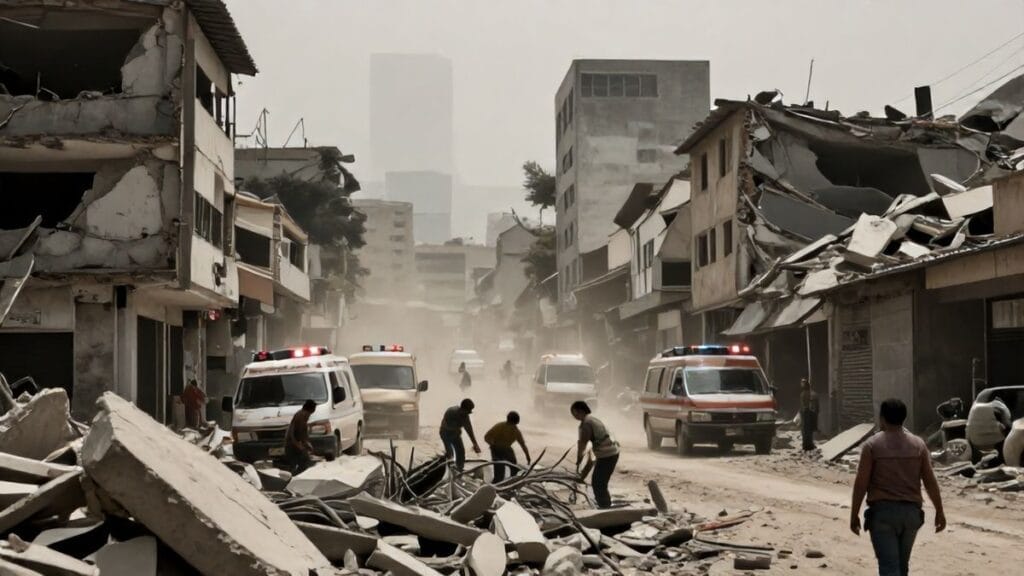
As days passed, the balance shifted from rescue to recovery. The number of bodies retrieved climbed steadily; the official death toll would eventually pass the 1,000 mark, with tens of thousands injured and a vast number left homeless across the region. The exact figure varied depending on the source and the method of counting, a grim reminder that in chaotic disasters, statistics are as much approximations as they are records. What was clear, however, was the scale of the devastation. Entire blocks of the city center lay in ruins, and in some neighborhoods, more than half the structures were either destroyed or beyond repair.
The armenia quindio earthquake had not only broken buildings; it had shredded the networks of care and support that kept daily life running. Rescue operations, vital as they were, could not by themselves address the emerging crises of shelter, food, sanitation, and long-term medical care. The disaster was evolving from an acute emergency into a chronic challenge, one that would require a different kind of endurance from the city and the nation.
From Armenia to the Coffee Axis: A Region Shaken to Its Core
Although Armenia became the symbolic epicenter of the tragedy, the earthquake’s destructive reach extended far beyond the city limits. The departments of Quindío, Risaralda, and to a lesser extent Valle del Cauca and Caldas, all suffered damage. Towns such as Calarcá, La Tebaida, Montenegro, and Pereira reported collapsed buildings, injured residents, and disrupted services. Rural areas, where many coffee farms perched on steep slopes, experienced landslides and road blockages that isolated communities just when support was most needed.
Coffee growers, already grappling with economic difficulties due to fluctuating international prices, saw their infrastructure damaged in an instant. Warehouses crumbled, processing plants cracked, and transport networks were cut. Many families lost not only their homes but also their tools, storage facilities, and access to markets. In a region where land and coffee trees represented both livelihood and legacy, the shock was profound. Elder farmers spoke of never having seen anything like it in their lifetimes, despite living in a land of tremors and storms.
Regional capitals such as Pereira, though less devastated than Armenia, nonetheless bore psychological scars. Images of Armenia’s flattened neighborhoods circulated quickly on national television, and people in neighboring cities recognized familiar streets now rendered unrecognizable. Volunteers from surrounding towns organized caravans of food, water, blankets, and medicine, turning the highways of the Coffee Axis into arteries of solidarity. Churches opened their doors to receive displaced families; schools in less affected municipalities prepared to welcome children whose classrooms had vanished.
The earthquake also highlighted the interdependence of the Coffee Axis. Armenia’s role as an administrative and commercial center meant that its paralysis affected trade, services, and governance across the region. The flow of agricultural goods slowed; bureaucratic processes stalled; regional coordination bodies lost offices and staff. In this sense, the armenia quindio earthquake was not simply a local event: it was a regional blow to the economic and social heart of Colombia’s coffee-producing landscape.
Even in towns where physical damage was limited, the quake shook people’s assumptions about safety. Many residents slept outside for nights afterward, fearful of aftershocks and structural weaknesses in their homes. Engineers and officials from nearby cities began hurried inspections of public buildings—schools, hospitals, municipal offices—realizing that what had happened in Armenia could easily transpire elsewhere under slightly different conditions. The Coffee Axis, once synonymous only with picturesque landscapes and aromatic beans, was now associated in the national mind with disaster and vulnerability.
Government on the Rubble: Political Shockwaves and Emergency Response
Within hours of the quake, the Colombian state was forced into a test of its capacity to respond. Then-President Andrés Pastrana flew over the affected area, looking down at the jagged lines of destruction, the makeshift camps, and the twisted skeletons of buildings. His presence signaled national recognition of the scale of the disaster, but it also raised immediate questions: How fast could aid be delivered? Would corruption and bureaucracy impede recovery? Could a government beset by internal conflict and economic challenges handle a disaster of this magnitude?
The initial emergency response involved a flurry of decrees and mobilizations. Funds were allocated from national reserves; transportation was prioritized for relief goods; the armed forces were ordered to support rescue and logistics. The government created special agencies and commissions to coordinate the effort, including bodies dedicated to reconstruction planning. On paper, it was a comprehensive reaction; in practice, the reality on the ground was messier.
Some residents of Armenia accused authorities of moving too slowly, of leaving certain neighborhoods unattended while focusing on more visible downtown areas. Others complained that aid distribution was chaotic or unfair, that political connections influenced who received tents, food parcels, or construction permits. In the confusion of the first weeks, rumors of mismanagement multiplied, reflecting both genuine concerns and the understandable frustration of traumatized communities.
The disaster exposed long-standing structural problems: unequal development, fragile public institutions, and the lack of robust disaster-preparedness frameworks. While Colombia had agencies tasked with managing risk, their budgets and authority were limited. Civil defense plans existed, but they were often confined to documents rather than integrated into daily governance or public education. Now, under intense scrutiny from both citizens and the international community, the state had to learn in real time how to coordinate multi-level, multi-sectoral responses to a massive natural disaster.
Political leaders visited the region repeatedly, inaugurating temporary housing projects, announcing credit lines for affected businesses, and promising transparent oversight of funds. Some of these commitments bore fruit; others fell short. The armenia quindio earthquake became, as one academic later wrote, “a mirror held up to the Colombian state,” reflecting its strengths in mobilization and its weaknesses in long-term, equitable planning. The political shockwaves would echo for years, influencing debates about decentralization, anti-corruption mechanisms, and the design of a modern disaster-risk management system.
Homes, Markets, and Memories: The Social Fabric Torn Apart
For ordinary people, the quake’s most tangible consequence was the loss of home. Entire neighborhoods in Armenia and surrounding towns were reduced to piles of broken brick, concrete, and corrugated metal sheets. Families who had spent decades slowly improving their houses—adding a second floor, reinforcing a balcony, installing tiles—saw those investments vanish in seconds. Furniture, clothes, photographs, schoolbooks: all lay buried or exposed to the elements.
Many survivors spent weeks or months in temporary shelters: tents set up in parks, sports stadiums converted into dormitories, hastily built wooden barracks on the outskirts of the city. These spaces provided safety from collapsing structures, but they also brought new challenges. Privacy was minimal; tensions flared over shared bathrooms and limited resources. In cramped tents, entire families tried to carve out corners of normality, cooking on small stoves, hanging clothes from improvised lines, putting children to bed amid the murmurs and snores of dozens of strangers.
The loss of traditional markets and commercial streets disrupted not only the economy but also social life. Downtown Armenia, with its web of shops, cafes, and informal stalls, had been a daily meeting point, a place where people exchanged news and favors. Its partial destruction scattered these interactions. Street vendors who had operated the same corner for years found themselves relocated to distant, unfamiliar spaces. Small shop owners faced the dual blow of structural loss and debt: many had outstanding loans for inventory or renovations now buried under rubble.
Memories were as fragile as buildings. In interviews conducted in the years after the armenia quindio earthquake, survivors frequently spoke of losing objects that anchored their sense of identity: wedding albums, heirloom furniture, toys passed down from older siblings. These items, though trivial in material value, embodied family history. Their disappearance deepened the grief, making it not only about those who died but also about the erasure of shared pasts. One woman told a researcher, “I can rebuild a wall, but I cannot rebuild the smell of my mother’s kitchen.”
Social networks, however, also proved to be sources of resilience. Extended families pooled resources; neighbors organized childcare rotations so parents could navigate bureaucratic processes; religious communities provided emotional and spiritual support. In the absence of stable physical spaces, people tried to reconstruct social spaces: shared meals in shelters, outdoor church services, community meetings under tarps. These efforts helped preserve a sense of belonging at a time when everything else seemed to be sliding away.
Grief, Faith, and Community: How People Mourned and Held On
Grief after the earthquake unfolded on multiple levels. There was the immediate, searing pain of those who lost spouses, children, parents, or friends. There was also a more diffuse mourning for the city itself—the streets, buildings, and routines that had structured daily life. Funerals, where possible, became both personal farewells and public rituals of continuity. Yet in many cases, bodies were never recovered or were buried quickly in mass graves due to health concerns, leaving families without the closure of traditional rites.
Religious institutions played a central role in helping people process what had happened. In a country where Catholicism remained deeply ingrained, priests offered not only masses for the dead but also spaces for collective crying, questioning, and reflection. Some interpreted the quake as a test of faith, others as a natural event without moral meaning. Evangelical churches, which had been growing in number in urban neighborhoods, organized prayer circles and distributed aid, strengthening their social presence. Even those who did not consider themselves devout often found comfort in shared rituals and symbols.
Community solidarity, which had manifested so strongly in the immediate aftermath, continued in the months that followed. Volunteer groups organized food drives for the most vulnerable; teachers created improvised classrooms in tents or borrowed spaces; psychologists and social workers—many of them volunteers from other parts of Colombia—offered counseling, especially for children who had begun to exhibit signs of trauma: nightmares, bed-wetting, sudden outbursts of fear when trucks rumbled by or dishes clattered.
Yet grief also had a quieter, more solitary dimension. Some survivors felt guilty for having lived when others did not, especially if they had escaped with minor injuries while neighbors perished. Others grew resentful, whether toward fate, the government, or construction companies whose buildings had collapsed. Alcoholism, domestic violence, and mental health struggles increased in certain sectors, as unresolved trauma simmered beneath the surface of the reconstruction process. These were wounds not always visible in photographs of rebuilt streets.
Over time, stories emerged that tried to impose narrative on chaos. People spoke of premonitory dreams, of pets that had behaved strangely before the quake, of split-second decisions that saved or doomed lives. These tales, mixing superstition, religion, and hindsight, were ways of grappling with the incomprehensible. “It’s astonishing, isn’t it?” one survivor mused years later to an interviewer. “We spend our lives planning, imagining the future, and then everything changes between one minute and the next.”
Rebuilding Armenia: Plans, Promises, and Controversies
Even as rescue and relief continued, conversations about reconstruction began. The central question was not only how to rebuild Armenia, but what kind of city it should become. Should damaged neighborhoods be restored as they were, honoring existing social fabrics, or should the disaster be treated as an opportunity to redesign urban spaces with wider streets, better services, and stricter enforcement of building codes?
The national government, in collaboration with local authorities and international advisors, drafted ambitious plans. Special agencies were created to oversee reconstruction funds, coordinate housing projects, and regulate new construction. Financial instruments, including subsidized loans and grants, were offered to homeowners and businesses. There was talk of turning Armenia into a model of seismic-resistant urban design, a showcase of how a mid-sized Latin American city could rise safer and stronger from catastrophe.
But this was only the beginning of a long and contentious process. Implementation of plans ran up against realities on the ground: land tenure disputes, insufficient budgets, and competing interests between developers, local elites, and low-income residents. In some areas, reconstruction advanced quickly, especially in commercial zones vital to the regional economy. In poorer neighborhoods, however, residents complained of delays, inadequate consultation, or the imposition of solutions that did not fit their needs.
Debates flared over relocation versus in-situ rebuilding. Some geologically unstable areas were declared unsuitable for housing, and families were asked to move to newly developed sites, often farther from city centers and employment opportunities. Critics argued that such relocations risked breaking community ties and pushing the poor to peripheral zones, a common pattern in urban planning worldwide. Supporters insisted that safety had to come first, that the armenia quindio earthquake had exposed the unacceptable risk of building on certain slopes or soils.
Accusations of corruption dogged parts of the process. Journalistic investigations and civil-society watchdogs raised concerns about inflated contracts, misallocation of funds, and favoritism in housing assignments. In a country with a long history of clientelistic politics, the massive flows of reconstruction money created temptations. These controversies did not nullify the significant achievements of the rebuilding effort, but they complicated its legacy. As one scholar noted in a post-disaster analysis, successful reconstruction is never purely technical; it is always entangled with questions of power, equity, and trust.
Still, step by step, the city’s skyline began to change. New housing developments rose, some with more regular designs and visible structural reinforcements. Streets were reopened, markets reestablished, schools and hospitals repaired or rebuilt with modern standards. For visitors arriving a decade later, it might have been hard to picture the destroyed Armenia that had filled television screens in 1999. For residents, however, every new wall carried ghostly shadows of what and who had been there before.
Architecture After Disaster: Safer Cities in a Seismic Land
The armenia quindio earthquake triggered profound reflection among engineers, architects, and urban planners throughout Colombia. Why had so many buildings collapsed? Which types of structures had fared better, and why? How could a country crisscrossed by seismic faults continue to build in ways that minimized risk, especially for the poor, who often lived in the weakest constructions?
Post-disaster surveys revealed patterns. Structures that complied with more recent seismic codes, including reinforced concrete frames properly tied to beams and columns, tended to perform better, even if they suffered damage. Many of the worst collapses occurred in older buildings or those erected informally, without adherence to technical standards. “Soft-story” buildings—those with open, commercial ground floors and heavier upper levels—proved particularly vulnerable, as did structures where illegal modifications had undermined stability. In some cases, decorative facades or heavy parapets peeled off and rained down onto sidewalks, turning aesthetic features into deadly hazards.
In response, Colombian authorities revised and strengthened building regulations, expanding seismic design requirements and improving enforcement mechanisms. Professional associations of engineers and architects launched campaigns to educate both specialists and the general public about the importance of structural integrity. Universities incorporated lessons from Armenia into their curricula, using photographs and case studies to show students the real-world consequences of design choices. International agencies, including the United Nations and the World Bank, highlighted Colombia’s experience as a cautionary tale and a laboratory for better practices.
Yet a gap remained between norms on paper and realities in the field. Many low-income households continued to build incrementally, as savings allowed, often without access to professional guidance. Retrofits of existing buildings, while ideal, were expensive and technically challenging. Still, the cultural shift was notable: earthquakes were no longer seen as purely acts of God but as phenomena whose human toll could be reduced through preparation, regulation, and education. The armenia quindio earthquake, in that sense, contributed to a broader movement toward a “culture of prevention” in Colombian cities.
This evolution extended beyond Armenia itself. Municipalities across the Coffee Axis and other seismically active regions began to update hazard maps, run drills, and develop contingency plans. Critical infrastructure—bridges, hospitals, schools—was subjected to more rigorous scrutiny. While risk could never be entirely eliminated in a mountainous, tectonically restless country, the ambition shifted from reacting to disasters toward anticipating them. The images of Armenia’s fallen buildings became part of the professional and public consciousness, a constant reminder of what negligent construction could cost.
Coffee, Commerce, and Crisis: Economic Aftershocks
Economically, the earthquake struck at a delicate moment. Colombia’s coffee sector had already been under strain, challenged by international competition, changing consumer preferences, and the lingering impact of earlier coffee price collapses. The Coffee Axis, once a nearly unassailable economic motor, was in transition. The quake transformed this slow, complex crisis into a sudden, tangible one.
In the immediate aftermath, commerce ground to a halt in many affected areas. Damaged roads delayed the transport of goods; warehouses and processing plants were unusable; banks and government offices struggled to reopen amid debris. Small businesses, which formed the backbone of Armenia’s urban economy, faced devastating losses: inventory destroyed, clients dispersed, premises condemned. Some benefited from emergency credit lines and state support; others, particularly informal vendors and micro-entrepreneurs, fell through the cracks.
The coffee sector itself suffered multi-layered blows. Though coffee trees continued to grow on hillsides, the infrastructure that connected them to the market was fractured. Some farms lost drying patios, storage facilities, or access roads; others saw workers displaced or killed. The National Federation of Coffee Growers, a powerful institutional actor, mobilized resources to assist producers, but the scale of need was immense. Many smallholders worried less about the next harvest than about rebuilding their houses and ensuring their families’ survival.
Yet behind the immediate losses, there were also opportunities; or at least, that is how some policymakers framed it. Reconstruction funds could, in theory, be used to modernize certain sectors, introduce new technologies, or diversify local economies beyond coffee. Tourism, which had been growing before the quake, was seen as a potential pillar of recovery, especially if marketed around the narrative of resilience and the region’s still-stunning landscapes. In this sense, the armenia quindio earthquake became part of the story not only of tragedy but also of economic restructuring in the Coffee Axis.
Still, such transformations were uneven. Some entrepreneurs harnessed aid and credit to rebuild stronger, even expand. Others never fully recovered, joining the flows of internal migration toward larger cities or abroad. Inequalities that had existed before the disaster were often reproduced, and in some cases deepened, during the recovery. The earthquake did not create economic injustice, but it made it visible in new ways. Streets that were rebuilt with modern facades sat a short drive away from rural hamlets where makeshift repairs remained the norm years later.
Memory, Monuments, and Stories: Keeping 25 January Alive
As the dust settled and the most visible scars began to heal, another process gathered force: the construction of collective memory. Armenios and their neighbors faced a choice, whether conscious or not, about how to remember January 25, 1999. Would it become a date invoked only in hushed tones, a source of unspoken trauma? Or would it be publicly commemorated, turned into a focal point for reflection, mourning, and perhaps civic education?
Over time, memorials appeared. Plaques were installed at particularly affected sites, bearing the names of victims or simple inscriptions honoring “those who lost their lives in the earthquake.” Public ceremonies marked anniversaries, especially the first, fifth, and tenth years, bringing together survivors, officials, clergy, and schoolchildren. In these events, speeches emphasized both loss and resilience: the pain of the day itself and the pride in how the community had responded. “We are a city that fell and stood up again,” one mayor proclaimed, condensing a complex experience into a phrase.
Museums and small exhibitions dedicated sections to the disaster. Photographs taken in the days after the quake—collapsed churches, tent cities, rescue workers caked in dust—were displayed alongside testimonies. For younger generations who had been children or not yet born in 1999, these images offered a mediated access to an event that nonetheless shaped their daily environment. School curricula in Armenia and surrounding municipalities sometimes included units on the earthquake, linking it to lessons about geology, civic responsibility, or urban planning.
Not all memory work was institutional. In living rooms and neighborhood gatherings, stories circulated in more intimate registers. Families repeated certain anecdotes until they became almost ritualistic: what each person had been doing at 1:19 p.m.; how they had found each other again; the quirks of fate that separated those who died from those who lived. These narratives sometimes softened the horror with humor, at other times re-opened barely healed wounds. As anthropologists have observed in similar contexts, such storytelling is both a coping mechanism and a way of stitching individual experiences into a broader communal fabric.
There were also debates about what not to remember. Some residents resented the persistent association of their city’s name with disaster in national and international media. They wanted Armenia to be known again for coffee, hospitality, and natural beauty, not for rubble. Others argued that forgetting the quake’s lessons—about corruption, vulnerability, and inequality—would be dangerous. The tension between promoting a hopeful image and honoring a painful past remains part of the city’s identity. The armenia quindio earthquake, however, refuses to fade entirely; it returns each January in ceremonies, in quiet visits to cemeteries, and in the simple tightening of the chest when the ground trembles, even slightly.
Science Learns, Citizens Prepare: Lessons from the Quindío Tragedy
Disasters, as researchers often say, are laboratories of learning, albeit brutal ones. The armenia quindio earthquake became a case study for a wide array of disciplines: seismology, engineering, urban planning, sociology, political science, and psychology. Scholars from Colombian universities and international institutions descended on the region in the months and years that followed, collecting data, interviewing residents, and tracing the complex interplay between natural forces and human decisions.
Scientific studies provided detailed analyses of ground motion, fault behavior, and the distribution of damage. One frequently cited report mapped the intensity of shaking across the region, showing how local geological conditions amplified or dampened seismic waves. Other research focused on building performance, correlating structural types with collapse patterns. These findings fed back into revised codes and risk assessments, producing more nuanced hazard maps for the Coffee Axis and beyond.
Social scientists, for their part, examined how different groups experienced and responded to the disaster. Gender, class, age, and ethnicity all shaped vulnerability and resilience. Women often bore disproportionate burdens in the aftermath, managing childcare, elderly relatives, and household logistics in cramped shelters. The poor, who lived in the least robust housing and had few financial buffers, faced steeper paths to recovery. Yet these same groups frequently displayed remarkable organizational capacity, forming committees, advocacy groups, and mutual-aid networks.
One of the most enduring lessons was the importance of preparedness and education. In the years following the quake, Colombian authorities and civil society organizations invested more heavily in public-awareness campaigns about earthquakes. Schools conducted regular drills; children learned to “drop, cover, and hold on,” to identify safe zones in their homes and classrooms, to pack basic emergency kits. Local governments developed contingency plans outlining responsibilities, communication channels, and resource allocations for future disasters.
These efforts did not guarantee safety, but they represented a shift from fatalism to proactive risk management. As a later government report bluntly stated, “The tragedy in Armenia demonstrated that while we cannot prevent earthquakes, we can prevent many of the deaths and losses they cause” (author’s translation). The armenia quindio earthquake thus became a grim but valuable teacher, its lessons echoing through policy documents, training courses, and the everyday vigilance of citizens who had learned the hard way that the ground beneath them was not unshakable.
From Local Disaster to Global Awareness: Aid, Media, and Diplomacy
News of the earthquake spread rapidly beyond Colombia’s borders. International media outlets broadcast images of destroyed neighborhoods and tent cities, situating the disaster within a global narrative of natural catastrophes that included, in that decade alone, earthquakes in Turkey, Taiwan, and elsewhere. Armenia, a city little-known outside Colombia, suddenly appeared on television screens in distant countries, its name spoken with strained accents by foreign news anchors.
International aid followed this surge of attention. Governments, multilateral organizations, and NGOs offered assistance: money, supplies, technical expertise, and specialized rescue teams. The United Nations coordinated aspects of the response, while the Red Cross and various humanitarian agencies set up operations on the ground. For Colombia, a country often in the news for drug-related violence and internal conflict, the disaster provided a different kind of interface with the world—one defined by sympathy and solidarity rather than fear or condemnation.
Yet behind the expressions of support lay complex dynamics. Aid had to be coordinated with national and local authorities, channeled through bureaucracies that were not always agile. Different organizations brought their own priorities and conditions, sometimes leading to duplication of efforts in some areas and gaps in others. Media attention, so intense in the first days, quickly moved on to other crises, leaving long-term reconstruction largely out of the global spotlight. Armenios learned, in real time, the rhythms of international concern: urgent, emotive, but often short-lived.
Diplomatically, the armenia quindio earthquake highlighted Colombia’s participation in emerging global frameworks for disaster risk reduction. The country’s experience contributed to international discussions and agreements, such as those shepherded by the United Nations Office for Disaster Risk Reduction (UNDRR). Colombian experts were invited to share findings and strategies at international conferences, and foreign scholars came to study the reconstruction process as an example of post-disaster urban transformation in the Global South.
For many survivors, however, these macro-level interactions were distant abstractions. What mattered most was whether tents arrived before the next rain, whether their children could return to school, whether their insurance claims were processed. Still, the infusion of international resources and attention, however imperfect, helped ease some immediate suffering and accelerated certain aspects of rebuilding. The disaster became a node in a global network of knowledge and aid, connecting Armenia’s tragedy with broader efforts to understand and mitigate natural hazards worldwide.
Survivors’ Voices: Lives Divided into “Before” and “After”
Behind every statistic of the armenia quindio earthquake lay human stories, each with its own texture of fear, loss, courage, and adaptation. In the years that followed, journalists, researchers, and local chroniclers recorded some of these voices, recognizing that without them, the disaster’s history would be incomplete.
A schoolteacher recalled the moment the earth began to move: “The blackboard shivered, the lights went out, and the children screamed. I shouted for them to get under their desks, but some ran toward the door, and I had to choose—grab them or duck myself. I remember thinking: this is how we die. But then, suddenly, it was over, and the building was still standing. We spent hours in the yard, holding each other, listening to the sirens.” Her voice, years later, still trembled.
A street vendor described losing both his stall and his home: “I had my little cart near the plaza. I sold arepas and coffee. When the quake hit, the facade of the building behind me fell right on top of the cart. If I hadn’t stepped away to talk to a friend, I would have died there. My house in the barrio also collapsed. In one day, I lost my job, my place to sleep, everything. I slept in a tent with my wife and kids for months. We started again, little by little. Now I have a new spot, but I still dream about that sound of the wall falling.”
A teenage girl, who later became a community organizer, remembered the solidarity: “I was fourteen. We spent nights outside, all the neighbors together. We cooked in big pots; we shared stories; we cried. I realized then how much we needed each other. Before, everyone was in their own world. After the earthquake, we knew we were one barrio. That feeling pushed me to get involved later, to fight for better housing and services.”
These testimonies share a common thread: the sense that life had been divided into two eras—before and after January 25, 1999. Everyday inconveniences that once seemed important shrank in significance; the fragility of existence became a lived truth, not a philosophical abstraction. Many survivors reported changes in priorities: valuing family time more, engaging in community issues, or, conversely, withdrawing from long-term planning, living instead in a cautious present.
Memory, however, is not static. As years passed, some details faded or were reshaped, while others became sharper. The trauma did not vanish, but it coexisted with new experiences: births, graduations, elections, new buildings. The voices of survivors, recorded in oral-history projects and interviews, ensure that future generations will be able to hear, in their own words, what it felt like when the ground betrayed them and how they chose, despite everything, to keep going.
A City Reimagined: Armenia’s Long Road to Renewal
Today, walking through Armenia, it is possible to see both continuity and change. Reconstructed avenues bustle with traffic; new parks and plazas host families on weekends; shopping centers and office buildings reflect broader trends in Colombian urban development. Tourists once again pass through on their way to coffee farms and natural attractions. At first glance, the city might appear simply as another Andean urban center, bearing few visible signs of the catastrophe that struck more than two decades ago.
Look closer, however, and the imprint of the armenia quindio earthquake emerges. Certain neighborhoods display more orderly housing layouts, the result of post-disaster planning. Plaques and small monuments whisper reminders of lost lives and collapsed structures. Emergency-evacuation signs and school drills speak to an ingrained awareness of seismic risk. The very mindset of many residents—their reflex to head for open spaces when they feel even a mild tremor—testifies to a collective memory encoded in bodies as much as in institutions.
The city’s renewal has been uneven, like most long-term recovery processes. Some sectors boast modern infrastructure and robust services, while pockets of poverty persist, where houses were self-built or patched together over years, sometimes still without full compliance with seismic standards. The tourism industry, promoted through the image of the Coffee Cultural Landscape—later recognized by UNESCO as a World Heritage site—provides income but also raises questions about who benefits and who is left on the margins.
Yet Armenia’s story is not only one of gaps and struggles. It is also a narrative of adaptation and reinvention. Civic organizations born out of the earthquake’s crucible continue to advocate for better governance, transparency, and social inclusion. Universities and research centers in the region have carved out niches in studying natural hazards, urban resilience, and community organizing. Young people who barely remember the quake nonetheless grow up in an environment shaped by its legacies, inheriting both improved infrastructure and cautionary tales.
In this sense, the armenia quindio earthquake occupies a paradoxical place in the city’s identity. It is a wound that never fully heals, but also a source of hard-earned wisdom. It revealed weaknesses but also strengths, prompting changes that may, in the long term, save lives when the next major tremor strikes. Armenia, like many cities built on restless ground, lives with the knowledge that disaster is not a one-time event but a recurring possibility. Its challenge—and, perhaps, its quiet achievement—has been to transform that knowledge into a more conscious, if still imperfect, way of inhabiting the land.
Conclusion
The Armenia (Quindío) earthquake of January 25, 1999 was more than a violent geological episode; it was a turning point in the social, political, and emotional life of an entire region. In less than a minute, the armenia quindio earthquake collapsed buildings, severed families, and forced an entire city to confront the fragility of its foundations—physical and institutional alike. The tragedy revealed the costs of uneven development, lax enforcement of building codes, and limited disaster preparedness, even as it showcased extraordinary acts of solidarity and courage among ordinary citizens.
In its aftermath, Armenia and the broader Coffee Axis embarked on a complex journey of rescue, relief, and reconstruction. Governments, engineers, and planners drew technical lessons that reshaped building standards and risk management policies across Colombia. Survivors and communities, meanwhile, forged new forms of organization, advocacy, and mutual aid, turning immediate solidarity into longer-term civic engagement. International actors contributed aid and expertise, situating the disaster within a global conversation about natural hazards and human vulnerability.
Yet behind these structural changes lies a quieter, enduring story: that of individuals whose lives were split into “before” and “after,” who rebuilt homes and identities amid grief and uncertainty. Memory work—through monuments, testimonies, and commemorations—has ensured that the armenia quindio earthquake remains present in the city’s consciousness, not as a static trauma but as a source of caution and, paradoxically, resilience. Armenia today bears many signs of renewal, but the echo of that January afternoon persists in the reflexive glance upward at a ceiling when the floor trembles, in the careful construction of new walls, in the annual ceremonies that mark the date.
Ultimately, the story of the Armenia earthquake is a reminder that disasters are never purely “natural.” They occur at the intersection of tectonic forces and human choices—where we build, how we regulate, whom we protect. In honoring the victims and learning from the past, Armenia and Colombia have moved, however imperfectly, toward a future in which the next earthquake, inevitable in geological terms, need not be as devastating in human terms. The ground may shake again, but the knowledge and institutions forged in 1999 offer a measure of protection, born out of pain and sustained by a community’s determination to remember and to prepare.
FAQs
- What was the Armenia (Quindío) earthquake?
The Armenia (Quindío) earthquake was a powerful seismic event that struck central Colombia on January 25, 1999, with a magnitude of about 6.2. Its epicenter was near the town of Córdoba in the Quindío department, and it caused catastrophic damage in the city of Armenia and across the Coffee Axis region. - How many people died in the armenia quindio earthquake?
Official figures report that more than 1,000 people died and tens of thousands were injured, though exact numbers vary by source due to the chaos of the emergency and differing methodologies. In addition to the human toll, hundreds of thousands were affected through loss of homes, livelihoods, and essential services. - Why was the damage so severe if the magnitude was “only” around 6.2?
The severity of the damage was due to the quake’s shallow depth, its proximity to densely populated urban areas, and the vulnerability of many buildings. Structures that did not comply with seismic-resistant codes, or that had been modified informally, were especially likely to collapse, turning a moderate-to-strong quake into a major humanitarian disaster. - Which areas were most affected?
The city of Armenia in Quindío was the hardest hit and became the symbol of the tragedy, but the quake also caused serious damage in other municipalities of Quindío, as well as in parts of Risaralda, Valle del Cauca, and Caldas. The broader Coffee Axis region experienced infrastructure damage, landslides, and widespread social and economic disruption. - How did the Colombian government respond?
The government declared a state of emergency, mobilized the armed forces and emergency services, and created special agencies to manage reconstruction and aid distribution. While significant resources were deployed and many lives were saved, the response also faced criticism for delays, inequities, and instances of mismanagement or corruption. - What changes did the earthquake prompt in building regulations?
After the armenia quindio earthquake, Colombia strengthened its seismic design codes and put greater emphasis on enforcement, especially for critical infrastructure such as schools and hospitals. Engineering studies of collapsed structures informed updated standards, and public-awareness campaigns highlighted the importance of safe construction, even for small, self-built homes. - How long did the reconstruction of Armenia take?
Emergency relief occupied the first months, but substantial reconstruction efforts—rebuilding housing, infrastructure, and public buildings—extended over many years. While key sectors of the city were physically rebuilt within roughly five to ten years, social and psychological recovery has been a longer, ongoing process. - Did international aid play a major role?
Yes. International rescue teams, humanitarian organizations, and foreign governments provided crucial support in the immediate aftermath and contributed funds, supplies, and technical expertise to reconstruction projects. This aid complemented national efforts and helped place the Armenian disaster within a global conversation about disaster risk reduction. - How is the earthquake remembered today in Armenia?
The earthquake is commemorated annually through ceremonies, religious services, and public events. Memorials and plaques mark significant sites, and museums or exhibitions preserve photographs and testimonies. For many residents, personal memories—of loss, solidarity, and survival—remain vivid, shaping local identity and attitudes toward risk and preparedness. - What lessons did the armenia quindio earthquake provide for disaster preparedness?
The disaster underscored that vulnerability, not just hazard, determines the scale of catastrophe. Key lessons include the vital importance of enforcing seismic codes, educating the public about emergency responses, planning for coordinated relief, and ensuring that reconstruction processes are equitable and transparent. These insights have informed policies in Colombia and contributed to international best practices in disaster risk management.
External Resource
Internal Link
Other Resources
- Encyclopaedia Britannica – general search for the exact subject
- Google Scholar – academic search for the exact subject
- Internet Archive – digital library search for the exact subject