Table of Contents
- When the Mountain Awoke: Setting the Stage for Gaua’s Eruption
- Island of Fire and Mist: The Geological Soul of Gaua
- Echoes from the Past: Earlier Eruptions and Oral Histories
- Whispers of Ash: The First Signs in Early 2009
- The Sky Turns Gray: Escalation of the Gaua Eruption Vanuatu
- Living in the Shadow of a Crater: Daily Life Amid Rumbling Earth
- Voices of Alarm: Scientists, Observers, and the Birth of a Crisis
- Between Faith and Fear: Custom, Christianity, and the Volcano
- A Village on the Move: Evacuations and Reluctant Departures
- Ash on the Breadfruit Trees: Agriculture, Water, and Survival
- Inside the Command Room: Government, Warnings, and Hard Decisions
- A Distant Rumor to the World: Media, Aid, and Global Attention
- Children of Smoke: Memories, Trauma, and Stories of the Young
- When the Roar Softened: The Gradual Waning of the 2010 Activity
- Counting the Invisible Losses: Social and Cultural Consequences
- Lessons in Ash and Time: Disaster Preparedness After Gaua
- Gaua in the Eyes of Science: Data, Models, and Ongoing Watchfulness
- Island of Return: Homecoming, Resettlement, and Quiet Resilience
- A Volcano, a Nation, and the Future: Climate, Sea, and Fire
- Conclusion
- FAQs
- External Resource
- Internal Link
Article Summary: This article tells the story of the 2009–2010 gaua eruption vanuatu, an episode when a quiet island in the remote Banks group found itself under a restless sky of ash and thunder. It traces how distant tremors and faint plumes slowly turned into an urgent humanitarian crisis, forcing families to abandon ancestral lands and sacred sites. Blending historical context, local oral traditions, and scientific insight, the narrative shows how Gaua’s volcano has long shaped identity, belief, and survival on the island. It follows the difficult choices of government officials, volcanologists, village chiefs, and mothers trying to keep their children safe while not losing their home. Along the way, it explores the political and social implications of evacuations, the fragile systems of warning and response, and the emotional costs of displacement. The article also situates the gaua eruption vanuatu within the broader “Ring of Fire,” comparing it to other Pacific eruptions and highlighting what made this one distinct. Finally, it reflects on the quiet years that followed, the slow return of communities, and the continued, uneasy companionship between islanders and the mountain that sleeps above them. Through this lens, the gaua eruption vanuatu becomes not only a natural disaster, but a profound moment of historical and human transformation.
When the Mountain Awoke: Setting the Stage for Gaua’s Eruption
In late 2008, the island of Gaua lay in a kind of luminous isolation. Tucked in the northern Banks group of Vanuatu, it was an emerald ring around a hidden, simmering heart: Lake Letas, the largest freshwater lake in the country, encircling a brooding volcanic cone. On clear mornings, canoes slipped soundlessly across the lake’s glassy surface while roosters crowed in the coastal villages below. To passing fishing boats and distant satellite images, Gaua seemed quiet, almost forgotten—a speck of green amid a vast, restless ocean. Yet beneath this tranquil façade, magma was stirring, gases were pushing upward, and the island’s ancient cycle of fire and renewal was preparing its next chapter.
For the people of Gaua, the volcano was not a geological feature but a living presence, endowed with spirit and story. It had no single name in the way a Western map might label it: to many, it was simply “the mountain,” or associated with ancestral figures remembered in songs and myths. Children were taught where not to go, which crags and ridges were taboo, where spirits walked in the mist. The occasional whiff of sulfur or distant thud from deep within the earth were not necessarily signs of danger; they were part of the island’s breathing. And so, when the first whispers of increased activity came in early 2009, they arrived in a world that had long accepted that it lived side by side with something powerful, unpredictable, and sacred.
The nation of Vanuatu itself has been shaped by these forces. Straddling the Pacific “Ring of Fire,” the archipelago exists in a constant negotiation between land and sea, heat and storm. Volcanic cones rise from many islands; underwater vents, earthquake faults, and coral reefs form an intricate and fragile web. As one government official would later remark, half in jest and half in resignation, “We do not live near hazards. We live on them.” The gaua eruption vanuatu episode in 2009–2010 would become yet another test of how this small, dispersed nation responds when its foundations quite literally tremble.
But in those first months, there was no sense of impending disaster. There were school schedules to follow, yam gardens to tend, church services to attend, and betel nut to chew under breadfruit trees. Traders moved between islands in small boats, bringing kerosene, rice, and gossip. The global financial crisis was rippling across the world’s markets, yet Gaua, with its limited connection to cash economies, felt far away from such distant storms. The island’s attention rested on more immediate concerns—weather patterns, harvest yields, the balance between tradition and the modern world. If the mountain was beginning to wake, it did so with the subtlety of a slow breath drawn in the dark.
Island of Fire and Mist: The Geological Soul of Gaua
To understand what happened in 2009–2010, one must first understand what Gaua is, geologically and spiritually. The island is essentially the exposed summit of a massive stratovolcano, rising from the seafloor thousands of meters below. Its broad shoulders, cloaked in rainforest and garden plots, ring a central basin flooded by Lake Letas. Within that vast oval of water stands the active cone—Mount Gharat—its sides streaked with old lava flows, fumaroles, and gullies carved by relentless tropical rains.
Over tens of thousands of years, eruptions have built and reshaped this volcanic edifice. Ash layers, lahar deposits, and pyroclastic flows lie buried beneath the surface, like the pages of a vast, unread manuscript. Geologists who have studied the island describe a complex pattern of eruptive behavior: periods of quiescence broken by episodes of ash emissions, Strombolian explosions, and occasionally more violent events. Gaua is no stranger to activity; it is a volcano that seldom sleeps completely. But it had been decades since its last period of notable unrest, and for many islanders born in the late twentieth century, active eruption was a story from their parents’ or grandparents’ time rather than something they had personally witnessed.
This physical structure has profound implications for life. The fertile volcanic soils support dense vegetation, root crops, and fruit trees. At the same time, the steep slopes and ash-prone ridges mean that heavy rains can trigger landslides, and gas emissions can surprise hunters or travelers in the highlands. Lake Letas is both a barrier and a blessing: it forms a natural moat around the central cone, limiting direct access, but also stores a vast volume of water that, in a worst-case scenario, could interact explosively with newly erupted magma. Scientists viewing satellite imagery in 2009 were acutely aware that Gaua’s geography could both dampen and intensify certain hazards.
Historically, this duality—nurturing and dangerous—has been woven into local cosmology. Many Ni-Vanuatu communities perceive the landscape as animated by spirits and kastom (custom) powers. On Gaua, stories told by elders speak of ancestral figures who carved paths through the mountains, tamed or enraged the waters of the lake, and interacted with the fiery heart of the island. Some accounts describe times when the mountain “spoke loudly” with thunder, or when ash fell “like black rain.” These oral histories, passed from hearth to hammock, preserve the memory of past eruptions even when written records are absent.
Thus, by 2009, Gaua stood as a palimpsest of fire and rain, myth and measurement. The modern state of Vanuatu, in collaboration with international partners, had begun to monitor its volcanoes more systematically. Seismographs, gas sensors, and occasional helicopter overflights turned the island’s restlessness into graphs and tables. Yet for most residents, the truest barometer of danger remained the mountain’s own voice: the sound of explosions echoing over the lake, the thickness of ash on a leaf, the itch at the back of the throat when the wind blew from the crater. It is in this world—where digital data and ancestral lore coexist—that the story of the gaua eruption vanuatu must be situated.
Echoes from the Past: Earlier Eruptions and Oral Histories
Long before 2009, Gaua had already produced episodes that shaped its communities’ memory. Historical records from European and Melanesian observers in the nineteenth and twentieth centuries mention sightings of eruptions: distant plumes, floating pumice, and nights lit strangely red. Missionaries, traders, and colonial administrators occasionally noted “volcanic disturbances” on their charts, but their accounts were fragmented, filtered through the priorities of empire and commerce. For the islanders themselves, the volcano’s moods were part of a more intimate chronicle.
In villages along Gaua’s coast, elders recalled stories of ashfall events that damaged crops and darkened the sky. One commonly retold memory described a time when the sun “became like the moon” for several days, hidden behind veils of drifting ash. Gardens suffered, and fish were harder to catch; some families moved temporarily to less affected parts of the island. Another story spoke of a man who ignored taboos and hunted too close to the lake; the mountain, offended, responded with thunderous roars and smoke that frightened even the bravest warriors. Whether these tales described literal eruptions or blended symbolic caution with historical kernels, they kept the sense of the volcano as an unpredictable neighbor.
During the twentieth century, scientific documentation improved. Reports from the 1960s and 1970s referenced episodes of increased fumarolic activity and minor explosive events. Ash plumes rose several kilometers at times, and local inhabitants spoke of hearing the mountain “coughing” at night. Yet these events did not trigger large-scale evacuations; they were treated as interruptions, not existential threats. Life adapted—people shifted garden plots, avoided certain paths, listened to the radio for rare official bulletins, and trusted in both prayer and kastom rituals.
By the early 2000s, the memory of the last significant eruption was fading. Young adults in 2009 might have heard of it but had not personally experienced severe volcanic disruption. This generational forgetting is common in volcanic regions; as researchers in disaster anthropology often note, risk perception erodes in the absence of frequent events. One scholar writing about Vanuatu’s volcanoes observed that “disasters vanish into myth more quickly than ash washes from the leaves,” a poignant reminder of how time smooths the rough edges of danger. Gaua, for all its geological restlessness, carried an air of relative calm—until the patterns shifted again.
These past echoes would prove crucial once the mountain awoke. Some elders recognized familiar signs sooner than the younger generation did. When unusual rumbling began in 2009, a few older villagers reportedly said, “It is like in the stories of my grandfather.” In that sense, oral tradition functioned as a living archive, filling the gaps where written catalogues of eruptions were incomplete. The gaua eruption vanuatu was not a first-time event in the island’s long biography, but it would be the first to unfold in an era of modern national governance, global media, and climate anxiety—a convergence that made it uniquely consequential.
Whispers of Ash: The First Signs in Early 2009
The first tangible hints of change arrived quietly. In the early months of 2009, a few fishermen noticed that the plume over the central cone seemed thicker than usual on some mornings, its white steam tinged with a darker, more ominous gray. Hunters in the uplands reported a stronger sulfur smell when the wind shifted toward the coast. At night, those sleeping in open-sided houses sometimes woke to a faint tremor, like a heavy truck passing on a distant road—except there were no roads, and no trucks, on Gaua.
These signs trickled into local conversations long before they reached the desks of officials in Port Vila, Vanuatu’s capital. On small islands, news travels by footpath, canoe, and church gathering. After Sunday services, men and women lingered to discuss what they had noticed. Was the mountain simply reminding people of its presence, or was something larger unfolding? Some argued that changes in the crater were normal, part of a cyclical rhythm. Others, remembering older tales, said that such persistent rumbling was not to be dismissed.
By mid-2009, scientific monitoring began to confirm that Gaua was entering a new phase. The Vanuatu Geohazards Observatory, tasked with tracking the country’s numerous volcanoes, received reports of increased seismicity and occasional ash emissions. Satellite imagery picked up small, intermittent plumes rising from the island’s core. For volcanologists, these were classic warning signs: magma moving within the conduit, pressure building, gas seeking escape routes. Still, these observations did not automatically indicate a major eruption. Many volcanoes simmer at this heightened level for months or years without progressing to a full crisis.
Communication constraints made the situation more complicated. Vanuatu is spread across scores of islands, and resources for continuous, ground-based monitoring were limited. No dense network of instruments wrapped around Gaua; much of the understanding came from a combination of field visits, remote sensing, and, crucially, local testimony. When a team from the observatory traveled to the island in late 2009, they saw fresh ash on the slopes and heard the cannon-like booms from the crater. To stand at the edge of Lake Letas and listen to those explosions was to feel the earth speaking in a tongue as old as the archipelago itself.
But for now, the signs were still whispers rather than shouts. No lava flows poured down the cone. No pyroclastic avalanches raced toward the villages. The ash fall, while noticeable, remained light and sporadic. As a result, most residents continued with their routines, weaving the new noises into the daily soundtrack of island life. It would take a few more months—and a marked intensification of activity—before the gaua eruption vanuatu forced people to truly confront its implications.
The Sky Turns Gray: Escalation of the Gaua Eruption Vanuatu
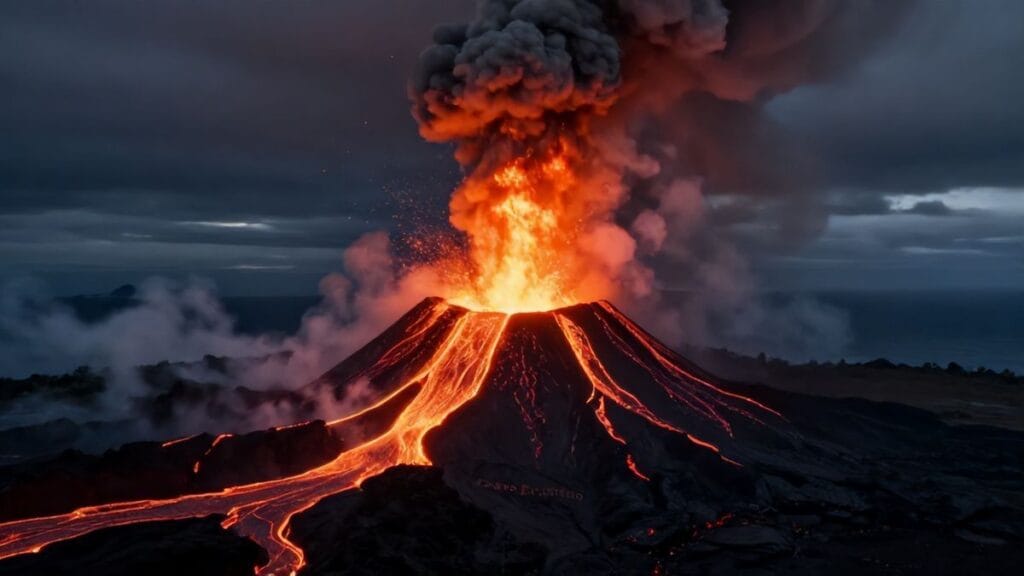
As 2009 turned toward its final quarter, the character of the unrest changed. Explosions from the central cone grew more frequent and more forceful. Ash plumes climbed higher into the sky, sometimes reaching several kilometers, their anvils spreading out and trailing with the wind. On some days, fine gray particles drifted down onto coastal villages, coating roofs and leaves, crunching softly under bare feet. Children rubbed their eyes more often; elders coughed and spat into the dust.
In October, regional bulletins began to refer openly to an “eruption” at Gaua, though not yet a cataclysmic one. The Vanuatu government raised the official alert level, signaling increased risk. For most outside observers, the gaua eruption vanuatu was still a distant line in technical reports, overshadowed by more dramatic disasters elsewhere. But for those on the island, the volcano was no abstraction: it was the sound that made the windows rattle, the smell that lingered in the air, the haze that turned sunsets into eerie smears of red and orange.
Nights grew particularly unsettling. Without urban lights to dull the heavens, any glow from the crater was sharp and insistent. On clear evenings, some villagers reported seeing flickers of red deep in the central cone, like a fire burning behind a veil of smoke. Each explosion produced not only a thunderclap of sound but also a pressure wave that some felt in their chests. Livestock grew skittish; dogs barked at what seemed to be nothing, then cowered when the mountain roared.
Daily chores were now framed by worry. Women washing clothes in streams checked the sky frequently; farmers wondered whether to invest effort in fields that might soon be covered in ash. The schools remained open, but teachers had to raise their voices over distant booms. At night, pastors and catechists led special prayers, asking for protection, guidance, and mercy. Yet behind the prayers lay difficult questions: If things worsened, where would people go? How would they travel? And when would someone in authority say, “It is time to leave”?
By early 2010, the answer was becoming harder to delay. Ashfall intensified on the western and northwestern flanks of the island. Some villages reported persistent respiratory irritation; water sources became suspect as fine particles settled into tanks and open pools. The combination of ash, gas, and psychological strain began to take a toll. The gaua eruption vanuatu had moved from a geological event to a humanitarian concern, and the island’s isolation turned that concern into urgency.
Living in the Shadow of a Crater: Daily Life Amid Rumbling Earth
To picture life on Gaua during the peak of the 2009–2010 unrest, one must imagine a world in which interruption becomes the new normal. The day still began at dawn—with the crowing of roosters, the crackle of small cooking fires, and the murmur of morning prayers—but every conversation circled back to the mountain. Parents calculated whether their children should travel the longer but safer path to school, avoiding routes that seemed more exposed to ash. Fishermen weighed the risk of being out on the sea when the wind changed and a fresh cloud of particles swept overhead.
Ash is deceptively light, but its accumulation is insidious. Thin layers on roofs added weight with every new fall, especially when moistened by passing showers. Women sweeping houses and yards found their work undone by the next gust of wind, which lifted fine grains back into the air. Eyes grew gritty, and throats raw. For those with preexisting health issues, these conditions were more than an annoyance; they were a genuine hazard. Yet access to medical care on a small island is limited. Basic clinics did what they could with modest supplies, treating coughs and eye irritation, monitoring more serious respiratory distress, and sending the most critical cases to hospitals on larger islands when transport was available.
Children processed the crisis in ways both poignant and unsettling. Some made games of tracking how loud each explosion sounded, or how much the ground shook, giving the mountain a personality—sometimes a grumpy grandfather, sometimes an angry spirit. Others developed nighttime anxieties, clinging to parents when the sky flashed with lightning or the crater’s glow seemed brighter than usual. Teachers, some themselves anxious, tried to integrate simple explanations into lessons: what a volcano is, why ash falls, how to stay safe. But the lines between education and fear management blurred.
Livelihoods tilted under the strain. Gardens near the ashfall zones suffered as particles coated leaves and blocked sunlight. Some crops, more resilient, survived; others withered, their yields reduced. Coconut palms and breadfruit trees, mainstays of island diets, displayed leaves dulled by gray dust. For families already living close to subsistence level, the loss of even part of a harvest felt like a direct threat to survival. Fishing remained a fallback, but rougher seas and changing weather patterns complicated this lifeline.
And through it all, the volcano kept up its unpredictable rhythm. Some days were quieter, lulling people into a fragile sense of relief. On other days, a string of loud detonations reminded everyone of their vulnerability. The gaua eruption vanuatu was not a single, cinematic event; it was a drawn-out ordeal, a months-long negotiation between staying and going, between endurance and flight. In that ambiguity, daily life became both an act of resilience and a test of limits.
Voices of Alarm: Scientists, Observers, and the Birth of a Crisis
While villagers swept ash from their doorsteps, a parallel drama unfolded in offices, laboratories, and coordination rooms. The Vanuatu Geohazards Observatory, based in Port Vila, was receiving increasingly concerning data from Gaua. Field teams returning from brief visits described strong explosive activity, dense ash plumes, and fresh impact craters from falling blocks near Lake Letas. Instruments, though sparse, recorded elevated seismic activity consistent with an ongoing magmatic eruption.
Volcanologists, both local and international, debated the likely trajectory. Would Gaua continue at this moderate but damaging level of activity, or was it building toward something more severe? Assessing such questions is notoriously difficult. As the volcanologist Clive Oppenheimer has written in another context, “Volcanoes are like people: each has its own character and unpredictable moods.” This insight resonated keenly in meetings where officials pored over maps and hazard scenarios, aware that an overreaction could trigger unnecessary displacement, while an underreaction could cost lives.
International agencies, including the Global Volcanism Program and regional monitoring networks, started to circulate more detailed advisories. Travel warnings, though limited in their practical impact on a little-visited island like Gaua, acknowledged that a significant eruptive episode was underway. The phrasing was technical and restrained, but between the lines lay a clear message: the situation demanded close attention.
Field scientists returning from Gaua brought back more than measurements; they carried stories. They spoke of darkened skies, of villagers expressing both fear and stoic acceptance, of the eerie silence that sometimes followed a sequence of explosions, as if the island were holding its breath. One team member later recalled standing on the rim of Lake Letas, hearing a powerful blast from the cone, and feeling the shock wave ripple across the water to thump against their chest. “You realize very quickly that you are a guest in a system much larger than yourself,” he said.
These experiences shaped the tone of their recommendations. It was no longer enough to describe activity levels; they had to translate seismic traces and ash plume heights into actionable advice for policymakers. As the gaua eruption vanuatu dragged on, the pressure mounted to decide whether full or partial evacuations of exposed communities should be implemented. This was not only a scientific question, but also an ethical, economic, and cultural one. To uproot a village is to disrupt social fabric, ancestral ties, and livelihoods—choices not made lightly.
Between Faith and Fear: Custom, Christianity, and the Volcano
Behind the technical warnings and government bulletins lay another layer of interpretation: the spiritual. Gaua, like much of Vanuatu, is a place where kastom beliefs and Christianity coexist, sometimes in tension, often in creative dialogue. For many islanders, the volcano’s unrest in 2009–2010 demanded not only scientific explanations but spiritual ones. Why was the mountain angry? What had people done—or failed to do—to provoke such a response?
Some elders turned to ancestral narratives. They spoke of broken taboos, of sacred sites near the lake that had been neglected or disrespected. Perhaps, they suggested, the balance between humans and the spirits of the island had been disturbed. In such a framework, the gaua eruption vanuatu was as much a moral message as a geological event. To restore peace, communities might need to perform specific rituals, offer symbolic gifts, or reaffirm old agreements with the land and its unseen guardians.
Christian leaders, meanwhile, framed the crisis in terms of faith, providence, and repentance. Churches became focal points for communal response: places where fears were voiced, songs rose in harmonies tinged with anxiety, and sermons grappled with suffering and trust. Some pastors emphasized the need to “listen to the wisdom of those who study the world God has made”—a subtle endorsement of scientific guidance and evacuation plans. Others stressed prayer and resilience, urging people not to panic but also not to ignore the signs.
For many residents, there was no contradiction in drawing from both wells. They could attend mass or a revival meeting on Sunday and still consult an elder versed in kastom on Monday. They could heed a geohazards officer’s advice about ash and still interpret the mountain’s roar through a spiritual lens. This multiplicity shaped decisions in powerful ways. A family might choose to evacuate not only because officials recommended it, but because a dream, a prophecy, or an elder’s warning confirmed that the time had come to move.
The interplay of belief systems also influenced how people viewed the risk of leaving ancestral lands. Some worried that abandoning shrines or important graves without proper rituals would invite misfortune. Others saw evacuation as a test of faith: would God protect their homes if they trusted and obeyed? Within this complex web of meaning-making, the gaua eruption vanuatu became a crucible where theology, kastom, and volcanic ash met in unexpected combinations.
A Village on the Move: Evacuations and Reluctant Departures
By early 2010, the strain on communities living downwind of the crater had become unsustainable. Ashfall was compromising water quality, damaging gardens, and affecting respiratory health. Explosions continued, sometimes sending larger blocks tumbling down the upper slopes near the lake. After a series of consultations between the Vanuatu government, provincial authorities, local chiefs, and scientific advisers, the decision was made: certain villages, particularly on the western side of Gaua, would need to be evacuated.
The announcement did not land on blank ground. For weeks, rumors of possible relocation had circulated. Some families had already sent children to stay with relatives in less affected areas. Others had stockpiled what they could: dried cassava, tinned fish, a few personal treasures. Still, when the plan was formally conveyed—often in meetings held under the shade of large trees or in simple community halls—the emotional impact was profound. People were being asked to leave not just houses, but history: gardens cleared by grandparents, paths worn by generations of bare feet, cemeteries where ancestors lay.
Evacuation in a place like Gaua is logistically complex. There are no highways or fleets of buses; transport often means open boats, laden with people and possessions, traversing choppy seas to nearby islands or safer parts of Gaua itself. The government and humanitarian partners organized boats and supplies as swiftly as possible, but the operation was constrained by limited resources and rough weather. Loading a boat became a scene of hurried tenderness and quiet grief: mothers clutching toddlers, men balancing bundles of tools and mats, elders leaning on walking sticks as they stepped uncertainly onto rocking planks.
Some resisted leaving. A few households chose to remain behind, unwilling to abandon livestock or convinced that the worst would soon pass. Chiefs and church leaders tried to persuade them, emphasizing both the scientific warnings and the moral responsibility to protect children and elders. In some cases, it took repeated conversations and visible deterioration of conditions—thicker ash, sharper coughs, sickly plants—to break through the reluctance. Evacuation is rarely a single moment; it is a series of thresholds crossed, each one painful.
Those who departed found themselves in temporary camps or hosted by relatives on other islands. Shelter, food, and sanitation became urgent concerns, and humanitarian agencies stepped in where they could. Yet even when basic needs were met, the sense of loss was acute. People spoke of dreaming of their home coastlines, of hearing the surf on familiar rocks. Children asked when they would return; adults, uncertain, gave evasive answers. The gaua eruption vanuatu had turned villagers into internally displaced persons, a transformation as psychological as it was geographic.
Ash on the Breadfruit Trees: Agriculture, Water, and Survival
Long after the last explosion faded, ash would remain as the most visible legacy of the 2009–2010 eruption. On Gaua, as on many volcanic islands, agriculture is both the backbone of life and highly sensitive to atmospheric whims. Fine particles settling from the sky can, in some cases, enrich soils over time. But in the short term, especially when deposited in repeated layers, ash can be devastating: clogging stomata on leaves, reducing photosynthesis, breaking branches under accumulated weight, and altering soil texture.
During the gaua eruption vanuatu, many food plants suffered. Taro and yam leaves sagged under gray coatings; banana fronds shredded in the gritty wind. Breadfruit trees, towering symbols of sustenance in the Pacific, displayed crowns muffled in dust. Farmers walking their plots after a heavy ashfall described a sense of desolation: “It is like a sickness on the land,” one reportedly said. Even when roots and trunks survived, yields for that season plummeted, forcing greater reliance on imported rice and tinned goods—commodities that strained family budgets and supply chains alike.
Water, too, became a contested resource. On an island ringed by the sea, drinkable water is paradoxically fragile. Many households relied on rainwater tanks, shallow wells, or small streams. Ash settling on roofs washed into tanks with the next rain, clouding and contaminating supplies. Streams turned murky; some developed a faint sulfurous taste or smell that people instinctively distrusted. Aid in the form of water containers, purification tablets, and technical advice helped mitigate the problem, but the underlying vulnerability remained stark: when the sky itself becomes the source of pollution, where can one turn?
Livestock fared variably. Chickens, pigs, and cattle exposed to ash-laden grazing areas showed signs of irritation and weight loss. Some animals died, either directly from inhalation and ingestion of ash or indirectly from declining forage quality. For families who counted their wealth in pigs and cows more than in bank accounts, such losses were not abstract; they were blows to social standing and economic security. Ceremonial exchanges—bridewealth, reconciliation feasts, and other kastom events—depend on these animals, so their decline rippled into the cultural sphere.
And yet, over time, nature’s resilience began to creep back. Rains washed ash from leaves; new growth emerged, bright green against the gray. Farmers discovered which crop varieties tolerated the changed conditions better and began to adapt planting patterns. Extension officers and NGOs offered advice on soil rehabilitation, erosion control, and resilient agriculture. In this slow recovery, one sees another side of volcanic landscapes: they wound, but they also renew. The same mineral richness that feeds explosive eruptions eventually nourishes some of the most fertile soils on earth.
Inside the Command Room: Government, Warnings, and Hard Decisions
The story of the 2009–2010 Gaua unrest is also a story of governance under pressure. Vanuatu, a small island nation with limited resources, had to manage a multi-hazard crisis—volcanic activity intertwined with logistical, social, and economic challenges. In Port Vila and provincial offices, officials convened emergency meetings, analyzed reports from the Geohazards Observatory, and coordinated with international partners such as the United Nations agencies and regional disaster networks.
Disaster management in Vanuatu had been tested before by cyclones, earthquakes, and volcanic events on other islands, but each new crisis reopened questions of capacity. How quickly could warnings reach remote communities by radio or word of mouth? Were there enough boats and fuel to conduct timely evacuations? Which budgets could be diverted to support displaced families without undermining other essential services? These were not hypothetical debates; they were decisions with life-and-death implications.
Evacuation orders, in particular, carried heavy weight. Officials knew that moving people from their homes would trigger economic and emotional costs—and potentially generate political criticism if the eruption later subsided without causing widespread destruction. However, the alternative—hesitating too long in the face of escalating activity—was not acceptable. In the end, authorities erred on the side of caution, a stance later generally praised by disaster experts who viewed the gaua eruption vanuatu as a case where proactive measures likely prevented more serious harm.
Coordination required translation across multiple languages and worldviews. Technical bulletins written in English or French scientific jargon had to be rendered into Bislama and local languages, stripped of ambiguity without losing nuance. Local leaders sometimes felt that their own observations were undervalued compared to instrument readings; conversely, some officials worried that village-level rumors might undercut consistent messaging. Bridging these gaps demanded trust, patience, and repeated face-to-face engagement.
One internal review following the eruption reportedly concluded that communication channels had improved compared to earlier crises, but that coverage was still patchy. In some villages, warning messages arrived late or indirectly; in others, they were received promptly and acted upon quickly. The unevenness underscored a sobering fact: in archipelagic nations, distance magnifies vulnerability. For Vanuatu’s disaster authorities, the Gaua experience became both a validation of existing strategies and a stark reminder of how much remained to be strengthened.
A Distant Rumor to the World: Media, Aid, and Global Attention
In an age of instant news, it is easy to assume that any eruption will dominate headlines, its ash clouds splashed across television screens. But the gaua eruption vanuatu was, in many ways, a quieter story on the global stage. Major international media outlets paid only sporadic attention, issuing brief notes when evacuations were announced or when regional agencies released new bulletins. The images that did circulate—photos of gray-blanketed villages, children with dust-streaked faces—competed with more dramatic disasters in other parts of the world.
Yet the relative lack of global spotlight did not mean absence of concern. Specialized organizations—volcanological observatories, humanitarian agencies, and regional disaster management bodies—tracked events closely. Aid pledges, though modest, helped support evacuation logistics, relief supplies, and technical assessments. For smaller NGOs with long-standing presence in Vanuatu, the eruption was painfully tangible: staff members knew the affected families by name, had walked their footpaths, had shared meals in their homes.
Coverage by Pacific-focused media and academic networks helped ensure that the story of Gaua was not entirely lost. Reports highlighted the interplay of kastom and Christianity, the intricate social consequences of displacement, and the broader context of climate and hazard vulnerability in Vanuatu. As one regional commentator wrote at the time, “In the shadow of Gaua’s ash cloud, we see not only a volcano, but the fragile arithmetic of life on small islands.” That phrase captures how the eruption became a lens through which to examine enduring inequalities in attention and assistance.
The limited scale of international coverage had a double-edged effect. On the one hand, it spared Gaua some of the more sensationalist narratives that sometimes distort disaster stories. On the other, it meant that appeals for support had to work harder to gain traction. The island’s suffering unfolded mostly out of sight, witnessed directly by those who lived it and by a relatively small circle of specialists and advocates. Today, when one searches for information about the gaua eruption vanuatu, much of what appears is tucked away in technical databases or scattered news archives—a reminder of how easily the trials of remote communities can recede from collective memory.
Children of Smoke: Memories, Trauma, and Stories of the Young
Years after the ash stopped falling, the children of Gaua who lived through 2009–2010 still carried its marks, though not always visibly. For a boy who was ten at the time, the eruption might be remembered as a series of thunderclaps that rattled his bones, the taste of grit in his teeth, and the sudden, bewildering journey by boat to a place he had never seen before. For a girl of seven, it might be the way her mother’s hands shook while packing their few belongings, or the strange quiet that fell over the village once so many neighbors had gone.
Psychologists speak of “disaster narratives” that shape how individuals and communities process trauma. On Gaua, such narratives took multiple forms. Some children framed the experience as an adventure: the time when they rode in big boats, saw new islands, and slept in crowded temporary shelters where bedtime stories were told by candlelight. Others remembered fear more vividly: nightmares of mountains exploding, anxieties whenever thunderclouds gathered or airplanes roared overhead.
Schools, once they resumed more regular operations, became crucial spaces for healing and meaning-making. Teachers encouraged students to draw or write about what they had gone through. Simple exercises—drawing the volcano, tracing the path from home to evacuation site, listing the things they missed most—helped turn a tumult of impressions into a story that could be shared and, over time, integrated. In some cases, visiting counselors or NGO workers offered basic psychosocial support, though these services were often intermittent due to resource constraints.
Family storytelling also played a key role. Around kerosene lamps or under the broad canopy of banyan trees, parents and grandparents recounted their own memories of past eruptions, storms, and hardships. By placing the gaua eruption vanuatu within a longer chain of challenges that the community had survived, they implicitly conveyed a message: “We have endured before; we will endure again.” This does not erase trauma, but it can transform isolation into belonging and fear into resilience.
Of course, not all wounds healed neatly. Some young people became more wary of living near the volcano, expressing a desire to move permanently to other islands or urban centers. Others struggled with the social disruptions caused by prolonged displacement: friendships frayed, schooling interrupted, family structures strained. These subtle, long-term effects are easily overlooked in disaster statistics, yet they shape the human legacy of an event as profoundly as any visible ash layer on a hillside.
When the Roar Softened: The Gradual Waning of the 2010 Activity
As months passed, the character of Gaua’s unrest began to shift once more. Explosions became less frequent and less powerful. Ash plumes, though still present at times, rose to lower altitudes and dispersed more quickly. Seismic records showed a gradual decline in energy, indicating that whatever magma had driven the 2009–2010 episode was now cooling or draining away at depth. Just as the eruption had built slowly, it now ebbed in a drawn-out, uneven retreat.
For those displaced from their villages, this posed a new, agonizing question: when was it safe to return? Authorities, guided by scientific advice and cautious of premature moves, were reluctant to give a definitive green light. The volcano, after all, could surge again; many systems experience waxing and waning phases before finally settling. Yet from the vantage point of a crowded temporary camp or a borrowed corner of a relative’s house, each relatively quiet week on Gaua felt like a potential missed opportunity to go home.
In practice, returns unfolded gradually and informally. Some families sent a few members back first to assess conditions—checking houses for structural damage, clearing ash from rooftops, testing water sources, and inspecting gardens. If the reports were reassuring and activity remained low, others followed. This staggered process allowed communities to hedge their bets, maintaining a foothold in both the evacuation sites and their home villages while the situation clarified.
Officials monitored closely, adjusting alert levels downward as indicators improved. Field visits confirmed that while the crater still emitted gas and occasional minor explosions, the intense explosive phase had passed. The gaua eruption vanuatu, in its most acute form, was ending. There were no triumphal declarations, no ribbon-cutting ceremonies; only a slow, careful uncurling of the island’s posture from defensive crouch to cautious normalcy.
Emotionally, the waning of activity brought both relief and an odd emptiness. People had spent months living on edge, orienting every decision around the volcano’s moods. When that constant tension began to lift, it left space for other feelings to surface: grief for what had been lost, anger at perceived failures in the response, gratitude for survival, and a lingering sense of vulnerability. The mountain, quieter now, still loomed over the lake, a reminder that silence is not the same as safety but rather another phase in a long, unpredictable relationship.
Counting the Invisible Losses: Social and Cultural Consequences
In official tallies, the 2009–2010 Gaua eruption did not register as a catastrophic disaster on the scale of some global volcanic crises. There were no reported mass casualties, no cities buried, no aviation networks crippled by continent-spanning ash clouds. But to measure its impact only in such terms is to miss a deeper, more subtle ledger of loss. Social ties were strained, cultural practices disrupted, and the delicate balance of community life reshuffled in ways that defy easy quantification.
Displacement fractured some extended families, at least temporarily. In evacuation sites, traditional authority structures sometimes clashed with the logistical frameworks set up by outside agencies. Chiefs had to negotiate not only with their own people but also with government representatives, NGO staff, and church leaders, all of whom brought different expectations about how space, resources, and decision-making should be organized. In this complex arena, longstanding customs around land use, gender roles, and conflict resolution were put under stress.
Cultural practices linked to specific landscapes—sacred groves, initiation sites, ancestral graveyards—were rendered inaccessible or precarious. Ceremonies that required certain plants or animals from particular areas became harder to perform, or had to be adapted hastily. Some elders worried that the younger generation, already navigating the pull of urban migration and global media, would lose further connection to kastom in the disrupted years after the eruption. This anxiety was not simply nostalgic; it touched on real questions of identity, cohesion, and moral guidance.
At the same time, new solidarities emerged. Communities from other islands that hosted evacuees forged bonds of reciprocity and shared struggle. Young people who had grown up with limited interaction with formal institutions gained firsthand experience with government processes, aid distribution, and the language of “risk” and “resilience.” Women, often at the forefront of daily survival in camps—organizing food, caring for children, maintaining hygiene—demonstrated leadership that sometimes translated into greater voice in community affairs afterward.
One of the most intangible yet enduring consequences was a shift in how people thought about their relationship to place. The implicit assumption that one would live and die on ancestral land, itself a powerful anchor of identity in Vanuatu, had been shaken. After the gaua eruption vanuatu, some families treated migration or relocation not as unthinkable ruptures but as options that, while painful, might be necessary in a future of recurring hazards and changing climate. The cultural conversation about what it means to belong, and where, grew more complex.
Lessons in Ash and Time: Disaster Preparedness After Gaua
Crisis, while unwelcome, can be a stern teacher. In the years following the 2009–2010 unrest, Vanuatu’s disaster management community sifted through the experience of Gaua to extract lessons, both technical and social. Training workshops, policy reviews, and debrief sessions examined what had worked and what had faltered—from the speed of warning dissemination to the adequacy of evacuation shelters and the cultural sensitivity of external interventions.
One key insight was the importance of integrating local knowledge more systematically into hazard assessment. Elders’ recollections of past eruptive behavior, combined with community observations about unusual animal movements, water changes, or sounds, provided valuable context that instruments alone could not capture. Efforts increased to formalize channels for such information—through local disaster committees, designated community focal points, and participatory mapping exercises.
Another lesson centered on communication tools. Radio emerged as a critical lifeline, but coverage gaps and equipment shortages had hampered timely alerts. In response, initiatives were launched to expand access to communication technologies, train local “watch groups,” and develop clearer, more standardized alert messages in Bislama and vernacular languages. These efforts sought to reduce the confusion that can arise when technical jargon or inconsistent phrasing muddles the urgency of a situation.
The experience also reinforced the value of regular drills and education. Communities that had previously engaged in disaster simulations—whether for cyclones, tsunamis, or volcanic events—tended to respond more quickly and cohesively during the Gaua crisis. Recognizing this, schools and local organizations placed greater emphasis on embedding preparedness into curricula and community life, not as a one-off project but as an ongoing practice.
Internationally, the gaua eruption vanuatu contributed to growing recognition of small-island states’ distinct vulnerabilities and strengths in the face of natural hazards. In regional forums, Vanuatu shared its experiences, both to seek support and to offer guidance to neighbors confronting similar threats. The image of Gaua—its quiet lake, its volatile cone, its resilient people—became part of a wider conversation about how to live responsibly and safely in high-risk environments without severing the bonds that tie communities to their homelands.
Gaua in the Eyes of Science: Data, Models, and Ongoing Watchfulness
For scientists, the 2009–2010 episode on Gaua provided a rare opportunity to observe a moderately sized eruption in a relatively remote, complex setting. Seismic records, satellite imagery, field observations, and gas measurements were compiled into datasets that, years later, still inform research on volcanic behavior and hazard mitigation. The patterns of tremor, explosive frequency, plume height, and ash dispersal added another case study to the global library of eruptive styles.
In technical articles and conference presentations, researchers have examined aspects such as the interaction between the central cone and Lake Letas, the dynamics of ash-driven weather changes on the island, and the challenges of monitoring with sparse instrumentation. One study cited the Gaua event as an “illustrative example of the need for multi-parameter monitoring systems even in resource-limited contexts,” highlighting how a combination of seismic, visual, and community-based data can create a more robust picture than any single method alone.
The gaua eruption vanuatu also influenced how risk models are calibrated for similar volcanoes in the region. By comparing pre-eruptive and eruptive signals, scientists refined their understanding of which patterns are most indicative of imminent change. These insights, while technical, have deeply practical implications: better thresholds for raising alert levels, more targeted evacuation zone maps, and more accurate estimates of likely ashfall under different wind scenarios.
Ongoing watchfulness remains essential. Gaua is not an extinct volcano; it is an active system whose apparent calm can never be fully trusted. The Geohazards Observatory continues to monitor it within the constraints of funding and infrastructure, aware that the next phase of activity could arrive with little warning. For scientists who have stood on its shores, Gaua is more than a dataset; it is a tangible reminder of the thin line between stability and upheaval in geologically young landscapes.
In this sense, the story of the 2009–2010 eruption is unfinished. Each new earthquake swarm, each change in gas emission, each subtle deformation of the island’s surface is read against the memory of that episode. The data gathered then serves both as a baseline and as a caution, reminding researchers that volcanoes, like histories, do not repeat themselves exactly—but they do echo.
Island of Return: Homecoming, Resettlement, and Quiet Resilience
When families finally returned to Gaua’s most affected villages, the homecoming was bittersweet. Paths were overgrown, houses layered in dust, gardens choked with weeds and ash. Some structures had collapsed under the weight of accumulated debris or the strain of tremors. Clearing and rebuilding required not only physical labor but emotional stamina: each swept floor and repaired wall was an act of defiance against the memory of flight.
Communities did not simply reconstruct what had been there before; they made adjustments informed by hard-earned experience. Some dwellings were shifted to slightly safer locations, away from ravines prone to lahars or from sites that had received the heaviest ashfall. Water collection systems were modified, sometimes with assistance from NGOs, to allow easier cleaning and filtration in future events. Emergency meeting points were designated more clearly, and routes to possible evacuation points were discussed and, in some cases, physically improved.
Ceremonies marked the return. Churches were cleansed and re-consecrated; kastom rituals were performed to acknowledge the spirits of the land and to ask for protection. In these acts, people sought not only safety but reconciliation—with the volcano, with the disruption of community life, and with their own fears and doubts. Children ran again along familiar beaches, their laughter mingling with the surging waves, while elders sat in the shade, watching, remembering, and slowly relaxing into the rhythms of peacetime.
Resilience is often described in policy documents as a set of capacities: the ability to absorb shocks, adapt, and transform. On Gaua, resilience looked like women planting new cuttings in ashy soils, men repairing canoes to restore fishing livelihoods, youth organizing sports matches to reclaim a sense of normalcy, and leaders—both traditional and elected—holding meetings to plan for futures that might include both prosperity and renewed hazard. None of this was easy. Scarcity, fatigue, and occasional conflict colored the recovery period. But in the persistence of effort one sees a quiet determination not to be defined solely by victimhood.
The gaua eruption vanuatu thus ended not with a dramatic final event but with a slow, collective exhale. The mountain remained, the lake shimmered, the villages lived on. Over time, the eruption joined the pantheon of remembered ordeals: a story to be told to grandchildren, a reference point in discussions about risk, a layer of ash beneath the roots of new trees.
A Volcano, a Nation, and the Future: Climate, Sea, and Fire
Looking ahead, Gaua’s story intersects with broader currents shaping Vanuatu and the Pacific region. Climate change is altering rainfall patterns, intensifying cyclones, and driving sea-level rise that threatens low-lying coasts. For island communities, this means more frequent and overlapping stresses: a bad hurricane season can follow an eruption; a drought can exacerbate the effects of ash on water supplies. The gaua eruption vanuatu, while not caused by climate change, unfolded within this increasingly complex risk landscape.
Policymakers in Vanuatu are acutely aware of these intersections. National strategies emphasize “multi-hazard” approaches that account for the ways different threats amplify one another. In such frameworks, experiences from Gaua are invaluable. They illustrate, for instance, how evacuations for volcanic activity must consider cyclone shelters, how food security plans must anticipate both ashfall and prolonged drought, and how social protection systems need to support people not just during a single crisis but across repeated displacements.
At the same time, the eruption raises profound questions about mobility and belonging in an era of environmental change. If some areas become repeatedly unsafe or unproductive, will communities choose—or be compelled—to relocate more permanently? How will such movements interact with existing patterns of labor migration, urbanization, and diaspora formation? For many Ni-Vanuatu, the idea of leaving ancestral land remains deeply painful, yet the combination of volcanic, climatic, and economic pressures is reshaping what choices are imaginable.
In international fora, Vanuatu has emerged as a strong moral voice on climate justice, invoking its experiences with cyclones, rising seas, and active volcanoes to argue that those who contributed least to global emissions bear some of the heaviest burdens. The image of islands like Gaua—caught between heaving earth below and warming atmosphere above—encapsulates this argument powerfully. As one Vanuatu delegate reportedly remarked at a UN meeting, “We live where the world’s experiments in climate and geology meet.”
Ultimately, Gaua stands as both a local and a global symbol. Locally, it is a living mountain that shapes daily life, belief, and opportunity. Globally, it is part of a wider conversation about how human societies navigate unstable Earth systems with dignity and foresight. The future will not be free of eruptions; if anything, growing populations and development in hazard-prone areas may amplify their impacts. But if the lessons of the 2009–2010 eruption are honored—if science, tradition, governance, and empathy continue to be woven together—then the next chapter in Gaua’s long story may find its people better prepared to face whatever the mountain decides to do.
Conclusion
The 2009–2010 Gaua eruption in Vanuatu was not a single, spectacular catastrophe, but a long, grinding ordeal that revealed the many layers of life on a volcanic island. It began with subtle tremors and faint plumes, evolved into months of ashfall and anxious nights, and culminated in difficult evacuations, disrupted livelihoods, and slow, fragile returns. Along the way, it summoned into conversation elders’ oral histories, modern seismographs, church prayers, kastom rituals, government decrees, and humanitarian aid protocols—a convergence that exposed both the strengths and frailties of a small island society.
In human terms, the gaua eruption vanuatu was about children coughing under gray skies, farmers watching their crops wither, mothers packing hurried bundles for the journey by boat, and elders weighing spiritual interpretations against the hard evidence of ash on their doorsteps. It was about officials in Port Vila wrestling with the ethics of ordering evacuations, scientists balancing caution with uncertainty, and neighbors on other islands opening their homes to the displaced. The volcano itself, indifferent to these dramas, continued its own cycles of pressure and release, reminding all who live in its shadow that the ground beneath them is alive.
Yet the story is not solely one of vulnerability. It is also a record of resilience, adaptation, and learning. Communities found ways to maintain dignity and solidarity in evacuation camps, to rehabilitate damaged fields, and to reinterpret their relationship with the mountain without severing it. Authorities strengthened monitoring and communication systems; researchers extracted insights that may help anticipate future unrest. The social and cultural impacts were profound, including shifts in how people think about land, mobility, and risk, but they did not erase the deep attachments that tie Gaua’s people to their home.
Today, as the lake once more reflects quiet skies and the central cone broods in relative silence, the eruption lives on in memory and in the land itself. Ash layers underfoot, altered vegetation patterns, and repaired houses all bear mute witness to the time when the island’s heart beat louder than usual. For Vanuatu and for the wider world, Gaua’s experience underscores an enduring truth: that living with volcanoes is not merely a challenge of geology, but of history, politics, spirituality, and everyday courage. The mountain may sleep again, but its lessons remain awake.
FAQs
- Where is Gaua and why is it significant?
Gaua is an island in the Banks group of northern Vanuatu, essentially the exposed summit of a large active volcano surrounding Lake Letas. It is significant both geologically, as one of the country’s notable active volcanic systems, and culturally, as home to communities whose identity, kastom, and livelihoods are deeply intertwined with the mountain and its surrounding landscapes. - What happened during the 2009–2010 Gaua eruption in Vanuatu?
During the 2009–2010 period, the volcano on Gaua entered a phase of heightened activity characterized by frequent explosive eruptions from the central cone, substantial ash plumes, increased seismicity, and gas emissions. Ashfall affected villages, damaging crops, contaminating water sources, and causing respiratory problems, which led authorities to raise alert levels and eventually to evacuate some communities from the most affected areas. - Were there any casualties during the gaua eruption vanuatu episode?
Available reports indicate that there were no widely documented mass casualties directly attributed to the 2009–2010 Gaua eruption, thanks in part to timely monitoring, warnings, and evacuations. However, the event caused significant indirect impacts, including health issues from ash exposure, loss of livestock and crops, and considerable psychological and social stress associated with displacement and uncertainty. - How did the eruption affect local communities and their livelihoods?
The eruption disrupted daily life through persistent ashfall, which damaged agriculture, tainted water supplies, and affected livestock. Many residents had to leave their homes and live temporarily in evacuation sites or with relatives on other islands. These disruptions strained family economies, altered social structures, and interrupted cultural practices tied to specific places, even as communities mobilized collective resilience to cope and eventually return. - What role did traditional beliefs and Christianity play during the crisis?
Traditional kastom beliefs and Christianity both shaped how people on Gaua interpreted and responded to the eruption. Some saw the unrest as a sign of offended spirits or broken taboos, prompting rituals and consultations with elders, while others framed it as a test of faith addressed through prayer and church gatherings. Many islanders drew on both systems at once, blending spiritual interpretations with scientific advice when deciding whether to evacuate or stay. - How was the eruption monitored and managed by authorities?
The Vanuatu Geohazards Observatory tracked the volcano using seismic instruments, field observations, satellite imagery, and community reports, issuing updates as activity escalated. Government disaster management offices, in coordination with provincial authorities and international partners, used this information to raise alert levels, inform communities, and organize evacuations. The response highlighted both progress in preparedness and the continuing challenges of monitoring remote islands with limited infrastructure. - Is Gaua still an active volcano today?
Yes, Gaua remains an active volcanic system even though the intense 2009–2010 eruptive phase has subsided. The central cone continues to emit gas and can experience periodic low-level unrest. Authorities maintain ongoing surveillance, and communities remain aware that future episodes of activity are possible, though their timing and magnitude cannot be predicted with certainty. - What lessons were learned from the gaua eruption vanuatu for future disasters?
Key lessons include the value of integrating local knowledge with scientific monitoring, the need for clear and culturally appropriate communication of warnings, and the importance of regularly practicing evacuation and preparedness measures. The experience also underscored how social and psychological impacts can be as significant as physical damage, encouraging more holistic approaches to disaster risk reduction that consider culture, mental health, and long-term recovery. - How did the eruption affect agriculture and food security?
Ashfall damaged many crops, particularly yams, taro, bananas, and breadfruit, reducing yields and forcing greater reliance on imported food like rice and tinned goods. Livestock also suffered from degraded forage and ash exposure. These impacts heightened food insecurity for already vulnerable households, but over time, with rainfall, replanting, and targeted agricultural support, many fields gradually recovered. - Can visitors travel to Gaua now, and is it safe?
Travel conditions can change, so visitors should always consult up-to-date advice from Vanuatu’s authorities and monitor current volcanic alert levels. In general, outside of periods of heightened activity, Gaua receives limited but steady tourism focused on its natural beauty—particularly Lake Letas and the volcano—though such visits must be undertaken with respect for local communities, guidance from experienced operators, and awareness that conditions at an active volcano can evolve.
External Resource
Internal Link
Other Resources
- Encyclopaedia Britannica – general search for the exact subject
- Google Scholar – academic search for the exact subject
- Internet Archive – digital library search for the exact subject

