Table of Contents
- A Fiery Night at Hualālai: The Beginning of the 1800 Eruption
- Hawaiʻi on the Eve of Catastrophe: A Kingdom in Flux
- The Geological Pulse of Hualālai: Understanding a Sleeping Giant
- The First Flickers: Early Signs and Native Observations
- Beyond the Flames: Cultural Reactions to Volcanic Awakening
- The Flow Unleashed: Lava on the Move across Kona’s Slopes
- The Human Toll and Adaptations: Communities Amidst Ash and Fire
- The Role of Oral Traditions in Preserving the Eruption's Memory
- Navigating Uncertainty: Hawaiian Leadership and Crisis Response
- The Landscape Transformed: Ecological Shifts in the Wake
- Comparative Perspectives: Hualālai in the Context of Hawaiian Volcanism
- Scientific Fascination: Early Western Accounts and Modern Insights
- The Aftermath: How 1800–1801 Shaped Kona’s Development
- Volcanic Legacies: From Historical Disaster to Modern Conservation
- Echoes Through Time: The Enduring Significance of Hualālai’s Flames
1. A Fiery Night at Hualālai: The Beginning of the 1800 Eruption
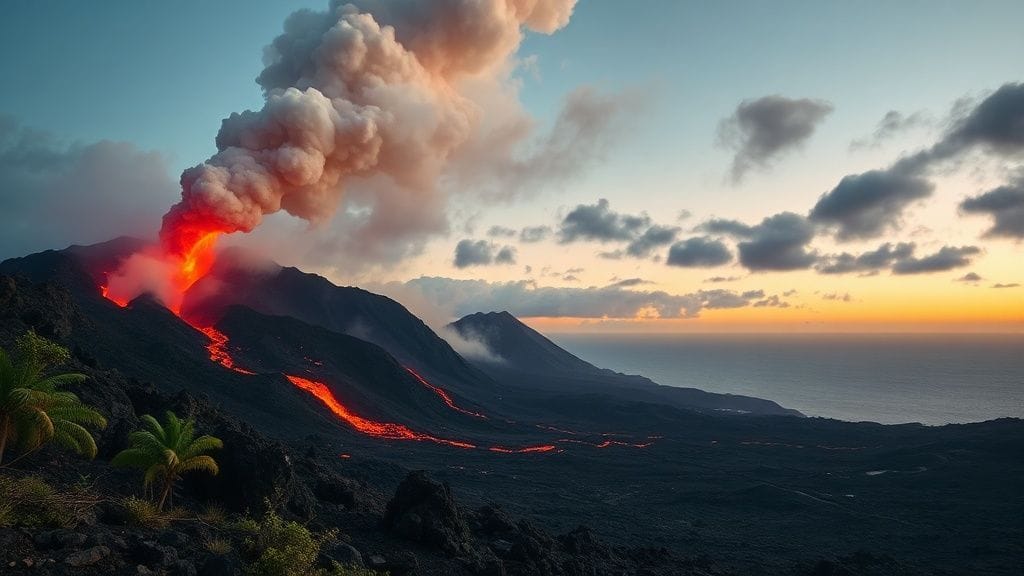
There’s a certain silence that descends before a storm of fire. Imagine, on a humid night in late 1800, as the tropical breeze sweeps through the rugged west coast of Hawaiʻi Island—known then as the Big Island—the ground begins to rumble faintly beneath the feet of the island’s inhabitants. Suddenly, cracks rupture the earth’s crust, glowing orange within their depths. Molten rock bursts under the cloak of darkness, sending rivers of incandescent lava down ancient slopes.
This was no ordinary volcanic display. It was the awakening of Hualālai, a volcano that had long slumbered at the western edge of the island, stirring to life in an eruption that would burn deep into the collective memory of Hawaiians and leave an everlasting imprint on the land.
The 1800–1801 eruption of Hualālai was both magnificent and terrifying, heralding a dance between fire and life that shaped the trajectory of Kona’s communities for generations. But what stirred this giant from its centuries of quietude? How did it change the lives of Hawaiians living beneath its shadow? And what can its fiery legacy teach us today?
2. Hawaiʻi on the Eve of Catastrophe: A Kingdom in Flux
At the dawn of the 19th century, Hawaiʻi was a kingdom navigating profound transformation. Under the recent unifying rule of Kamehameha I, the islands had entered an era of political consolidation, with Hawaiʻi Island at its nucleus. Kona, on the leeward side where Hualālai loomed, was a region of fertile lands, abundant fishery, and growing settlements.
Yet this world was a fragile balance between nature’s omnipotence and human resilience. The people of Hawaiʻi understood intimately that their land was shaped by fire and water, wind and wave. Volcanic eruptions were not simply disasters; they were manifestations of deity Pele’s temper—goddess of fire and volcanoes, revered and feared. To witness a volcano’s awakening was both a spiritual and physical challenge.
The eruption of Hualālai in 1800 emerged in this volatile mix of royal ambition, cultural belief, and the raw power of the Earth. Just as Kamehameha’s warriors were forging a new political order, nature was preparing its own upheaval.
3. The Geological Pulse of Hualālai: Understanding a Sleeping Giant
Hualālai is one of Hawaiʻi’s five shield volcanoes, with a shape gentle yet imposing, crowned with a summit crater complex. Unlike the perpetually active Mauna Loa and Kīlauea to the south and east, Hualālai had been relatively quiet for over 200 years before its 1800 rebirth.
Beneath its placid surface, magma chambers swirled and pressure built along deep faults and fractures. A shield volcano’s eruptions tend to be fluid and effusive rather than violent explosions, but their slow-moving lava can consume vast areas. Scientists today know Hualālai’s eruptions tend to begin with seismic tremors, ground fissures, and finally the sprawling flow of basalt.
In 1800, native Hawaiians did not have the science we do—but they had generations of observation, passed down through chants and stories. They recognized the signs of change long before the ground cracked open.
4. The First Flickers: Early Signs and Native Observations
Oral histories suggest that before the first lava emerged, Hawaiians observed unsettling tremors—the earth whispering its imminent transformation. These seismic quakes were not ignored; islanders heeded warning through traditional protocols, invoking Pele’s presence and organizing protective ceremonies.
The initial lava flows are believed to have begun near the summit caldera, forming fissures that expelled incandescent rock. From the distant shorelines, the night sky glowed ominously red, a beacon that something monumental had begun.
The eruption's onset likely sent shockwaves through native communities, many of whom had never witnessed Hualālai’s power firsthand. Some fled to higher ground, others gathered in hālau (meeting houses), seeking strength through ritual and shared resolve.
5. Beyond the Flames: Cultural Reactions to Volcanic Awakening
Volcanoes in Hawaiian cosmology are embodiments of divine power. Pele’s fiery wrath was not mere destruction; it was purification, creation, and renewal. The 1800 eruption was interpreted as Pele speaking directly to the people.
Traditional chants, mele, and prayers were sung to calm the goddess, petitioning her to spare villages and croplands. Elders recounted tales of past eruptions and survival, reinforcing cultural bonds. The eruption, despite its threat, became another chapter in a continuing dialogue between people and volcano.
Yet the emotional toll cannot be underestimated. Families lost homes, sacred grounds were buried, and the landscape they knew forever altered. The eruption was a spiritual test as much as a physical ordeal.
6. The Flow Unleashed: Lava on the Move across Kona’s Slopes
Once the eruption gained momentum, lava flows surged down Hualālai’s flanks towards the Kona coast. The fluid basalt spread over fertile fields, sweeping past agricultural terraces, fishing villages, and ancient taro patches.
Contemporary observers would have seen rivers of fire snaking slowly but inexorably through the darkened landscape. By the time the flows came to rest in early 1801, large tracts of valuable land lay buried beneath black rock.
The geographic reach of this lava altered not just the physical space but disrupted trade routes and settlement patterns. Some villages were abandoned, others relocated. The community’s resilience was tested through adaptation, migration, and reconstruction.
7. The Human Toll and Adaptations: Communities Amidst Ash and Fire
Volcanic eruptions don't merely sculpt the landscape—they permanently shift human lives. While records from 1800 Hawaiʻi are sparse, later retellings and early Western travelers’ observations reveal a story of loss and recovery.
Families buried possessions in haste; agricultural cycles were interrupted; food shortages loomed. But the Hawaiian people were no strangers to such challenges. Communal support networks ensured survival, while sacred knowledge guided land reclamation.
In time, new fertile ground would emerge from cooled lava fields. Life, as always, found a way to balance atop the volcanic bedrock.
8. The Role of Oral Traditions in Preserving the Eruption's Memory
Without written accounts, the 1800 eruption’s memory passed through chant, story, and song. Hawaiian oral traditions encode both scientific observation and spiritual reflection in a seamless narrative.
These stories helped preserve knowledge about volcanic behavior, survival strategies, and cultural resilience. They became crucial for future generations when Hualālai stirred again.
Anthropologists and geologists rely today on these narratives to reconstruct the timeline and impact of the eruption—proof that history lives in voices as much as in stone.
9. Navigating Uncertainty: Hawaiian Leadership and Crisis Response
The eruption unfolded during a formative period politically. Kamehameha I had unified Hawaiʻi Island and was expanding his influence over the archipelago. His administration needed to respond thoughtfully to natural disasters that could weaken tribal alliances or disrupt commerce.
Though specifics are scarce, it is likely that local chiefs (aliʻi) coordinated relief and relocation efforts. The leader’s capacity to protect land and people from natural calamities was integral to maintaining authority and social order.
This eruption underscored the delicate interplay between political power and environmental stewardship.
10. The Landscape Transformed: Ecological Shifts in the Wake
After the lava cooled, the landscape was stark and barren—fields of sharp, black rock where verdant forests and farmland had once flourished.
Over decades, pioneer plants like ʻōhiʻa lehua began reclaiming the slopes, slowly rebuilding ecological complexity. The new terrain presented both challenges for settlement and opportunities for scientific study.
The eruption’s imprint remains visible in Kona’s geology, reminding us how quickly nature can erase and rewrite the surface of the Earth.
11. Comparative Perspectives: Hualālai in the Context of Hawaiian Volcanism
Compared with Mauna Loa and Kīlauea, Hualālai’s eruptions have been less frequent but no less significant. The 1800 event is a pivotal example of a volcano sleeping for centuries before awakening with considerable force.
This pattern informs current volcanic risk assessments on Hawaiʻi Island, highlighting the need to respect every volcano’s potential for sudden change.
12. Scientific Fascination: Early Western Accounts and Modern Insights
Western explorers and missionaries arrived in Hawaiʻi only early in the 19th century, shortly after the eruption. While direct eyewitness accounts are rare, subsequent visitors documented the fresh lava fields and collected native stories.
Modern volcanology uses tephrochronology, radiometric dating, and geological mapping to reconstruct the eruption in detail. The 1800–1801 event remains a benchmark in understanding shield volcano behavior on the island.
13. The Aftermath: How 1800–1801 Shaped Kona’s Development
The eruption, by reshaping land use, indirectly influenced Kona’s economic and social development. With once-fertile areas buried, populations adjusted, moving inland or toward less-affected locales.
Trade patterns shifted; agriculture became more intensive in safer zones. Over time, the imprint of the eruption laid the groundwork for future settlement configurations, some still apparent today.
14. Volcanic Legacies: From Historical Disaster to Modern Conservation
Today, the lava fields from the 1800–1801 eruption are treasured not only for their geological story but also as part of natural and cultural heritage. They offer living classrooms for science and remind us of human vulnerability and adaptability.
Conservation efforts seek to protect these landscapes, honoring their significance for both native Hawaiians and the global community fascinated by volcanic forces.
15. Echoes Through Time: The Enduring Significance of Hualālai’s Flames
More than two centuries later, the echoes of the 1800 eruption resound through time, teaching resilience, respect, and the intricate dialogue between humans and the restless Earth.
Hualālai remains a sentinel volcano—a reminder that beneath serene surfaces, forces of transformation always pulse, shaping the destinies of people and place alike.
Conclusion
The eruption of Hualālai in 1800–1801 is far more than a geological event; it is a profound human story woven into the fabric of Hawaiʻi’s identity. It encapsulates the drama of nature’s power, the endurance of culture, and the inevitability of change. Witnessing lava carve through ancient lands, Hawaiians stood not as victims but as participants in a timeless dance with fire, guided by spiritual wisdom and communal strength.
This eruption challenges us today to listen closely—not only to the rumblings beneath our feet but to the voices of those who came before, who understood that destruction and creation are often two faces of the same fiery coin. Hualālai’s story invites us to embrace uncertainty with courage, to find hope in renewal, and to cherish the ever-evolving relationship between humanity and the Earth’s magnificent fury.
FAQs
Q1: What triggered the Hualālai eruption in 1800?
A1: The eruption was caused by magma rising from beneath the Earth’s crust, increasing pressure until fractures opened on the volcano’s flanks; geological processes typical of shield volcanoes like Hualālai.
Q2: How did Hawaiians interpret volcanic eruptions like Hualālai’s in 1800?
A2: Eruptions were seen as expressions of Pele, the goddess of fire and volcanoes; they embodied spiritual tests and demands for respect from humans toward nature.
Q3: What was the human impact of the 1800–1801 eruption?
A3: Communities lost homes and farmland, prompting migrations and adaptations; oral traditions helped preserve survival strategies and cultural lessons.
Q4: How does the 1800 eruption compare to other Hawaiian volcanic events?
A4: Hualālai’s eruption was less frequent and less voluminous than Mauna Loa or Kīlauea but equally transformative for local communities and landscapes.
Q5: What role do oral histories play in understanding this eruption?
A5: They provide vital qualitative details about timing, effects, and cultural responses not captured by scientific methods alone.
Q6: How has the landscape changed since the eruption?
A6: Initially barren lava fields have slowly been recolonized by native plants over two centuries, altering ecosystems and soil composition.
Q7: Did this eruption affect Hawaiian politics?
A7: Indirectly yes; leaders had to manage disaster response amid ongoing efforts to unify the islands under Kamehameha I.
Q8: Why is the 1800 eruption important today?
A8: It informs volcanic hazard understanding on Hawaiʻi Island and embodies lessons of human resilience and respect for natural power.

