Table of Contents
- A New Dawn in Astronomy: The Night Before the Launch
- The Birth of an Ambitious Vision: Early Concepts of the Hubble Telescope
- The Scientific Imperative: Why Space-Based Observation?
- Engineers and Dreamers: The Team Behind the Mission
- NASA’s Leap of Faith: The Politics and Funding Battles
- Designing the Eye in the Sky: Technological Innovations and Challenges
- April 24, 1990: The Day Humanity’s Eye Took Flight
- From the Shuttle’s Bay to Orbit: Deployment and Initial Thrills
- Early Hurdles: The Blurry Vision Crisis
- Crisis and Triumph: The 1993 Servicing Mission’s Redemption
- The Hubble Legacy: Transforming Our Cosmic Perspective
- Revolutionary Discoveries: From Black Holes to Dark Energy
- The Cultural Impact: Hubble and the Public Imagination
- International Collaboration and the Future of Space Telescopes
- The Continuing Voyage: Hubble’s Extended Missions and Enduring Role
- Lessons Learned: Engineering, Astronomy, and Perseverance
- The Telescope as a Symbol: Bridging Science and Humanity
- Conclusion: Gazing Forward While Looking Back
- Frequently Asked Questions about the Hubble Telescope
- External Resource
- Internal Link
1. A New Dawn in Astronomy: The Night Before the Launch
The crisp night air of April 23, 1990, hung heavy with anticipation at Kennedy Space Center in Florida. Engineers, scientists, and journalists clustered near the space shuttle Discovery, their eyes reflecting the gleam of the mammoth white rocket poised for launch. Here lay the gateway to the universe’s deepest secrets—the space telescope that had been decades in the making. Around the world, observatories went silent in reverent pause, aware that history was about to unfold. This wasn’t merely the launch of a machine; it was the birth of an entirely new way of seeing the cosmos.
The Hubble Space Telescope, perched within the shuttle’s cargo bay, was a marvel of human ingenuity—an orbiting observatory designed to stare deep into the cosmos, unaffected by Earth’s turbulent atmosphere. Behind its polished instruments lay the hopes and dreams of generations of astronomers eager to glimpse the universe’s earliest galaxies, its sprawling nebulae, and the very fabric of space-time.
Yet, beneath the excitement lurked the weight of uncertainty. A mission of this magnitude was riddled with risks. Would Hubble operate flawlessly? Could it withstand the harshness of space? The final countdown was more than mechanical; it was a collective heartbeat that tied humanity’s curiosity to destiny.
2. The Birth of an Ambitious Vision: Early Concepts of the Hubble Telescope
The dream of a telescope in space stretches back almost a century. Visionaries like astronomer Lyman Spitzer, who in 1946 championed the idea of placing a telescope beyond Earth’s atmosphere, sowed the seeds for what would become Hubble. Spitzer argued passionately that the atmosphere blurs and dims celestial light—a problem that a telescope floating in orbit could overcome, offering unprecedented clarity.
Throughout the 1950s and 1960s, this vision gained traction amid the Cold War’s technological race. The successes of Sputnik and the Apollo missions ignited public imagination and scientific determination. NASA began formal planning for space-based observatories, recognizing that Earth’s atmosphere was a prison for astronomers.
The telescope was named after Edwin Hubble, the American astronomer whose 1929 discovery that the universe is expanding forever reshaped cosmology. If Earth-bound astronomers could see only faint glimpses of the cosmos, Hubble's namesake promised to bring the universe close enough to study in astonishing detail.
3. The Scientific Imperative: Why Space-Based Observation?
The atmosphere that breathes life into Earth tells a very different story to a telescope. It absorbs and scatters light, distorting images of stars, galaxies, and nebulae. Ground-based telescopes, even with adaptive optics, faced limitations that restricted the kind of research possible.
By placing a powerful optical telescope above the atmosphere, astronomers would eliminate atmospheric distortion entirely. This meant sharper images, increased sensitivity to faint objects, and the ability to observe across a broader range of the electromagnetic spectrum.
Moreover, Hubble provided a stable, continuous viewing platform without the interruptions of weather or daylight—opening the possibility of time-lapse studies and deep-field observations unimaginable before.
The promise was bold: to peer back 13 billion years and unravel the mysteries of the cosmos—from the birth of stars to the expansion rate of the universe itself. The stakes were astronomically high, both intellectually and financially.
4. Engineers and Dreamers: The Team Behind the Mission
Behind the gleaming instruments and precise orbits stood thousands of dedicated men and women whose collective genius made Hubble possible. NASA’s engineers collaborated with industrial partners such as Perkin-Elmer and Lockheed to craft the intricate mirrors and cutting-edge sensors.
The challenge was daunting. The 2.4-meter primary mirror, the heart of Hubble’s vision, had to be polished to a precision of mere nanometers—thinner than a human hair. Optics experts tirelessly calibrated instruments sensitive enough to detect the faint glow of distant galaxies, all while surviving the rigors of launch and space conditions.
Project managers like Nancy Grace Roman, often called the “Mother of Hubble,” battled bureaucracies and skepticism to keep the dream alive. They balanced competing priorities: technical feasibility, budget constraints, schedule delays—all while maintaining the scientific integrity of the mission.
Human stories abound within the launch’s shadow: engineers working night after night to fix minute issues, astronomers lobbying fervently in Congress, and shuttle crews meticulously preparing for the historic deployment.
5. NASA’s Leap of Faith: The Politics and Funding Battles
The Hubble project was not immune to the tangled web of politics and economics swirling during the Cold War’s waning days. In an era when the space race had lost the urgency of the moon landing, funding such an ambitious telescope required relentless advocacy.
Initial cost estimates ballooned over time, awakened to the telescope’s technical complexity and the hazards of space operations. NASA faced congressional scrutiny, with critics labeling the project as extravagant or risky.
Yet, proponents argued that the returns would be immeasurable—not just scientifically, but culturally and internationally. Hubble symbolized American ingenuity and leadership in space exploration amidst shifting geopolitical landscapes.
Decades of lobbying, compromise, and negotiation finally secured the necessary budget and authorization. By the late 1980s, the project was a go—set to launch aboard the space shuttle Discovery in 1990. The decision was a leap of faith, a leap into the unknown, with hopes that would soon be realized—and challenged.
6. Designing the Eye in the Sky: Technological Innovations and Challenges
Crafting the Hubble telescope was a feat akin to assembling a Swiss watch, but on an astronomical scale. Unlike traditional ground-based observatories, Hubble needed to operate autonomously, resist extreme temperature variations, and survive radiation blasts.
Its instruments—cameras, spectrographs, fine guidance sensors—had to work in perfect harmony to capture and analyze light across ultraviolet, visible, and near-infrared wavelengths.
One of the most dramatic technical challenges involved the telescope’s mirror. The polishing process took years, yet a mere 2.2 micrometer error in the mirror’s shape drastically compromised clarity—a detail only discovered after launch.
The spacecraft required highly precise pointing systems to lock onto targets millions or billions of light-years away. Thermal blankets, gyroscopes, and reaction wheels worked together to maintain stability. Every subsystem was redundantly backed up—there was no room for failure hundreds of kilometers above Earth.
This engineering ballet laid the groundwork for the boldest space observatory in history, setting new standards for precision and endurance.
7. April 24, 1990: The Day Humanity’s Eye Took Flight
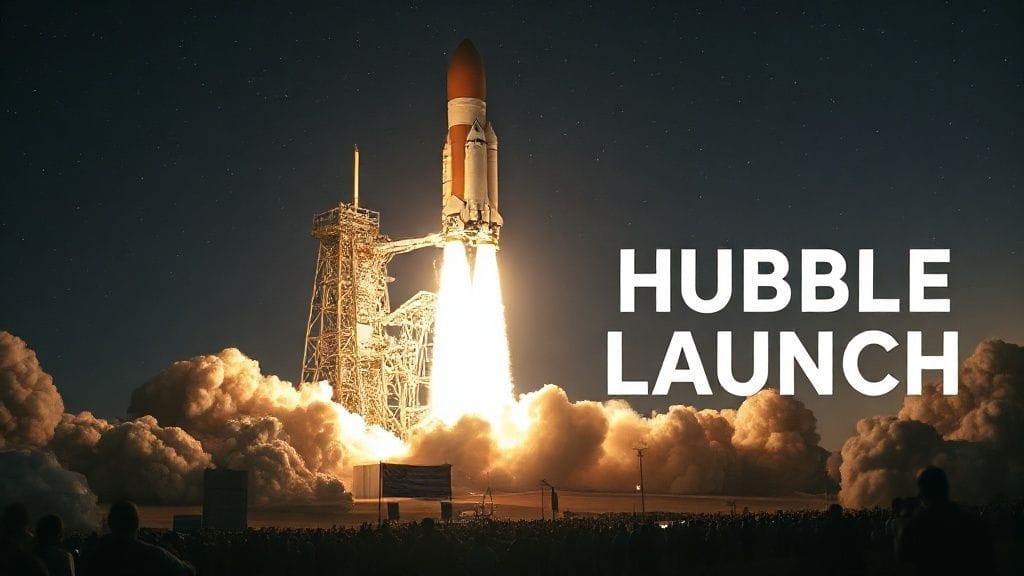
At 8:33 a.m. EDT, April 24, 1990, the space shuttle Discovery roared into the sky, its engines screaming, lifting the Hubble telescope beyond the veil of Earth’s atmosphere. Cameras tracked the shuttle’s ascent live; millions watched globally, holding their breath.
Four days later, on April 25, astronauts deployed Hubble from the shuttle’s cargo bay into a stable low Earth orbit about 547 kilometers above the surface. For the first time, the telescope’s optics gazed unimpeded across the vast cosmic ocean.
The initial images sent back filled scientists with awe—the crisp resolution of star clusters and distant galaxies was unlike anything previous telescopes had captured. Yet, excitement soon met with a sobering reality: the images weren’t as sharp as expected.
8. From the Shuttle’s Bay to Orbit: Deployment and Initial Thrills
Operating in orbit, Hubble communicated with Earth via NASA’s Tracking and Data Relay Satellites. The first months involved careful calibration and system checks.
Astronomers worldwide hailed the arrival of the space telescope. Within weeks, Hubble began sending back images—brilliant and evocative, hinting at the promise buried in the pixels.
But, as technicians poured over the details, they noticed subtle blurring. The telescope’s iconic first light image of the star cluster NGC 3532 appeared fuzzy—a puzzle that would reveal a deeper problem.
The deployment was a triumph of engineering, but the blurry images dampened hopes, bringing an early test of the mission’s resilience.
9. Early Hurdles: The Blurry Vision Crisis
The cause of Hubble’s blurry vision was a devastating blow—its primary mirror suffered from spherical aberration due to a tiny but critical manufacturing error. A minuscule deviation—less than 1/50th the thickness of a human hair—had skewed the mirror's shape just enough to distort all images.
The discovery incited public scrutiny and internal crisis. Critics dubbed it a billion-dollar mistake. Technicians and scientists scrambled to design corrective optics, analogous to eyeglasses for the telescope.
This failure was not only technical but a humbling human moment—the fragile limits of ambition meeting the stark reality of imperfection. Yet, it galvanized NASA and the global scientific community to respond with determination and ingenuity.
10. Crisis and Triumph: The 1993 Servicing Mission’s Redemption
NASA’s solution was bold: a servicing mission to install a corrective optics package called COSTAR and replace the Wide Field and Planetary Camera with an upgraded version. Scheduled for December 1993, this mission became one of NASA’s most daring repair operations ever.
Astronauts aboard the shuttle Endeavour performed five intense spacewalks, carefully installing the delicate instruments within Hubble’s confined inner workings.
When Hubble’s vision cleared, the results were nothing short of miraculous. Sharper than ever, the telescope revealed cosmic images so stunning that public and scientific enthusiasm reignited instantly.
This redemption cemented Hubble’s place not only as a scientific tool but as a symbol of perseverance and human resolve in space exploration.
11. The Hubble Legacy: Transforming Our Cosmic Perspective
Post-repair, Hubble revolutionized our understanding of the universe. It provided the clearest, most detailed images of celestial bodies ever seen, reshaping astrophysics and cosmology.
From documenting the accelerating expansion of the universe to probing the atmospheres of distant exoplanets, Hubble opened new research frontiers. Its deep-field observations pierced back billions of years, capturing galaxies forming soon after the Big Bang.
Moreover, Hubble helped measure the Hubble Constant with unprecedented accuracy, clarifying the universe’s age and fate. Its detailed studies of nebulae and star formation unveiled lifecycle processes previously hidden.
Hubble transformed a once-abstract sky into an accessible laboratory for discovery.
12. Revolutionary Discoveries: From Black Holes to Dark Energy
Among Hubble’s landmark revelations was confirming the existence of supermassive black holes at the centers of galaxies, including our own Milky Way. It captured evidence of stellar nurseries where stars hatch amid cosmic dust and gas clouds.
Perhaps its most profound contribution was to our understanding of dark energy—the mysterious force accelerating the universe’s expansion. Hubble’s precise observations provided data supporting this startling phenomenon, challenging fundamental physics.
By stretching human vision back in time and space, Hubble unveiled a cosmos both more majestic and mysterious than previously imagined—a universe alive with motion, creation, and profound enigma.
13. The Cultural Impact: Hubble and the Public Imagination
Hubble’s breathtaking images transcended the scientific community, captivating the public like few instruments before. Galaxies with swirling arms, glowing nebulae in vivid colors, and time-lapse star births captivated hearts worldwide.
Its imagery featured in museums, textbooks, films, and television, inspiring generations of students and artists alike. Hubble became a cultural icon—a symbol of exploration, curiosity, and the infinite.
The telescope’s trials and triumphs played out publicly, humanizing scientists and astronauts as they wrestled with complexity and setbacks. Hubble became a shared story and source of wonder across the globe.
14. International Collaboration and the Future of Space Telescopes
Though an American project, Hubble benefited from international partnerships, notably European cooperation via ESA, which contributed instruments and manpower. This collaboration marked a shift toward global scientific unity.
Hubble paved the way for future space telescopes—James Webb Space Telescope being its direct successor—each building on its legacy of innovation and ambition.
The cooperative spirit and technological lessons from Hubble endure, informing humanity’s next cosmic ventures, from planet-hunting probes to gravitational wave detectors.
15. The Continuing Voyage: Hubble’s Extended Missions and Enduring Role
Originally designed for 15 years, Hubble outlived all expectations. Multiple servicing missions extended its life and capabilities, making it the longest-operating space observatory to date.
Even as newer telescopes rise, Hubble’s unique ultraviolet observation remain irreplaceable. Its archives continue to produce valuable scientific insights, reaffirming the telescope’s timeless value.
NASA plans for its eventual retirement, but Hubble’s orbit now orbits memory and data—an eternal sentinel in space, a testament to human curiosity.
16. Lessons Learned: Engineering, Astronomy, and Perseverance
The saga of Hubble teaches enduring lessons about ambition, error, and resilience. Technical failure taught engineers humility and the importance of rigorous testing, pushing the boundaries of engineering safeguards.
For astronomers, Hubble exemplifies how technology catalyzes discovery—tools enabling theories to be tested and refined.
Above all, Hubble is a story of perseverance—the will to fix mistakes, to push forward despite setbacks, and to uphold the quest for knowledge as a shared human endeavor.
17. The Telescope as a Symbol: Bridging Science and Humanity
More than a technological marvel, Hubble stands as a symbol of humanity’s yearning to understand its place in the cosmos.
Its eye in the sky connects every culture and generation, reminding us that the universe belongs to all and that the pursuit of knowledge transcends borders.
In a time of global division, Hubble represents hope, cooperation, and the enduring spirit of discovery that defines us.
Conclusion
The launch of the Hubble Space Telescope on April 24, 1990, marked a monumental moment in human history—a bold leap beyond Earth’s confines that fundamentally transformed astronomy and our view of the universe. From its perilous early struggles with flawed optics to its redemption through ingenious repair, Hubble’s story reveals the intertwined nature of human ambition, fragility, and resilience.
Decades later, Hubble remains a luminous beacon, expanding not only scientific frontiers but reaching into cultural hearts worldwide. It teaches us that progress is seldom linear, that setbacks can fuel triumphs, and that in gazing outward, we discover ourselves.
As Hubble continues to orbit above, a silent witness to the cosmic dance, it embodies the eternal human quest: to explore, understand, and marvel at the universe we call home.
Frequently Asked Questions about the Hubble Telescope
Q1: Why was the Hubble Space Telescope launched into orbit?
To overcome atmospheric distortion, enabling astronomers to capture clearer and more detailed images across various wavelengths, thus expanding our understanding of the universe.
Q2: What caused the initial blurry images from Hubble?
A tiny error in the shape of the primary mirror—a spherical aberration caused by incorrect polishing—led to distorted images, later corrected by a servicing mission.
Q3: How did the 1993 servicing mission fix Hubble?
Astronauts installed corrective optics (COSTAR) and upgraded instruments during a series of spacewalks, correcting the blurry vision problem and significantly improving the telescope’s performance.
Q4: What are some of Hubble’s most important discoveries?
Confirming supermassive black holes, measuring the universe’s expansion rate, observing stellar formation regions, and providing data supporting the presence of dark energy.
Q5: How long has the Hubble Telescope been operational?
Launched in 1990 with an expected 15-year lifespan, Hubble has functioned for over three decades, thanks to multiple servicing missions.
Q6: What is Hubble’s legacy in modern astronomy?
Hubble revolutionized observational astronomy, helping establish space telescopes as indispensable scientific tools and inspiring subsequent missions like the James Webb Space Telescope.
Q7: Did international collaboration play a role in the Hubble project?
Yes, the European Space Agency contributed instruments and support, marking a significant instance of international cooperation in space science.
Q8: What will happen to Hubble in the future?
NASA plans to eventually deorbit or retire Hubble safely, but it will continue to deliver scientific data for years, leaving an unparalleled legacy in cosmic exploration.