Table of Contents
- The Twilight of Carolingian Power: A Kingdom in Crisis
- The Fragmented Realm of West Francia on the Eve of 987
- Hugh Capet: The Man Behind the Name
- The Political Climate in Senlis: An Assembly of Power and Ambition
- June 987: The Election That Changed the Course of History
- The Crowning Moment: Consecration at Noyon, July 987
- The Symbolism of Noyon: Why Consecration Mattered
- The Role of the Clergy: Guardians of Faith and Crown
- Nobles and Power Brokers: The Realpolitik of the Election
- The Decline of the Carolingian Dynasty: From Dynasty to Memory
- Hugh Capet's Early Reign: Consolidation and Challenges
- The Capetian Legacy: Foundations of Modern France
- The Evolution of Kingship: From Elected Monarch to Hereditary Dynasty
- Political and Social Consequences: The Shifting Balance of Power
- The Historical Significance of 987: A Turning Point in Medieval Europe
- Remembering Hugh Capet: Myth, Legend, and Reality
- The Capetian Dynasty and the Formation of a Nation
- The Role of Senlis and Noyon in French Medieval Politics
- From Elective Kingdom to Hereditary Monarchy: The Change Over Time
- The Broader European Context: How Hugh Capet’s Election Resonated Beyond France
- Conclusion: A Crown Worn at the Dawn of a New Era
- FAQs: Unpacking the Election of Hugh Capet and Its Legacy
- External Resource
- Internal Link
1. The Twilight of Carolingian Power: A Kingdom in Crisis
In the sultry heat of the summer of 987, a murmur of uncertainty buzzed through the courts and hovels alike, from the vineyards of Burgundy to the forests surrounding Paris. The once-brilliant flame of the Carolingian dynasty flickered weakly, its luminescence dimmed by decades of internal strife, nobles’ ambitions, and invasions. The death of the last Carolingian king, Louis V, left a power vacuum—a swirl of questions, fears, and hopes for the future. On a June day in Senlis, the hearts of the Frankish nobles beat collectively with ambition and trepidation: who would now wear the crown, a symbol as much of divine right as fragile earthly power?
The story of Hugh Capet’s election as King of the Franks is more than a political footnote; it is a pivotal moment marking the end of one epoch and the birth of another. It was a moment laden with symbolism, ambition, and historical gravitas—a covenant between faith, nobility, and the people that would shape the destiny of France for centuries to come.
2. The Fragmented Realm of West Francia on the Eve of 987
At the close of the 10th century, West Francia—roughly the territory of modern France—was not the unified and centralized state we recognize today. Instead, it was a patchwork of fractious duchies, counties, and lordships, each ruled by powerful magnates who warred, negotiated, and allied according to shifting loyalties rather than a cohesive national identity.
The Carolingian dynasty, which had once united the Frankish lands under Charlemagne’s imperial shadow, had weakened considerably. Louis V, the last direct Carolingian monarch, died childless in 987, leaving no heir to the throne. The noble elite faced a dilemma: accept the election of a new king or risk chaos and fragmentation.
This political uncertainty unfolded against a backdrop of repeated Viking raids, growing local autonomy, and the rising prominence of regional powers such as the Duchy of Normandy. The crown had become a diminishing prize compared to the expanding power of local lords.
3. Hugh Capet: The Man Behind the Name
Hugh Capet emerged not from royal bloodlines but from the ranks of powerful nobility. Born around 939 into the Robertian family—descended from the influential Robert the Strong—Hugh was already Duke of the Franks and Count of Paris before his election.
A man described by contemporaries as judicious, pragmatic, and politically skilled, Hugh’s strength lay in his ability to navigate between competing factions. His marriage to Adelaide of Aquitaine fortified alliances, while his role as an intermediary between the king and nobles raised his profile. Some chroniclers praised Hugh for his piety and justice, while others hinted at his ruthless ambition.
Yet despite not being a Carolingian, Hugh garnered significant support, signaling a shift in the understanding of kingship—from divine hereditary right to a vote of the realm's most powerful magnates.
4. The Political Climate in Senlis: An Assembly of Power and Ambition
The town of Senlis, nestled just north of Paris, bore witness to a secretive and potent gathering in June 987. Nobles, bishops, and influential abbots came together in a tense election with the burden of shaping France’s future resting on their shoulders.
The nobles, weary of Carolingian ineffectiveness and fragmentation, recognized the need for a stable yet malleable monarchy. The Frankish crown, once a symbol of imperial continuity, now had to be reinvented. Debates, alliances, and bargaining marks the days of this convocation.
A critical factor in Hugh’s favor was his relationship with the Church. Many bishops trusted him and viewed him as a protector of Christian order—at a time when religious authority and political legitimacy were becoming inseparable.
5. June 987: The Election That Changed the Course of History
When the electors convened in Senlis, the tension in the air was palpable. There was no automatic succession, no inherited claim that could settle the dispute. The crown was up for negotiation, a prize to be won by credibility and coalition.
In a compact yet momentous decision, Hugh Capet was chosen as king. The election was symbolic as well as strategic: it endorsed the power of the nobility and signaled a move away from Carolingian lineage. The choice of Hugh Capet recognized the reality of political power that rested increasingly with regional lords and magnates, not with a distant and weak royal lineage.
Chroniclers described the scene as both solemn and hopeful. A new chapter in French history was being written, not with swords alone, but with votes, influence, and vision.
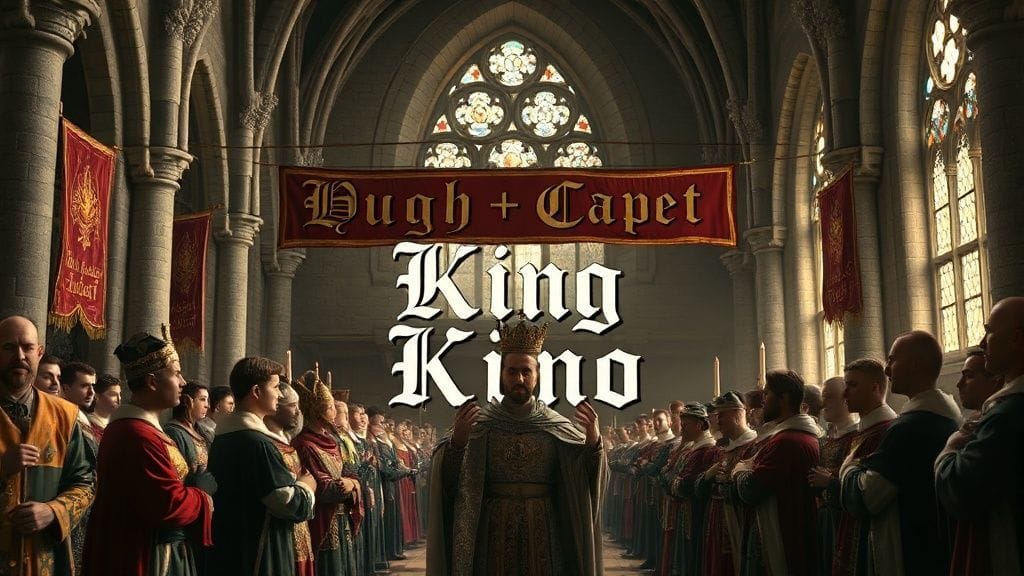
6. The Crowning Moment: Consecration at Noyon, July 987
The election was only the beginning. In July, Hugh Capet journeyed to Noyon, a city rich in religious symbolism, to be consecrated king. This sacred rite was more than ceremony—it was an act inscribing divine approval upon his reign.
Noyon, a seat of a powerful bishopric, had witnessed royal ceremonies since the early Middle Ages. The consecration in its cathedral forged a mystical bond between Hugh and the Christian God’s sanction. The anointing with holy oil, the presentation of the crown, sceptre, and ring, evoked centuries of Christian kingship tradition.
This act convinced skeptics that his legitimacy was not merely political but sanctified—an essential cornerstone for governance amid competing claims.
7. The Symbolism of Noyon: Why Consecration Mattered
In medieval Europe, to be king was to be God’s representative on earth. Consecration was a public religious act that affirmed that relationship. The choice of Noyon reflected the Church’s integral role in legitimizing power and controlling succession.
Without consecration, a king might be perceived as merely a warlord or usurper. But with it came divine authority, a sacred aura that bolstered obedience and generated loyalty. Hugh understood this deeply, and his consecration marked the institutional birth of a new kind of monarchy—one where political legitimacy was tied explicitly to religious blessing.
8. The Role of the Clergy: Guardians of Faith and Crown
The clergy were not passive observers but active participants in the birth of the Capetian monarchy. Bishops and abbots played crucial roles as kingmakers, using their spiritual influence to shape political outcomes.
The Church sought stability and order, especially after decades of feudal fragmentation and Viking incursions. By supporting Hugh, they hoped to restore a monarchy that could protect the Church’s interests and enforce Christian moral order.
Furthermore, clerical backing provided Hugh with a network of support, resources, and moral authority that proved indispensable in his early reign and beyond.
9. Nobles and Power Brokers: The Realpolitik of the Election
Behind the liturgical ceremonies and sacred pronouncements lay a complex web of power struggles among the Frankish nobility. The election was as much about securing alliances and dividing spoils as about legitimacy.
The election of Hugh Capet was a triumph of pragmatic politics. Powerful nobles saw in him a figure strong enough to unify the fractious realm but flexible enough not to threaten their local autonomy.
This delicate balance set the tone for much of Capetian rule—a monarchy dependent on negotiation and alliance-building rather than autocratic authority.
10. The Decline of the Carolingian Dynasty: From Dynasty to Memory
The end of the Carolingians was both poignant and inevitable. Their dynasty had shaped Europe’s early medieval history but failed to maintain cohesion in a changing political landscape.
Louis V’s death without heirs in 987 signaled not just a dynastic crisis but the collapse of an era. The once-mighty family receded into history, remembered more for what they had been than what remained.
The election of Hugh Capet symbolized this shift—the death of old orders, the birth of new.
11. Hugh Capet's Early Reign: Consolidation and Challenges
Despite the symbolic power of his coronation, Hugh’s hold on the crown was not uncontested. His early years were marked by cautious diplomacy and internal struggles as he sought to secure his authority.
Much of his reign involved mollifying powerful regional lords, safeguarding Paris, and repelling external threats such as those posed by the Normans and Magyar raiders. Hugh’s modest but steady exercise of power laid the groundwork for a new form of stable kingship.
12. The Capetian Legacy: Foundations of Modern France
Hugh Capet’s reign planted seeds for the centuries-long Capetian dynasty, arguably the longest-lasting royal house in European history. Through gradual extension of royal power, enhanced administration, and dynastic marriages, his successors would transform France.
This election set in motion the slow but steady centralization of authority, the gradual supplanting of feudal anarchy, and the emergence of a powerful French kingdom.
13. The Evolution of Kingship: From Elected Monarch to Hereditary Dynasty
Though initially elected, Hugh Capet and his heirs worked diligently to transform the monarchy into a hereditary institution. By crowning his son Robert II during his own lifetime, Hugh inaugurated a tradition that progressively diminished the importance of formal election.
This shift would have deep ramifications: the Capetian monarchy’s hereditary principle strengthened the crown’s legitimacy and set a precedent for the modern nation-state.
14. Political and Social Consequences: The Shifting Balance of Power
The election rippled throughout the social fabric. It signaled to nobles the possibility of collective political authority and to the Church the chance to influence governance.
At the same time, it destabilized lingering loyalties to the Carolingians and ushered in a period of negotiated power-sharing that ultimately strengthened royal institutions.
15. The Historical Significance of 987: A Turning Point in Medieval Europe
In the grand sweep of medieval history, Hugh Capet’s ascent marks a seminal juncture—where France transitioned from fractious feudal kingdoms to an embryonic modern state.
It symbolized the decline of old imperial traditions and the rise of localized monarchies combined with ecclesiastical power—a model that would echo across Europe.
16. Remembering Hugh Capet: Myth, Legend, and Reality
Over centuries, Hugh Capet’s figure has been enveloped in both legend and scholarly reassessment. Royal chronicles painted him as a pious, wise founder; modern historians probe his pragmatic and political qualities.
His image remains emblematic—both as a man of his time and a symbol of enduring statehood.
17. The Capetian Dynasty and the Formation of a Nation
The dynasty Hugh founded would survive wars, succession crises, and revolutions, imprinting its influence on French identity and institutions.
By tracing lineage to Hugh Capet, French kings established claims that connected medieval divine right with burgeoning national consciousness.
18. The Role of Senlis and Noyon in French Medieval Politics
Senlis and Noyon were more than mere locations; they were focal points of political and religious legitimation.
These towns bore witness to rituals and assemblies that reflected the intertwined nature of medieval power—a fusion of sacred and secular.
19. From Elective Kingdom to Hereditary Monarchy: The Change Over Time
The 987 election was a reminder of an elective past; yet by the 11th century, hereditary monarchy had firmly taken root.
This evolution speaks to broader medieval transformations: the consolidation of power, the importance of lineage, and the role of custom over formal procedures.
20. The Broader European Context: How Hugh Capet’s Election Resonated Beyond France
Across Europe, rival dynasties watched the Capetian election attentively. It foreshadowed patterns of monarchical succession that would influence kingdoms in England, Germany, and beyond.
It also reshaped diplomatic relations: a stable French monarchy could negotiate, ally, or confront its neighbors with renewed confidence.
21. Conclusion: A Crown Worn at the Dawn of a New Era
Hugh Capet’s election in 987 was not merely the installment of a new king; it was a foundation stone for the French state and monarchy. It marked the twilight of one medieval order and the dawn of another—where power, faith, and politics intertwined in novel ways.
It was a moment of hope amid uncertainty, a gesture both pragmatic and visionary. The Crown that Hugh wore was modest in extent but immense in consequence.
Today, as we trace the roots of modern France, the echoes of that June day in Senlis and that July consecration at Noyon remind us how the past shapes the present—not as static memory but as living legacy.
FAQs
Q1: Why was Hugh Capet elected king instead of a Carolingian heir?
A1: The last Carolingian king, Louis V, died childless, and no viable Carolingian heir remained. Nobles preferred Hugh Capet, a powerful and pragmatic nobleman, who could unify the realm and stabilize the monarchy.
Q2: What role did the Church play in Hugh Capet’s rise?
A2: The Church was crucial in legitimizing Hugh through consecration at Noyon, providing divine authority and moral support. Bishops and abbots also influenced the noble electors.
Q3: How did Hugh Capet’s election affect the concept of kingship?
A3: It marked a shift from hereditary Carolingian royalty to a more elective and politically negotiated kingship that would evolve into hereditary rule under the Capetians.
Q4: Were there immediate challenges to Hugh Capet’s rule?
A4: Yes, his reign faced skepticism, regional autonomy, and external threats. However, he used diplomacy and alliances to consolidate power gradually.
Q5: How does Hugh Capet’s election relate to the formation of the modern French state?
A5: His dynasty’s gradual consolidation of royal authority laid the groundwork for the centralized French monarchy and, eventually, the nation-state.
Q6: Why were Senlis and Noyon important locations?
A6: Senlis was the political site of the election, and Noyon held religious significance for royal coronations, ensuring ecclesiastical endorsement of the new king.
Q7: How did Hugh Capet’s election resonate outside France?
A7: It influenced European power dynamics, signaling the rise of new royal houses and serving as a model for the medieval relationship between church and state.
Q8: What is Hugh Capet’s legacy today?
A8: He is remembered as the founder of the Capetian dynasty and a pivotal figure who transformed medieval France into an enduring kingdom and cultural entity.

