Table of Contents
- The Calm Before the Storm: Silent Fires Beneath the Pacific
- The Islands of Tonga: A Volcanic Archipelago in Waiting
- The Birth of Hunga Tonga–Hunga Haʻapai: A Fiery Union Emerges
- Early Signs: From Underwater Murmurs to Surface Sculpting
- December 2014: The Submarine Volcano Pushes Through
- A New Land Rises: Formation of the Volcanic Island
- The 2015 Eruption: Breaking the Surface with Explosive Force
- The Science of Fire and Water: Interplay of Magma and Ocean
- Local Reactions: Islanders Witness Nature’s Raw Power
- International Scientific Attention: Remote but Revealing
- The Changing Landscape: Erosion and Island Longevity Debates
- The Role of Satellite Imagery in Tracking Volcanic Growth
- Environmental Impacts: Marine Life and Atmospheric Effects
- Tonga’s Geological Story: Contextualizing the 2015 Event
- Cultural Resonance: Mythologies and Modern Meanings
- Lessons Learned: Volcanology Advances and Preparedness
- The Aftermath: Land, Life, and Stories Rewritten
- Long-term Monitoring: Keeping Watch Over an Unstable Giant
- Comparing Pacific Volcanism: Tonga in a Broader Frame
- The Eruption’s Legacy: Science, Society, and the Sea
- Human Connection: Eyewitness Accounts and Oral History
- The Unfolding Mystery: Future of Hunga Tonga–Hunga Haʻapai
- Conclusion: Volcanoes as Narrators of Earth’s Deep Rhythms
- FAQs
- External Resource
- Internal Link
The Calm Before the Storm: Silent Fires Beneath the Pacific
In the vast, cerulean heart of the South Pacific, where the ocean kisses the horizon in interminable calm, a tempest was quietly brewing beneath the waves. For months and years, deep within the Earth’s crust, tectonic plates, moved by invisible but relentless forces, rubbed and rended, forging molten rivers that carved their way upward. Beneath the shimmering surface around Tonga, a restless submarine volcano was stirring—its slow, simmering pulse unnoticed by most, yet destined to reshape landscapes and rewrite geological narratives.
It was an eruption unlike any other, both a violent spectacle and a delicate process of creation. When the Hunga Tonga–Hunga Haʻapai volcano finally breached the ocean's surface, it unfolded a powerful story of nature’s grandeur —one of destruction and rebirth, of fire meeting the sea, and of the fragile relationship between island, ocean, and sky.
This is the tale of the Hunga Tonga–Hunga Haʻapai eruption of 2015, a volcanic birth witnessed by scientists and islanders alike, a moment when the Earth’s inner fires spoke loudest, reminding us of our planet’s ceaseless dynamism.
The Islands of Tonga: A Volcanic Archipelago in Waiting
Tonga, a Polynesian kingdom composed of over 170 islands scattered like precious gems across the Pacific, sits atop one of the planet’s most geologically active regions. Part of the infamous “Ring of Fire,” this archipelago owes its very existence to tectonic drama. The Pacific Plate dives beneath the Indo-Australian Plate here in a slow but steady subduction zone, igniting volcanic activity both beneath and above the waves.
Volcanoes are not strangers to Tonga; many islands are the summits of underwater mountains risen by millions of years of volcanic force. Yet the emergence of new land from the ocean—especially visible and accessible within human memory—is a phenomenon both rare and exhilarating.
Amid this seething geological milieu lies the Hunga Tonga–Hunga Haʻapai volcano complex, a submarine volcano couplet named for two closely situated volcanic islands. It was here, between these sibling islets, that the underground magmatic forces would once again choose to assert their presence dramatically.
The Birth of Hunga Tonga–Hunga Haʻapai: A Fiery Union Emerges
Before 2015, the Hunga Tonga and Hunga Haʻapai islands had existed intermittently over decades, reshaped cyclically by volcanic eruptions. The volcanic system beneath them consists of an active submarine vent system, capable, like a living organism, of alternately building and eroding landmass.
From early aerial photographs and geological surveys, it was clear: this was a place of restless creation. The volcano had flickered to life more than once in the recent past, but what lay ahead would outshine all previous activity.
The confluence of two craters and proximity to the ocean surface created a unique stage for the forthcoming volcanic spectacle—one where fiery lava would meet icy seawater in a violent but beautiful dance.
Early Signs: From Underwater Murmurs to Surface Sculpting
Scientists monitoring the region in late 2014 detected subtle signs: undersea seismic tremors, minor gas emissions, and changes in the shape of the volcano’s submarine slopes. These signals indicated magma was pushing upward, rising through fissures below the ocean floor.
Fishermen and island residents, too, noticed changes—bubbling water, discolorations signaling mineral emissions, and mysterious rumblings no one could ignore. It was nature’s prelude: a warning written in waves, sound, and the shifting earth.
By December 2014, the volcano breached the water surface for the first time in years, a testament to the enormous subterranean pressure building below.
December 2014: The Submarine Volcano Pushes Through
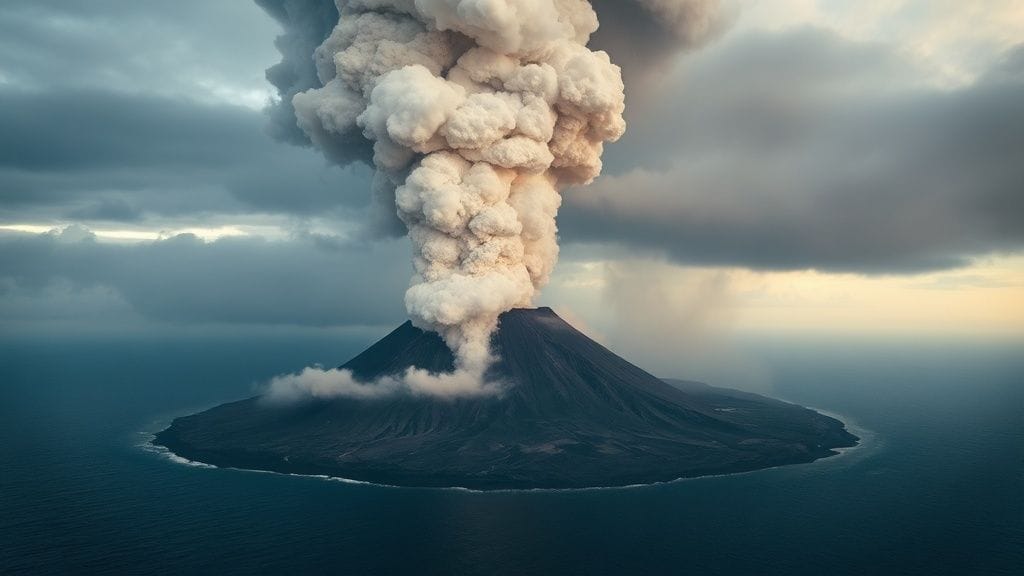
The ascent from ocean depths was neither quiet nor graceful. As magma met the cold waters, violent steam explosions punctuated the sea’s usual calm. Plumes of ash and steam rose, while molten rock cooled and solidified rapidly, layering black and red onto the volcanic edifice.
Within weeks, what had been mountaintops mired under water were pushing skyward, forming new volcanic islands. The volcanic activity was not a single, explosive event but a protracted performance of eruptions, collapses, and rebuilds.
Observers saw the mountain's fiery heart exposed, flashes of incandescent lava visible in ash clouds by day, glowing red at night.
A New Land Rises: Formation of the Volcanic Island
Between late 2014 and early 2015, the joining of Hunga Tonga and Hunga Haʻapai through eruptive activity drew global scientific attention. The new landmass, joining the two previously separate islands, stretched nearly two kilometers and reached heights of over 100 meters.
The rapid emergence of this island fascinated volcanologists. Here was a textbook example of volcanic island creation, though occurring with a messy, explosive energy.
For Tonga, an island nation too familiar with volcanic threats, this new island was a symbol of both peril and opportunity—providing fresh ground for ecosystems but reminding locals of nature’s mercurial temperament.
The 2015 Eruption: Breaking the Surface with Explosive Force
By mid-2015, the eruptive activity had reached a crescendo. On December 20th, 2014, for example, a violent phreatomagmatic explosion—caused by magma interacting with seawater—sent towering plumes of ash and gas thousands of meters into the atmosphere.
This explosion graphically illustrated the unpredictable power of the volcano. The interaction between superheated magma and the cold ocean water created shockwaves that rippled through the air and water, sometimes generating minor tsunamis.
The eruptions persisted intermittently, showcasing a surprisingly complex geology involving underwater vents, ephemeral vents on the new island, and sudden collapses into the sea.
The Science of Fire and Water: Interplay of Magma and Ocean
What made the Hunga Tonga–Hunga Haʻapai eruption of 2015 especially captivating to geologists was the intimate relationship between volcanic fire and surrounding water.
When magma explodes underwater, it reacts explosively with seawater, turning rock into ash and steam, sometimes even producing glassy volcanic fragments known as “pumice.” Furthermore, new island formation depends heavily on whether lava can consolidate quicker than ocean waves erode it.
In this case, intense underwater explosions shaped the island's initial form, but the ocean’s persistent battering began reshaping the volcanic deposits soon after, turning the landscape into an evolving mosaic.
Local Reactions: Islanders Witness Nature’s Raw Power
For the Tongans living nearby, including the inhabitants of the Haʻapai island group, these eruptions were at once awe-inspiring and unsettling.
Elders recalled ancestral stories of volcanic upheaval, making the event all the more poignant. Children watched as new land formed like a giant’s handiwork overnight, while elders grappled with memories of past disturbances caused by the Earth’s restlessness.
Safety concerns arose, and occasional ash fall affected daily life and agriculture. Yet, the islanders maintained a resilient spirit, framing the eruption both as calamity and a gift—new land for future generations and a powerful reminder of the island’s living earth.
International Scientific Attention: Remote but Revealing
Even from thousands of miles away, the eruption attracted intense scientific interest. Using satellite imagery, aerial surveys, and seismic monitoring, volcanologists pieced together the unfolding drama thread by thread.
Drones and remote sensing techniques captured real-time growth and erosion of the new island, while international volcanic observatories collaborated to interpret data.
These efforts expanded understanding of submarine volcanoes, with implications far beyond Tonga. Such active formations could help explain island creation processes globally and underline the hazards of underwater volcanic activity near populated coasts.
The Changing Landscape: Erosion and Island Longevity Debates
Though dramatic in creation, volcanic islands face an uncertain future. Ocean waves, weather, and chemical erosion relentlessly chip away at new volcanic land, sometimes washing it away within months or years.
Scientists debated whether the new Hunga Tonga–Hunga Haʻapai island would endure or be ephemeral. Initial observations suggested rapid erosion—but also intermittent volcanic replenishment.
The delicate balance between creation and destruction took center stage as the island’s fate became a microcosm of geological cycles writ large.
The Role of Satellite Imagery in Tracking Volcanic Growth
Satellite technology revolutionized the observation of Hunga Tonga–Hunga Haʻapai’s eruption. High-resolution images showed erosion patterns, ash plume trajectories, and subtle elevation changes impossible to observe from the ground.
Compared over time, satellite photos narrated the island’s life story—from birth, through violent growth, to gradual wearing down. Open data allowed academic collaboration, while public media shared striking visuals captivating global audiences.
This collaborative, tech-enabled scientific inquiry marked a new era in understanding submarine volcano phenomena.
Environmental Impacts: Marine Life and Atmospheric Effects
Volcanic eruptions are powerful disruptors of ecosystems. The emission of ash, chemicals, and heat reshaped marine habitats around the volcano.
Fish populations were affected by changes in water temperature and clarity, while ashfall altered soil chemistry on neighboring islands. However, new habitats also emerged in the form of hard volcanic substrates colonized by pioneering marine organisms.
Atmospheric effects, while localized, included increased particulate concentrations and minor climate impacts due to sulfur dioxide release, drawing attention to the wide-reaching influence of such eruptions.
Tonga’s Geological Story: Contextualizing the 2015 Event
The 2015 eruption is but the latest chapter in Tonga’s dynamic geological saga. The region has witnessed countless volcanic events shaping the archipelago over millennia.
Historic eruptions have caused both destruction and renewal, with island shapes continuously remodeled by fire and sea. The recent activity renewed interest in Tonga’s seismic and volcanic threats, driving improvements in monitoring and disaster preparedness.
Understanding this eruption against the backdrop of Tonga’s volcanic past enriches appreciation for the continuous dance between earth and ocean that defines these islands.
Cultural Resonance: Mythologies and Modern Meanings
For Polynesian cultures, volcanoes are more than geological features—they are living entities imbued with spiritual significance. Tales of gods and ancestral spirits govern the forces of fire and earth.
The eruption of Hunga Tonga–Hunga Haʻapai resonated deeply with local cosmologies, interpreted both as a manifestation of divine power and a natural cycle of transformation.
In the modern age, this event has also become a metaphor for resilience—both environmental and cultural—as the Tongan people adapt to their volatile environment with courage and reverence.
Lessons Learned: Volcanology Advances and Preparedness
From a scientific and public safety perspective, the eruption underscored the importance of volcanic monitoring in remote regions.
The data gathered enhanced models of submarine eruptions, revealing new insights into eruption mechanisms, island formation, and hazards.
For Tonga, too, the event catalyzed improvements in early-warning systems and community training, reinforcing preparedness for future volcanic and seismic challenges.
The Aftermath: Land, Life, and Stories Rewritten
As the eruptions waned, the new island settled into a fragile permanence. Local ecosystems slowly recolonized the black volcanic soils, birds found new nesting grounds, and marine life reestablished balance around the edifice.
Human narratives evolved alongside the landscape—scientists published papers, islanders told new stories, and the world watched how fire and water collaborated to renew the Pacific canvas.
This volcanic birth was a physical and symbolic event, connecting the cycles of nature with human stories of survival and discovery.
Long-term Monitoring: Keeping Watch Over an Unstable Giant
Post-2015, the volcano remains under continuous surveillance. Tonga’s geophysical institutes, aided by international partners, monitor seismicity, gas emissions, and morphological changes.
Given the volcano’s active nature, vigilance is critical for anticipating future eruptions and mitigating risks to nearby communities.
Each new tremor or fissure is logged and studied, contributing to an ever-growing understanding of volcanic behavior beneath the Pacific.
Comparing Pacific Volcanism: Tonga in a Broader Frame
Tonga’s volcano joins an extensive network of Pacific hotspots spewing fire and smoke in a perpetual geological symphony.
When compared to Indonesian and Japanese volcanic activity, Tonga’s submarine eruptions provide a unique laboratory for studying ocean-floor volcanism.
Insights from Hunga Tonga–Hunga Haʻapai inform disaster preparedness across the Pacific Rim, emphasizing the interconnectedness of Earth’s geological systems.
The Eruption’s Legacy: Science, Society, and the Sea
Beyond its immediate physical imprint, the Hunga Tonga–Hunga Haʻapai eruption forever altered scientific paradigms and cultural landscapes.
It bridged gaps between marine geology and volcanology, prompted new satellite monitoring methods, and rekindled global imagination about island genesis.
For the Tongan people and volcanologists worldwide, it remains a vivid example of Earth’s extraordinary capacity to create in the wake of destruction.
Human Connection: Eyewitness Accounts and Oral History
Stories from islanders enrich the eruption’s narrative, grounding scientific data in human experience.
Eyewitnesses describe ash clouds blotting the sky, roaring explosions shaking their homes, and the awe of witnessing new land rise from the sea.
These oral testimonies weave emotion and memory into the scientific tapestry, reminding us: history is lived and felt, not just observed.
The Unfolding Mystery: Future of Hunga Tonga–Hunga Haʻapai
While much has been learned, the volcano still holds secrets. How will it evolve? Will eruptions intensify or lull? Can new islands persist in the relentless ocean?
Continuous study and respect for the volcano’s potent rhythms guide future research.
Hunga Tonga–Hunga Haʻapai remains a living puzzle—inspiring curiosity, caution, and wonder.
Conclusion
Nature’s theater unfolded on a grand stage beneath the South Pacific, where water and fire collided to birth land from ocean depths. The 2015 eruption of Hunga Tonga–Hunga Haʻapai was more than a geological event; it was humanity’s reminder of Earth’s ceaseless change, its volatility, and its boundless creativity.
From the first rumblings beneath the waves to the gleaming new island-song rising above the surf, this volcanic saga connected science and spirit, danger and beauty, destruction and creation. It challenged us to watch, learn, and respect the restless heart of the planet we call home.
As the island breathes under the tropical sun, slowly changing with each ocean wave, it tells a story as old as Earth itself—a story not only of land and fire but of life’s unyielding will to emerge from chaos and ignite hope anew.
FAQs
Q1: What caused the Hunga Tonga–Hunga Haʻapai eruption in 2015?
A1: The eruption resulted from magma rising through the submarine volcanic system due to the subduction of the Pacific Plate beneath the Indo-Australian Plate, creating pressure that led to the volcanic activity breaching the ocean surface.
Q2: How long did the volcanic island formation last?
A2: The main eruptive activity that formed the new island extended from late 2014 through most of 2015, with ongoing phases of volcanic growth and erosion shaping the island dynamically.
Q3: Did the island formed by the eruption survive?
A3: Initially, rapid erosion challenged the island’s longevity, but the landmass persisted for years, although its size and shape fluctuated due to volcanic activity and oceanic forces.
Q4: How was the eruption monitored scientifically?
A4: Monitoring utilized satellite imagery, seismic sensors, aerial surveys, and remote sensing, allowing detailed observation despite the volcano's remote underwater location.
Q5: What impact did the eruption have on local communities?
A5: Islanders experienced ash fall, tremors, and environmental changes but also viewed the event as a meaningful natural occurrence, balancing respect with resilience.
Q6: How does this eruption compare to other Pacific volcanic events?
A6: This eruption is one of the clearest modern examples of submarine volcano island formation, highlighting unique dynamics of underwater eruptions compared to more studied terrestrial volcanoes.
Q7: Has the eruption changed scientific understanding?
A7: Yes, it provided new insights into phreatomagmatic eruptions, volcanic island formation, and the interaction between magma and ocean water.
Q8: What is the future risk of eruptions at Hunga Tonga–Hunga Haʻapai?
A8: The volcano remains active and monitored closely. Future eruptions are possible, given the region’s tectonics, requiring ongoing vigilance.

