Table of Contents
- The Dawn of a New Era: March 15, 1848, in Pest
- The Winds of Change: Europe on the Brink of Revolution
- Hungary’s Long Quest for Autonomy and Identity
- The Influences that Sparked the Revolution: Liberalism and Nationalism
- The Martyrs and Visionaries: Key Figures Who United a Nation
- The Uprising Begins: From Petitions to Crowds in Pest
- The Twelve Points: Demands that Shook the Empire
- The Power of the Press: Lajos Kossuth’s Words that Kindled Hope
- The Crowd Gathers: Citizens, Students, and Soldiers in the Streets
- The Symbolism of the National Flag and Red-White-Green Cockades
- The Opening Shots: When Riots Transitioned to Revolt
- The Collapse of Habsburg Authority in Pest
- The Role of the Military: Soldiers’ Defections and Shifting Loyalties
- The Spread of Revolution: From Pest to the Countryside and Beyond
- Franz Joseph’s Dilemma: The Empire’s Response
- The Promise and Perils of the April Laws
- Women and the Revolution: Silent Strength and Visible Presence
- The Cultural Renaissance Amidst Turmoil
- The Temporary Triumph: A Nation Proclaimed — But for How Long?
- Repression and Retaliation: The Revolution’s Dark Turn
- The International Echoes: Hungarian Revolution in the Context of 1848 Revolutions
- Legacy of March 15: From Tragedy to National Holiday
- Remembering Heroes: Poetry, Monuments, and Memory
- Lessons from 1848: Nationalism, Freedom, and the Struggle for Justice
- Conclusion: The Enduring Spirit of March 15, 1848
The Dawn of a New Era: March 15, 1848, in Pest
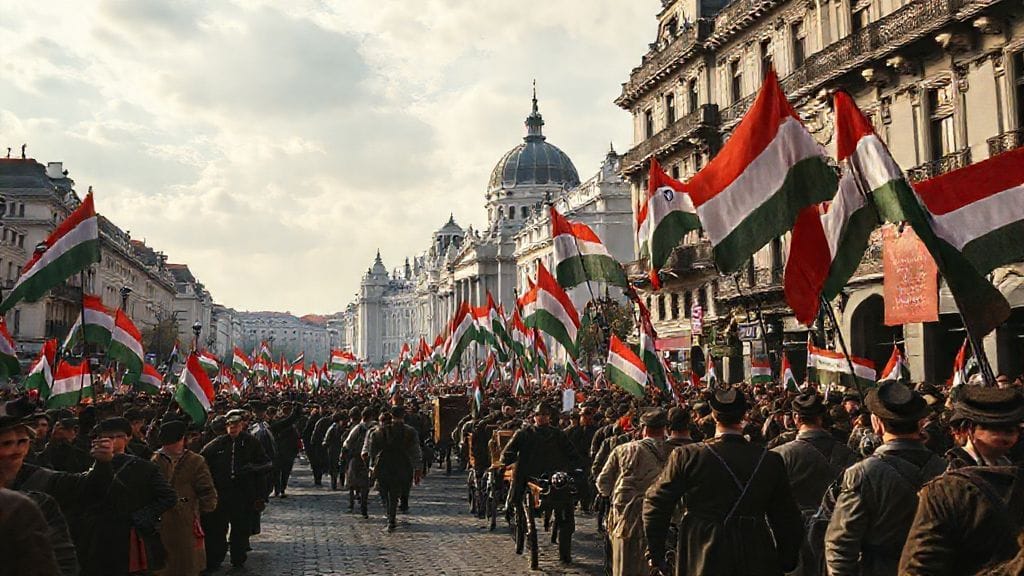
On a brisk spring evening in mid-March 1848, the cobblestone streets of Pest thrummed with an electrifying mix of hope, fury, and resolute courage. The air was thick with anticipations as young students, craftsmen, lawyers, and simple townsfolk gathered beneath a grey, overcast sky, clutching the red-white-green cockades—the colors that would soon blaze as a symbol of Hungary’s fight to reclaim its destiny. In cafés, print shops, and on street corners, the whisper of change had grown into a shout; the time for patience was over. It was here, amid the sharp clang of bells and the impassioned recitations of poetry and proclamations, that the Hungarian Revolution was proclaimed, igniting a movement that would blaze across the nation and reverberate throughout Europe.
This was not just an outburst of youthful idealism—it was the culmination of decades of simmering frustrations against Habsburg imperial rule, economic hardship, and the crushing oppression of national identity. As the crowd surged into the heart of Pest, the city became the crucible for a new Hungary—one defined by liberty, justice, and self-determination. The echoes of legendary words and the pounding of hurried footsteps would forever mark March 15 as the day a nation rose from the shadows.
The Winds of Change: Europe on the Brink of Revolution
By 1848, Europe was a continent on edge. The old order—monarchies steeped in dynastic rights and feudal privileges—stood vulnerable under the relentless pressure of Enlightenment ideas, industrialization, and a rising tide of popular demands for emancipation. Cities like Paris had already witnessed riots; Prague, Vienna, Berlin—all stirred with revolutionary fever. The “Springtime of Peoples,” as historians call it, was not a series of isolated incidents but a sweeping convulsion that uprooted centuries of political and social stability.
Hungary, part of the Habsburg monarchy, was caught in this swirl. While Austria clung to absolutism, many Hungarian intellectuals and political leaders had been increasingly inspired by the revolutions brewing to the west. The call for reforms—constitutional limits, civil rights, economic development—was no longer abstract but immediate and urgent. Yet, beneath this shared European impulse lay distinct Hungarian grievances: centuries of subjugation, cultural repression, and economic marginalization within the empire.
Hungary’s Long Quest for Autonomy and Identity
The story of Hungary in the 19th century is a tapestry woven with threads of struggle for self-rule and cultural preservation. Since the Battle of Mohács in 1526, which pitched the country into Habsburg hands, Hungarian nobility had navigated a delicate balance of loyalty and resistance. The kingdom retained nominal autonomy under the Habsburg crown, but the centralized absolutism of the dynasty—especially under Emperor Franz Joseph—eroded that privilege.
Lands were farmed for the empire’s benefit, Hungarian language and traditions were sidelined in favor of Germanization, and serfdom still shackled many common people to the land. Yet, a growing class of educated elites, lawyers, writers, and activists kept alive a fervent hope for national sovereignty. The question was no longer if Hungary should change, but how and when.
The Influences that Sparked the Revolution: Liberalism and Nationalism
By the 1840s, Hungarian intellectual life had been transformed by the European waves of liberalism and romantic nationalism. These ideologies were not mere foreign imports; they found fertile ground in Hungary’s unique situation. The liberal demand for constitutional governance, legal equality, and economic freedom meshed with the nationalist desire to preserve the Magyar language, cultural customs, and territorial integrity.
The works of figures like Sándor Petőfi—whose poems would become the anthem of the revolution—and the political leadership of Lajos Kossuth synthesized these strands into a clear program: Hungary must govern itself, abolish serfdom, and become a modern state within or outside the empire if necessary. Thus, the revolution did not simply challenge Habsburg rule but proposed a bold vision of progress and identity.
The Martyrs and Visionaries: Key Figures Who United a Nation
Any telling of March 15 must name the fiery champions who turned idealism into action. Lajos Kossuth, the passionate orator and lawyer, was the soul of the revolution, articulating its demands with unmatched clarity and fervor. Sándor Petőfi, poet and patriot, inspired the masses with his verses that captured the spirit of freedom.
Count István Széchenyi, though more cautious, had laid much groundwork with his modernization efforts and advocacy for reform. Others, like Mór Jókai, József Eötvös, and the youthful students led by the likes of Mihály Táncsics, together galvanized a diverse citizenry—from upper classes to artisans and peasants—around common cause.
The Uprising Begins: From Petitions to Crowds in Pest
In the weeks leading up to March 15, Pest was a hive of political activity. Student groups painstakingly printed leaflets and newspapers, spreading “The Twelve Points”—a succinct and fiery list of demands calling for freedom of the press, a representative government, national administration, and the abolition of serfdom.
On the evening of March 15, these activists rallied their fellow citizens with readings of Petőfi’s “Nemzeti Dal” and public recitals of the Twelve Points, which were read aloud in coffeehouses and public squares. The crowd swelled organically, fed by an urgency that no authority could contain. The transformation from petition to protest was swift and unstoppable.
The Twelve Points: Demands that Shook the Empire
The Twelve Points stood as the revolution’s manifesto, crisp and uncompromising. Among them: freedom of speech and assembly, the establishment of a national militia, equal taxation, and the unification of Transylvania with Hungary. Each point struck directly at the heart of Habsburg control and social injustice.
Written in clear, emotive language, these demands were accessible to common people and intelligentsia alike, uniting disparate social groups under a banner of justice. When these points were publicly posted and circulated, they became a rallying cry, transforming abstract political ideas into urgent and concrete objectives.
The Power of the Press: Lajos Kossuth’s Words that Kindled Hope
Newspapers, broadsheets, and pamphlets spread revolutionary fervor with an immediacy that stunned the authorities. Kossuth, at the helm of the influential Pesti Hírlap, used the press as a weapon to challenge the regime, voice the people's grievances, and inspire mass mobilization.
His editorials were fiery calls for national independence and social reform, emphasizing not just Hungarian pride but universal human freedoms. “We do not revolt against our Emperor; we revolt for rights denied!” he declared, carefully framing the revolution as a movement seeking justice, not anarchy.
The Crowd Gathers: Citizens, Students, and Soldiers in the Streets
As night fell on March 15, Pest’s streets became a mosaic of voices and faces—students handing out leaflets, workers chanting slogans, artists and intellectuals reciting poems, and ordinary citizens swelling the ranks with resolute hope. The atmosphere was at once festive and tense, a collective breath held in anticipation of change.
Remarkably, even some soldiers sympathized, refusing to suppress the crowds and, in some cases, joining the demonstrators. The seduction of ideals and the tangible possibility of freedom electrified the city, creating an unprecedented unity across social boundaries.
The Symbolism of the National Flag and Red-White-Green Cockades
The revolution’s most powerful visual symbol emerged almost spontaneously: the Hungarian national colors—red, white, and green—worn proudly on cockades pinned to lapels and hats. These colors, drawn from centuries-old heraldry, now took on new and potent meaning.
To display them was an act of defiance, a silent yet eloquent statement of identity and resolve. Governments tried to ban the cockades, but their popularity only grew—worn by everyone from shopkeepers to nobles, they became a visible thread stitching Hungarians together in the struggle.
The Opening Shots: When Riots Transitioned to Revolt
While March 15 remained largely peaceful, the situation rapidly intensified in subsequent days. Habsburg attempts to quell the movement met unexpected resistance as revolutionary committees took control of the city. Skirmishes erupted between imperial troops and civilians, marking a shift from symbolic protest toward armed challenge.
Pest’s streets echoed with the cries of battle as barricades were erected and artillery moved into place. The initial cries of liberty set the stage for a protracted conflict that would embroil the entire kingdom and test the limits of both patriotism and imperial might.
The Collapse of Habsburg Authority in Pest
Within days, the imperial administration in Pest weakened dramatically. Governors and bureaucrats either fled or pledged allegiance to the revolutionary government. The city became a hub of revolutionary governance, with new assemblies and militias tasked with defense and administration.
This collapse was not mere chaos but a redefinition of power—one where citizens claimed their right to self-rule. The speed and breadth of change stunned observers, both within Hungary and across Europe, illustrating the deep fractures in the empire's control.
The Role of the Military: Soldiers’ Defections and Shifting Loyalties
The Hungarian Revolution’s success hinged partially on the loyalty—or lack thereof—of the military. Many Hungarian soldiers, influenced by nationalist sentiments and loyal to their homeland, defected to join the revolutionary forces.
This phenomenon complicated imperial efforts to restore order, transforming the revolution into a civil war. The fragmentation of the army revealed the fissures in Habsburg authority and the potent force of national identity even within disciplined ranks.
The Spread of Revolution: From Pest to the Countryside and Beyond
News of the uprising in Pest ignited similar calls for reform and revolt across the Hungarian countryside, in Transylvania, and in smaller towns. Peasants and urban workers, inspired yet cautious, joined in demands for serf liberation and political participation.
Though the revolution’s epicenter was Pest, the tidal wave of change soon engulfed the entire kingdom, presenting the Habsburg monarchy with a crisis far beyond a mere city riot.
Franz Joseph’s Dilemma: The Empire’s Response
Emperor Franz Joseph I faced a stark choice: compromise with the revolutionaries or use force to suppress the movement. His decision was complicated by the multi-ethnic nature of the empire, conservative advisors, and the specter of losing Hungary altogether.
Initially, the empire sought to negotiate but soon resorted to military campaigns aimed at subjugation. The failure to accommodate Hungarian demands sowed the seeds for years of violent conflict and deepened the empire's internal fractures.
The Promise and Perils of the April Laws
In the immediate aftermath, revolutionary leaders pushed through the April Laws—a sweeping reform package that abolished serfdom, established civil liberties, and created a parliamentary government. These laws represented one of the most ambitious modernization efforts in Central Europe.
Yet, the enactment of these laws also heightened tensions with the imperial court and minority nationalities within Hungary, generating paradoxes between unity and division, hope and conflict.
Women and the Revolution: Silent Strength and Visible Presence
Although often overshadowed by male leaders, women played crucial roles during the revolution—as organizers, messengers, caregivers, and sometimes combatants. Their contributions were vital in sustaining morale and spreading revolutionary ideals within families and communities.
Figures like Klára Leövey championed women’s education and involvement, embodying the revolution’s broader push for social transformation beyond mere political sovereignty.
The Cultural Renaissance Amidst Turmoil
Amid the turmoil, Hungary experienced a cultural blossoming. Literature, music, and art flourishing with nationalistic themes fueled the revolutionary spirit. Poets like Petőfi and painters like Miklós Barabás became symbols of a new Hungary—creative as well as political.
This renaissance embedded the revolution not only in political annals but in the heart of Hungary’s cultural identity.
The Temporary Triumph: A Nation Proclaimed — But for How Long?
For a fleeting moment, it seemed Hungary was on the threshold of a new era. The revolutionary government functioned with vigor, reforms were enacted, and a collective hope blossomed that the country might govern its own destiny.
Yet beneath this promise lurked dangers—a powerful empire unwilling to let go, ethnic tensions, and international geopolitics that would soon engulf the fledgling state in violent suppression.
Repression and Retaliation: The Revolution’s Dark Turn
By late 1848, the Habsburgs, aided by Russian intervention, launched brutal military campaigns crushing the revolution. Key leaders went into exile or captivity; cities were bombarded; civilians suffered reprisals.
The dream of March 15 was stamped out by force, yet the memory of struggle endured, fueling lifelong political debates and revolutionary aspirations well into the next century.
The International Echoes: Hungarian Revolution in the Context of 1848 Revolutions
Hungary’s upheaval was part of a unified European canvas of revolution and reform. Though unique in its nationalist goals and imperial context, its aspirations echoed those in Paris, Berlin, and Vienna.
The revolution’s failure also marked the limits of 1848’s popular uprisings, demonstrating the resilience of old regimes but ensuring that ideas of national self-determination and liberal reform could never be fully extinguished.
Legacy of March 15: From Tragedy to National Holiday
After centuries of repression, March 15 became more than a date; it evolved into a symbol of national pride, resistance, and hope. Celebrated annually as a national holiday, it serves as a reminder of sacrifice and the enduring quest for freedom.
Through commemorations, education, and public memory, the revolution’s spirit remains alive, inspiring Hungarians and reminding the world of the universal struggle for dignity.
Remembering Heroes: Poetry, Monuments, and Memory
Statues to Kossuth, memorials for fallen students, and the verses of Petőfi echo through Budapest’s streets, embedding history into the physical and emotional landscape. These tributes keep the revolutionary moment vivid—not just as politics, but as story, passion, and identity.
Their endurance is testament to the profound human need to honor courage and aspiration in the face of oppression.
Lessons from 1848: Nationalism, Freedom, and the Struggle for Justice
The Hungarian Revolution teaches us about the power and limits of nationalism, the profound human desire for liberty, and the sacrifices such dreams entail. It highlights the complexity of multi-ethnic empires, the nexus of social and political reform, and the price of change.
In today’s world, where questions of sovereignty and identity persist, the revolution’s story remains deeply relevant—its triumphs and tragedies a mirror to our own times.
Conclusion
March 15, 1848, was a moment when a nation dared to envision itself freed from centuries of subjugation, a day when poetry became politics, and hope cast its fire across cobblestones and hearts alike. Though the revolution would face brutal repression, its legacy endured—an unquenchable flame in Hungary’s collective soul.
This day was not merely an event but a beginning: the beginning of modern Hungarian identity, the beginning of the universal struggle for national dignity, and a reminder that freedom, though often fleeting, is the prize for which generations must tirelessly strive.
The heroes of March 15, with their dreams and sacrifices, live on—calling us to remember that revolutions are not just upheavals but the very heartbeat of history.
FAQs
1. What triggered the Hungarian Revolution of 1848?
Deep dissatisfaction with Habsburg absolutism, demands for political and social reforms inspired by European liberalism and nationalism, and the influence of concurrent revolutions across Europe sparked the uprising.
2. Who were the key leaders of the revolution?
Lajos Kossuth, Sándor Petőfi, István Széchenyi, and other intellectuals and students played pivotal roles, combining oratory, literature, and political action to mobilize the population.
3. What were the “Twelve Points”?
A manifesto of the revolution’s demands, including freedom of press, independence of Hungary, abolition of serfdom, and civil rights, which galvanized support and united diverse social groups.
4. How did the Habsburg monarchy respond?
Initially hesitant, the empire resorted to military force, ultimately crushing the revolution with help from Russian troops, restoring control but fueling long-term resentment.
5. What was the significance of the red-white-green colors during the revolution?
These national colors became symbols of Hungarian identity and resistance, worn proudly on cockades as a visible sign of unity and defiance.
6. How is March 15 remembered in today’s Hungary?
It is a national holiday commemorating the revolution’s ideals of freedom and justice, honored with ceremonies, cultural events, and public reflections on national identity.
7. What role did women play in the revolution?
Women contributed significantly, though often unofficially, as organizers, supporters, and promoters of education and civic engagement during the uprising.
8. How did the Hungarian Revolution fit into the broader European revolutions of 1848?
It was part of a continent-wide wave of democratic and nationalist uprisings seeking reform and rights, highlighting the interconnectedness of nationalist and liberal aspirations.