Table of Contents
- The Final Moments of a Visionary: Ibn Khaldun’s Last Day in Cairo
- The World in 1406: A Crossroads of Cultures and Empires
- Ibn Khaldun: The Man Behind the Legacy
- Early Life and Intellectual Formation
- The Rise of a Historian Amid Political Turmoil
- The Muqaddimah: A Revolutionary Magnum Opus
- Scholars, Courts, and Conflicts: Ibn Khaldun’s Political Engagements
- Cairo in the 15th Century: A City of Learning and Intrigue
- The Waning Days: Ibn Khaldun’s Final Work and Reflection
- Death on March 17, 1406: Witnesses and Accounts
- The Immediate Aftermath: Mourning a Sage
- The Transmission of His Ideas in the 15th and 16th Centuries
- Ibn Khaldun’s Influence in the Islamic World and Beyond
- Rediscovery by the Western World: From Obscurity to Reverence
- The Legacy of Ibn Khaldun in Modern Historiography
- Philosophy of History and Society: Enduring Themes
- Ibn Khaldun and the Sociology of Power
- The Role of Ibn Khaldun’s Work in Contemporary Middle Eastern Studies
- Cairo’s Memory of Ibn Khaldun Through the Centuries
- Ibn Khaldun in Popular Culture and Scholarship Today
- An Enduring Inspiration: Lessons from Ibn Khaldun's Life and Death
The Final Moments of a Visionary: Ibn Khaldun’s Last Day in Cairo
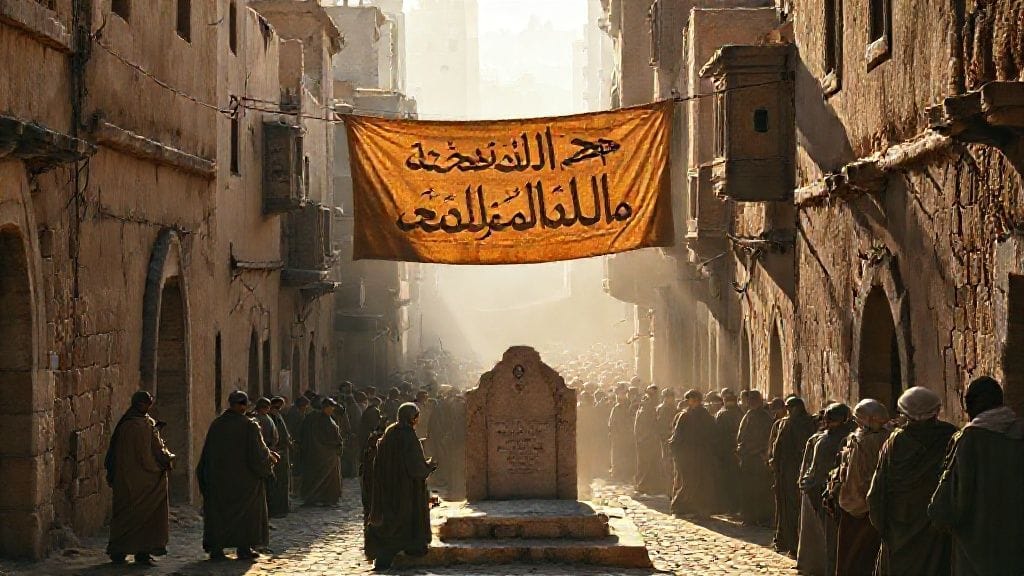
As dawn stretched over the bustling alleys of Cairo on March 17, 1406, the city stirred with its usual rhythm—the calls of merchants blending with the devout chants echoing from mosques. Yet inside a modest home, a luminary of medieval scholarship breathed his final breaths. Ibn Khaldun, the great historian, philosopher, and sociologist, lay surrounded by a handful of family and disciples, the weight of years and intellect pressing gently upon his fading frame.
His death was not simply the loss of a man but the closing of a chapter in the intellectual blossoming of the Islamic world. To understand the significance of this moment, one must peer into the tapestry of his life and the broad strokes of history that shaped it.
The World in 1406: A Crossroads of Cultures and Empires
The early 15th century was a period teetering between the medieval and the emerging Renaissance, a world where cultures collided and empires strove for dominance. The Mamluk Sultanate ruled Egypt and Syria, defending Muslim lands against Crusaders and the rising Ottoman threat. This was also a time when trade routes linked Africa, Europe, and Asia, making Cairo a vibrant hub of commerce and scholarship.
Yet political instability was omnipresent. Dynastic struggles, secret alliances, and the renewed threat from the Mongol successor states cast long shadows over scholars, who often had to navigate the treacherous waters of court politics. Ibn Khaldun’s life mirrored this world: dynamic, complex, and precarious.
Ibn Khaldun: The Man Behind the Legacy
Abu Zayd ‘Abd al-Rahman ibn Muhammad ibn Khaldun al-Hadrami, commonly known as Ibn Khaldun, was more than a towering intellect: he was a man shaped by exile, ambition, and ceaseless curiosity. Born in 1332 in Tunis, his trajectory would wander through the courts of North Africa and the Levant, always seeking knowledge but often caught in the swirl of political storms.
He was a polymath—a historian attuned not just to events but to the undercurrents of human civilization. His insight into the rise and fall of societies was nowhere clearer than in his seminal work, the Muqaddimah, often considered the world’s first comprehensive philosophy of history and sociology.
Early Life and Intellectual Formation
Hailing from a family of Andalusian origin, Ibn Khaldun was steeped in a tradition of learning early on. His formative years coincided with the decline of the Marinid dynasty in Morocco and the Hafsid rule in Tunisia, environments rife with intrigue and instability. His education was eclectic—from Islamic jurisprudence to Arabic literature, mathematics, and philosophy—reflecting the rich intellectual milieu of the Maghreb.
Yet, what set Ibn Khaldun apart was his critical, empirical approach. Unlike many who recited history as mere chronology, he sought to understand causes and patterns—how power worked and societies evolved. This depth of analysis foreshadowed the modern scientific method centuries before it was widely recognized.
The Rise of a Historian Amid Political Turmoil
Ibn Khaldun’s career was not confined to scholarship alone. Intrigues in North African courts repeatedly forced his hand—he became an ambassador, a judge, and even a political advisor. His attempts to serve rulers brought him both favor and danger.
One dramatic episode saw him imprisoned and tortured on accusations tied to the chaotic political climate of Tunis. Such ordeals only deepened his insights into power’s fragility and the human cost of political decay. More than once, he fled persecution, only to reappear with renewed vigor in distant cities.
The Muqaddimah: A Revolutionary Magnum Opus
Written in 1377 as an introduction to a universal history, the Muqaddimah quickly grew into a standalone masterpiece. It dissected tribal loyalties, economic forces, the cyclical nature of dynasties, and the sociology of nomadic peoples versus urban centers.
What makes the Muqaddimah astonishing is its prescience: Ibn Khaldun theorized concepts akin to social cohesion ('asabiyyah), economic supply and demand, and even climate’s impact on civilizations. He argued that every regime would rise with strong group solidarity only to decay as luxury and complacency set in—a cycle he observed repeatedly.
Scholars, Courts, and Conflicts: Ibn Khaldun’s Political Engagements
Even as a scholar, Ibn Khaldun was a pragmatic man, deeply enmeshed in the politics of his day. His interactions with the Mamluk Sultanate in Cairo were marked by fluctuating fortunes. Often called upon as a jurist or historian, he also found himself under suspicion or out of favor.
In Cairo, then a cosmopolitan center, Ibn Khaldun continued his work and taught until his health and age slowed him. His last years were peaceful compared to his younger times, but his mind remained sharp, still dissecting history and philosophy with unparalleled clarity.
Cairo in the 15th Century: A City of Learning and Intrigue
The city of Ibn Khaldun’s last days was not a sleepy town but a hive of intellectual and political activity. Madrasas (Islamic schools) flourished, religious scholars debated jurisprudence, and merchants from across the known world mingled in vibrant souks.
Yet beneath this energy lay tensions among religious authorities, rulers, and foreign envoys. These dynamics provided a living context for Ibn Khaldun’s reflections on power, society, and decay—real-life proof of his theories unfolding before his eyes.
The Waning Days: Ibn Khaldun’s Final Work and Reflection
In his last years, Ibn Khaldun remained committed to completing his historical work. His correspondence reveals a man deeply aware of mortality but also resolved to leave a lasting intellectual heritage. Anecdotes suggest he was often tranquil but reflective, surrounded by disciples eager to capture his wisdom.
Some of the final pages of his unfinished manuscripts tantalize scholars to this day, hinting at further insights into governance and human nature that never fully saw the light of day.
Death on March 17, 1406: Witnesses and Accounts
Contemporary biographers provide moving portraits of Ibn Khaldun’s death. The accounts testify to a peaceful passing surrounded by respect and sorrow. Witnesses describe how he repeated prayers, expressed hope for the afterlife, and exhorted his followers to pursue knowledge with sincerity.
The date of March 17, 1406, therefore stands not just as a chronological fact but as a symbolic farewell of one of the premodern world’s towering intellectuals.
The Immediate Aftermath: Mourning a Sage
News of Ibn Khaldun’s demise spread swiftly among Cairo’s scholarly and religious circles. His funeral was marked by solemnity, attended by dignitaries and students alike. Poets and thinkers lamented the loss; yet, even then, his reputation was already rooted beyond Cairo’s walls.
The manuscripts he left behind circulated, inspiring a new generation of historians and philosophers eager to grapple with his radical approach to understanding society.
The Transmission of His Ideas in the 15th and 16th Centuries
Despite initial respect, Ibn Khaldun’s work gradually slipped into relative obscurity in subsequent centuries. Political upheavals and shifting scholarly fashions relegated him to the peripheries of dominant narratives.
However, his ideas survived within intellectual circles in the Islamic world, particularly in North Africa and Egypt, preserved in handwritten copies and oral traditions, waiting to be rediscovered.
Ibn Khaldun’s Influence in the Islamic World and Beyond
Ibn Khaldun’s impact can be traced through a mosaic of historians and sociologists who referenced his ideas, albeit indirectly. In the Ottoman Empire, scholars debated his theories on economics and power.
His work influenced not only Muslim historians but, eventually, European orientalists who encountered his writings through translations, thereby integrating his insights into emerging disciplines like sociology and historiography.
Rediscovery by the Western World: From Obscurity to Reverence
It was not until the 19th century that Ibn Khaldun received widespread recognition in the West. European scholars, fascinated by oriental knowledge, translated the Muqaddimah, astonished by its modernity and breadth.
This rediscovery framed Ibn Khaldun as a precursor to modern social sciences, a narrative that increasingly placed him among the intellectual giants of world history.
The Legacy of Ibn Khaldun in Modern Historiography
Today, Ibn Khaldun is hailed as a founding figure in history, sociology, economics, and political theory. His methodology—careful data collection, critical skepticism, emphasis on cause and effect—reshaped how scholars study the past.
Universities around the world include his work in curricula, celebrating him as a pioneer of interdisciplinary thought bridging cultures and epochs.
Philosophy of History and Society: Enduring Themes
Ibn Khaldun’s reflections on cyclical history, group solidarity, economic development, and political decay continue to resonate. His ideas about the interplay between social structures and individual agency anticipate later social contract theories and systemic analyses.
His insistence on factoring ecology, climate, and psychology into historical understanding remains revolutionary, urging modern scholars to consider complexity beyond mere events.
Ibn Khaldun and the Sociology of Power
At the heart of Ibn Khaldun’s work lies a profound insight into power dynamics. His notion of 'asabiyyah (social cohesion) remains a pivotal concept, explaining how solidarity fuels the rise of dynasties and its erosion leads to decline.
This has inspired political scientists and sociologists alike to examine the foundations of authority in varied contexts—from tribal confederations to nation-states.
The Role of Ibn Khaldun’s Work in Contemporary Middle Eastern Studies
In the context of modern Middle Eastern studies, Ibn Khaldun’s work serves as a critical lens for interpreting historical change, state formation, and social conflict. His emphasis on empirical observation empowers scholars to bridge classical Islamic thought and modern academic rigour.
Several research centers and think tanks draw upon his insights to analyze ongoing political and social dynamics in the region.
Cairo’s Memory of Ibn Khaldun Through the Centuries
Cairo remembers Ibn Khaldun as a cherished son of the city. His burial site became a subtle landmark; intellectuals recall his influence as woven into Egypt’s cultural fabric.
Monuments, academic chairs, and public lectures celebrate his enduring relevance. His name remains synonymous with the city’s golden intellectual age.
Ibn Khaldun in Popular Culture and Scholarship Today
From academic conferences to popular documentaries, Ibn Khaldun’s figure has transcended dusty manuscripts to become a symbol of intellectual curiosity and universal insight.
Novels, plays, and even digital media explore his life and theories, introducing him to new generations eager for timeless wisdom on human society.
An Enduring Inspiration: Lessons from Ibn Khaldun's Life and Death
The story of Ibn Khaldun’s final day is ultimately a reminder of the power of knowledge to transcend personal and political vicissitudes. His death ended a remarkable journey but ignited an eternal dialogue on civilization, power, and human nature.
As modern readers reflect on his legacy, they discover a mirror to our own times: the fragile cycles of rise and fall, the search for truth amid chaos, and the indomitable spirit of inquiry that defines humanity itself.
Conclusion
Ibn Khaldun’s death on that early spring day in 1406 was not merely the extinguishing of a single life but the dawning of an intellectual legacy that would traverse continents and centuries. His reflections, written amid turmoil and exile, reveal a mind striving to comprehend the grand patterns of history—a quest that resonates even today.
His insights into social cohesion, economics, and the impermanence of political power invite us to reconsider the forces that shape societies. In an era where history often feels fragmented and certain truths elusive, Ibn Khaldun’s life reminds us of the enduring value of scholarship grounded in observation, critical thought, and human empathy.
Cairo mourned a wise man; the world gained a timeless teacher.
FAQs
Q1: Who was Ibn Khaldun, and why is he significant?
A: Ibn Khaldun was a 14th-century historian, philosopher, and sociologist known primarily for his work Muqaddimah, which laid foundational principles for the modern study of history and social sciences.
**Q2: What were the main themes of Ibn Khaldun’s Muqaddimah?**
A: The Muqaddimah addresses social cohesion (‘asabiyyah), economic cycles, the rise and fall of dynasties, the impact of environment on human societies, and political structures.
Q3: How did Ibn Khaldun’s political life influence his scholarship?
A: His involvement in courts and political affairs provided firsthand experience of power’s dynamics, enriching his analysis of historical patterns and social change.
Q4: What was Cairo like when Ibn Khaldun died?
A: Cairo was a thriving intellectual and commercial center, marked by religious scholarship, political intrigue, and cultural vibrancy under Mamluk rule.
Q5: How has Ibn Khaldun’s work influenced modern historiography?
A: His empirical and analytical approach anticipated methods in sociology and economics, influencing scholars worldwide and shaping interdisciplinary studies.
Q6: Why was Ibn Khaldun’s work rediscovered in the West only centuries after his death?
A: Political and cultural shifts limited the spread of his ideas; Western interest grew during the 19th-century orientalist movement, leading to translations and renewed scholarly attention.
Q7: What is ‘asabiyyah, and why is it crucial in Ibn Khaldun’s thought?
A: ‘Asabiyyah refers to social solidarity or group cohesion, a vital force for the emergence and endurance of political power according to Ibn Khaldun.
Q8: How is Ibn Khaldun remembered in contemporary Cairo?
A: He is celebrated as a key intellectual figure, with commemorations in academic institutions and cultural events keeping his legacy alive.