Table of Contents
- The Fiery Dawn: The Opening Moments of Ibu’s 2018 Eruption
- Halmahera: The Island of Fire and Myths
- Geological Beginnings: What Made Ibu Awake in 2018?
- The Quiet Before: Signs and Warnings from a Sleeping Giant
- February 2018: The First Explosions Shake the Landscape
- Ash Clouds and Lava: Nature’s Spectacle and Human Fear
- Local Lives Upended: The Human Cost of the Eruption
- Responses and Resilience: How Communities Endured and Adapted
- The Indonesian Government and Volcanic Monitoring
- Sulfur Dioxide and Ash Fallout: Environmental Consequences
- Scientists in Action: Decoding Ibu’s Anger
- The International Attention: Volcano Tourism Meets Caution
- Cultural Narratives: The Spirit of the Volcano Among Local Peoples
- Comparing Ibu 2018 with Halmahera’s Past Eruptions
- The Aftermath: Recovery and Reconstruction Efforts
- Lessons from Ibu: Volcanic Preparedness in Indonesia’s Archipelago
- The Broader Impact: Ibu in the Global Volcanic Record
- Stories of Survival: Personal Accounts from the Eruption’s Eye
- The Eruption’s End—or a Pause? Signs of a Slumbering Giant
- Preserving Memory: Documenting the 2018 Ibu Eruption
- Toward Future Safety: Innovations in Volcanic Risk Management
- The Unfolding Narrative: Ibu’s Place in Modern Indonesian History
The Fiery Dawn: The Opening Moments of Ibu’s 2018 Eruption
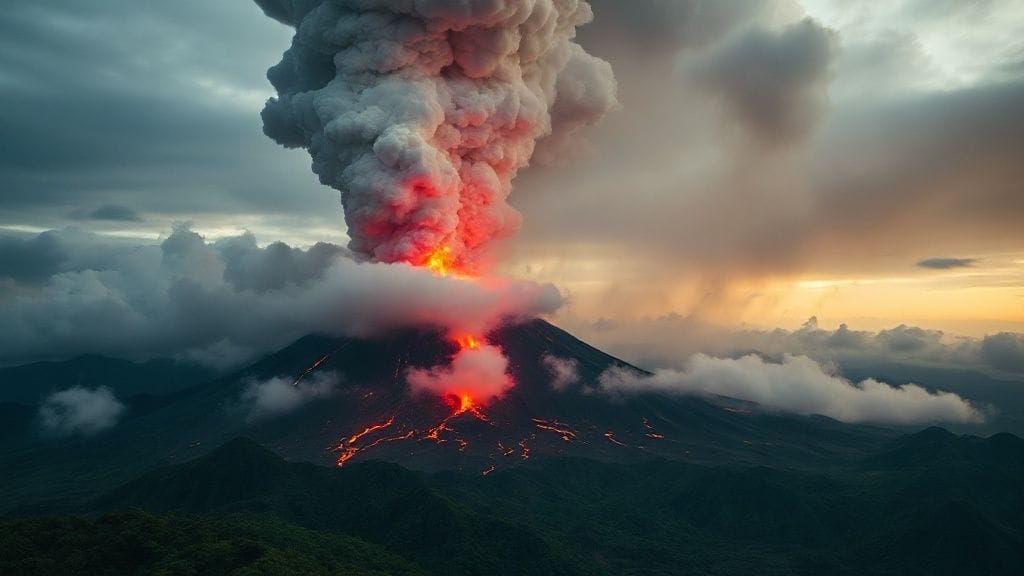
As the first glow of dawn stretched over Halmahera’s rugged landscape on February 12th, 2018, the slumbering Ibu volcano shattered the eerie silence with a brutal roar. Plumes of thick grey smoke climbed rapidly towards the sky, blotting out the rising sun and casting a foreboding shadow on the island below. Villagers, many awakened by the ground’s subtle trembles, stared upwards in despair and awe, as sheets of ash rained down like a dark, unforgiving tide.
It was not merely smoke and fire; this eruption was a stark reminder that beneath Indonesia’s emerald veneer lurked violent forces capable of changing lives in moments. For the islanders of North Halmahera and the world watching from afar, Ibu’s awakening in 2018 was a drama of elemental power, resilience, and a powerful testament to nature’s unpredictability.
Halmahera: The Island of Fire and Myths
Nestled within the Maluku Islands, Halmahera stands as Indonesia’s largest island east of Sulawesi. Shaped like a stretched-out crescent, it is a mosaic of dense rainforests, winding rivers, and towering volcanoes. Ibu, perched majestically on the island’s northwest coast, is one of six active volcanoes dotting this seismic hotspot.
For centuries, the people of Halmahera have woven tales around the volcanic peaks—stories of gods’ wrath, spiritual guardians, and the dual nature of destruction and creation. The volcano was not only a geological presence but a profound cultural symbol, inspiring reverence and caution. Such myths would be recalled in hushed tones as Ibu’s fury erupted anew in 2018.
Geological Beginnings: What Made Ibu Awake in 2018?
To understand the 2018 eruption, one must peer deep beneath the Earth’s crust. Ibu’s volcanic activity arises from subduction processes—the Pacific Plate diving beneath the Eurasian Plate—generating magma that slowly pressures the volcano’s magma chamber.
Over months preceding the eruption, subtle signs pointed to an imminent upheaval. Increasing seismic activity, slight ground deformation, and gas emissions hinted at magma movement close to the surface. Yet, in the vast, volatile equatorial ring often dubbed the “Ring of Fire,” such rumblings are as common as the tropical rains.
Still, the accumulation of these signs at Ibu hinted toward something more profound. Magma, rich in volatile gases and silica content, was gearing up to break free with an intensity not seen for several years.
The Quiet Before: Signs and Warnings from a Sleeping Giant
From January 2018, local volcanic observatories began to detect a rise in tremors beneath Ibu. Residents of nearby villages like Kayu Lif and Tingkulu noticed faint rumbles and a sulfurous scent carried on the coastal breezes. Though cautious, many held a fragile hope that the volcano might remain dormant.
Government agencies issued early warnings. However, understanding and communication hurdles—common in Indonesia’s remote island geographies—meant that much of the populace remained unaware of the imminence and scale of the hazard. The stage was set for a sudden, dramatic change.
February 2018: The First Explosions Shake the Landscape
On February 12th, the volcano’s vent expelled hundreds of meters of ash and volcanic rock in a spectacular – and terrifying – eruption column. The explosion sent shockwaves through Halmahera’s northern tip, shaking the very earth beneath feet and rattling windows miles away.
Ashfall quickly darkened the skies, turning day into a preternatural twilight. Visibility dropped sharply, crops were covered with thick layers of ash, and livestock scattered in fear. The eruption marked the beginning of a weeks-long phase of intermittent explosive activity, punctuated by lava flows creeping slowly down Ibu’s slopes.
Ash Clouds and Lava: Nature’s Spectacle and Human Fear
Watching ash clouds twist and curl against Halmahera’s backdrop was to witness raw power – majestic, terrible, mesmerizing. At night, the glowing lava flows illuminated the dark, tracing scars down the mountain’s side, a ghastly lightshow.
Yet for the people living in Ibu’s shadow, it was a time suffused with fear and uncertainty. Ash inhalation posed health risks, farmland smothering threatened food security, while the threat of sudden pyroclastic flows and lahars haunted every rainfall.
Still, a delicate balance existed between awe and terror. This volcano, fierce and unpredictable, commanded respect as well as fear.
Local Lives Upended: The Human Cost of the Eruption
For Halmahera’s local communities, the eruption was not an abstract event but a tangible crisis. More than 4,000 residents were forced to evacuate their homes, relocated to temporary shelters and makeshift camps often lacking in adequate sanitation and supplies.
Elderly villagers expressed anguish at losing ancestral lands. Children faced disrupted schooling; farmers confronted ruined rice paddies and cassava fields blanketed in ash. These profoundly human dimensions remind us that volcanic eruptions are not merely geological phenomena but deeply social tragedies.
Responses and Resilience: How Communities Endured and Adapted
Remarkably, the people of Halmahera displayed resilience in the face of adversity. Community leaders organized evacuation drills, distributed masks and medical supplies, and coordinated with government rescue efforts. Traditional knowledge about volcanic hazards wound through local disaster strategies, complementing scientific data.
In many cases, neighbors opened their homes, and communal kitchens were set up. Solidarity became a lifeline, demonstrating how cultural cohesion serves survival amid natural disasters.
The Indonesian Government and Volcanic Monitoring
Indonesia’s volatile geography has long necessitated a robust volcano monitoring system. The Center for Volcanology and Geological Hazard Mitigation (PVMBG) issued regular bulletins during the crisis, updating alert levels and hazard zones.
Yet logistical challenges in Halmahera’s rugged terrain hampered rapid response and timely evacuations. The 2018 Ibu eruption revealed both the strengths and weaknesses of Indonesia’s volcanic risk management—underscoring the ongoing need for investment in infrastructure and community education.
Sulfur Dioxide and Ash Fallout: Environmental Consequences
Beyond immediate disruptions, the eruption released large quantities of sulfur dioxide gas, acidifying the local atmosphere. Ash particles damaged vegetation and waterways, altering ecosystems in subtle but enduring ways.
Researchers documented increased soil acidity and water contamination affecting freshwater fish stocks. Such environmental disturbances paint a fuller picture of volcanic eruptions’ lasting influences, extending well beyond the fiery spectacle.
Scientists in Action: Decoding Ibu’s Anger
Volcanologists from Indonesia and abroad studied the event meticulously, employing seismographs, gas sensors, satellite imagery, and drone surveys. Initial findings indicated a classic phreatomagmatic eruption, where groundwater interacts explosively with rising magma.
This interaction often creates highly fragmented, ash-rich eruptions—explaining the dense ash clouds and sharp explosions observed. Ibu’s 2018 eruption thus serves as a textbook example, offering valuable data to the global scientific community.
The International Attention: Volcano Tourism Meets Caution
Indonesia’s volcanoes attract adventure seekers worldwide. Ibu’s dramatic 2018 eruption brought sudden international attention, sparking interest—and concern—among tourists and mountaineers.
Authorities took a firm stance, restricting access to the danger zone. Though some visitors attempted to catch glimpses from afar, the event highlighted the delicate balance between promoting eco-tourism and preserving public safety.
Cultural Narratives: The Spirit of the Volcano Among Local Peoples
For the indigenous Tobelo people and other ethnic groups inhabiting Halmahera, Ibu’s eruption reaffirmed spiritual beliefs about the mountain as a living entity with will and agency. Storytellers narrated the eruption as a manifestation of ancestral displeasure, urging appeasement rituals.
This intertwining of geology and spirituality remains a potent lens to understand the local response to volcanic hazards—where science and tradition coexist uneasily but meaningfully.
Comparing Ibu 2018 with Halmahera’s Past Eruptions
Ibu’s eruptions are not new phenomena; historical records reveal periodic activity since the 17th century. Yet the 2018 event was among the most intense in recent decades, rivaled perhaps only by the eruptions of the 1990s.
Comparisons underscore an irregular pattern of dormancy and fury, emphasizing the volcano’s capricious temperament. This irregularity further complicates prediction efforts and heightens the stakes for monitoring.
The Aftermath: Recovery and Reconstruction Efforts
In the months following the eruption, humanitarian agencies and local governments rallied to rebuild affected communities. Houses were repaired, farmland rehabilitated, and public services restored.
Psychological support programs were introduced to address trauma. However, many challenges persisted, including persistent ash deposits and the looming threat of renewed activity.
Reconstruction in volcanic landscapes requires not only physical rebuilding but also fostering community resilience—a process that continues to evolve.
Lessons from Ibu: Volcanic Preparedness in Indonesia’s Archipelago
The 2018 eruption served as a case study for refining volcanic preparedness across Indonesia. Investment in early warning systems, community education, and emergency infrastructure received renewed emphasis.
Crucially, the event highlighted the necessity of culturally sensitive approaches—engaging local wisdom alongside modern science for holistic risk management.
The Broader Impact: Ibu in the Global Volcanic Record
Though modest compared to giants like Mount St. Helens or Eyjafjallajökull, Ibu’s 2018 eruption occupies a meaningful place in the catalog of global volcanic activity. It reminds us that eruptions of various scales shape our world in diverse ways.
By studying Ibu, volcanologists gather insights pertinent to predicting eruptions elsewhere, thus enhancing planetary safety.
Stories of Survival: Personal Accounts from the Eruption’s Eye
Amid the geologic pageantry and official reports, individual voices resonate. One elder, Pak Musa, recalled, “The mountain warned us with small tremors first; we did not think it would roar like this. But our spirit stayed strong.”
Children remembered nights illuminated by red lava, while mothers spoke of the terrifying ash that blanketed their homes. These testimonies transform abstract disaster into lived experience—full of fear, hope, and human endurance.
The Eruption’s End—or a Pause? Signs of a Slumbering Giant
By late 2018, volcanic activity at Ibu had dwindled, smoke columns reduced to thin wisps. Scientists cautiously declared the eruption’s end, though monitoring remained vigilant.
Volcanoes rarely provide closure; their “silent” phases offer uneasy respite, a waiting game fraught with uncertainty. Ibu’s story in 2018 became a chapter, not the final paragraph.
Preserving Memory: Documenting the 2018 Ibu Eruption
Recognizing the significance of the event, local historians, journalists, and scientists collaborated to archive photographs, videos, and oral histories. These records serve not only academic purposes but also community healing and education.
Documenting natural disasters helps societies remember, learn, and prepare—turning calamity into legacy.
Toward Future Safety: Innovations in Volcanic Risk Management
Drawing on lessons from Ibu and similar eruptions, Indonesia has advanced new technologies in risk communication, such as smartphone alerts and GIS mapping of hazard zones. Efforts to improve infrastructure and emergency logistics continue.
The goal is to transform vulnerability into preparedness, preserving lives and livelihoods against future volcanic tempests.
The Unfolding Narrative: Ibu’s Place in Modern Indonesian History
The 2018 eruption of Ibu volcano stands as a vivid episode in Indonesia’s ongoing encounter with geological forces. It encapsulates the complex relationship between people and nature—fear and reverence, destruction and renewal.
As Indonesia continues to navigate its position along the volatile Pacific Ring of Fire, Ibu remains a powerful symbol of the island’s resilience, a reminder that beneath the calm, fire always simmers.
Conclusion
The 2018 eruption of Ibu volcano on Halmahera was a remarkable demonstration of nature’s unpredictable power and humanity’s enduring resilience. Through ash-filled skies and trembling earth, communities faced fear with courage, ancient traditions mingled with modern science, and the island’s fiery heart reminded the world of its eternal restlessness.
This event transcends mere geological fact; it is a human story woven into time—a profound lesson in respect for nature’s forces, and a testament to the strength of community amidst chaos. Indonesia’s volcanic landscapes will continue to remind us that life and destruction, culture and science, tragedy and hope are forever intertwined beneath the shifting earth.
FAQs
1. What caused the 2018 eruption of Ibu volcano?
The eruption resulted from magma rising due to tectonic subduction beneath the Halmahera region. Increased magma pressure and interaction with groundwater triggered explosive activity.
2. How many people were affected by the eruption?
More than 4,000 residents were displaced due to evacuations, with damage to farmland and infrastructure impacting a larger population indirectly.
3. What were the main environmental effects?
The eruption released ash and sulfur dioxide, which affected air quality, acidified soils, and disrupted ecosystems, including freshwater supplies and agriculture.
4. How did local communities respond to the eruption?
Communities combined traditional knowledge and modern emergency protocols to evacuate safely, support displaced neighbors, and adapt to disruption.
5. What role did the Indonesian government play?
Government agencies monitored the volcano, issued warnings, coordinated evacuations, and provided humanitarian assistance, though challenged by geographic and communication barriers.
6. How significant was the 2018 eruption historically?
It was one of the most intense eruptions of Ibu in decades, adding valuable scientific data and reinforcing the volcano’s position as a critical hazard in Indonesia.
7. Are there ongoing risks from Ibu volcano?
Yes. While the 2018 eruption subsided, Ibu remains active, necessitating constant monitoring and preparedness due to the unpredictable nature of volcanic activity.
8. How is the eruption remembered today?
Through community archives, oral histories, and scientific documentation, the 2018 event remains a living memory that shapes local culture and disaster readiness.

