Table of Contents
- A Storm Over the Sacred: Constantinople in 726
- The Rise of Emperor Leo III: A New Vision for an Ancient Empire
- The Religious Landscape Before the Edict: Icons and Idolatry
- The Theological Dilemma: Between Veneration and Idolatry
- The Political Motives Behind Iconoclasm
- The Edict is Proclaimed: An Empire Divided
- The Role of Monks, Bishops, and the Patriarchate
- Popular Reaction: Veneration, Rebellion, and Resistance
- The Iconoclastic Controversy Extends Beyond Constantinople
- The Byzantine Military and Iconoclasm: Divine Warfare?
- The Role of Islam and External Threats in Shaping Policy
- Culture Stripped: Art, Mosaics, and the Erasure of Icons
- Leo III’s Legacy: Consolidating Power Through Religion
- The Edict’s Impact on East-West Relations: Rome’s Disapproval
- The Enduring Struggle: Iconoclasm’s Second Wave
- Women, Icons, and the Social Fabric of Byzantium
- The Intellectual Battle: Scholars and Theologians Respond
- The Long-Term Cultural and Religious Consequences
- A Precursor to Later Religious Conflicts
- Conclusion: The Resonance of Leo III’s Edict Through the Ages
- FAQs: Understanding the Iconoclasm Edict and Its Context
- External Resource
- Internal Link
A Storm Over the Sacred: Constantinople in 726
It was under a grey and oppressive sky that the streets of Constantinople started murmuring the first hints of unrest. Endless clouds hung above the marble columns, as if echoing the tempest about to shake the spiritual foundations of the Byzantine Empire. In the year 726 AD, the capital of what was once the glorious Roman Empire found itself rent not by sword or siege, but by an edict that would challenge the soul of its people. Imagine the bewilderment and fury: an imperial decree ordered the removal and destruction of sacred icons, the holy images that had for centuries been embraced as windows to the divine.
The Iconoclasm Edict of Leo III was more than a law—it was the opening salvo in a bitter conflict that would pit emperor against patriarch, soldier against monk, and faith against fear. The streets were filled with clinging prayers, anguished cries, and covert acts of rebellion. It was a scene that combined devotion with dread, hope with despair. How could a symbol—the image of the Christ, the Virgin Mary, the saints—be declared not sacred but sinful? For devout Byzantines, these icons were more than paintings; they were tangible connections to God himself.
This is the story of how the Byzantine world grappled with the command to break its sacred icons, a seismic event that would echo for centuries in church and empire alike. It is a tale brimming with passion, ideology, politics, and cultural upheaval.
The Rise of Emperor Leo III: A New Vision for an Ancient Empire
In order to understand the seismic impact of the iconoclastic edict, one must first turn to the figure at its center: Leo III the Isaurian, the emperor who seized power in 717 AD amid crisis and uncertainty. Leo was a man of sharp intelligence, a seasoned soldier from the far mountainous region of Isauria. He had risen through the ranks not by birthright but by grit and capability, eventually claiming the throne at a perilous moment when Constantinople faced existential threats from Arab sieges and internal factionalism.
Leo's reign promised a new chapter—one of reform and resurgence—but also a time of strict order and ideological rigor. He faced an empire battered both militarily and spiritually. The Church held unparalleled influence over the hearts of the people, while religious art and ritual had become deeply woven into Byzantine identity.
Leo’s policies were bold and controversial. Central to his vision was an effort to unify and strengthen imperial authority, including reforms targeting taxation, law, and especially religion. Although he initially maintained good relations with the Church hierarchy, cracks soon appeared under the weight of his theological and political ambitions.
The Religious Landscape Before the Edict: Icons and Idolatry
Before Leo III's dramatic intervention, icons were an integral part of Byzantine spirituality. Religious images—paintings, mosaics, and statues—filled churches and homes. They were objects of veneration, believed to mediate divine grace. The faithful kissed them, lit candles before them, and sought comfort in their presence. The tradition had gained momentum since the early Christian centuries and had survived previous waves of skepticism and debate.
Yet, not all voices were unanimous in acceptance. For centuries, theological disputes had simmered beneath the surface. Was venerating an image a form of true worship, or did it verge dangerously on idolatry condemned by the Old Testament? This question haunted Byzantine theologians and laypeople alike. Some condemned the use of icons as a profanation of true faith, while many others embraced them as essential instruments of devotion.
Moreover, the proliferation of icons was not merely a religious matter but also had profound social implications. Icons served as a link between earthly believers and the heavenly realm—a daily reminder that holiness was near.
The Theological Dilemma: Between Veneration and Idolatry
The core theological tension that underpinned the Iconoclasm Edict was subtle yet profound. Orthodox doctrine distinguished between latreia (worship due to God alone) and proskynesis (veneration or honor given to saints and their images). However, this distinction was becoming muddled among the faithful.
Opponents of icons argued that any physical representation risked conflating the symbol with the divine itself—crossing into forbidden idolatry. They cited biblical injunctions such as the Second Commandment, warning against graven images. A particularly vocal opposition existed among monks and ascetics, who condemned the popular cult of images as corrupt and distracting.
In contrast, defenders of icons pointed to Christ’s own incarnation—arguing that since God took visible form, depicting Him in art was permissible and spiritually necessary. Celebrated figures like John of Damascus defended icons with penetrating eloquence, insisting that destroying images would be tantamount to denying God’s incarnation.
It was within this agonizing theological crossfire that Leo III made his fateful decision, galvanized not only by conviction but political necessity.
The Political Motives Behind Iconoclasm
Behind the religious veneer lay crucial political motives shaping the edict. The empire faced external threats: relentless Arab invasions consumed resources and morale; the empire was constantly on edge. Leo III believed that divine displeasure against Byzantium might explain these calamities. Some historians argue he saw iconoclasm as a way to reinvigorate the empire’s spiritual purity and thereby secure heavenly favor.
Moreover, icon veneration had become entangled with powerful monastic communities that sometimes challenged imperial authority. The destruction of icons would weaken these religious factions and reestablish the primacy of the emperor over church affairs. Leo’s edict was thus both a spiritual reform and an assertion of political dominance.
At its heart, the Iconoclasm Edict was an attempt by Leo to unify the empire under a single religious policy that strengthened the throne and sought divine protection in turbulent times.
The Edict is Proclaimed: An Empire Divided
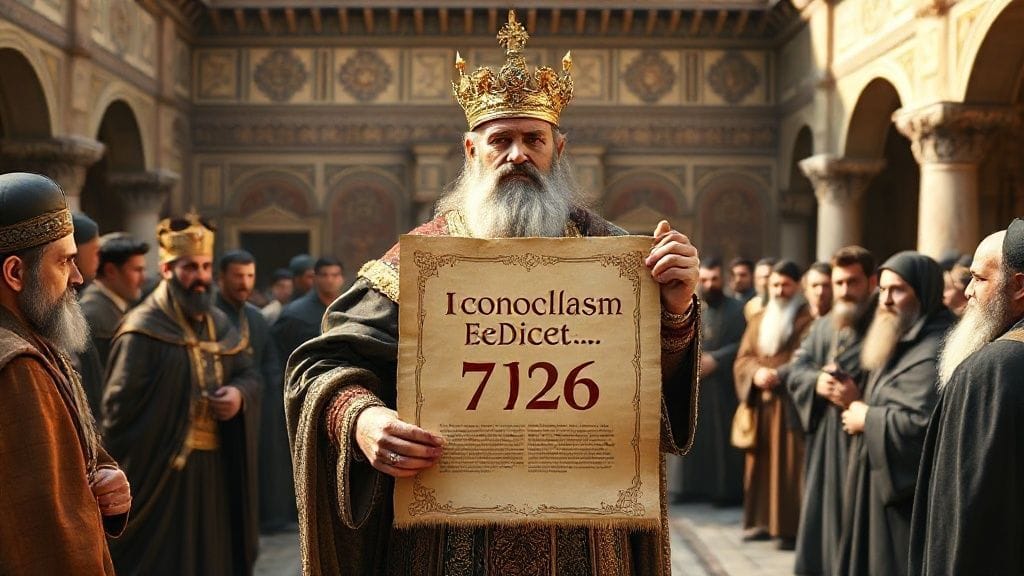
In 726, the imperial decree was issued: all icons were to be removed from churches and homes, and those who persisted in their veneration faced punishment. Mosaics were smashed, frescoes defaced, wooden panels broken. The law was emphatic and swift.
But the edict did not bring peace—it divided Constantinople and the broader empire into angry factions. The devout majority viewed it as sacrilege; confiscations of cherished icons caused widespread grief and resistance. Popular protests erupted in neighborhoods and marketplace gatherings where people defiantly continued to pray before hidden icons.
Church leaders found themselves torn between loyalty to the emperor and their spiritual flock. The Patriarch Germanus I of Constantinople outright condemned the measure, resigning in protest and signaling that the emperor’s religious policy was not universally accepted even at the highest ecclesiastical level.
The Role of Monks, Bishops, and the Patriarchate
Monastic communities became the epicenters of resistance. Monks protected icons, sheltered sacred art, and often became martyrs for their refusal to comply. Their austere devotion contrasted starkly against the imperial demands.
Bishops faced excommunication or exile if they defied the edict, leading to a reshuffling of ecclesiastical authority with more compliant clergy installed by imperial favor. The tension between the Patriarchate and the imperial palace grew, severely straining church-state relations.
This conflict between spiritual conscience and imperial decree reflected a larger dilemma of authority: Who held ultimate power over religious life—the emperor or the church?
Popular Reaction: Veneration, Rebellion, and Resistance
The common people’s reaction was complex and deeply emotional. Icons were part of everyday piety; to lose them was to lose a lifeline. Some hid their icons in secret, others secretly continued their veneration despite penalties.
Several localized uprisings occurred, though none succeeded in overturning the edict. Anecdotes tell of women and children carrying icons underground, preserving images for future generations. Such defiant acts underscored how much the edict wounded the intimate private faith of millions.
This popular resistance was not merely about images but about preservation of identity and hope in a world under siege.
The Iconoclastic Controversy Extends Beyond Constantinople
Iconoclasm was not confined to the capital. Provincial governors and military commanders adopted differing stances, creating inconsistency and unrest. In Italy and the Balkans, pockets of support for icons persisted, sometimes leading to open insubordination.
The controversy sparked debates throughout the Christian world and cast a shadow over Byzantine relations with Rome, which opposed the destruction of icons. This rupture would foreshadow the eventual East-West Schism.
The Byzantine Military and Iconoclasm: Divine Warfare?
Leo III’s reign was marked by ongoing military conflict. The emperor promoted iconoclasm as a way to purify the empire and secure divine favor against Islamic armies pressing at the borders.
Troops sometimes carried the imperial message that success in battle was linked to purging idolatry. Whether or not this belief was widely accepted, it illustrates how religion and war were tightly intertwined in Byzantine ideology.
The notion that iconoclasm could influence military fortune provided a compelling—if controversial—justification for Leo’s policy.
The Role of Islam and External Threats in Shaping Policy
The rise of Islam and the relentless Arab conquests devastated Byzantine territories, particularly in the Levant and North Africa. Leo III, acutely aware of these losses, interpreted these calamities through a religious lens.
Some scholars argue that iconoclasm was in part a reaction to Islamic aniconism—the prohibition against religious images in Islam—which presented a powerful alternative worldview for Christians confronting overwhelming military and cultural pressure.
This external threat amplified internal debate and emboldened Leo’s drastic reforms. The empire sought to reconcile its battered identity amid a new religious and geopolitical reality.
Culture Stripped: Art, Mosaics, and the Erasure of Icons
One cannot overstate the cultural cost of the edict. Byzantine churches, once dazzling with intricate mosaics of Christ, angels, and saints, were defaced. Faces were scratched out, holy images plastered over with geometric crosses or blank spaces.
Artistic expression suffered a deep fracture, a loss that distanced Byzantium from much of its classical and Christian heritage. This act of cultural cleansing reverberated for decades.
Yet paradoxically, Iconoclasm also inspired new forms of art focused on non-figural decoration—an austere beauty born from absence—demonstrating how creativity adapts even through destruction.
Leo III’s Legacy: Consolidating Power Through Religion
Leo III would reign until 741, his iconoclastic program a defining and controversial legacy. By strengthening imperial authority over the church and enforcing religious uniformity, he left a blueprint for how rulers could harness theology as an instrument of statecraft.
But the cost was high. His policies estranged many Christians and sowed divisions that would last generations. Iconoclasm would flare again under his successors, entwining religion and politics in Byzantine history.
The emperor was neither villain nor hero—rather a complex figure navigating impossible choices in troubled times.
The Edict’s Impact on East-West Relations: Rome’s Disapproval
Leo’s edict reverberated beyond the empire’s borders. The Pope in Rome, protector of Western Christendom, vehemently opposed the destruction of sacred images.
This theological divide widened the gap between Constantinople and Rome, which had already suffered political tensions, and foreshadowed the schism that would fracture Christianity in 1054.
The Iconoclast controversy thus served as an early signal of the growing estrangement between Eastern Orthodox and Roman Catholic churches.
The Enduring Struggle: Iconoclasm’s Second Wave
After Leo’s death, the policy lost momentum, only to surge again under Emperor Constantine V. The second phase brought harsher persecution of iconophiles and intensified conflict.
Events during this period included public trials, forced exiles, and even executions. Yet the opposition endured, and over time, popular veneration reemerged.
The ultimate victory of the iconophile position in 843—celebrated as the “Triumph of Orthodoxy”—marked the closure of this turbulent chapter but left lasting scars.
Women, Icons, and the Social Fabric of Byzantium
Among the most poignant aspects of the iconoclast crisis was its impact on women. Many Byzantine women were devoted keepers of icons, central to household and communal prayer life.
Icons provided spiritual solace in a patriarchal society where public religious roles were limited. The edict disrupted these intimate religious practices and challenged women’s sacred cultural roles.
Their resilience in hiding and preserving icons highlights a silent but powerful female agency in preserving Byzantine faith and tradition.
The Intellectual Battle: Scholars and Theologians Respond
Theological objections to iconoclasm were articulated in impassioned treatises by scholars such as John of Damascus and Theodore the Studite.
These intellectuals crafted arguments distinguishing veneration from worship and asserted the theological necessity of icons as affirmations of the Incarnation.
Their writings not only sustained the iconophile cause but influenced future Christian doctrine, embedding the iconoclastic controversy into the broader history of Christian theology.
The Long-Term Cultural and Religious Consequences
The iconoclastic edicts left an indelible mark on Byzantine religion and art. They forced a redefinition of sacred space and practice, altered theological language, and reshaped ecclesiastical politics.
Culturally, the destruction of icons created a rupture yet also planted the seeds for renewed artistic traditions once Iconodulism was restored. Spiritually, the debate enriched church understanding of representation and worship.
The controversy exemplifies how faith communities wrestle with images and symbols that carry deep meaning—reminding us how fragile the relationship is between doctrine and daily devotion.
A Precursor to Later Religious Conflicts
The Iconoclasm Edict and its aftermath were an early demonstration of how religious doctrine can become a battleground for political power, identity, and control.
The boundaries struck during this conflict echoed in the Reformation’s iconoclastic outbreaks centuries later and in other global religious disputes about images and idolatry.
It remains a poignant reminder that religious symbols are never simply art; they are living expressions of faith, politics, and community.
Conclusion
The Iconoclasm Edict of Leo III was a moment that shook the Byzantine Empire to its core—pitting imperial will against popular devotion, uniting political ambition with religious controversy. It was a time of shattered mosaics, displaced prayers, and wounded souls. Yet, through this upheaval, we glimpse the profound human struggle over meaning, identity, and power.
Leo III’s bold but divisive decree reminds us that history often unfolds not only in battles of armies but in battles of belief; where images wield power far beyond their colors and shapes. The scars of iconoclasm echo still—in the art, theology, and politics of faith communities worldwide.
It is a story of conviction and conflict but also resilience—of those who preserved beauty and reverence under threat, ensuring that light would return even in the darkest hours.
FAQs
Q1: Why did Leo III issue the Iconoclasm Edict in 726?
A1: Leo III sought to reform the empire spiritually and politically, believing that Christian icon veneration had become idolatrous and that their removal could restore divine favor amid military threats, while also consolidating imperial authority.
Q2: What were the main theological arguments against icons?
A2: Opponents argued that icons violated biblical prohibitions against idolatry, confusing veneration with worship, which should be reserved for God alone. They feared images detracted from true faith.
Q3: How did the Byzantine Church react to the edict?
A3: Many clergy opposed it, including Patriarch Germanus I who resigned. Monks led resistance, protecting icons and facing exile or death, revealing deep division within the church.
Q4: What impact did the edict have on Byzantine art?
A4: Significant destruction of religious art occurred as icons were defaced or removed, creating a break in the classical Byzantine artistic tradition, though new non-figurative art forms emerged.
Q5: How did the edict affect relations between Constantinople and Rome?
A5: Rome, led by the Pope, strongly opposed iconoclasm, worsening relations and contributing to the growing estrangement between Eastern and Western Christianity.
Q6: Did the Iconoclasm Edict resolve the controversy?
A6: No, the dispute continued for over a century, experiencing a second, harsher wave, eventually ending with the restoration of icon veneration in 843.
Q7: What role did external threats, like Islam, play in the edict?
A7: Military pressures from Islamic conquests influenced Leo, as Islam’s aniconism presented a contrasting religious worldview that may have spurred iconoclastic policies.
Q8: How is the Iconoclasm Edict remembered today?
A8: It is remembered as a critical moment in Byzantine and Christian history, symbolizing the conflict between religious authority, imperial power, and popular faith, influencing religious art and doctrine deeply.

