Table of Contents
- A Final Sunset in the City That Shaped a Maestro
- The Last Days of Igor Stravinsky: A Life Fading in New York
- From Russia to Paris, and Beyond: The Composer’s Journey
- The Musical Revolution That Echoed Around the World
- Stravinsky’s Early Years: Roots of a Revolutionary
- The Ballets Russes and the Birth of Modernism in Music
- Emigration and Reinvention: Stravinsky in America
- The Personal and Political Backdrop of the 20th Century
- April 1971: The Unfolding of the Final Act
- Medical Struggles and the Composer’s Fragile Silence
- The World Reacts: Mourning a Musical Titan
- Legacy Cemented: Stravinsky’s Influence on Contemporary Music
- The Composer’s Death: Rituals, Remembrances, and Farewells
- Cultural Reverberations: How the News Reshaped Artistic Circles
- Recording the Immortal: Stravinsky’s Work in the Age of Technology
- Remembering the Man Behind the Music: Character and Philosophy
- What Stravinsky Meant to 20th-Century Art and Thought
- The Aftermath: Institutions, Archives, and Recordings
- The Continuation of Stravinsky’s Legacy in Modern Composition
- The Composer’s Final Rest and Memorial Sites
- How New York City Commemorated a Fallen Giant
- Modern Perspectives: Contemporary Evaluations of Stravinsky
- Enduring Questions: The Enigma of Stravinsky's Creativity
- A Legacy in Sound: The Continuing Resonance of Igor Stravinsky
1. A Final Sunset in the City That Shaped a Maestro
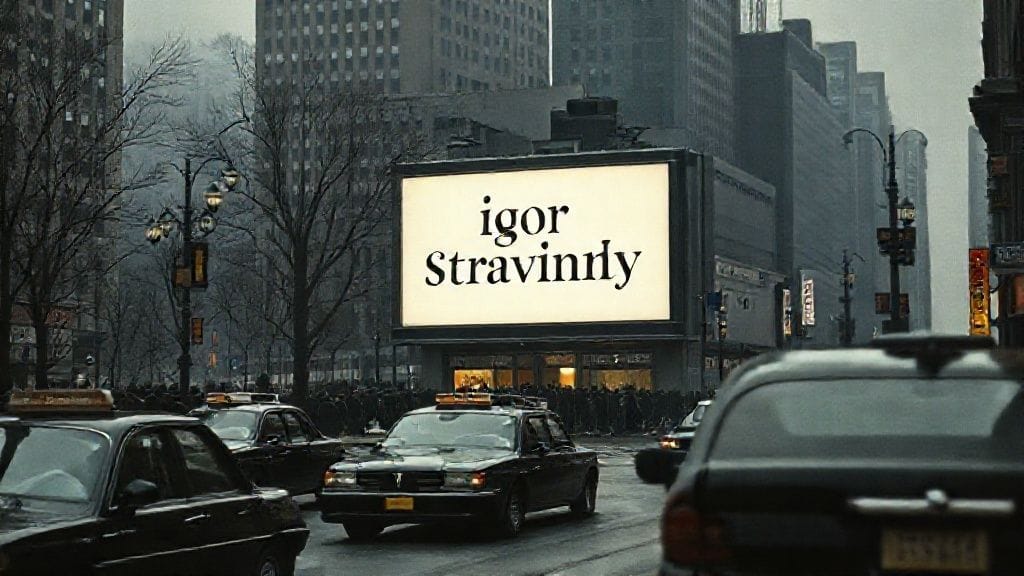
On a cool spring evening in New York City, April 6th, 1971, the air hung heavy with a quiet sorrow that only the passing of a true legend could summon. The skyline, dusted with the last glimmers of twilight, bore silent witness to a moment the world of music had long dreaded—the death of Igor Stravinsky, the titanic figure who had, for nearly a century, reshaped the very fabric of musical composition and expression.
Stravinsky's passing wasn’t just an event—it was the closing chord of a symphony that had echoed across continents, epochs, and artistic revolutions. As the city buzzed with the energy of everyday life, an almost palpable void emerged in concert halls, conservatories, and private studios worldwide. The maestro who had dared to reimagine rhythm, harmony, and melody had slipped quietly from this world.
Yet, to understand the breadth and depth of this loss, one must retrace the winding paths of Stravinsky’s life: through exile and adaptation, triumph and controversy, solitude and collaboration. His final moments in New York were but the concluding stanzas of a composition whose impact refuses to fade.
2. The Last Days of Igor Stravinsky: A Life Fading in New York
Igor Fyodorovich Stravinsky, by 1971, was an aging giant in frail form. He had endured years shadowed by health complications, including heart issues and diabetes, quietly withdrawing from the public eye. His home in the Upper West Side of Manhattan, a sanctuary amid the urban din, became the stage of his fading vitality.
On April 6, 1971, Stravinsky succumbed to heart failure, surrounded by loved ones who had long witnessed both his brilliance and vulnerability. Yet, even in these twilight days, his mind remained a vault of creativity and resolve, reflecting on a legacy that transcended time.
Reports of his declining health had circulated, but few anticipated the immediate void his death would leave. Musicians, critics, and admirers grappled with the paradox of mourning a man whose music would continue to live and resonate.
3. From Russia to Paris, and Beyond: The Composer’s Journey
Born in 1882 in Oranienbaum, Russia, Stravinsky’s life was a relentless journey through displacement and reinvention. The upheavals of the Russian Revolution forced him to seek refuge in Western Europe with his family, forever altering the course of his artistic output.
Settling in Paris during the 1910s, Stravinsky immersed himself in the vibrant cultural milieu that had captured the world’s imagination atop a pedestal of avant-garde creation. Collaborating with impresario Sergei Diaghilev’s Ballets Russes, he unleashed work that would not only underscore the era but redefine classical music itself.
Later relocations to Switzerland and ultimately the United States were marks on a life shaped by exile, survival, and relentless artistic pursuit—a continual transformation to stay relevant amidst a century’s turbulent tides.
4. The Musical Revolution That Echoed Around the World
Stravinsky’s name became synonymous with innovation. His compositions shattered classical conventions, casting aside the romantic lushness dominant in the 19th century, replacing it with bold, jarring rhythms and neo-Classical clarity.
Premieres like The Rite of Spring in 1913 sent shockwaves through the artistic community, inciting riots at the Théâtre des Champs-Élysées. The primal energy, complex rhythms, and dissonance challenged listeners' expectations and transformed public perceptions of what music could be.
This redefinition of sound sparked ripples across the globe, influencing composers across genres—from jazz to electronic music—and cementing Stravinsky as the harbinger of modernism in music.
5. Stravinsky’s Early Years: Roots of a Revolutionary
The son of a renowned opera singer, Stravinsky’s earliest musical education came under his father’s guidance, exposing him to Russian folk traditions and classical Western forms. This blend of cultures and styles became the fertile soil from which his future innovations grew.
His formal studies under Nikolai Rimsky-Korsakov imbued him with a rigorous foundation in composition technique. Yet, Stravinsky’s restless genius pushed beyond these conventions, drawn to the untamed energy of folk motifs and the mysteries of rhythm—elements that would later define his signature.
6. The Ballets Russes and the Birth of Modernism in Music
The collaboration with Diaghilev’s Ballets Russes was the crucible in which Stravinsky's genius truly ignited. Works like The Firebird (1910) and Petrushka (1911) combined Russian folk elements with innovative orchestration, attracting immense acclaim.
The apex was The Rite of Spring, a ballet steeped in pagan rituals that provoked outrage and wonder. It was not merely music for entertainment—it was a visceral, primal statement penetrating the cultural dormancy of the time.
This pioneering period cemented Stravinsky's reputation, positioning him as the forefront figure of a nascent modernist movement.
7. Emigration and Reinvention: Stravinsky in America
The outbreak of the Second World War found Stravinsky in the United States, where he would remain until his death. America offered refuge but also new challenges: adapting to a different cultural landscape and resonating in an expanding entertainment industry.
Here, he embraced new forms and experimented with serialism and twelve-tone techniques, melding his European avant-garde roots with American eclecticism. His persona became both that of a revered old master and an unyielding innovator.
The sprawling urbanity of New York, the city of immigrants and endless reinvention, mirrored his own story in the final chapters of his life.
8. The Personal and Political Backdrop of the 20th Century
Stravinsky’s century was marked by seismic shifts: world wars, revolutions, and rapidly transforming social landscapes. His music both reflected and transcended these upheavals.
Politically, he was apolitical in expression but deeply influenced by forced migrations, the pain of exile, and the longing for lost homelands. These personal histories poured into his music’s emotional landscapes, imbuing them with layers beyond mere notes.
9. April 1971: The Unfolding of the Final Act
In the weeks leading to his death, Stravinsky’s health deteriorated quietly but irrevocably. Friends and family report moments of lucid reflection interspersed with weakness.
April 6 dawned with a somber calm—a city unaware of the momentous loss it was about to endure. Stravinsky’s passing was peaceful, closing the book on an era that had produced the most formidable compositional voice of the modern period.
10. Medical Struggles and the Composer’s Fragile Silence
Throughout the 1960s, Stravinsky wrestled with heart disease and deteriorating eyesight. These ailments increasingly isolated him, cutting the chords between a man and his art.
Despite this, he maintained correspondence and immersed himself in editing and conducting, revealing a resilience of spirit that paralleled the textures of his music: layered, complex, and defiant.
11. The World Reacts: Mourning a Musical Titan
News of Stravinsky’s death swept internationally, eliciting outpourings from musicians, statesmen, and cultural leaders. Leonard Bernstein called him “the greatest composer of our age.”
Concert halls scheduled tributes; radio stations aired retrospectives; and scholars prepared published collections of his writings and music. It was a collective grieving of a community bound by sound and artistic revelation.
12. Legacy Cemented: Stravinsky’s Influence on Contemporary Music
The contours of modern music—jazz, pop, film scores—bear traces of Stravinsky’s innovations. His rhythmic daring and modal experimentation redefined compositional possibilities.
His pedagogical influence extended through students and protégés who carried forward his principles of experimentation and fusion of tradition with the avant-garde.
13. The Composer’s Death: Rituals, Remembrances, and Farewells
The funeral service in New York was a solemn occasion; friends and muses shared memories and readings. The ceremony underscored the bridge between the old world and the new, echoing Stravinsky’s own life.
His remains were later interred in Venice, a city symbolic of his artistic odyssey, linking his Russian roots and European sojourns.
14. Cultural Reverberations: How the News Reshaped Artistic Circles
Stravinsky’s death punctuated a moment of reflection for cultural elites navigating the rapidly modernizing art world. Debates over modernism, tradition, and innovation surged anew.
Younger generations invoked his legacy to justify breaking the last barriers in experimental music and multimedia art, pushing boundaries he once did.
15. Recording the Immortal: Stravinsky’s Work in the Age of Technology
By the early 1970s, recording technology preserved Stravinsky’s music as never before, immortalizing performances with unprecedented fidelity.
Archives and new releases brought his compositions into homes worldwide, extending his reach far beyond traditional concert halls.
16. Remembering the Man Behind the Music: Character and Philosophy
Colleagues described Stravinsky as both enigmatic and approachable, a man of sharp wit and deep reflection.
His philosophical views on art emphasized discipline and evolution over mere inspiration — a legacy of craftsmanship and relentless pursuit of innovation.
17. What Stravinsky Meant to 20th-Century Art and Thought
Stravinsky was more than a composer; he was a symbol of modernity’s hopes and tensions—a figure whose art mirrored the chaos and aspirations of his era.
He bridged divides between folk tradition and cutting-edge experimentation, between emotional expression and intellectual rigor.
18. The Aftermath: Institutions, Archives, and Recordings
Posthumously, foundations and archives dedicated themselves to preserving his work and promoting new research.
Centres for study, composition competitions, and festivals sprang up, ensuring that Stravinsky’s voice remained a dynamic presence in cultural life.
19. The Continuation of Stravinsky’s Legacy in Modern Composition
Contemporary composers across genres reference Stravinsky’s harmonic daring and rhythmic inventiveness as foundational.
His ability to reinvent himself across styles serves as a model for artistic courage in the face of changing tastes and technologies.
20. The Composer’s Final Rest and Memorial Sites
Stravinsky’s tomb in Venice has become a pilgrimage site for music lovers and scholars, a peaceful counterpoint to the frenetic energy of his life.
Commemorative plaques and concerts around the world mark his anniversaries, deepening public connection with his work.
21. How New York City Commemorated a Fallen Giant
The metropolis that had sheltered Stravinsky during his last decades recognized his contribution with exhibitions, performances, and dedications, celebrating an adopted citizen whose music had become part of its cultural fabric.
22. Modern Perspectives: Contemporary Evaluations of Stravinsky
Today, musicologists revisit Stravinsky’s work with new analytic tools, reconsidering his place not just as a revolutionary but as a master craftsman attuned to his times.
His music continues to challenge performers and audiences, retaining its power to provoke and inspire.
23. Enduring Questions: The Enigma of Stravinsky's Creativity
Scholars still debate the inner workings of Stravinsky’s creative process: his balance between control and spontaneity, influence and originality, tradition and radicalism.
These mysteries, far from diminishing his legacy, add to its allure and depth.
24. A Legacy in Sound: The Continuing Resonance of Igor Stravinsky
More than half a century after his death, Igor Stravinsky’s music pulses with life, a beacon of innovation and expression. His death in New York was not an end, but a transformation—from presence to eternal echo, inspiring new generations to listen, question, and create.
Conclusion
Igor Stravinsky’s passing on April 6, 1971, in New York City marked more than the death of an individual—it punctuated a century of musical innovation and cultural upheaval. The maestro’s life journey from Tsarist Russia through the capitals of Europe to the sprawling mosaic of America mirrored the complexities of modernity itself. His music, sometimes confrontational, always profound, challenged audiences to rethink rhythm, harmony, and narrative.
Yet, beyond chords and scores, Stravinsky’s legacy lies in the unyielding spirit of exploration he embodied. His death was a poignant farewell to an era, but his impact—like the resonant final note of a great symphony—continues to inspire, stir, and transform. The city where he breathed his last now carries his memory in its streets, stages, and hearts, reminding us all that the greatest artistry is timeless.
FAQs
1. Who was Igor Stravinsky, and why is he significant?
Igor Stravinsky was a Russian-born composer known for revolutionizing 20th-century music through his bold rhythms, innovative harmonies, and stylistic diversity. His works like The Rite of Spring changed the fundamentals of musical composition.
2. What were the circumstances surrounding Stravinsky’s death?
Stravinsky died from heart failure on April 6, 1971, in New York City, having suffered from health complications during his final years. His passing was peaceful and surrounded by close family members.
3. How did Stravinsky’s work influence modern music?
His pioneering use of rhythm, dissonance, and new forms influenced genres ranging from classical to jazz, pop, and film music. He inspired generations of composers to explore beyond traditional boundaries.
4. What role did Stravinsky’s emigration play in his creative life?
Exile forced him to adapt and evolve, merging cultural influences from Russia, Europe, and America. The upheaval infused his music with a cosmopolitan vitality and continual reinvention.
5. Where is Igor Stravinsky buried, and how is he commemorated?
Stravinsky is buried in Venice, Italy. He is commemorated worldwide through music festivals, archival institutions, and memorial concerts, including several events in New York City.
6. What was Stravinsky’s relationship with other modernist artists?
Stravinsky collaborated with visual artists, choreographers, and writers, most famously with Diaghilev’s Ballets Russes and artists like Picasso, aligning his music with broader modernist currents.
7. How did the public react to Stravinsky’s death?
The death sparked international mourning in musical and cultural communities, with tributes, concerts, and retrospectives honoring his unparalleled influence.
8. What ongoing questions remain about Stravinsky’s creative process?
Scholars continue to explore how Stravinsky balanced innovation with tradition, the sources of his rhythmic and harmonic language, and the philosophical underpinnings of his work.