Table of Contents
- The Silence Before the Storm: Setting the Scene in 6th Century El Salvador
- Ilopango’s Fiery Heart: Understanding the Volcano and Its Past
- Life Around Lake Ilopango Before the Eruption
- The Day the Sky Darkened: Describing the Ilopango Eruption
- Ashes Over the Land: Immediate Impact on El Salvador’s Environment and People
- The Forces Behind the Fury: Geological Causes and Mechanisms of the Eruption
- Voices Lost in the Ash: Societies and Cultures Affected
- The Regional Fallout: Effects Beyond El Salvador’s Borders
- Climate Chaos: Understanding the Global Consequences of the Ilopango Eruption
- Survivors’ Tales and Archaeological Echoes
- Rebirth from Ruin: Ecological and Human Recovery
- Volcanoes and Myths: How Ilopango Entered Local Lore
- The Eruption in Modern Science: Discovering Ilopango’s Past Through Geology
- Lessons from the Past: What Ilopango Teaches about Volcanic Risks Today
- The Legacy of Ilopango: A Volcano That Shaped History and Environment
- Conclusion: The Eternal Dance Between Earth’s Fury and Human Tenacity
- FAQs: Understanding the Ilopango Eruption and Its Place in History
- External Resource
- Internal Link
The Silence Before the Storm: Setting the Scene in 6th Century El Salvador
The sun hung low over the dense tropical forests surrounding the heart of what is now El Salvador. Mist drifted lazily over the placid waters of Lake Ilopango; a silent witness to the rhythms of life that had pulsed here for centuries. Villages dotted the landscape; the daily hum of human activity wove a tapestry of tradition, kinship, and survival. Children played near the lakeshore, farmers tended their fields, and fishermen cast their nets into the shimmering water.
Yet beneath this tranquil veneer, the earth harbored a sleeping giant—a mountain of fire and fury, known as Ilopango. No one could have imagined that in mere moments, this serene world would be engulfed in unimaginable chaos, reshaping not only the land but the destiny of entire civilizations.
This is the story of the Ilopango eruption—one of the largest volcanic events in the last two millennia, whose echoes still reverberate through the geological record and the cultural memory of Central America.
Ilopango’s Fiery Heart: Understanding the Volcano and Its Past
The Ilopango caldera, now a sprawling lake surrounded by jagged ridges, was once a mountain that grew out of the earth’s restless crust. Situated on the volatile Pacific "Ring of Fire," the volcano was a natural landmark for early inhabitants. Unlike typical cone-shaped volcanoes, Ilopango’s defining feature is its vast caldera—a sunken crater formed by cataclysmic collapses during massive eruptions.
Although volcanic activity is a common phenomenon in the region, Ilopango’s eruptions have been rare but extraordinarily violent. Before the 6th-century eruption, the volcano had periods of dormancy, lulling local populations into a fragile sense of security. But this calm was deceptive.
Volcanoes like Ilopango are born of tectonic tension—a dance between the Cocos and Caribbean plates that generates magma reservoirs beneath the earth’s surface. When pressure builds beyond the strength of rock, the pent-up energy is released explosively, ejecting ash, gas, and molten rock with catastrophic consequences.
Life Around Lake Ilopango Before the Eruption
In the early 500s CE, the region around Ilopango was home to vibrant indigenous cultures, ancestors of the Pipil people, among others. These communities had developed intricate agricultural networks, growing maize, beans, and squash, and they were beginning to experiment with trade and social stratification. Their settlements reflected a delicate balance between humanity and nature.
Archaeological finds reveal that villages were built near fertile volcanic soils and the lake, whose abundant fish provided sustenance. Life here was rooted in the cycles of the earth and sky, with ceremonies honoring deities believed to control weather and harvests.
But the tranquility of this life shattered without warning.
The Day the Sky Darkened: Describing the Ilopango Eruption
Historical geological reconstructions and sediment analysis reveal what the eyewitnesses—had they survived to tell their tale—would have seen on the day Ilopango erupted.
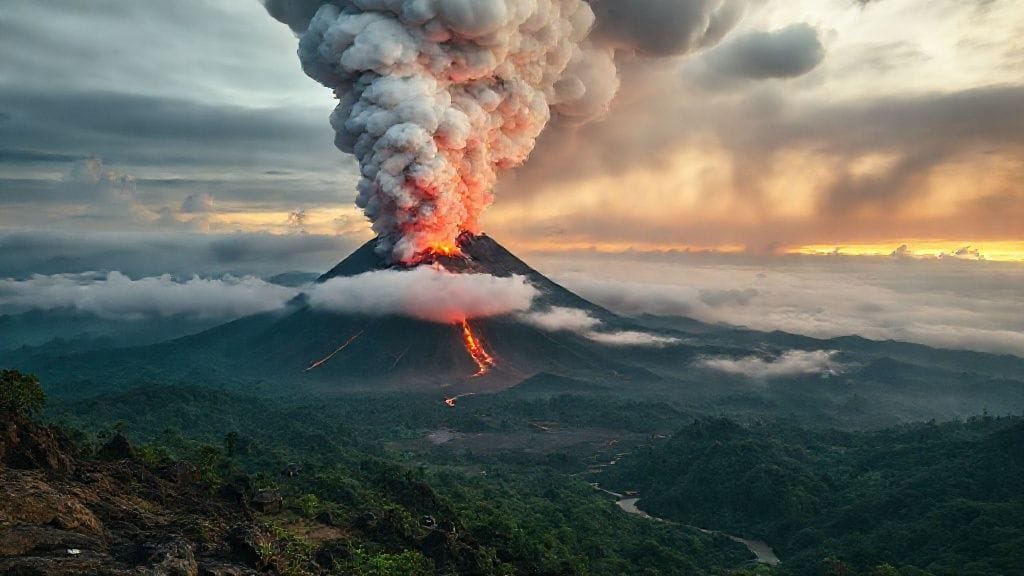
With little prelude, a thunderous roar tore through the air. The ground trembled as if the earth itself were convulsing. Vast columns of ash and volcanic gas shot upward, blotting out the sun and plunging the landscape into ghostly darkness. Torrents of pyroclastic flows—blazing avalanches of hot gas, ash, and rock—swept across the terrain, incinerating everything in their path.
Ash rained relentlessly, layers deep enough to bury entire villages and alter the course of rivers. The sky was acrid with sulfur and obsidian dust. People would have fled in panic, but many were trapped by the speed and scale of destruction.
Scientists estimate that the eruption expelled over 84 cubic kilometers (about 20 cubic miles) of tephra—volcanic fragments—a colossal release surpassing several times the infamous 1980 Mount St. Helens eruption in the United States. This classified the event as a “super-colossal” eruption on the Volcanic Explosivity Index (VEI 6-7).
The violence of Ilopango’s blast reshaped the landscape itself—collapsing the central volcanic peak and leaving behind the enormous caldera that formed Lake Ilopango. This was a defining moment that altered nature and history in a pulse of destruction.
Ashes Over the Land: Immediate Impact on El Salvador’s Environment and People
The aftermath was apocalyptic. The skies remained blackened for days, blocking sunlight critical for crops and wildlife. Rivers flooded with debris were poisoned; fertile fields turned barren under layers of volcanic ash.
The human toll was staggering. Although there are no written records from local populations—pre-Columbian Central America lacked a formal writing system—evidence suggests significant population displacement, loss of life, and cultural disruption.
Food shortages would have followed swiftly, compounded by famine and disease. Survivors were forced to flee to safer regions, scattering communities and fracturing social networks.
For decades, the region remained inhospitable. This eruption was not merely a geological event; it was a humanitarian catastrophe.
The Forces Behind the Fury: Geological Causes and Mechanisms of the Eruption
The Ilopango eruption was the product of powerful geodynamic processes. Deep below the earth’s crust, an expanding magma chamber accumulated immense volumes of gas-charged magma.
Pressure gradually built until the overlying rock could no longer contain it—resulting in an explosive release that blew the volcano’s core outward, creating the caldera.
This eruption possessed all the hallmarks of a Plinian event: sustained columns of ash soaring to the stratosphere, lateral blasts, pyroclastic density currents, and widespread tephra fallout. The speed and energy involved testify not only to natural force but to the lethal potency of volcanism in Central America.
Ilopango’s eruption is a textbook case studied in volcanology, enhancing understanding of caldera-forming eruptions and their potential consequences.
Voices Lost in the Ash: Societies and Cultures Affected
Though direct testimony is absent, archaeologists piece together a somber narrative—one of lost cities and disrupted civilizations.
The Pipil, ancestors of modern Nahua peoples, inhabited this area, intertwined with other regional groups like the Mayan civilizations and Lenca tribes. The erosion of settlements, agricultural land, and trade networks after the eruption reshaped power dynamics.
Excavations show abandoned sites layered with ash, artifacts frozen in time. The social landscape would have experienced a forced reset: migration, social realignment, and the slow forging of new identities.
Ilopango’s eruption thus acts as an inflection point in Central American pre-colonial history—an ancient trauma curiously underscored by modern studies.
The Regional Fallout: Effects Beyond El Salvador’s Borders
Volcanic ash, soaring tens of kilometers high, does not respect political boundaries. Depending on prevailing winds, ash clouds enveloped neighboring Guatemala, Honduras, and parts of southern Mexico.
Agriculture in these zones likely suffered similar devastation—crops failed, water supplies contaminated. The eruption may have disrupted trade routes connecting Mesoamerican peoples.
Interestingly, some scholars link this eruption to regional population shifts and brief declines in the growth of certain Mayan cities during the 6th century, suggesting far-reaching ripple effects.
Climate Chaos: Understanding the Global Consequences of the Ilopango Eruption
One of the most remarkable aspects of Ilopango’s eruption is its suspected influence on global climate.
Massive injections of volcanic ash and sulfur dioxide into the stratosphere can reflect sunlight away from Earth, triggering temporary cooling periods—events known in climatology as volcanic winters.
Ice core samples from Greenland show evidence of marked aerosol deposits around the mid-6th century, coinciding with the Ilopango eruption. Some climate models suggest a drop in global temperatures by up to 2–3°C may have followed, leading to crop failures, famines, and social upheaval worldwide.
Historians speculate that these conditions contributed to the so-called “Late Antique Little Ice Age,” a period marked by widespread hardship, coinciding with epidemics like the Justinian Plague in Europe.
Thus, Ilopango’s fury transcended geography, imprinting itself on the fragile web of Earth’s interconnected systems.
Survivors’ Tales and Archaeological Echoes
Though no written records survive, oral traditions passed through indigenous mythologies hint at cataclysmic upheavals.
Archaeological digs around Ilopango reveal traces of ash layers and tsunami deposits in the lake—signatures of largescale destruction and water surges linked to the eruption.
Artifacts recovered—from pottery shards to tools—offer glimpses of lost lives. In some cases, burial sites suggest rapid, catastrophic deaths consistent with a volcanic disaster.
These fragments speak silently but powerfully, bridging centuries to remind us of humanity’s vulnerability before nature’s overwhelming might.
Rebirth from Ruin: Ecological and Human Recovery
Nature is resilient. After decades of desolation, vegetation recolonized the ash-covered terrain. Pioneer plant species stabilized soils; animals returned.
Human communities, too, began to resettle, harnessing fertile volcanic soils, though their cultures inevitably evolved, shaped in the shadow of this event.
The new Lake Ilopango became a vital resource, supporting fisheries and enabling trade. Over centuries, the region once again thrived—though the memory of eruption remained etched in folklore.
Volcanoes and Myths: How Ilopango Entered Local Lore
For indigenous peoples, volcanoes were sacred entities—sources of life and destruction.
Stories passed down orally evoke “fire mountains” whose anger shaped the landscape. Some myths reference the darkening sky, the swallowing of villages, and the rebirth of the land.
Ilopango’s eruption imprinted itself as a cautionary tale—a reminder of the earth’s double-edged generosity.
The Eruption in Modern Science: Discovering Ilopango’s Past Through Geology
It was not until the mid-20th century that geologists began meticulously piecing together Ilopango’s hidden history.
Through tephrochronology, radiocarbon dating, and geochemical analysis, scientists framed precisely when and how this gigantic volcanic blast devastated Central America.
These studies are crucial: understanding the scale and nature of Ilopango’s eruption informs hazard assessments and disaster preparedness for nearby populations today living in the shadow of this active volcano.
Lessons from the Past: What Ilopango Teaches about Volcanic Risks Today
Ilopango remains active, a threat waiting silently beneath the surface. Contemporary urban centers—including parts of San Salvador—perch near its caldera, exposing thousands to risk.
The past teaches that beneath seemingly calm landscapes lies potential catastrophe. Monitoring seismic activity, educating communities, and maintaining emergency protocols can save lives when next Ilopango awakes.
History is a lantern, illuminating pathways to coexist with earth’s fiery forces.
The Legacy of Ilopango: A Volcano That Shaped History and Environment
Ilopango’s 6th-century eruption is one of the geological and historical milestones of Central America.
It reshaped ecosystems, altered human trajectories, and helped scientists decode the potent forces that mold our planet’s surface.
It serves as a symbol—both of nature’s savage unpredictability and humanity’s enduring resilience.
Conclusion: The Eternal Dance Between Earth’s Fury and Human Tenacity
The Ilopango eruption stands as a profound reminder of the delicate balance between life and destruction.
It shows how a single moment—an earth-shaking explosion—can unwrite centuries of history, sowing suffering but also forcing adaptation and renewal.
Yet, amid the ash and ruin, life finds a way—cultures rebuild, environments renew, and knowledge advances.
This ancient event teaches us humility and hope, binding past, present, and future in the enduring dance between human tenacity and the wild heart of our planet.
FAQs: Understanding the Ilopango Eruption and Its Place in History
Q1: When did the Ilopango eruption occur?
The most significant eruption of Ilopango happened in the early 6th century CE, approximately around the year 535 AD.
Q2: How large was the eruption?
The eruption expelled more than 84 cubic kilometers of volcanic material, classifying it as a VEI 6-7 “super-colossal” eruption, several times larger than more recent well-known eruptions like Mount St. Helens.
Q3: What civilizations were affected by the eruption?
Local indigenous groups such as early ancestors of the Pipil and other regional Mesoamerican peoples were directly impacted, suffering social and ecological upheavals.
Q4: Did the eruption affect climate globally?
Yes. Scientific evidence suggests the volcanic aerosols injected into the atmosphere triggered global cooling and contributed to the “Late Antique Little Ice Age,” impacting agricultural productivity and possibly linked to major historical events.
Q5: How do we know about the eruption without direct written records?
Through geological studies including tephra layers, carbon dating, ice core analysis, and archaeological excavations revealing ash deposits and settlement disruptions.
Q6: Is Ilopango still active today?
Yes, Ilopango remains an active volcano, with ongoing seismic monitoring keeping watch for signs of future eruptions.
Q7: What lessons does the Ilopango eruption hold for modern societies?
It underscores the importance of volcanic monitoring, emergency preparedness, and respecting nature’s power to prevent or mitigate future disasters.
Q8: How has the eruption influenced local culture?
The eruption has been woven into oral traditions and myths that convey respect and caution towards volcanic forces, sustaining cultural memory through generations.

