Table of Contents
- The Quiet Dawn of July 2, 1972: A New Chapter in Indo-Pak Relations
- Aftermath of the 1971 War: Embers of Conflict and Hope for Peace
- The Roots of Hostility: Historical Tensions Between India and Pakistan
- The Political Figures Behind the Agreement: Indira Gandhi and Zulfikar Ali Bhutto
- The Diplomacy of Shimla: Setting the Stage in the Himalayan Hills
- The Negotiation Marathon: Struggles, Compromises, and Breakthroughs
- Key Provisions of the Simla Agreement: From Ceasefire to Commitment
- The Fate of Prisoners of War: Human Stories Behind Diplomatic Lines
- The Agreement’s Impact on Kashmir: A Delicate Balance of Power
- International Reactions: The World Watches Indo-Pak Diplomacy
- The Simla Agreement and the Transformation of Bilateral Relations
- The Role of the Simla Agreement in Shaping South Asian Geopolitics
- Lingering Doubts and Criticisms: Was the Agreement a True Peace Treaty?
- The Agreement's Place in Collective Memory: Remembering 1972 Today
- The Legacy of Shimla in Indo-Pak Relations: Peace Deferred or Path Forward?
- Lessons from Shimla: Diplomacy, War, and the Pursuit of Lasting Peace
- Conclusion: Shimla’s Promise Amidst the Shadows of Conflict
- FAQs about the Indo-Pakistani Simla Agreement
- External Resource
- Internal Link
The Quiet Dawn of July 2, 1972: A New Chapter in Indo-Pak Relations
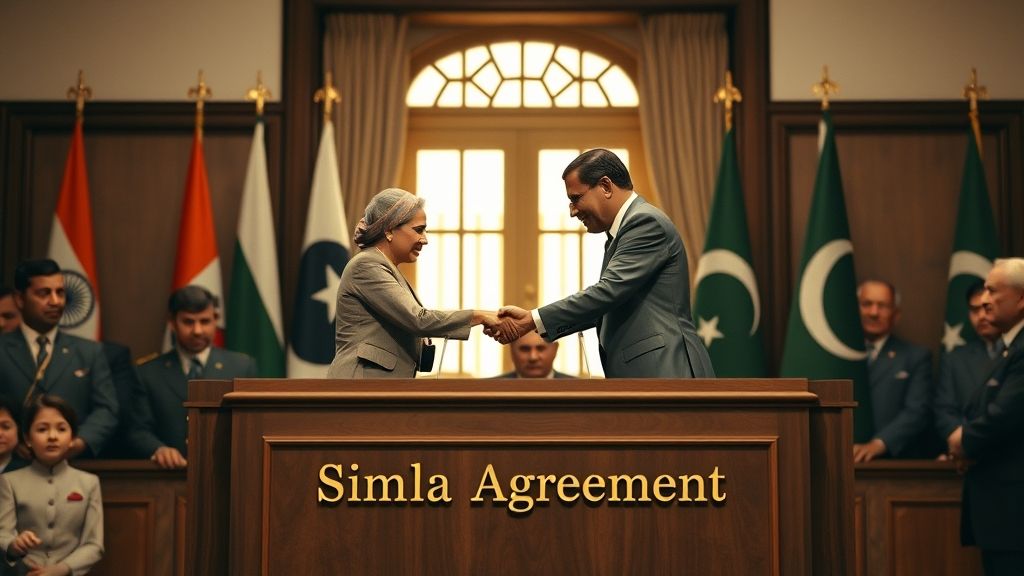
The summer air of Shimla was thick with a cautious hope as the delegations gathered in the heart of the Himalayan city. It was the morning of July 2, 1972—a day that would mark not just a signature on a document, but the tentative beginning of a new chapter between two nations long marred by hostility. Against a backdrop of mountains that had witnessed centuries of contested borders, the Simla Agreement was signed, aiming to redefine the future of India and Pakistan after the devastating war of 1971.
Imagine the atmosphere: war fatigue heavy on shoulders, yet eyes bright with the fragile desire for peace. Soldiers weary from battle, politicians burdened by national expectations, and millions of displaced souls hoping for stability—these were the silent actors behind the pages upon which fresh ink was spilled. Shimla, a serene hill station, transformed into a crucible where diplomacy grappled with the raw wounds of conflict.
But this moment, serene on the surface, was a culmination of decades of struggle, angst, and an elusive quest for coexistence between two nations born from the same soil, yet divided by history and aspiration.
Aftermath of the 1971 War: Embers of Conflict and Hope for Peace
The Indo-Pakistani War of December 1971 was not merely a military conflict—it was a cataclysmic event that reshaped the subcontinent’s geography and psyche. The war resulted in the creation of Bangladesh, formerly East Pakistan, carving a new nation-state out of ethnic and political tensions that had boiled over for years. For India, it was a strategic and humanitarian victory, but for Pakistan, an existential crisis—a wound that cut deep into national pride and identity.
The war left nearly 90,000 Pakistani prisoners of war in Indian custody, millions of refugees displaced, and a bitter legacy of inter-communal violence and animosity. The world watched in stunned silence as India’s decisive military action altered the map, with Bangladesh emerging from the ashes as a sovereign state by December 1971.
Yet, as the guns fell silent, the daunting task remained: how to lay down arms without igniting new fires? How to transform this fragile ceasefire into durable peace? These questions set the stage for the Simla talks, where India and Pakistan aimed to negotiate the terms of a post-war order.
The Roots of Hostility: Historical Tensions Between India and Pakistan
To understand the weight of the Simla Agreement, one must look back at the fractious legacy of partition in 1947. The birth of India and Pakistan as independent states was marred by massive communal violence, displacement of millions, and territorial disputes—most notably over Kashmir, a princely state whose Muslim majority wished to join Pakistan, but whose Hindu ruler acceded to India.
This unresolved conflict sparked the first Indo-Pak war of 1947–48 and subsequent skirmishes, embedding a distrust that simmered throughout the decades. The ideological divide was stark: Pakistan founded as a homeland for Muslims, India as a secular republic with a Hindu majority, yet pluralist in principle. Each state forged narratives of victimhood and righteousness, further polarizing their relationship.
The 1965 war again proved inconclusive, with both sides claiming victory but no resolution to the Kashmir issue. By 1971, with East Pakistan’s secessionist movement intensifying, the tinderbox of enmity was once again set ablaze. Against this volatile backdrop, the Simla Agreement was not simply a peace document—it was a symbolic and practical attempt at redefining hostility into dialogue.
The Political Figures Behind the Agreement: Indira Gandhi and Zulfikar Ali Bhutto
Two towering personalities stood at the heart of the Simla Agreement: Indira Gandhi, the formidable Prime Minister of India, and Zulfikar Ali Bhutto, the charismatic and ambitious leader of Pakistan. Their relationship was complex, woven with threads of rivalry, pragmatism, and mutual recognition of the need to stabilize relations.
Indira Gandhi, a resolute and strategic leader, had scored a decisive military and diplomatic victory in 1971, solidifying her stature both domestically and internationally. Bhutto, meanwhile, was grappling with a humiliating defeat but eyeing a path to restore Pakistan’s dignity on the world stage.
Their negotiations were marked as much by personal dynamics as by national interests—through dialogues tempered by egos, regrets, and hopes. Both understood that the war's legacy could only be managed through a political process that required compromise, even if difficult to accept.
The Diplomacy of Shimla: Setting the Stage in the Himalayan Hills
Shimla, once the summer capital of British India, was an evocative location—remote, serene, yet laden with political symbolism. The choice of venue was deliberate. Far from the capitals’ hubbub, the two sides could negotiate in a quieter environment, insulated from the immediacy of public pressure and political theater.
The talks began in late June 1972, with tense discussions unfolding in historic government buildings framed by pine trees and mountain vistas. Delegations arrived under clouds of uncertainty; guarded, cautious, but aware that the fragile opportunity before them could not be wasted.
Behind closed doors, battles of rhetoric gave way to painstaking negotiation. The diplomats and leaders faced the shadow of recent bloodshed and the burden of millions affected by displacement and loss. Every sentence negotiated was a step toward redefining hostility into a framework for coexistence.
The Negotiation Marathon: Struggles, Compromises, and Breakthroughs
Negotiations stretched across days, fraught with moments of deadlock and sudden breakthroughs. Pakistan insisted on the return of prisoners of war and called for recognition of Bangladesh’s independence as a prerequisite for normalization, while India emphasized restoration of peace and a commitment to peaceful dispute resolution.
Bhutto famously pressed for recognition of Bangladesh—an issue India firmly rejected—while Gandhi pushed for Pakistan’s acceptance of the ceasefire lines as a basis for future peace.
Ultimately, willingness to compromise prevailed. India agreed to begin repatriation of prisoners of war—a major humanitarian gesture—while Pakistan consented to accept the Line of Control (LoC) in Kashmir as the de facto border pending further negotiations.
In this painstaking back-and-forth, words like “renounce the use of force” and “settle differences by peaceful means” emerged as cornerstones, signifying a mutual recognition of the futility of war.
Key Provisions of the Simla Agreement: From Ceasefire to Commitment
The Simla Agreement contained several critical provisions, articulated with a language that balanced firmness and hope:
- Both countries agreed to resolve their differences by peaceful means through bilateral negotiations.
- The ceasefire line of December 17, 1971, was to be respected and converted into the Line of Control.
- Neither side would seek unilateral changes to the status quo by force.
- Prisoners of war were to be repatriated promptly.
- Relations between the two nations would be “normalized” on the basis of sovereign equality.
This framework marked a departure from previous attempts: it was a binding bilateral commitment, with an explicit renunciation of conflict as a means of settling disputes.
The Fate of Prisoners of War: Human Stories Behind Diplomatic Lines
Beyond the official text, the Simla Agreement had profound human implications. More than 90,000 Pakistani soldiers were held in India at war’s end—a staggering number that burdened an already tense peace.
The agreement enabled the phased release of these prisoners, allowing thousands to return home after months of uncertainty. These men, many young and imprisoned far from home, symbolized the human cost of conflict.
Among these stories were tales of camaraderie, survival, and heartbreak that rarely made headlines but profoundly shaped public sentiments on both sides.
The Agreement’s Impact on Kashmir: A Delicate Balance of Power
Kashmir remained deeply contested—its status unresolved but temporarily frozen by the Agreement’s recognition of the Line of Control. While the Agreement did not settle the roots of the dispute, it established a framework emphasizing dialogue over war.
This created a precarious peace, a balance of uneasy truce that ebbed and flowed over subsequent decades. The Simla Agreement underscored that any future solution had to be negotiated bilaterally—excluding external powers—a commitment that carried strategic and symbolic weight.
International Reactions: The World Watches Indo-Pak Diplomacy
International observers greeted the Simla Agreement with cautious optimism. The Cold War context made South Asia a geopolitical chessboard where global superpowers watched closely.
The United States, USSR, and China each had stakes in the region, and the peaceful resolution of the 1971 conflict was seen as a relief for regional stability. Western media praised the leadership shown; yet skeptics cautioned that deep-rooted tensions could quickly resurface.
The Agreement resonated beyond borders, seen as a rare moment when diplomacy prevailed over hostility, even amidst complex rivalries.
The Simla Agreement and the Transformation of Bilateral Relations
In the months and years following the Agreement, India and Pakistan approached diplomacy with renewed, if fragile, commitment. Thousands of refugees returned home, diplomatic channels reopened, and cultural exchanges tentatively restarted.
Yet, underlying mistrust lingered. Political shifts, internal upheavals, and divergent visions of nationalism meant that peace remained tentative. The Agreement did not erase wounds but laid a diplomatic foundation to manage them.
The Role of the Simla Agreement in Shaping South Asian Geopolitics
The Agreement’s significance extended beyond India and Pakistan, influencing South Asia’s balance of power. It reaffirmed the region’s preference for bilateral dispute resolution, sidelining external interference.
This principle affected international relations in the decades to follow, contributing to regional frameworks of dialogue and cooperation—albeit imperfect and often fraught.
Lingering Doubts and Criticisms: Was the Agreement a True Peace Treaty?
Despite its promise, some critics viewed the Simla Agreement as a ceasefire, not a peace treaty. The Kashmir question remained unresolved, and the Agreement did not address broader issues like water-sharing or cross-border terrorism that would plague relations later.
Some in Pakistan saw the acceptance of the Line of Control as a capitulation, while in India, some viewed the failure to extract broader concessions as a missed opportunity.
Yet, most agree it was an indispensable step—a diplomatic milestone in a fraught historical relationship.
The Agreement's Place in Collective Memory: Remembering 1972 Today
In India and Pakistan, the memory of July 2, 1972, survives with mixed feelings. For many, it marks a moment of pragmatic hope shrouded by the trauma of war.
Annual commemorations, scholarly debates, and popular narratives recall Simla as a symbol of reluctant peace—a reminder that even after bitter conflict, dialogue remains possible.
The Legacy of Shimla in Indo-Pak Relations: Peace Deferred or Path Forward?
More than five decades later, the Simla Agreement remains a reference point in discussions about Indo-Pak relations. Its ideas—the sanctity of dialogue, respect for territorial status quo, and commitment to peaceful dispute resolution—are invoked whenever tensions rise.
Whether seen as a foundation or a symbol of unfinished business, Shimla’s legacy underscores the complexity of peace-building in a region shaped by history and emotion.
Lessons from Shimla: Diplomacy, War, and the Pursuit of Lasting Peace
The Agreement teaches vital lessons about the interplay between war and diplomacy. That even amid the anger and trauma of conflict, leaders can choose dialogue and negotiate for the future.
It also highlights the limits of diplomacy without broader political will and social reconciliation, reminding us that peace requires persistent effort beyond treaties.
Conclusion: Shimla’s Promise Amidst the Shadows of Conflict
The Simla Agreement of July 2, 1972, stands as both a beacon of hope and a sobering reminder of the challenges in forging peace where history is heavy and wounds run deep. It encapsulated the magnificent human capacity to seek reconciliation amidst devastation, yet also the fragility of such efforts when mistrust and unresolved disputes linger.
In the cool mountain air of Shimla, beneath skies that had witnessed centuries of empire and war, two leaders signed a pact that dared to dream of a harmonious future. Though that dream would be tested repeatedly, the Agreement’s spirit—the refusal to let violence define relations—remains a testament to the enduring human aspiration for peace.
FAQs about the Indo-Pakistani Simla Agreement
Q1: What triggered the Indo-Pakistani Simla Agreement?
The Agreement was triggered by the aftermath of the 1971 Indo-Pakistani War, which resulted in the creation of Bangladesh and had left considerable tension and humanitarian crises to resolve.
Q2: Who were the main architects of the Simla Agreement?
The key figures were Indian Prime Minister Indira Gandhi and Pakistani Prime Minister Zulfikar Ali Bhutto, whose personal and political negotiations shaped the Agreement.
Q3: What were the key provisions of the Agreement?
Fundamental provisions included respect for the ceasefire line, renouncement of force to change boundaries, peaceful dispute resolution, repatriation of prisoners of war, and normalization of bilateral relations.
Q4: How did the Agreement affect the Kashmir conflict?
The Agreement made the ceasefire line of 1971 the Line of Control, freezing the territorial dispute and committing both sides to bilateral negotiations without external intervention.
Q5: Did the Simla Agreement lead to lasting peace between India and Pakistan?
While it established a framework for peaceful relations, persistent mistrust, and unresolved issues meant that full peace was not achieved, though the Agreement helped in managing conflict.
Q6: What was the international reaction to the Simla Agreement?
The global community welcomed it as a positive step toward peace in a volatile region, with cautious optimism amid the Cold War geopolitical context.
Q7: Are prisoners of war still a significant issue in Indo-Pak relations?
The 1971 prisoners of war were eventually repatriated, but new conflicts have occasionally led to new captures; however, the Simla Agreement set a precedent for their humane treatment.
Q8: How is the Simla Agreement remembered today?
It is regarded as a landmark diplomatic achievement symbolizing hope for peace, despite not resolving all conflicts; its principles continue to influence bilateral policy.