Table of Contents
- Introduction
- What Was the Industrial Revolution?
- Why England?
- Early Innovations and Inventions
- The Textile Industry Boom
- Steam Engines and Power
- Coal, Iron, and Infrastructure
- Factories and the Labor Shift
- Urbanization and Social Change
- Impact on Daily Life
- Criticisms and Consequences
- Long-Term Global Impact
- Conclusion
- External Resource
- Internal Link
1. Introduction
In the mid-18th century, a quiet yet powerful revolution began—not with political banners or warfare, but with machines. The Industrial Revolution, often marked from around 1760 in England, would forever change the world. From handcrafting to mechanized production, from rural life to sprawling cities, the transformation was sweeping.
2. What Was the Industrial Revolution?
✔️ A period of major industrialization and mechanization
✔️ Shift from agrarian economies to factory-based production
✔️ Characterized by innovation, economic growth, and social upheaval
It fundamentally altered how people lived, worked, and interacted.
3. Why England?
✔️ Abundant coal and iron resources
✔️ A politically stable and wealthy nation
✔️ Colonial markets and a booming trade economy
✔️ Strong banking and legal systems to support entrepreneurship
England had the perfect storm of conditions for industrial takeoff.
4. Early Innovations and Inventions
✔️ The spinning jenny (James Hargreaves, 1764)
✔️ The water frame (Richard Arkwright, 1769)
✔️ The flying shuttle (John Kay, 1733)
✔️ Early steam engines (Thomas Newcomen, James Watt)
Each innovation increased efficiency and production exponentially.
5. The Textile Industry Boom
✔️ Textiles became the first fully industrialized sector
✔️ Factories emerged in cities like Manchester and Birmingham
✔️ Cotton imported from colonies fueled expansion
Textile mills became symbols of industrial progress—and exploitation.
6. Steam Engines and Power
✔️ James Watt’s improved steam engine (1776) changed everything
✔️ Factories could now operate anywhere, not just by rivers
✔️ Steam locomotives and ships revolutionized transport
Steam unshackled industry from geography.
7. Coal, Iron, and Infrastructure
✔️ Coal powered machines and heated buildings
✔️ Iron was used for tools, railways, bridges, and buildings
✔️ Canals and railroads expanded rapidly
These raw materials built the physical backbone of the new industrial world.
8. Factories and the Labor Shift
✔️ Cottage industries declined as factories rose
✔️ Rural workers migrated to cities
✔️ Long hours, low wages, and child labor became common
For many, industrialization meant survival, not prosperity.
9. Urbanization and Social Change
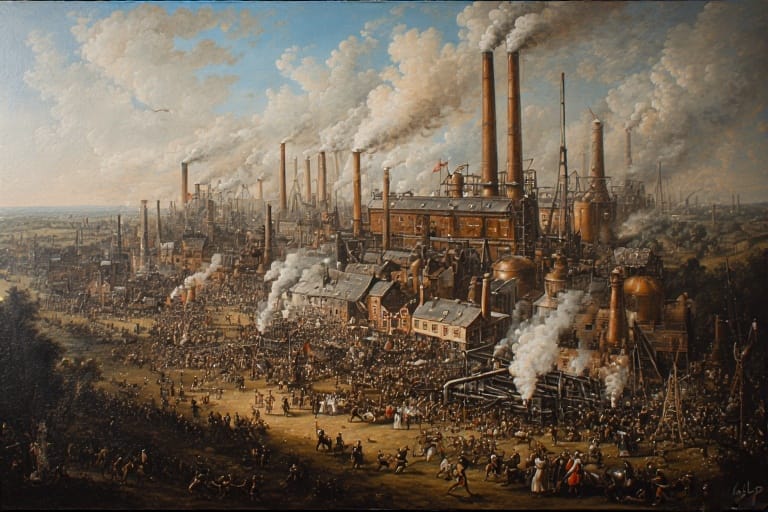
✔️ Cities like London, Manchester, and Liverpool expanded quickly
✔️ Overcrowded slums and poor sanitation led to health crises
✔️ A new working class emerged, along with tensions and protests
Urban life was a mix of opportunity and hardship.
10. Impact on Daily Life
✔️ Consumer goods became more affordable and abundant
✔️ Time became regulated by factory whistles, not the sun
✔️ Education and printed material became more accessible
Modern life, as we know it, took root during this era.
11. Criticisms and Consequences
✔️ Workers’ rights abuses and unsafe conditions
✔️ Environmental degradation due to coal and industrial waste
✔️ Widening gap between rich and poor
The progress came at a significant human and ecological cost.
12. Long-Term Global Impact
✔️ Inspired future revolutions across Europe, the U.S., and Japan
✔️ Triggered global capitalism and trade networks
✔️ Paved the way for modern economic theory
The Industrial Revolution was not just British—it became a global transformation.
13. Conclusion
The Industrial Revolution’s beginning in England around 1760 was nothing short of revolutionary. It altered every corner of society, ushering in the modern age. With machines at the helm, humanity entered an era of innovation, acceleration, and complexity. Yet alongside the marvels came deep challenges—many of which still resonate today.
14. External Resource
🌐 Wikipedia – Industrial Revolution