Table of Contents
- A Spring Day in Rome: The World Changes on Parchment
- Before the Lines Were Drawn: Medieval Christendom and the Expansionist Dream
- Columbus Returns: Rumors, Riches, and the Vatican’s Dilemma
- Alexander VI and the Politics of the Tiara
- Drafting the Decree: Inside the Making of the Inter caetera Papal Bull
- The Imaginary Line: Geography, Theology, and Power
- Spain, Portugal, and the Race to Own the Ocean
- From Rome to Lisbon: Outrage, Negotiations, and the Road to Tordesillas
- On Distant Shores: How a Roman Decree Touched Indigenous Worlds
- The Doctrine of Discovery: Legal Shadows of Inter caetera
- Gifts, Gold, and Souls: Missionaries, Conquistadors, and Justifications
- Cracks in the Sacred Line: Challenges, Reformations, and Rival Empires
- From Parchment to Courtroom: Inter caetera in Modern Law and Memory
- Voices of Resistance: Indigenous Reclamations and Calls for Revocation
- The Emotional Aftermath: Identity, Loss, and the Weight of a Bull
- Historians at Work: Rereading Inter caetera Across the Centuries
- Conclusion
- FAQs
- External Resource
- Internal Link
Article Summary: On May 4, 1493, in the echoing chambers of Renaissance Rome, Pope Alexander VI signed the inter caetera papal bull, a document that claimed to slice the unknown world between Spain and Portugal with a stroke of ink. This article traces the world that produced that decree, from medieval dreams of Christian unity to the tense politics unleashed by Christopher Columbus’s first voyage. It follows the making of the bull itself—its careful wording, its theological justifications, its bold geographic assumptions—and explores how European powers used it to legitimize conquest far beyond anything its authors imagined. Along the way, we witness how the line drawn in Rome reshaped lives on distant shores, especially for Indigenous peoples whose lands and cultures were suddenly declared “available” in the name of Christ and crown. We examine how inter caetera inspired later doctrines like the so-called Doctrine of Discovery and how its logic seeped into colonial law, missionary endeavors, and imperial rivalries. The narrative then turns to modern times, considering how courts, activists, and scholars still grapple with the legacy of this 1493 decree and its moral consequences. Ultimately, the article asks what it means for a handwritten bull, born in the candlelit Curia, to still cast a legal and ethical shadow over the globe more than five centuries later.
A Spring Day in Rome: The World Changes on Parchment
Rome in early May 1493 was a city oscillating between splendor and tension. Pilgrims shuffled through narrow streets where laundry hung like faded flags between crumbling stone walls, while cardinals glided past in bright scarlet, their litters carried above the noise of vendors and beggars. In the Apostolic Palace, behind heavy doors and under frescoed ceilings, an event was unfolding that most Romans would never hear about in detail—but that would press its invisible weight on continents they did not yet know existed.
Messengers had been arriving for weeks, mud on their cloaks and urgency in their eyes. They came from the royal courts of Spain, bearing letters stamped with the seals of Ferdinand of Aragon and Isabella of Castile. These rulers, fresh from their victory in Granada that ended centuries of Muslim rule in Iberia, now looked beyond the horizon. The Genoese mariner they had entrusted—a certain Cristóbal Colón, or Christopher Columbus—had returned from a voyage west, bringing tales of lands that he believed lay on the fringes of Asia. Yet the maps in the Vatican library were silent on these new islands; the known world, so carefully charted in illuminated manuscripts, seemed suddenly too small.
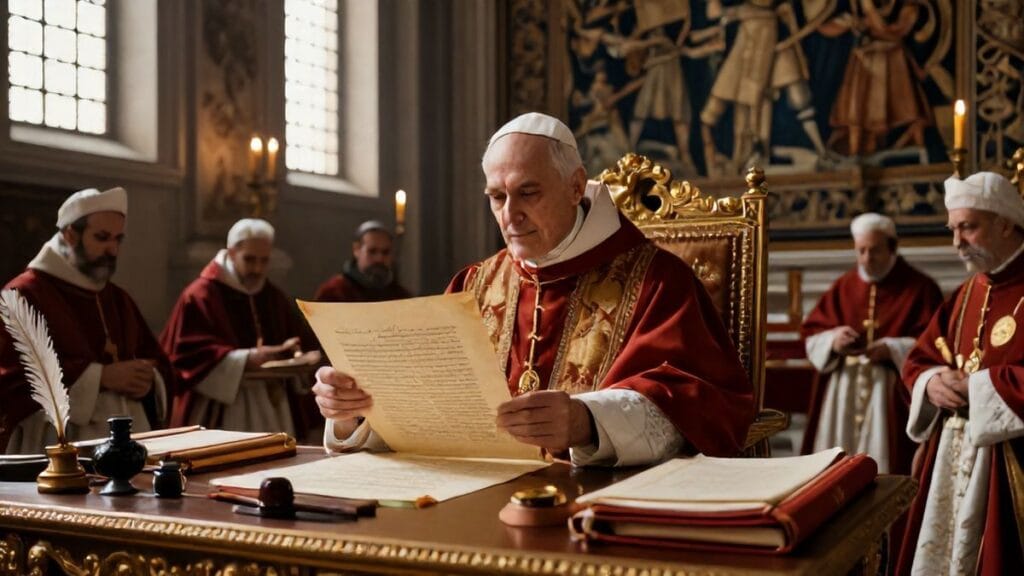
In this atmosphere of anticipation and uncertainty, scribes in the papal chancery sharpened their quills and laid out crisp sheets of parchment. They were preparing for the drafting of a text whose opening words, Inter caetera, would give it its name. The inter caetera papal bull would not describe a battle won or a heresy condemned. Instead, it would draw a line—an invisible meridian across the Atlantic Ocean—handing vast, unnamed territories to one Christian monarchy and implicitly denying them to another. By the time the ink dried on May 4, 1493, the world of oceans, islands, and shores would be legally and spiritually reimagined in favor of Spain.
It is astonishing, isn’t it, that so much could be decided by people who had never seen the lands they were confidently dividing? Inside the Vatican, discussions turned not on firsthand observations, but on reports, rumors, and the delicate balance of power between Spain and Portugal. To many churchmen, what mattered most was not geography but the salvation of souls and the unity of Christendom. If these newly encountered peoples were, as Columbus insisted, gentle and receptive, should they not be shepherded by a Christian power deemed loyal to Rome? The inter caetera papal bull became the answer to that question—couched in pious language, but rooted in very human calculations of influence and prestige.
Outside, the bells of Rome tolled as they did every day, marking the hours of prayer. No proclamation rang out to announce that an invisible line had just been drawn across oceans thousands of miles away. The city’s bakers kneaded dough, muleteers cursed at traffic, and children chanted skipping rhymes in the dust. Yet, in the quiet of the archive, a new reality had been born, written in Latin on a sheet of parchment that would survive long after its authors were gone. The inter caetera papal bull would travel farther in its effects than any Roman emissary that spring, shaping the destinies of empires—and of peoples who had never heard the name of Alexander VI.
Before the Lines Were Drawn: Medieval Christendom and the Expansionist Dream
To understand how a pope in Rome could claim authority over lands he had never seen, one must step back into the long Middle Ages and walk through the intellectual and spiritual corridors that prepared the way. For centuries, Christian Europe had lived with a mental map of the world drawn from the ancients and glossed by theologians. At its heart lay a belief that the pope, as the vicar of Christ, bore responsibility not only for the souls of Europe but, in theory, for all humanity.
Medieval theologians did not imagine a globe alive with sovereign nations in the modern sense. Instead, they saw a Christian commonwealth in which spiritual and temporal powers were intertwined, even as emperors and kings contested jurisdiction. When new lands came into view—whether through crusade, missionary work, or the slow westward expansion of Iberian kingdoms—churchmen framed such advances as extensions of Christ’s lordship. The conversion of pagans or Muslims was cast as both a spiritual rescue and a political reordering that brought territories into the orbit of Christendom.
This perspective had already been encoded in earlier papal bulls that sanctioned crusades and granted lands to Christian princes who vowed to fight infidels. The Iberian Reconquista, a grinding centuries-long struggle, was accompanied by a stream of such documents from Rome. They framed wars against Muslim-ruled territories in Spain as holy undertakings; in return, popes bestowed spiritual privileges and recognized territorial gains. As historians often note, including the scholar Anthony Pagden, papal authority became a tool as much as a moral compass, one that rulers could wield in pursuit of their own ambitions.
By the fifteenth century, the Portuguese, under princes like Henry the Navigator, had begun to push systematically down the west coast of Africa. Each new cape rounded and each trading post planted raised fresh questions: Who had the right to these shores? Could a Christian prince claim exclusive dominion? Popes responded with bulls such as Dum Diversas (1452) and Romanus Pontifex (1455), which granted Portugal rights over lands discovered along the African coast and even sanctioned the subjugation of “Saracens, pagans and other enemies of Christ.” These precedents would become crucial when Columbus crossed the Atlantic. They had already carved out an ideological path: the pope could assign territories to Christian monarchs as part of a divine mandate to expand the faith.
At the same time, the late medieval world was undergoing profound change. The fall of Constantinople in 1453 had shaken Christian Europe; the old overland routes to Asia had become more precarious. Trade, pilgrimage, and tales from travelers like Marco Polo kept alive the dream of reaching the wealth of the East by new routes. When Portuguese ships began to circle Africa, and when rumors spread of a westward path that might reach Asia faster, these dreams and fears coalesced. The stage was set for a competition in which Rome’s sanction would be a prized weapon.
Thus, when Columbus returned and the Spanish monarchs knocked on the Vatican’s door, they were not inventing the idea that the pope could distribute overseas territories. They were stepping into a long-established pattern. The inter caetera papal bull would be only the latest, though ultimately the most consequential, in a series of documents that blended theological aspiration with geopolitical calculation.
Columbus Returns: Rumors, Riches, and the Vatican’s Dilemma
In March 1493, news traveled faster than ships. Before Columbus himself reached the Spanish court, talk of his discoveries was already spreading through taverns and chancelleries, embroidered with each retelling. He had sailed west, people whispered, into what most still believed to be the open Ocean Sea—and he had returned with evidence that something lay out there: islands, strange peoples, golden ornaments.
At the court of Ferdinand and Isabella, Columbus presented not only treasures—a few small gold pieces, exotic parrots, and captives—but a story. He insisted he had reached the fringes of Asia, islands off the great continent described by Marco Polo. The monarchs listened, gauging possibilities. If he was right, Spain might have found a shortcut to the East, bypassing Portuguese control of the route around Africa. Even if he was wrong, even if these islands were unknown to Ptolemy and all the ancients, they might still represent a treasure trove of resources, converts, and prestige.
But joy was tempered by fear. The Portuguese had been granted extensive rights along the African coasts and into the Atlantic by previous papal bulls. Their mariners had already reached the Cape of Good Hope by 1488. If these newly discovered lands fell within Portugal’s legally and spiritually recognized sphere, Spain’s triumph could quickly dissolve into a diplomatic defeat. The Spanish rulers needed something stronger than Columbus’s enthusiastic reports; they needed a legal and spiritual shield. And that meant Rome.
In this moment, the pope became an arbiter not of doctrine alone, but of direction itself—east versus west, Portugal versus Spain. Envoys hurried from the Spanish court to the Vatican, armed with letters framing the discoveries as a continuation of the Reconquista’s holy purpose. Ferdinand and Isabella, they stressed, were the Catholic Monarchs whose recent victory at Granada had expelled Islam from the last stronghold in Iberia. Would not God now reward their zeal with new lands to evangelize?
For Alexander VI, a Spaniard by birth and a Borgia by name, the dilemma was acute. On one side stood Portugal, long favored by the Curia in matters of overseas exploration. On the other side, Spain—now ascendant, militarily triumphant, and spiritually lionized as the champion of the faith. The Vatican was also acutely aware of the symbolic power of sanctioning these discoveries. Was this not, in some way, a fulfillment of Christ’s command to preach the Gospel to all nations?
Yet behind the celebrations of Columbus’s return hovered uncertainties. What precisely had he found? How far away were these islands? Did they lie in waters already granted to Portugal? The maps on which the Vatican relied were approximate at best, their oceans and coasts often drawn more from tradition than measurement. In this fog of ignorance, the inter caetera papal bull would function less as a precise cartographic deed and more as a sweeping gesture of favor and legitimacy. Like a judge ruling before all the evidence is in, Alexander VI would decide first and leave it to future navigators to fit reality to the decree.
Alexander VI and the Politics of the Tiara
The man who would lend his seal to the inter caetera papal bull was one of the most controversial popes of the Renaissance. Born Rodrigo de Borja in Spain’s Kingdom of Valencia, he rose through the ranks of the Church as a skilled administrator, consummate politician, and, in the eyes of his enemies, a master of nepotism and intrigue. When he became Pope Alexander VI in 1492—ironically the same year Columbus sailed west—he embodied both the spiritual and worldly dimensions of the papacy.
Alexander VI’s Spanish origin mattered. In Rome’s intricate web of alliances and rivalries, nationality could color perceptions and decisions. The Borgia pope was often suspected of favoring Spanish interests, though he also had to navigate pressures from Italian states, France, and the Holy Roman Empire. Still, when Spanish envoys came bearing news of Columbus’s discoveries and seeking papal backing, they were dealing with a man whose language, culture, and early loyalties aligned with theirs.
At the same time, Alexander’s papacy was preoccupied with power struggles within Italy, the management of his own relatives’ fortunes, and the broader task of projecting papal authority in a rapidly changing Europe. Granting sweeping rights to Spain over lands in the west could serve both as a spiritual gesture and a political maneuver, tightening the bond between the Holy See and the Spanish crown at a crucial moment. The pope needed strong Catholic allies to buttress his position in a continent increasingly restless with corruption in the Church and whispering about reform.
Yet Alexander VI could not ignore Portugal. The Portuguese monarchy had long cultivated papal favor, especially in matters of exploration. Their navigators’ achievements—charting the African coast, establishing trade with West African kingdoms, reaching India shortly after Columbus’s voyages—had been repeatedly endorsed by papal decrees. The issuance of a bull blatantly favoring Spain risked diplomatic backlash. The Vatican’s diplomats understood that the line Alexander drew would be measured not just in degrees of longitude, but in degrees of loyalty and resentment.
Inside the Curia, debates swirled. Should the pope affirm Spain’s claims with the same clarity and exclusivity earlier granted to Portugal? How far could he go without alienating Lisbon? How should he frame the spiritual mission of Spain in these new territories without undermining the universal role of the Church? Alexander VI’s advisers combed earlier bulls, searching for language that could be repurposed or expanded. They knew that the inter caetera papal bull would be read not only in Madrid and Lisbon, but in every court watching the Atlantic drama unfold.
In the end, Alexander’s decision reflected both conviction and calculation. He would align conspicuously with Spain, portraying the newly discovered lands as a divine reward for the Catholic Monarchs’ zeal and a new field for evangelical labor. At the same time, he would leave just enough ambiguity and room for negotiation to avoid an outright rupture with Portugal. The bull’s words would be grand and sweeping; its practical implications would be left to future treaties and voyages to hammer out.
Drafting the Decree: Inside the Making of the Inter caetera Papal Bull
In the papal chancery, the creation of a bull was both an art and a ritual. The drafting of the inter caetera papal bull began not with maps, but with words—Latin phrases honed by centuries of canon law and curial practice. Scribes worked under the guidance of legal experts and ecclesiastical secretaries, their quills scratching steadily as they shaped sentences meant to bear both moral weight and legal force.
The opening of the bull followed established forms. It invoked the authority of the pope as Christ’s representative, situating the coming decree within a cosmic hierarchy: God, Christ, Peter, and therefore the pontiff who sat in Peter’s seat. This was not mere flourish. By rooting the bull’s authority in that chain, its authors signaled that what followed was more than political favor; it was, they claimed, an extension of divine order.
The text soon turned to the achievements of Ferdinand and Isabella. It praised their conquest of Granada, the end of Muslim political power in Iberia, and their steadfastness in the Catholic faith. The bull framed their sponsorship of Columbus’s voyage as a natural continuation of their holy mission: having cleansed their realm of heresy and unbelief, they now sought to bring the Gospel to distant peoples “who live in ignorance of the true God and worship false gods and demons.” The language was suffused with the conviction—common at the time—that non-Christians lived in error and needed rescue, though that rescue would come bound up with imperial control.
Then came the heart of the matter: the granting of lands. The inter caetera papal bull declared that all islands and mainlands discovered and yet to be discovered west of a certain line, not already in the possession of a Christian ruler, were given to the Spanish monarchs and their heirs. The document spoke of lands “found and to be found” toward the west and south, an elastic phrase that left staggering room for future interpretation. It ordered that no other Christian prince should dare to infringe upon this grant without the pope’s permission.
But what exactly was this line? The bull attempted to define it as a meridian drawn a certain number of leagues west of the Azores and Cape Verde Islands—imprecise reference points on incomplete maps. Later, the Treaty of Tordesillas would shift and clarify this line, but in 1493 the papal scribes were sketching an imaginary boundary in a space they could scarcely imagine. One chronicler would later marvel that “they divided the earth as if it were an orchard.”
Interwoven with geographic assertions were spiritual commands. The Spanish monarchs were charged with sending “upright and God-fearing men, learned, skilled, and experienced” to instruct the Indigenous peoples in the Catholic faith. They were to prioritize the salvation of souls, not merely the extraction of wealth. Failure to do so, the bull warned, would constitute disobedience to the Church’s will. On parchment, at least, empire and evangelization were fused into a single mission.
When the draft was complete, it was reviewed, revised, and finally approved. The formal copy was written on fine parchment, its lines evenly spaced, the initial letters elaborately decorated. The leaden papal seal—bulla—was affixed, giving the document its name. In the hushed ceremony of authentication, the inter caetera papal bull passed from the realm of handwritten proposal into binding decree. It was now, in the eyes of Rome, an expression of God’s plan for the newly encountered world.
The Imaginary Line: Geography, Theology, and Power
It is tempting, from a modern vantage point, to see the line described in the inter caetera papal bull as absurd—a bold black slash drawn across a globe they did not fully know. But to contemporaries, the idea of such a boundary made sense within their conceptual world. Medieval maps often depicted the earth not as a perfect sphere but as a disk or oval, structured by sacred history rather than geographic precision. Even as Renaissance cartography began to embrace more accurate measurements, many educated Europeans still accepted that spiritual authority could organize territory.
The line was not just a geographic marker; it was a theological assertion. By dividing the world into spheres of influence for Spain and Portugal, the pope was, in theory, ensuring that missionary efforts would be orderly and effective. Each crown would know where its responsibility lay. Each would carry the Gospel, and with it European norms of law and governance, into their assigned half of the unknown. The line was a cord binding temporal conquest to spiritual oversight.
Yet behind this tidy logic lurked contradictions. The bull claimed it did not infringe on lands already ruled by a Christian prince, but it said nothing about the rights of non-Christian rulers or Indigenous communities. The silence was telling. In practice, the line treated the peoples beyond Europe as if they existed in a kind of juridical vacuum. Their polities, customs, and territories did not register as sovereign in the way European kingdoms did. This omission would echo across centuries as colonizers cited papal authority to justify taking what they desired.
Moreover, the line was drawn at a time when no one in Rome knew where Asia truly lay in relation to these new islands. Columbus and his supporters insisted that the lands reached in 1492 were near Asia; skeptics suspected that he had found something else altogether. But the bull hedged its bets, referring not to specific continents but to any lands “towards the west and south” beyond the agreed meridian. In effect, it was a legal net cast across half the globe, its exact contents to be discovered later.
This blend of theological certainty and geographic ignorance created a powerful tool. By grounding the line in papal authority rather than empirical measurement, the inter caetera papal bull allowed Spain to claim moral and legal superiority in vast unknown regions. Any rival European power stepping into those waters could now be labeled a usurper, not merely of Spanish ambition, but of a sacred grant. The line, though invisible, would be fiercely defended.
Spain, Portugal, and the Race to Own the Ocean
The ink on the inter caetera papal bull was scarcely dry before its implications were felt most keenly in Lisbon. Portugal had spent decades building its Atlantic and African presence under papal auspices. Its exploration of Madeira, the Azores, and the Cape Verde Islands had been accompanied by bulls that recognized its rights and authorized its trade. The sudden appearance of a bull that favored Spain in the newly discovered western regions threatened to upend that careful edifice.
From the Portuguese perspective, the pope’s new grant to Spain trespassed on territory they considered at least morally theirs, if not explicitly defined. Their navigators had charted large swaths of the Atlantic; their cosmographers believed that any line giving Spain dominion over lands beyond a short distance west of the Azores would encroach on latitudes they were already exploring. If Columbus had truly reached Asia—or even islands on the way there—Portugal could claim that such routes belonged within its earlier papal grants.
Diplomatic protests followed. Portuguese envoys argued that the inter caetera papal bull was too favorable to Spain and infringed on Portugal’s prior rights. They reminded Rome of Portugal’s long-standing loyalty and of the bulls that had blessed its African campaigns. Behind the scenes, both Iberian courts maneuvered, each seeking to draw the pope closer. Alexander VI, for his part, wished to avoid alienating Portugal entirely, but he had committed himself in writing to a line that clearly advantaged Spain.
The tension was more than legal. It was personal and strategic. Portuguese sailors like Bartolomeu Dias had already rounded Africa’s southern tip; within a few years Vasco da Gama would reach India, opening a sea route that would reshape global trade. Spain, late to the game of oceanic exploration, had suddenly vaulted into contention through Columbus’s westward gamble. Both kingdoms saw in these waters the possibility of immense wealth—spices, gold, slaves, and new markets—and both wanted Rome’s blessing as they raced to secure it.
In this charged atmosphere, the inter caetera papal bull became both a weapon and a bargaining chip. Spain used it to legitimize its claims in the Americas; Portugal countered by pressing for adjustments that would preserve or expand its sphere. The papal decree, intended perhaps as a neat solution, had instead sharpened competition. A more precise agreement would be needed, one that moved beyond the broad strokes of a Roman parchment to lines that navigators could, at least roughly, plot on their ever-evolving charts.
From Rome to Lisbon: Outrage, Negotiations, and the Road to Tordesillas
The outcry in Portugal over the inter caetera papal bull set the stage for intense diplomatic negotiations. King João II, a shrewd and determined ruler, refused to accept that Spain could claim everything west of a line so close to the Portuguese-claimed islands. He understood that if the papal grant stood unchanged, it might block future Portuguese voyages into areas they suspected lay beyond Africa, perhaps even to unknown southern lands.
Meetings were arranged between Spanish and Portuguese representatives, convened not in Rome but closer to the theaters of power: on the Iberian Peninsula itself. The goal was to reinterpret, supplement, or effectively sideline the bull through a bilateral treaty. The papal word carried immense spiritual authority, but in matters of practical navigation and rivalry, the two crowns knew that only a mutually accepted agreement would prevent future conflict.
The result was the Treaty of Tordesillas, signed on June 7, 1494, in a small Castilian town whose name would become synonymous with global partition. This treaty moved the line of demarcation significantly westward—by about 370 leagues west of the Cape Verde Islands—than the position implied in the original bull. In doing so, it granted Portugal room to explore and claim territory farther to the west and south, a seemingly technical shift that would later allow Portugal to lay claim to what became Brazil.
The treaty did not repudiate the inter caetera papal bull, but it reinterpreted it in practice. The pope’s decree had established the concept of a papally sanctioned division of the non-European world; Tordesillas specified the numbers. Spain and Portugal then sought papal ratification of their new arrangement, weaving back into the Church’s fabric what they had negotiated at the royal level. The line drawn in Rome thus bent under the weight of royal diplomacy, but it did not break.
Still, the compromise left much unresolved. No one could accurately measure degrees of longitude at sea in 1494, and disagreements about the exact placement of the line persisted. Did it leave room for Portuguese claims in Asia reached by sailing west? How far south and north did the line extend? The treaty had offered a framework, but as more of the globe came into focus, its ambiguities widened.
Yet behind these technicalities lay a more profound truth: Spain and Portugal had, with Rome’s silent blessing, arrogated to themselves the right to partition much of the earth. Other European powers—England, France, the emerging Dutch Republic—were not parties to Tordesillas and would increasingly challenge its legitimacy. But for several crucial decades, the inter caetera papal bull and its treaty successor set the stage upon which Iberian expansion would surge forward, reshaping the Americas, Africa, and Asia.
On Distant Shores: How a Roman Decree Touched Indigenous Worlds
While diplomats argued over lines in Europe, life continued in the lands that the inter caetera papal bull had blithely assigned to Spain. On the islands of the Caribbean, peoples such as the Taíno fished, farmed, worshiped, traded, and told stories as they had for generations. They had no concept of being “discovered,” no sense that far away, in a city called Rome, strangers had divided oceans and claimed their homelands in the name of a distant god.
The first Spanish expeditions that followed Columbus came armed not just with weapons but with an invisible pack of legal and spiritual assumptions. When they planted crosses and unfurled banners bearing the arms of Castile and Aragon, they did so convinced—at least officially—that the land and its inhabitants had been granted to their sovereigns by the pope. The inter caetera papal bull lay thousands of miles away on parchment, but its logic was present in every act of possession, in every ceremony of “taking” a bay, river, or island for Spain.
The impact on Indigenous communities was swift and devastating. As Spanish settlements expanded across the Caribbean and onto the mainland, they brought forced labor systems like the encomienda, outbreaks of Old World diseases, violent campaigns against resistance, and the layering of a foreign religion onto local spiritual landscapes. The bull’s insistence on conversion as a central duty meant that missionaries accompanied soldiers and settlers, pressing Indigenous peoples to abandon their gods and take part in a new sacramental order.
To many Indigenous observers, the Spaniards’ claims must have seemed incomprehensible. How could a man in Rome or kings across the sea decide who owned these lands, or declare that the local gods were false? Some communities initially welcomed the newcomers as potential allies or as beings of uncertain origin; others resisted fiercely. Either way, the legal mandate rooted in inter caetera made little room for Indigenous sovereignty. Resistance could be cast not merely as a political challenge but as defiance of a divinely sanctioned order.
The human cost cannot be reduced to numbers, though historians have tried. Estimates of the demographic collapse in parts of the Caribbean within decades of contact are staggering—sometimes as high as 80 to 90 percent due to disease, warfare, enslavement, and disruption. The bull had not commanded such destruction explicitly, but its silence on Indigenous rights and its portrayal of their lands as spiritual territory to be claimed and reordered made it easier for colonizers to rationalize brutality. As one modern historian grimly observed, the “ink of the papal seal dissolved into the blood of conquered peoples.”
The Doctrine of Discovery: Legal Shadows of Inter caetera
Over time, the ideas embedded in the inter caetera papal bull crystallized into a broader framework often called the Doctrine of Discovery. While no single document bears that exact title, the doctrine emerged from a web of papal bulls, royal charters, and legal theories that shared a common premise: that Christian European powers gained special rights over non-Christian lands simply by “discovering” them.
Inter caetera’s insistence that lands “discovered and to be discovered” belonged to Spain, provided they were not already Christian, was a clear statement of this logic. The notion that non-Christian territories were available for claiming—subject to a duty of evangelization but not to the consent of their inhabitants—became a cornerstone of European imperial ideology. Portugal applied similar reasoning along the African and Asian coasts; later, England, France, and the Netherlands would adapt the doctrine to their own colonial ventures, even when they rejected papal authority in other matters.
The doctrine seeped into secular law. In the Iberian world, Spain’s Laws of the Indies attempted, often imperfectly, to regulate relations between colonizers and Indigenous peoples within a framework that assumed Spanish sovereignty. Elsewhere, Protestant empires, though hostile to Rome, embraced the underlying principle that “discovery” by a Christian sovereign nullified or subordinated Indigenous title. As legal scholar Robert A. Williams Jr. has argued, European law “made the Indian into a legal stranger in his own land,” using Discovery as a justification.
By the nineteenth century, this doctrine had crossed the Atlantic again—not as a papal pronouncement, but as a principle in American jurisprudence. In the 1823 U.S. Supreme Court case Johnson v. M’Intosh, Chief Justice John Marshall cited European practices of discovery to hold that Indigenous nations had only a right of occupancy, not full sovereignty, over their lands. The ultimate title, he asserted, belonged to the discovering European nation and its successor states. Though he did not quote inter caetera directly, the intellectual lineage is unmistakable. What began as a Latin bull in 1493 had, through centuries of repetition and adaptation, become part of the bedrock of modern property law in settler states.
The persistence of the Doctrine of Discovery reveals the enduring power of the inter caetera papal bull’s assumptions. Even in societies that no longer recognize papal authority, the idea that Indigenous rights are subordinate—historically overridden by an act of “discovery”—continues to shape legal and political disputes. The bull’s language about conversion and spiritual care may now seem distant, but its underlying claim to the right to apportion others’ lands remains hauntingly familiar.
Gifts, Gold, and Souls: Missionaries, Conquistadors, and Justifications
On the ground, the legacy of the inter caetera papal bull took on a human face: that of missionaries reciting Mass under open skies, conquistadors demanding submission in the name of king and pope, and Indigenous leaders caught between accommodation and resistance. The bull had commanded Spain to prioritize the spread of the faith; colonizers translated that mandate into rituals and proclamations that veered between earnest piety and brutal coercion.
One of the most infamous instruments derived from these assumptions was the Requerimiento, a declaration drafted in the early sixteenth century and read—often in Spanish, to uncomprehending audiences—to Indigenous communities in the Americas. It recounted the creation of the world, the authority of the pope, and the grant of lands to the Spanish monarchs, then demanded submission. Refusal, it warned, would justify war, enslavement, and dispossession. The document’s logic was a direct descendant of inter caetera: because the pope had granted these lands, resistance to Spain became resistance to God’s order.
Yet the story is not simple. Many missionaries genuinely believed in their duty to protect and uplift Indigenous peoples, even as they sought to convert them. Figures like Bartolomé de las Casas began as participants in the colonial enterprise but later emerged as fierce critics of its abuses. In his Brief Account of the Destruction of the Indies, Las Casas cataloged atrocities committed in the New World and argued that the violence was a betrayal of Christian teaching. He appealed to the same papal and royal authorities that had sanctioned conquest, asking them to enforce the spiritual responsibilities that bulls like inter caetera had proclaimed.
These debates echoed through Spanish universities and councils. The famous Valladolid debate of 1550–1551, in which Las Casas confronted the humanist Juan Ginés de Sepúlveda, turned in part on whether Indigenous peoples possessed sufficient reason and political organization to warrant respect for their rights. Sepúlveda leaned on arguments that non-Christians guilty of “crimes against nature” could rightly be subjugated—a view that fit neatly with the conquest’s legal underpinnings. Las Casas countered that Indigenous societies showed clear evidence of rationality and that forced conversion and dispossession were incompatible with the Gospel.
Through all this, the inter caetera papal bull hovered in the background as a foundational document. It had framed the initial encounter as a Spanish mission under papal guidance. Later critics and defenders alike referred, implicitly or explicitly, to its vision: a world in which Spain held plenary authority to rule and evangelize in the Americas, subject only to God and His vicar. Even those who condemned colonial brutality often stopped short of challenging the underlying grant of sovereignty; they sought a more humane empire, not an end to empire itself.
Cracks in the Sacred Line: Challenges, Reformations, and Rival Empires
As the sixteenth century wore on, the seemingly solid edifice built by the inter caetera papal bull and the Treaty of Tordesillas began to crack. Two forces, in particular, undermined the idea that Spain and Portugal could, with papal blessing, monopolize the non-European world: the Protestant Reformation and the rise of rival maritime powers.
The Reformation shattered Western Christendom’s religious unity. Protestant nations like England and the Dutch Republic rejected papal authority outright. To them, bulls like inter caetera were not binding decrees but evidence of Roman overreach and corruption. When English or Dutch captains sailed into waters claimed by Spain or Portugal, they did so without any sense of violating a sacred boundary drawn by Rome. On the contrary, they sometimes framed their incursions as blows against a tyrannical Catholic monopoly.
Legal theorists in these emerging powers developed their own justifications. The Dutch jurist Hugo Grotius, in his 1609 work Mare Liberum (“The Free Sea”), argued that the oceans could not be owned by any single nation. Without naming inter caetera directly, he attacked the underlying idea that a pope or any human authority could assign exclusive rights over vast stretches of water and distant lands. For Grotius, trade and navigation were natural freedoms. His ideas gave intellectual ammunition to Protestant merchants and navies challenging Iberian dominance.
At the same time, Spain’s and Portugal’s internal troubles weakened their grip. Economic strains, wars in Europe, corruption in colonial administration, and the sheer scale of their overseas possessions made enforcement of exclusive claims difficult. English privateers plundered Spanish treasure fleets; French corsairs raided Caribbean settlements; Dutch traders muscled into the Indian Ocean spice trade. The line that inter caetera had drawn became more theoretical than real, a memory invoked diplomatically but often ignored in practice.
Within the Catholic world, too, questions arose. Some theologians and canon lawyers began to question whether papal grants could negate the natural rights of non-Christian peoples. The School of Salamanca, with thinkers like Francisco de Vitoria, argued that Indigenous peoples possessed true dominion over their lands and should not be dispossessed simply for their unbelief. Vitoria maintained that while the pope could authorize missions and arbitrate disputes among Christian princes, he could not legitimately give away others’ sovereignty wholesale. In effect, he challenged the legal logic that had underpinned inter caetera without directly overturning the bull itself.
Despite these cracks, the structure did not collapse entirely. Spanish and Portuguese authorities continued to cite papal grants to bolster their claims, and rival powers, even when rejecting Rome, often adopted similar discovery doctrines to justify their own colonization. The sacred line that had once seemed to divide the world had blurred, but its ghost remained etched into maps, treaties, and habits of thought.
From Parchment to Courtroom: Inter caetera in Modern Law and Memory
Centuries after Pope Alexander VI’s death, the inter caetera papal bull still surfaces in places he could never have imagined: modern courtrooms, Indigenous land claims, and international forums. Its text, once the guarded property of ecclesiastical archives, is now readily available, cited by activists and scholars as a symbol of dispossession and as historical evidence of how law was weaponized against Indigenous peoples.
In several settler states, particularly those in the Americas, litigants have drawn lines connecting the bull to doctrines embedded in national law. In Canada, the United States, Australia, and New Zealand, Indigenous leaders have pointed out that legal concepts limiting Indigenous sovereignty—doctrines of “terra nullius” or occupancy rights subordinate to Crown title—echo the logic of Discovery first articulated by papal bulls. While courts may not invoke inter caetera by name, its spirit lingers in assumptions about who holds ultimate authority over land.
Occasionally, the bull itself becomes an explicit point of contention. Petitions have been sent to the Vatican demanding that the Church formally revoke or repudiate inter caetera and related bulls. In 2015, during the lead-up to the Church’s Jubilee of Mercy, Indigenous delegations appealed directly to Pope Francis, asking him to address this legacy. While the Church has at times expressed regret for the harms of colonization and emphasized the equal dignity of Indigenous cultures, it has been more cautious about the legal status of centuries-old documents. Some Vatican officials have argued that bulls like inter caetera are “obsolete” and no longer have canonical force; critics respond that, obsolete or not, their effects endure.
In legal scholarship, the bull is often analyzed as a key early expression of international law—what one historian called “Europe’s first attempt at a global zoning code.” Writers like Antony Anghie have explored how early doctrines of sovereignty and civilization, shaped by encounters with non-European peoples, laid the foundations for a global legal order that still struggles with inequality and imperial legacies. In these readings, inter caetera is not just an embarrassing relic but a crucial, if troubling, ancestor of modern norms.
Memory, too, plays a role. For many Indigenous communities, the bull symbolizes the moment their lands were declared someone else’s property, their spiritualities labeled superstitions, their futures scripted without their consent. Ceremonies, marches, and educational campaigns often cite inter caetera and the Doctrine of Discovery to explain why land rights and cultural survival remain contested. The parchment in Rome has become a touchstone in struggles far from the papal archives, a silent witness pressed into the service of those who seek redress.
Voices of Resistance: Indigenous Reclamations and Calls for Revocation
In recent decades, the movement to confront the legacy of the inter caetera papal bull has grown louder and more organized. Indigenous activists, scholars, and allies have framed the bull not just as a historical curiosity but as a living wound. Their argument is simple and powerful: if a decree once helped justify the seizure of their lands and the suppression of their cultures, then repudiating it is a step—symbolic but significant—toward healing.
One can trace these voices across continents. In the Americas, Indigenous delegations have traveled to Rome or met with papal representatives during visits to their homelands, presenting documents that recount the bull’s impact on their peoples. They point to how its language, filtered through colonizers’ practices, turned sacred sites into commodities and free communities into subjects. Similar critiques have emerged from Indigenous groups in the Pacific and elsewhere, who see parallels between Iberian and later British or French justifications for empire.
These campaigns gained international resonance with the adoption of the United Nations Declaration on the Rights of Indigenous Peoples (UNDRIP) in 2007. Though UNDRIP does not mention inter caetera directly, its affirmation of Indigenous peoples’ rights to lands, territories, and resources historically possessed challenges the very logic of Discovery. In speeches at the UN and other forums, Indigenous leaders have explicitly named the bull as part of the legal infrastructure UNDRIP seeks to dismantle.
The Catholic Church’s response has been uneven. Various bishops’ conferences have issued statements rejecting the Doctrine of Discovery and acknowledging the role of Christian institutions in colonization. Some Catholic universities and religious orders have hosted conferences that critically examine the bull’s legacy, inviting Indigenous scholars to speak. In 2023, the Vatican released a statement that, while not naming inter caetera alone, rejected concepts that “fail to recognize the inherent human rights of Indigenous peoples,” referencing the use of Discovery in later legal systems.
Still, many activists argue that more is needed: a clear, formal repudiation of the inter caetera papal bull and other related bulls. They seek not only words of sorrow but institutional support for land restitution, cultural revitalization, and legal reforms. For them, revoking the bull is not about erasing history but about disarming a symbol that has long been used, directly or indirectly, to marginalize their claims.
In community gatherings, one sometimes hears a poignant inversion: where inter caetera once declared that peoples “living in darkness” needed European guidance, Indigenous speakers now assert that it is the heirs of empire who must learn, to rediscover humility and reciprocity. The bull that once presumed to grant them a future under foreign rule has become, in their hands, a catalyst for reclaiming that future on their own terms.
The Emotional Aftermath: Identity, Loss, and the Weight of a Bull
Laws and bulls can seem cold things—texts on parchment, sealed and shelved. But behind every line of the inter caetera papal bull lies a world of human emotion: the hope and pride of Spanish courtiers, the fear and anger of Portuguese envoys, the bewilderment and grief of Indigenous communities encountering an onrush of strangers who claimed to own the very ground beneath their feet.
For descendants of the colonized, the bull often functions as a symbol that concentrates diffuse historical trauma. It stands for lost languages, shattered kinship systems, sacred landscapes scarred by mines and plantations. To read its Latin phrases today is to feel a jarring dissonance between lofty spiritual rhetoric and the suffering that followed in its wake. The promise to send “upright and God-fearing men” to instruct new peoples sounds bitterly ironic in light of the massacres, forced conversions, and cultural erasures that so often accompanied colonization.
Yet the story is not solely one of victimhood. Across the Americas and beyond, Indigenous communities have shown remarkable resilience, preserving fragments of ancient traditions, reshaping Christianity in their own image, and insisting on their presence in lands the bull once presumed to assign elsewhere. Hybrid devotions, syncretic rituals, and vibrant cultural renaissances testify to a capacity to endure and adapt that no decree from Rome could extinguish.
In Spain and Portugal, the legacy is complex as well. For many centuries, national pride in the “Age of Discovery” overshadowed critical reflection on its costs. Only more recently have historians and educators begun to foreground the voices of the colonized, to complicate the celebratory narratives with accounts of exploitation and resistance. For some Catholics, learning about inter caetera becomes a painful confrontation with the darker uses of ecclesiastical authority, prompting questions about how faith can be disentangled from imperial ambition.
Standing in the Vatican archives today, where the bull is preserved under controlled conditions, one might be struck by its fragility. The parchment is old, the ink faded; the handwriting, for all its formality, reveals the hand of a fallible scribe. And yet this fragile object helped anchor centuries of conquest. There is something almost unbearable in that contrast—a reminder that human institutions can, with the best or worst of intentions, unleash consequences far beyond what their authors foresee.
But this was only the beginning of the reckoning. As conversations about reparations, decolonization, and historical accountability intensify around the world, the inter caetera papal bull has become one of many focal points. It forces difficult questions: How do we live with the legacies passed down from a past that cannot be undone? What responsibilities do churches, states, and individuals bear for decisions made five hundred years ago? And how can recognition of wrong be transformed into concrete change, rather than remaining a rite of guilt without action?
Historians at Work: Rereading Inter caetera Across the Centuries
In the quiet of libraries and archives, historians continue to wrestle with the inter caetera papal bull, not as a dead artifact but as a text that must be read, reread, and situated within ever-evolving questions. Each generation brings its own concerns to the document: empire and evangelization for nineteenth-century scholars, law and sovereignty for twentieth-century jurists, decolonization and Indigenous rights for our own century.
Some historians focus on context, reconstructing the world of 1493 with painstaking care. They examine correspondence between the Spanish court and the Vatican, the careers of the bull’s drafters, the cartographic knowledge available at the time. Their aim is to understand how the document made sense to its authors, how they could believe that drawing a line on a map no one had seen was both practical and pious. Others adopt a more critical stance, reading inter caetera alongside testimonies from colonized peoples, missionary reports, and legal cases, to trace the chain of cause and effect from Rome’s chancery to distant frontiers.
Interdisciplinary work has enriched this picture. Legal scholars analyze the bull’s language in light of emerging concepts of sovereignty and international jurisdiction, while theologians debate whether its assumptions about non-Christian peoples can be squared with contemporary Catholic teaching on human dignity and religious freedom. Anthropologists and literary scholars, meanwhile, explore how the narrative of “discovery” shaped European self-understanding, casting the explorers as bearers of civilization to “empty” or “immature” lands.
Citations to inter caetera appear in unexpected places. In one article on the history of international law, for example, the historian Martti Koskenniemi describes early papal bulls as “a curious mixture of universalist aspiration and territorial greed,” a phrase that could easily serve as a caption beneath the bull’s opening lines. Another scholar, in a study of Indigenous legal resistance, notes how contemporary activists transform the bull’s text into a tool of critique, turning its claims of authority on their head.
Through such work, the inter caetera papal bull becomes not just an origin point but a mirror, reflecting back our own preoccupations. To some, it is primarily a legal watershed; to others, a theological scandal; to still others, an opportunity to rethink the roots of global inequality. The historian’s task is not to pass final judgment, but to illuminate: to show how a document born of its time helped create the conditions of ours.
In doing so, historians contribute to a broader cultural conversation. Museum exhibits, school curricula, and public commemorations increasingly incorporate critical perspectives on “discovery” and colonization. The bull may remain in its protective case in Rome, but its story is retold in classrooms in Bogotá, Lisbon, Manila, and beyond. Each retelling chips away at the myth that what happened in 1493 was inevitable or benign, opening space for alternative futures.
Conclusion
On that May day in 1493, when scribes in Rome set down the words of the inter caetera papal bull, they could not see the full reach of their work. They knew only that they were responding to urgent pleas from powerful monarchs, trying to reconcile rival claims, and extending what they believed was the Church’s mission to new shores. The line they drew across the Atlantic was, to them, a tool of order in a suddenly expanding world.
Across the centuries, that line has proven far more than an administrative convenience. It helped legitimize empires, frame laws, and shape the destinies of entire peoples. It stood at the head of a genealogy of doctrines that treated Indigenous lands as discoverable, claimable, and divisible without consent. Its language of evangelization provided cover for exploitation, even as some missionaries sought to live up to its higher ideals.
Yet the story of inter caetera is not frozen in the past. It lives on in legal precedents, in debates over the Doctrine of Discovery, in the demands of Indigenous activists for recognition and redress, and in the soul-searching of religious institutions confronting their histories. The bull has become a touchstone for conversations about sovereignty, morality, and the uses—and abuses—of spiritual authority in worldly affairs.
To study inter caetera is to confront the unsettling truth that ideas can travel farther than ships and last longer than empires. A text crafted in the candlelit rooms of the Vatican continues to cast a shadow over lands its authors never knew existed, and over peoples whose names they never learned. Acknowledging that shadow is not an exercise in anachronistic condemnation, but a necessary step toward understanding how our world was made—and how it might yet be remade with greater justice.
In the end, perhaps the most important legacy of the inter caetera papal bull is the dialogue it compels. Between past and present, conqueror and conquered, law and conscience, it forces us to ask who has the right to draw lines on maps, and at what cost. Only by keeping those questions alive can we hope to move beyond the logic of partition and possession that the bull so confidently inscribed into history.
FAQs
- What was the Inter caetera papal bull?
The inter caetera papal bull was a decree issued by Pope Alexander VI on May 4, 1493, granting the Spanish Crown rights over newly discovered lands west of a specified meridian in the Atlantic, provided they were not already ruled by a Christian power. It effectively divided the non-European world between Spain and Portugal and became a cornerstone of early colonial law and ideology. - Why did Pope Alexander VI issue Inter caetera?
Alexander VI issued the bull in response to the return of Christopher Columbus and the competing claims of Spain and Portugal over new territories. As a Spaniard and as head of a Church that saw itself as guardian of global Christendom, he sought to reward the Catholic Monarchs, guide missionary efforts, and manage Iberian rivalry by drawing a line that assigned western lands primarily to Spain. - How did Inter caetera affect Indigenous peoples?
The bull ignored Indigenous sovereignty, treating non-Christian lands as available for Christian monarchs to claim and rule. Its logic underpinned Spanish expansion in the Americas, leading to dispossession, forced labor systems, aggressive missionary campaigns, and severe demographic collapse due to disease and violence. While it spoke of conversion and care, in practice it helped justify conquest and subjugation. - What is the connection between Inter caetera and the Doctrine of Discovery?
Inter caetera is one of several papal bulls that contributed to the Doctrine of Discovery, a legal and ideological framework holding that Christian European powers gained special rights over non-Christian lands simply by discovering them. This doctrine influenced later colonial policies and legal systems, including landmark court decisions that limited Indigenous land rights in countries like the United States. - Did the Treaty of Tordesillas replace Inter caetera?
The Treaty of Tordesillas (1494) did not formally revoke Inter caetera, but it adjusted the line of demarcation westward through negotiations between Spain and Portugal. The treaty made the bull’s broad grant more specific, especially in ways that benefited Portugal, and both powers later sought papal approval for the new arrangement. - Is Inter caetera still legally valid today?
Within the Catholic Church, Inter caetera is generally considered to have no current canonical force; it addressed specific political circumstances in the late fifteenth century. However, its ideas live on indirectly in legal doctrines and precedents that shaped colonial and postcolonial land law. That is why some Indigenous activists argue that a formal repudiation, while symbolic, remains important. - Has the Catholic Church apologized for Inter caetera?
The Church has expressed regret for the suffering caused by colonization and has rejected concepts that deny the rights of Indigenous peoples, most recently in statements criticizing the Doctrine of Discovery. However, there has not been a single, definitive papal act explicitly revoking Inter caetera by name, which continues to be a point of contention for some Indigenous groups. - Why does Inter caetera matter in modern debates?
Inter caetera matters because it represents an early, influential moment when religious authority was used to legitimize global conquest and dispossession. Understanding its role helps explain how doctrines that minimized Indigenous sovereignty became embedded in international and domestic law, and why efforts to decolonize legal systems often begin by challenging the assumptions the bull helped establish.
External Resource
Internal Link
Other Resources
- Encyclopaedia Britannica – general search for the exact subject
- Google Scholar – academic search for the exact subject
- Internet Archive – digital library search for the exact subject

