Table of Contents
- The Dawn of a Crisis: Europe on the Brink
- Setting the Stage: The Medieval Power Struggle
- The Role of the Church in the 11th Century
- The German Monarchy and the Sacred Duty of Kingship
- The Investiture Rite: More than a Ceremony
- Pope Gregory VII: The Reformer Pope Enters the Arena
- Emperor Henry IV: The Assertive Monarch
- The Spark Ignites: The Dictatus Papae and Its Revolutionary Claims
- The Clash Begins: Henry IV’s Defiance and Excommunication
- The Walk to Canossa: A Penitent King’s Humbling Act
- The Aftermath of Canossa: Neither Side Triumphant
- Escalation and Civil War: Germany Torn asunder
- The Role of Nobles and Bishops: Shifting Allegiances
- Rome’s Political Turmoil: The Papacy’s Struggle for Authority
- The Concordat of Worms (1122): The Resolution of Investiture?
- Legacy of the Investiture Controversy: Church, State, and Europe
- The Cultural and Intellectual Impact on the Medieval West
- How the Investiture Conflict Shaped Modern Governance
- Personalities in Conflict: Pope Gregory VII and Henry IV in Retrospect
- The Lasting Symbolism of Canossa
- Questions of Faith vs. Power: The Broader Implications
- Conclusion: A Scars on the Soul of Medieval Christendom
- FAQs about the Investiture Controversy
- External Resource
- Internal Link
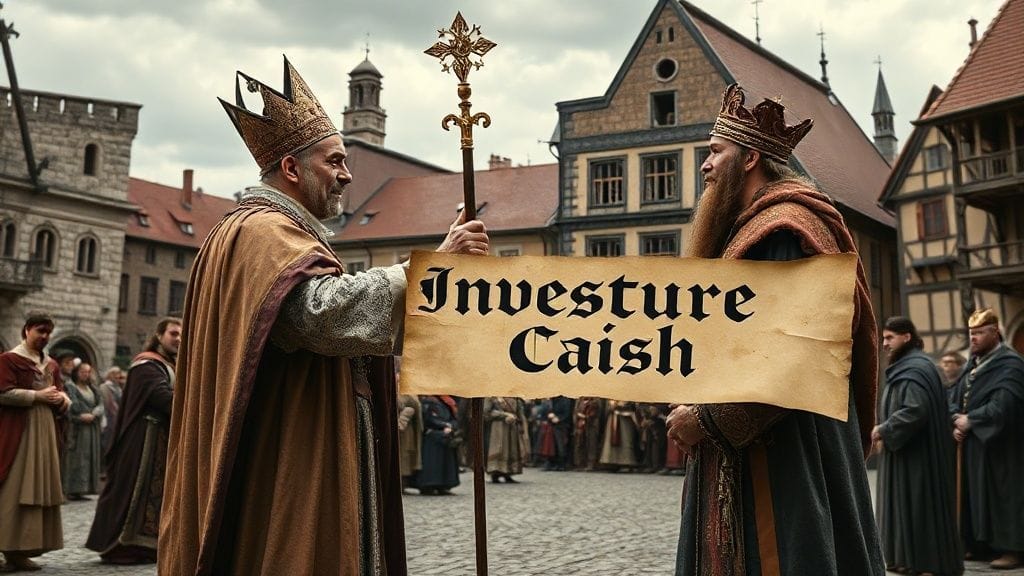
Europe, 1075. The flickering candlelight inside the austere chamber of the papal palace casts long shadows on cold stone walls. There, Pope Gregory VII, a man of iron will and profound faith, prepares a bold proclamation—one that will send shockwaves across Christendom and pit the papacy against the most powerful secular ruler of the age: Emperor Henry IV of the Holy Roman Empire.
This was not just a dispute over ritual. It was a fundamental battle for the soul of Europe — a fight over who, between Pope and Emperor, held the ultimate authority to shape the destiny of church and state.
In the mid-11th century, Europe was a fragmented continent caught in a web of competing authorities and overlapping jurisdictions. The Catholic Church, though united in doctrine, was internally fraught with corruption, nepotism, and the pervasive influence of secular rulers. Meanwhile, the German monarchy, at the heart of the Holy Roman Empire, wielded enormous influence, ruling over a mosaic of duchies, counties, and bishoprics.
Central to medieval political theology was the ideal of kingship as divinely ordained, yet the actual power dynamics were infinitely complex. One sacred ritual epitomized this tension: the investiture of bishops and abbots—the conferral of spiritual authority often entangled with temporal power and vast landholdings.
This ceremony was far from a mere blessing. To invest a bishop was to appoint a ruler with both spiritual and political clout within a given territory. The monarch’s privilege of investiture was a tangible expression of sovereignty, but the Church increasingly chafed at what it saw as secular intrusion.
Enter Pope Gregory VII, born Hildebrand of Sovana, a reformer with a vision to restore the Church’s purity and autonomy. His manifesto, later known as the Dictatus Papae, asserted unprecedented claims: the pope alone held the power to appoint or depose church officials, and even that emperors were subject to papal judgment.
This was an audacious challenge to centuries-old traditions and the fragile status quo. Emperor Henry IV, young but determined, could not accept a papal diktat that questioned his authority to manage the realm. For him, the loyalty of the bishops and abbots was vital to maintaining imperial cohesion.
The confrontation quickly escalated. When Gregory VII excommunicated Henry IV, it stunned Europe. A king cut off from the Church threatened to lose not just spiritual standing, but political legitimacy. The dramatic image of Henry’s journey through winter snows to the fortress of Canossa in 1077, where he stood barefoot and begging for absolution, became an enduring symbol of medieval power struggles.
Yet, the penance at Canossa was not an end but a pause. Both pope and emperor continued their rivalry for decades, plunging Germany into civil war and leaving Rome itself a battleground of factions.
The deadlock finally eased almost half a century later with the Concordat of Worms in 1122, which carefully balanced spiritual and imperial prerogatives — though neither side emerged as an absolute victor.
The Investiture Controversy was more than a power dispute; it marked a turning point in the separation of church and state, the emerging idea of sovereignty, and the shaping of European political thought and identity. It echoed through centuries of medieval history and resonates in modern discussions about the limits of spiritual and political authority.
Now, let us journey through the full tapestry of this struggle—a story of faith, ambition, and the shaping of the West.
1. The Dawn of a Crisis: Europe on the Brink
In the decades preceding 1075, the Latin West was simmering with tensions beneath its orderly surface. Monarchs, nobles, and church officials acted within a framework where divine sanction was the ultimate authority. But the reality was layered with compromise and contest.
The Holy Roman Empire under Henry III had maintained a close alliance with the papacy, often appointing popes and bishops who bolstered imperial control. But with Henry III’s death in 1056 and his young son Henry IV’s ascent, cracks appeared.
At the same time, moral and institutional decay within the Church was stirring backlash. Reform movements aimed to end simony (the buying of church offices), clerical marriage, and corruption.
It was in this crucible that Pope Gregory VII, the leading voice of Church reform, would emerge and soon confront Henry IV.
2. Setting the Stage: The Medieval Power Struggle
Before 1075, lay authorities routinely invested bishops with their symbols of office: the ring and staff known as the investiture. This granted bishops secular power over lands and allegiances, making them key imperial vassals.
But the Church increasingly viewed this practice as compromising ecclesiastical purity and independence. If lay rulers controlled appointments, could they be trusted to uphold spiritual values?
The stakes were existential. Control over appointments meant influence over the direction of religion, governance, and even military might in the region.
At this juncture, the ideal of the “Two Swords”—spiritual and temporal power wielded respectively by pope and emperor—was under severe stress. Which sword was truly supreme?
3. The Role of the Church in the 11th Century
The Church was not merely a spiritual institution but a sprawling political entity, owning vast properties and commanding large territories. High-ranking clergy were not only religious leaders but feudal lords with vassals and armies.
Corruption and lax discipline were pronounced. Simony and pluralism—holding multiple church offices—was rampant.
Reformers like the Cluniac monks pushed for renewal, emphasizing clerical celibacy, moral integrity, and autonomy from secular interference.
Pope Gregory VII emerged from this reformist tradition with an iron resolve to restore order and autonomy, convinced that the moral health of Christendom depended on reclaiming the Church from secular lords’ grasp.
4. The German Monarchy and the Sacred Duty of Kingship
Henry IV inherited a fractured empire with powerful territorial princes and bishops controlling large swaths of land.
To unify the realm, he relied heavily on loyal bishops, whom he appointed and legitimized. These clerics were vital administrators and military supporters in a kingdom lacking a centralized bureaucracy.
Henry’s father, Henry III, had maintained papal authority largely through imperial appointment; Henry IV saw no reason to alter what he considered his divine right and political necessity.
In his eyes, the Church was part of the empire’s fabric, not above it.
5. The Investiture Rite: More than a Ceremony
Fundamentally, investiture was a ritual rich in symbolism. The handing over of the ring symbolized spiritual authority; the staff, pastoral leadership.
For a lay ruler to perform investiture was to assert control over the Church’s hierarchy within his domain, ensuring loyalty and political stability.
To the Church reformers, this was scandalous—a profanation of sacred rites by secular hands.
But to kings and emperors, it was a practical tool essential for governance.
6. Pope Gregory VII: The Reformer Pope Enters the Arena
Born Hildebrand, Pope Gregory VII was a seasoned churchman dedicated to reform.
His Dictatus Papae, issued around 1075, declared that the pope alone possessed the right to appoint and depose bishops, that the pope could depose emperors, and that he was the ultimate judge of all.
These claims disturbed the established order.
Gregory believed that the moral authority of the Church necessitated independence and supremacy over secular powers.
7. Emperor Henry IV: The Assertive Monarch
Henry IV was young but politically savvy. He could not accept papal interference in appointments.
When Gregory demanded the return of invested bishops and refused imperial input, Henry saw it as a direct threat to his sovereignty.
He continued investing bishops and defied papal commands—a bold move that would trigger his excommunication.
8. The Spark Ignites: The Dictatus Papae and Its Revolutionary Claims
The Dictatus Papae was a manifesto that shook medieval Christendom.
It claimed:
- The pope alone could appoint or depose bishops.
- The pope held all worldly power, including the power to depose emperors.
- Those who resisted the pope could be punished with penalties including excommunication.
For centuries, emperors had maintained a say in investitures. The pope’s document redefined centuries of tradition into a challenge that demanded total submission.
9. The Clash Begins: Henry IV’s Defiance and Excommunication
In 1076, Pope Gregory VII excommunicated Henry IV, dissolving his subjects’ allegiance.
This represented a catastrophic blow to Henry’s legitimacy.
Nobles and princes seized the opportunity to rebel, plunging the empire into chaos.
Yet Henry refused to back down.
10. The Walk to Canossa: A Penitent King’s Humbling Act
The winter of 1077 witnessed one of the most iconic moments of medieval history.
Henry journeyed across snow-covered lands to Canossa Castle, where the pope was staying.
Standing barefoot in the snow for three days, he begged for forgiveness.
This act of submission compelled Gregory to lift the excommunication.
But the moment was fraught; Henry’s humiliation was public, yet the struggle for power continued.
11. The Aftermath of Canossa: Neither Side Triumphant
Despite the apparent triumph of papal authority, Henry swiftly regained power.
He appointed an antipope and waged war against Gregory’s supporters.
The empire fractured between factions loyal to pope or emperor.
This prolonged conflict plunged the empire into civil war.
12. Escalation and Civil War: Germany Torn asunder
The investiture struggle fractured Germany’s political landscape.
Nobles exploited the chaos to advance their own agendas, often siding with either the pope or emperor according to convenience.
This internal strife weakened royal authority for decades.
Only diplomacy and exhaustion would bring about resolution.
13. The Role of Nobles and Bishops: Shifting Allegiances
Bishops, once appointed firmly by imperial will, now found themselves courts of conflict.
Some embraced Gregorian reform, seeking independence.
Others remained loyal to Henry for material interests.
The nobles were equally pragmatic, switching sides as power shifted.
14. Rome’s Political Turmoil: The Papacy’s Struggle for Authority
Simultaneously, Rome was beset with its own turmoil.
Factional violence, clashes between the papacy and Roman nobility, and competing antipopes weakened papal control.
Gregory VII eventually died in exile, embodying the question of whether spiritual authority could truly dominate temporal power.
15. The Concordat of Worms (1122): The Resolution of Investiture?
Decades later, in 1122, the Concordat of Worms forged a compromise.
The emperor renounced the right to invest bishops with ring and staff but retained a role in their temporal investiture.
The Church gained spiritual autonomy; the emperor maintained political influence.
This balance ended the crisis but left ambiguous lines between spiritual and political authority.
16. Legacy of the Investiture Controversy: Church, State, and Europe
The struggle defined the trajectory of medieval Europe.
It established principles of papal supremacy, but also laid foundations for secular sovereignty.
It inspired later conflicts on the limits of authority and the rule of law.
17. The Cultural and Intellectual Impact on the Medieval West
The controversy catalyzed new ways of thinking about kingship, governance, and law.
It influenced the development of canon law and political philosophy, including the ideas of figures like Thomas Aquinas and Marsilius of Padua.
18. How the Investiture Conflict Shaped Modern Governance
Its echoes reach into modern ideas about the separation of church and state.
The debate between royal and papal power laid groundwork for concepts of sovereignty and constitutional limits.
19. Personalities in Conflict: Pope Gregory VII and Henry IV in Retrospect
History remembers Gregory as a zealous reformer, Henry as a strong-willed ruler.
Neither fully achieved victory, but their struggle defined an era.
Their personal tragedy unfolded on a grand historical stage.
20. The Lasting Symbolism of Canossa
Henry’s penance at Canossa has become shorthand for submission of secular power to spiritual authority.
Yet it was also a tactical move in a long political war.
Its legend continues to fascinate.
21. Questions of Faith vs. Power: The Broader Implications
The Investiture Controversy prompts reflection on the intertwined nature of spiritual and temporal authority.
It remains a cautionary tale of ambition, ideology, and the costs of conflict.
Conclusion
The Investiture Controversy was a crucible in which the medieval world’s deepest tensions were forged into a new order. It was a fierce contest not merely over ceremonies, but over ideology, power, and identity. A pope and an emperor clashed, their personal destinies bound to the fate of Europe itself.
From the icy snow of Canossa to the final compromises at Worms, the echoes of this conflict shaped the narratives of kings and popes, inspiring future generations to reflect on the limits of authority—both divine and earthly.
In the end, the Investiture Controversy was a story of human ambition and frailty, a testament to the enduring struggle between faith and power. And it remains, to this day, a vivid chapter in the vast, intricate tapestry of history.
FAQs about the Investiture Controversy
1. What were the main causes of the Investiture Controversy?
The controversy stemmed from competing claims to authority over the appointment of church officials, rooted in the balance of power between the papacy and secular rulers—especially the Holy Roman Emperor.
2. Why was the Investiture ceremony so important?
Because it symbolized the conferral of both spiritual and secular power. Control over investiture meant control over influential bishops and abbots who governed large territories and armies.
3. Who was Pope Gregory VII?
Gregory VII was a reform-minded pope who sought to free the Church from secular influence, issuing the Dictatus Papae which asserted papal supremacy over bishops and emperors.
4. What was Emperor Henry IV’s response to the pope’s claims?
Henry IV resisted papal interference, continued to invest bishops himself, and was eventually excommunicated—leading to his dramatic penance at Canossa.
5. What was the significance of the Walk to Canossa?
Henry’s penitential journey was a public symbol of submission to the pope’s spiritual authority, though it did not end the conflict.
6. How was the Investiture Controversy resolved?
Through the Concordat of Worms in 1122, which created a compromise separating spiritual from temporal investiture rights.
7. What lasting impact did the Investiture Controversy have on Europe?
It shaped the development of church-state relations, influenced the idea of sovereignty, and contributed to the rise of legal and political thought in medieval and modern Europe.
8. Can we see echoes of the Investiture Controversy today?
Yes—questions about the boundaries of religious influence on politics and vice versa continue to resonate globally.

