Table of Contents
- A Quiet Summer Day Shattered: The Dawn of Invasion
- Kuwait City Under Siege: The Shockwave Across the Gulf
- Historical Rivalries and Broken Promises: The Roots of Conflict
- Iraq’s Economic Struggles and Ambitions: Prelude to Aggression
- Saddam Hussein: The Man Behind the Conflagration
- The Day Before the Storm: Diplomatic Failures and Tense Negotiations
- The Invasion Unfolds: Military Tactics and Rapid Occupation
- The Human Cost: Civilians Caught in the Crossfire
- The World Watches and Reacts: International Outrage and Sanctions
- The United Nations’ Response: Resolutions and Coalitions
- Operation Desert Shield: The Build-Up to Liberation
- Kuwait’s Government in Exile: Voices of Resistance and Hope
- Media Around the World: Framing the Invasion and War
- The Role of Regional Powers: Allies, Adversaries, and Interests
- Economic Impacts: Oil Markets in Turmoil
- Saddam’s Calculations: Misjudgments and Overconfidence
- The Seeds of the Gulf War: From Invasion to Global Coalition
- The Legacy of Occupation: Destruction and Cultural Loss
- The Psychological Scars: Trauma of War on Kuwait’s People
- Lessons from 1990: The Invasion’s Place in Modern Geopolitics
- Conclusion: When Ambitions Ignite Conflicts
- FAQs: Key Questions About Iraq’s Invasion of Kuwait
- External Resource
- Internal Link
1. A Quiet Summer Day Shattered: The Dawn of Invasion
On the morning of August 2, 1990, the sun rose over Kuwait City as it had for centuries, casting golden light upon a metropolis that embodied both ancient heritage and modern ambition. Streets buzzed with the usual rhythms of commerce and life, families gathered for breakfast, and the world seemed, at least for a moment, oblivious to the dark shadows gathering just beyond the city’s shimmering skyline.
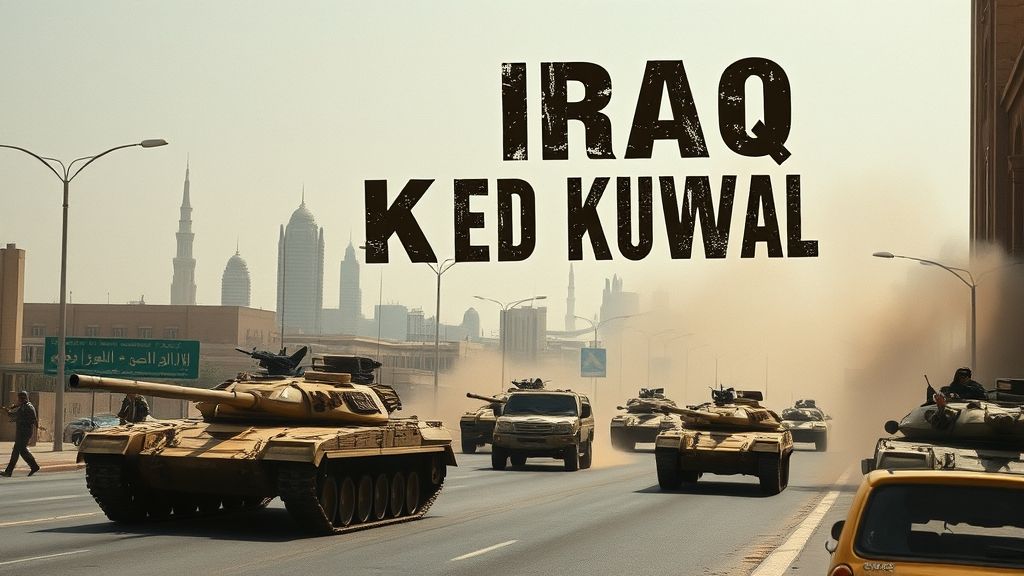
Then, as dawn broke higher, the silence shattered. The ground trembled with the roar of hundreds of Iraqi tanks barreling across a desert no-man’s land, while warplanes blackened the horizon with ominous clouds of smoke and fire. Kuwait was under invasion. The peaceful summer day had transformed itself into a brutal beginning — a sudden descent into chaos that would reverberate for decades across the Middle East and the global order.
It was a moment charged with fear, confusion, and disbelief — a moment where the fragile peace of the Gulf evaporated under the harsh footsteps of an army intent on rewriting the map of the region.
2. Kuwait City Under Siege: The Shockwave Across the Gulf
Kuwait City, once a beacon of prosperity nestled at the head of the Persian Gulf, quickly found itself encircled and subdued. The slender archipelago of Gulf states, their oil wealth fueling ambitions and anxieties alike, watched in horror as Iraqi battalions seized strategic points, communication hubs, and government buildings.
Internationally, the invasion was a gambit that stunned governments and citizens alike. Satellite images showed columns of soldiers advancing deep into Kuwaiti territory, and news reports rippled rapidly across continents. The small nation’s occupation was not just a regional crisis — it became a flashpoint demanding global attention.
For Kuwaitis, it was an overwhelming loss of sovereignty. Businesses shuttered, the streets emptied, and a pall of fear and uncertainty settled over the population. Yet, amidst the occupation, countless acts of bravery and resilience would quietly sow the seeds of resistance.
3. Historical Rivalries and Broken Promises: The Roots of Conflict
To understand the invasion, one must peer deeper into the tangled history of Iraq and Kuwait. The relationship between these neighbors was never simply about geography; it was a compendium of old grievances, colonial legacies, and contested borders.
Kuwait had long been viewed by Iraq, particularly under its 20th-century nationalist movements, as a rightful part of its territory — a notion partially rooted in discussions during the Ottoman era and the post-World War I carve-up of the Middle East. After the dissolution of the Ottoman Empire, British protectorate arrangements hardened Kuwait’s separate status, a distinction that Baghdad often contested.
Moreover, the oil beneath Kuwait’s sands magnified the stakes. The fluid, imprecise borders drawn by foreign powers translated into contested claims over lucrative oil fields along Iraq’s southern frontier. Saddam Hussein and his regime perceived Kuwait’s accumulation of oil wealth as both an economic threat and a source of resentment, stoking the flames of hostility.
4. Iraq’s Economic Struggles and Ambitions: Prelude to Aggression
The economic context surrounding the invasion was crucial. In the wake of the 1980–1988 Iran-Iraq War — a devastating conflict that drained resources and left Iraq deeply indebted — Saddam Hussein sought ways to rebuild his shattered economy.
Iraq’s debts to Kuwait and Saudi Arabia had become a festering sore. Baghdad accused Kuwait of exceeding OPEC oil production quotas, thereby suppressing prices and eroding Iraq’s oil revenues. Economic strife bred political tension; Iraq’s leadership felt betrayed by its Gulf neighbors, whom it had expected to follow a policy of Arab solidarity.
This cocktail of financial pressure and nationalistic fervor culminated in a dangerous calculus: the invasion was positioned as a solution to Iraq’s debts and a method to reclaim what Saddam portrayed as stolen territory and resources.
5. Saddam Hussein: The Man Behind the Conflagration
Saddam Hussein remains one of history’s most enigmatic and ruthless leaders — a man whose personality fused charisma, brutality, and grandiose visions of regional dominance. His rise to power within the Ba’ath Party marked the consolidation of authoritarian rule built on fear and propaganda.
By 1990, Saddam harbored ambitions of elevating Iraq to the preeminent Arab power. But his regime was fragile, relying heavily on military might to maintain control both at home and abroad. The invasion of Kuwait was, in many ways, Saddam’s gamble — an attempt to project strength and rewrite the regional hierarchy.
His speeches, laced with invocations to Arab nationalism and grievances against Kuwait, prepared the ground for the invasion. Yet, even close allies were caught off guard by the speed and scale of the operation.
6. The Day Before the Storm: Diplomatic Failures and Tense Negotiations
In the weeks leading to August 2, the diplomatic skylines were fraught with tension. Iraq relentlessly accused Kuwait of economic sabotage, while Kuwait, backed by Saudi Arabia and Western powers, maintained a stance of innocence and readiness.
Behind closed doors, emissaries and diplomats engaged in a flurry of negotiations, but mutual distrust derailed constructive dialogue. Iraq demanded debt forgiveness and production cutbacks from Kuwait; Kuwait demanded Iraqi withdrawal from contested areas. Neither side yielded.
The U.S. and the Soviet Union, still poised in the last years of the Cold War, watched with growing concern but initially refrained from overt intervention. It was as if the world hesitated, giving Saddam a window to advance on his own terms.
7. The Invasion Unfolds: Military Tactics and Rapid Occupation
At precisely 4 a.m. on August 2, Iraqi forces crossed into Kuwaiti territory in a coordinated, lightning invasion. Over 100,000 troops, supported by armored divisions, air strikes, and artillery barrages, overwhelmed the smaller Kuwaiti defense forces.
Iraqi planes bombed key military installations and infrastructure, while ground troops swiftly seized control of strategic urban and transport centers. The operation was swift, brutally efficient — within hours, the majority of Kuwait was under Iraqi control.
Kuwaiti resistance dissolved quickly in the face of overwhelming force, though pockets of armed and popular defiance persisted. The Iraqi flag was hoisted over Kuwait’s parliament — a stark symbol of domination.
8. The Human Cost: Civilians Caught in the Crossfire
War, above all, reshapes lives. Kuwaiti citizens woke to a new reality of occupation, checkpoints, curfews, and uncertainty. Families were uprooted; some fled underground, others faced arrests and violence.
Reports emerged of looting by Iraqi soldiers, destruction of property, and violations of human rights. The psychological trauma scarred generations — the invasion was not merely a land grab but a rupture in the social and emotional fabric of Kuwait.
Women and children in particular faced hardships — shortages of food, medical supplies, and safety became daily concerns. Yet, amidst such adversity, many Kuwaitis formed resistance networks, maintaining hope that liberation was possible.
9. The World Watches and Reacts: International Outrage and Sanctions
The occupation sent shockwaves far beyond the Gulf. The United Nations quickly condemned Iraq’s actions, labeling the invasion a clear breach of international law. The Security Council passed a series of resolutions demanding immediate Iraqi withdrawal and imposing economic sanctions.
Global media coverage amplified the urgency and gravity of the crisis. Protests erupted worldwide, while governments scrambled to formulate responses. Western powers, particular the United States, saw the invasion as a direct threat to regional stability and global oil supplies.
Economic sanctions would cripple Iraq’s international trade, but Saddam remained defiant, refusing to back down — a stance that extended the crisis and set the stage for military confrontation.
10. The United Nations’ Response: Resolutions and Coalitions
The UN Security Council passed Resolution 660, condemning the invasion and demanding withdrawal “immediately and unconditionally.” Further resolutions (661 and onwards) imposed comprehensive economic sanctions, choking off Iraqi imports and exports.
But diplomatic persuasion failed. Iraq declared Kuwait annexed as its 19th province, signaling no intention to reverse course. The UN began organizing a broad coalition of nations to enforce sanctions — an unprecedented moment of multinational unity.
For many, this was the first clear signal that the invasion was not just a regional dispute but an assault on the post-World War II international order.
11. Operation Desert Shield: The Build-Up to Liberation
In response to Iraqi aggression, the United States swiftly launched Operation Desert Shield — a massive military build-up in Saudi Arabia designed to protect its oil-rich neighbor and deter further Iraqi expansion.
More than 500,000 soldiers from 35 nations assembled across the Gulf, logistical chains buzzed with urgency, and the world braced for the inevitable next phase: liberation. This coalition embodied a rare unity of purpose during a time of lingering global tensions.
Yet, beneath the show of strength, diplomatic options were still explored. The world clung to the hope that a peaceful resolution might yet be possible.
12. Kuwait’s Government in Exile: Voices of Resistance and Hope
Meanwhile, the legitimate Kuwaiti government fled to Riyadh and then London, from where it worked tirelessly to rally international support. Emirs and cabinet ministers became the faces of resilience, urging the world not to abandon their homeland.
They provided vital intelligence and moral leadership, sending messages to their occupied people that liberation and justice remained attainable. The government-in-exile symbolized the persistence of national identity against erasure.
Their efforts helped galvanize global sympathy, turning a military occupation into a shared cause.
13. Media Around the World: Framing the Invasion and War
The invasion of Kuwait unfolded in real-time through the emerging 24-hour news cycle. CNN and other international outlets projected images of tank columns, refugee flows, and diplomatic meetings into living rooms worldwide.
The media played a dual role: informing global audiences and shaping public opinion. Human interest stories about displaced families, interviews with military experts, and footage of bombed infrastructure punctuated daily broadcasts.
Yet, media also faced ethical dilemmas — balancing propaganda, censorship, and accuracy in wartime coverage.
14. The Role of Regional Powers: Allies, Adversaries, and Interests
The Gulf War was not simply an East-West conflict; it was deeply entangled in a complex web of regional rivalries. Saudi Arabia, fearing Iraqi expansionism, opened its soil to coalition forces. Iran watched cautiously, while Syria aligned with the US-led coalition in a surprising strategic calculation.
Qatar, Bahrain, and the United Arab Emirates supported sanctions and contributed troops, while countries like Jordan and Yemen showed more ambivalence, wary of American military presence in the Arab world.
This patchwork of allegiances highlighted longstanding divisions and the perilous balance of power in the Middle East.
15. Economic Impacts: Oil Markets in Turmoil
Kuwait’s occupation—and the threat to Saudi Arabia—sent oil markets into chaos. Prices skyrocketed as the world feared disruption of critical energy supplies that powered global industry.
OPEC scrambled to stabilize production quotas amidst the crisis, but uncertainty bred volatility. The Gulf’s oil wealth was weaponized both politically and economically, turning resource control into a high-stakes geopolitical chess game.
Consumers from Tokyo to New York felt the tremors through rising fuel prices and economic concerns—a potent reminder of the invasion’s far-reaching effects.
16. Saddam’s Calculations: Misjudgments and Overconfidence
Saddam Hussein believed his swift aggression would yield quick gains and limited backlash. Yet, he underestimated the international community’s unity and resolve.
His miscalculations included believing that Arab states would support him, that the US would remain disengaged after the Cold War, and that economic sanctions would fail. The gamble was a catastrophic blunder — setting Iraq on a collision course with a powerful coalition and eventual military defeat.
Such hubris would haunt Saddam’s regime and the region for years to come.
17. The Seeds of the Gulf War: From Invasion to Global Coalition
The invasion of Kuwait marked the opening act of the Gulf War. What started as a regional occupation soon escalated into a massive global military engagement.
The coalition’s eventual decision to liberate Kuwait was fueled by concerns over world order, humanitarian necessity, and energy security. Thus, the invasion transformed from a territorial dispute to an international crisis demanding intervention.
It was a tipping point that reshaped global alliances and military doctrines into the 21st century.
18. The Legacy of Occupation: Destruction and Cultural Loss
Iraq’s occupation left scars on Kuwait’s land and heritage. Infrastructure was damaged, oil wells were deliberately set ablaze, creating apocalyptic fires that blackened skies and poisoned air.
Historic sites and cultural treasures suffered neglect or vandalism. Reconstruction would take years, and the economic cost ran into tens of billions of dollars.
Yet, the occupation also galvanized a renewed sense of national identity and pride among Kuwaitis, who vowed to protect their sovereignty in future generations.
19. The Psychological Scars: Trauma of War on Kuwait’s People
Beyond physical destruction, the invasion inflicted deep psychological wounds. Fear, displacement, and uncertainty became daily companions for ordinary Kuwaitis.
Stories of families torn apart, children witnessing violence, and the exiled government struggling with helplessness are threads in the tapestry of loss.
Post-war studies revealed widespread trauma, impacting education, mental health, and societal cohesion — consequences that linger decades after the final artillery shells fell.
20. Lessons from 1990: The Invasion’s Place in Modern Geopolitics
The Kuwait invasion remains a stark lesson in the dangers of unchecked ambition, the power of international coalitions, and the fragility of peace.
It exposed the limits of diplomacy when confronted with aggressive autocracy and the pivotal role natural resources play in global stability.
Moreover, it underscored the importance of unified global action in the face of aggression — a template that has since influenced responses to conflicts worldwide.
21. Conclusion: When Ambitions Ignite Conflicts
The invasion of Kuwait in August 1990 was not merely a seizure of territory; it was a disruptive earthquake that quaked through geopolitical landscapes and human lives alike.
Saddam Hussein’s ambitions collided with international law, regional sensibilities, and the dreams of a small nation bound by history and resilience.
As the dust settled, the world understood that peace requires vigilance, justice, and a recognition that even the smallest nations’ sovereignty commands universal respect.
The lesson remains timeless: when ambition crosses the threshold into aggression, history watches—and often stands united against tyranny.
22. FAQs: Key Questions About Iraq’s Invasion of Kuwait
Q1: What were the main causes of Iraq’s invasion of Kuwait?
Iraq’s invasion was driven by economic debts from the Iran-Iraq War, disputes over oil production and pricing, territorial claims based on historical grievances, and Saddam Hussein’s desire to increase regional power.
Q2: How did the international community respond to the invasion?
The United Nations condemned the invasion, imposed economic sanctions on Iraq, and constructed a multinational coalition led by the U.S. to pressure Iraq into withdrawal, culminating in the Gulf War.
Q3: Who was Saddam Hussein, and what role did he play?
Saddam was the authoritarian president of Iraq who orchestrated the invasion as a strategic move to solve economic difficulties and assert dominance, misjudging global reactions in the process.
Q4: What was Operation Desert Shield?
A U.S.-led military operation to deploy forces in Saudi Arabia to deter further Iraqi aggression following the invasion of Kuwait, serving as a prelude to the Gulf War.
Q5: What happened to Kuwait during the occupation?
Kuwait suffered military occupation, economic disruption, human rights abuses, infrastructure destruction, and widespread trauma among its population.
Q6: How did the invasion affect global oil markets?
The invasion caused oil prices to spike due to fears of supply disruptions, leading to economic uncertainty worldwide.
Q7: What was the significance of Kuwait’s government-in-exile?
The exiled government maintained international legitimacy, coordinated resistance, and helped galvanize global diplomatic and military efforts to restore Kuwaiti sovereignty.
Q8: How is the invasion remembered today?
It is remembered as a cautionary tale about aggression, the importance of international law, and the enduring resilience of Kuwait and its people.