Table of Contents
- Dawn over Dublin: The Birth of a New Nation
- The Long Road to Freedom: Historical Context Before 1922
- The Easter Rising: The Spark that Ignited the Flame
- The War of Independence: Guerrilla Warfare and Political Struggle
- The Anglo-Irish Treaty: The Fragile Foundation of the Free State
- The Dáil Debates: A Nation Divided Over Compromise
- From Treaty to Triumph: The Formal Establishment on December 6, 1922
- The First Provisional Government: Leaders and Visionaries
- Dublin’s Streets on December 6: A City Transformed
- The Irish Free State Constitution: Balancing Autonomy and Empire
- Challenges at Inception: Civil War Looms and Political Turmoil
- Economic and Social Realities in the Early Free State
- The Role of Michael Collins and Arthur Griffith: Legacy and Loss
- Symbolism and National Identity: Flags, Language, and Culture
- International Reactions: Britain, the Commonwealth, and Beyond
- The Irish Free State in the Shadow of the Empire
- Education and Nation-Building: Cultivating a Free People
- Women’s Place in the New State: Progress and Limitations
- The Catholic Church and the State: An Uneasy Partnership
- Seeds of the Republic: From Free State to Sovereignty
- The Irish Civil War: A Nation Tearing Itself Apart
- Economic Policies and Land Reforms: Foundations for Growth
- Remembering December 6: National Memory and Commemoration
- Legacy of the Irish Free State: Ireland’s Journey to Modern Independence
- Closing Reflections: What the Birth of the Free State Means Today
Dawn over Dublin: The Birth of a New Nation
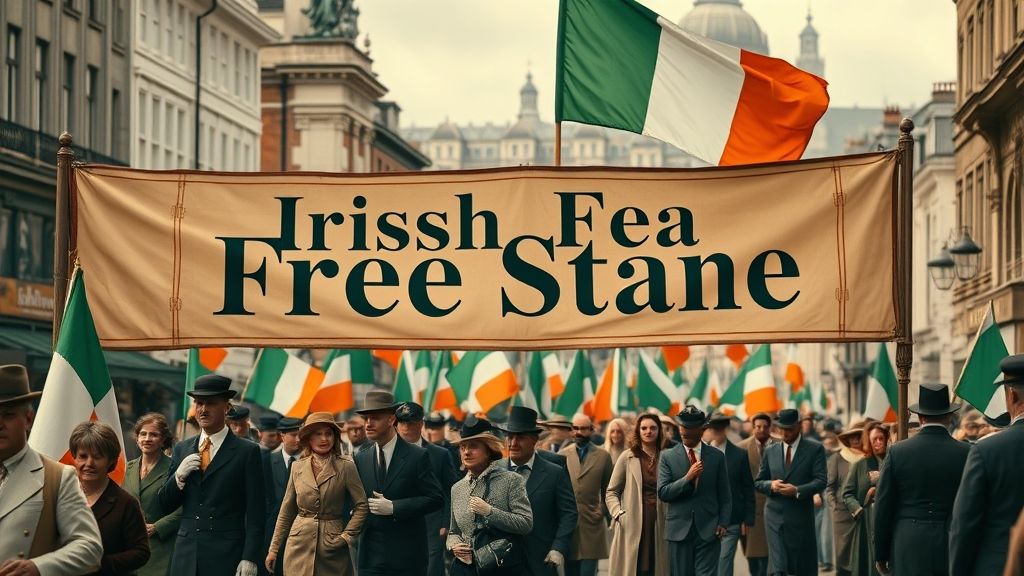
It was a crisp winter day in Dublin, December 6, 1922, a date etched forever into the annals of Irish history. The air was alive with anticipation, charged with the residue of conflict yet vibrant with hope. Across the city, crowds gathered, hands gripping tricolors that danced proudly against the grey skies. The Irish Free State—an idea long yearned for, bitterly fought over—was officially born. This day was not just a date on the calendar; it was the quiet, trembling heartbeat of a nation stepping into the uncertain dawn of self-governance.
At first light, the streets echoed with a mix of jubilation and tension. Young and old, veterans of rebellion and the wary civilians, all sensed that a new Ireland was taking its first tentative breaths. The British Union Jack was lowered for the last time over official buildings. In its place fluttered the green, white, and orange tricolor—a symbol of a fractured but determined people. Dublin had become the cradle of a new state, carved from centuries of struggle and sacrifice.
Yet beneath the celebrations, the fragile threads holding this new reality together frayed ominously. The Treaty signed just months earlier had divided comrades, friends, and families. The promise of autonomy was shadowed by what some perceived as betrayal. The Irish Free State was born into an uneasy peace, its future uncertain but full of promise—a paradox of hope and heartbreak intertwined.
The Long Road to Freedom: Historical Context Before 1922
To truly grasp the significance of December 6, 1922, one must unravel the complex tapestry of Ireland’s struggle for self-determination that stretched back centuries. Colonized by the English since the 12th century, Ireland endured waves of colonization and cultural suppression, punctuated by periodic rebellions. The nineteenth century, especially, witnessed the burgeoning of nationalist movements fueled by the awakening spirit of cultural revival and political assertion.
The late 1800s saw the rise of Home Rule campaigns, an effort to achieve autonomy within the United Kingdom. But it was only with the devastation of World War I and the Easter Rising of 1916 that the embers of revolution truly caught flame. The British handling of the rebellion galvanized public opinion, turning moderate nationalists into fervent republicans demanding full independence.
The decades preceding 1922 were riddled with political maneuvering, social upheaval, and brutal conflict. The entrenched opposition between those favoring complete separation and those willing to accept dominion status made reconciliation elusive.
The Easter Rising: The Spark that Ignited the Flame
On Easter Monday, April 24, 1916, a handful of armed revolutionaries seized key points in Dublin, proclaiming an Irish Republic. Though doomed from the start, the uprising's bold defiance shocked the Empire and the world. For six days, rebels held out against superior forces, knowing well the likely outcome. The British response was swift and severe; leaders were executed, but with their deaths came martyrdom.
This tragedy transformed the political landscape: “Our Motherland’s hatred,” declared Patrick Pearse from the steps of the General Post Office, “is the hatred of the oppressor and the no longer servile subject.” The Rising laid bare the impossibility of mere Home Rule and hardened the resolve of the Irish people.
The War of Independence: Guerrilla Warfare and Political Struggle
Following the Rising, Sinn Féin, often mistakenly seen as orchestrating it, surged in popularity, winning the 1918 general election in Ireland by a landslide. Its elected MPs abstained from Westminster, instead convening the revolutionary Dáil Éireann in 1919, proclaiming an Irish Republic. Thus began the War of Independence—a brutal conflict between the Irish Republican Army (IRA) and British forces.
This war was fought not in grand battles but in ambushes, assassinations, and covert operations. Michael Collins emerged as a master of intelligence and guerrilla warfare, turning asymmetric tactics into an art form. Public opinion split between hope and fear, as reprisals and atrocities marked the conflict. “We were fighting a war of shadows,” recalled IRA volunteer Tom Barry, “in the police barracks and on the roads, under the cloak of night.”
The Anglo-Irish Treaty: The Fragile Foundation of the Free State
By 1921, exhaustion and political realities pushed both sides to negotiate. The Anglo-Irish Treaty, signed on December 6, 1921, promised Ireland dominion status within the British Commonwealth—a compromise far short of full independence but a start. The Treaty’s terms included an oath of allegiance to the Crown and retention of partition with Northern Ireland remaining part of the UK.
For some, like Michael Collins, it was a stepping stone toward full sovereignty; for others, like Éamon de Valera, it was an unacceptable surrender. The Treaty exposed deep fissures within the nationalist movement, sowing seeds for the civil strife to come.
The Dáil Debates: A Nation Divided Over Compromise
The months after the Treaty saw intense debates within the Dáil Éireann. Heated arguments filled every chamber corner, and friendships fractured. The Treaty narrowly passed, but the division was profound.
Arthur Griffith, who championed the Treaty, believed pragmatic steps were necessary to achieve Irish freedom, while de Valera’s rejection stemmed from a vision of absolute independence at any cost. “I have done my duty and signed on my conscience,” Collins later remarked, “but this means war among ourselves.”
From Treaty to Triumph: The Formal Establishment on December 6, 1922
One year to the day after the Treaty’s signing, the Irish Free State formally came into existence, replacing the British administration. The new state comprised 26 of the 32 counties, with limited sovereignty under a constitutional monarchy.
On that historic day, the Provisional Government transferred power in ceremonies marked simultaneously by celebration and uncertainty. Officials took oaths, flags were raised, and a new parliament convened. Yet, beneath the veneer of formalities, the nation stood on the precipice of civil war.
The First Provisional Government: Leaders and Visionaries
The backbone of the new state rested on figures like Michael Collins as Chairman of the Provisional Government and W.T. Cosgrave as President of the Dáil. Their leadership embodied the difficult balancing act required: to build institutions from scratch amid suspicion and hostility.
Collins, often called the “Man Who Won Ireland,” was both a unifying figure and a target of fierce opposition. His vision blended pragmatism and idealism, striving to transform rebellion into administration. Tragically, his assassination in August 1922 during the civil conflict underscored the precariousness of the Free State’s infancy.
Dublin’s Streets on December 6: A City Transformed
Walking through Dublin on the day the Irish Free State was established was to witness history in motion. The city buzzed with spirited crowds singing traditional songs, and the patriotic murals commemorated revolutionaries past and present. Newspapers were plastered with headlines heralding a “New Dawn for Ireland.”
Yet, the city’s joy mixed uneasily with the sounds of armed patrols and whispered rumors of dissent. For every cheer, there was a shadow—the knowledge that not all accepted this new order.
The Irish Free State Constitution: Balancing Autonomy and Empire
The 1922 Constitution laid out the framework of government, blending parliamentary democracy with constitutional monarchy. It was Ireland’s first step toward self-rule, granting Irish citizens freedoms while tethering the state to the British Crown through the Governor-General.
This balance was a delicate compromise, reflecting the Treaty’s terms but clashing with republican aspirations. It embodied the conflict between realism and idealism, sovereignty and dependency.
Challenges at Inception: Civil War Looms and Political Turmoil
Though born with hope, the Irish Free State inherited an unstable foundation. The Treaty split the nationalist movement into pro- and anti-Treaty factions. By June 1922, civil war erupted, pitting former allies against each other.
The Free State had to contend with an internal armed conflict even as it sought international recognition and administration. This war would claim over 2,000 lives and leave wounds that took decades to heal.
Economic and Social Realities in the Early Free State
Far from abstract politics, the Free State faced urgent practical challenges. Widespread poverty, unemployment, and rural land disputes demanded immediate attention. Infrastructure damage from years of conflict hampered development.
The government’s fiscal policies emphasized stability and efficiency, but the scars left by rebellion and war made social cohesion difficult. Emigration remained high, undercutting hopes for rapid growth.
The Role of Michael Collins and Arthur Griffith: Legacy and Loss
Michael Collins’s death was a blow so profound it shook the state to its core. His leadership embodied both military success and visionary governance. Arthur Griffith, the first President of Dáil Éireann who died shortly before Collins, shaped the political vision underpinning the Free State.
Together, their legacies defined the early years—optimism marred by tragedy, the courage to build amidst chaos.
Symbolism and National Identity: Flags, Language, and Culture
Febrile debates about symbols reflected deeper questions about Irish identity. The tricolor flag became official, a banner for unity and hope. The revival of the Irish language was prioritized in schools and public life, part of a broader cultural renaissance.
But national identity remained contested, caught between tradition and modernity, Catholicism and emerging pluralism.
International Reactions: Britain, the Commonwealth, and Beyond
The British government officially recognized the Irish Free State with cautious optimism, glad to end a costly conflict yet wary of future instability. Within the Commonwealth, Ireland’s status was unprecedented, foreshadowing broader decolonization.
Internationally, Ireland’s experience resonated among other colonies and nationalist movements, offering both inspiration and cautionary lessons.
The Irish Free State in the Shadow of the Empire
Though nominally autonomous, the Free State remained linked to the British Empire. The Statute of Westminster (1931) would later legally sever many of these ties. But in 1922, the Free State’s status was ambiguous—part nation, part dominion.
This liminal status bred discontent that fueled republicanism and shaped Irish political discourse for decades.
Education and Nation-Building: Cultivating a Free People
Education reform was central to nation-building. Irish schools emphasized language, history, and citizenship, aiming to mold a new Irish identity. The state promoted curricula that highlighted independence narrative, heroes, and cultural distinctiveness.
Yet challenges of literacy, rural access, and poverty persisted, complicating this vision.
Women’s Place in the New State: Progress and Limitations
Women had played vital roles in the revolution, yet the Free State’s constitution and policies imposed conservative restrictions, reinforcing traditional roles. The Civil War and political upheavals overshadowed women’s rights, many of which would remain limited until later decades.
Still, figures like Constance Markievicz, a revolutionary and the first woman elected to British Parliament, signaled the complex place of women in this new Ireland.
The Catholic Church and the State: An Uneasy Partnership
The Catholic Church wielded immense influence in the Free State, shaping education, health, and moral policies. This alliance bolstered social cohesion but also imposed conservative values and curtailed certain freedoms.
The relationship was symbiotic but fraught with tensions that would persist into modern times.
Seeds of the Republic: From Free State to Sovereignty
The Irish Free State was a transitional entity. Throughout the 1920s and 1930s, constitutional changes gradually chipped away at imperial ties. The 1937 Constitution, enacted under Éamon de Valera, redefined Ireland as a sovereign republic in all but name.
The Free State era was thus both a beginning and a stepping stone toward full Irish independence.
The Irish Civil War: A Nation Tearing Itself Apart
The most devastating immediate aftermath of the Free State’s establishment was the Civil War between pro- and anti-Treaty forces. Friends and brothers found themselves on opposing sides, battles raged in Dublin streets and rural Ireland.
The civil conflict left scars that shaped Ireland’s politics, with bitterness that colored generations’ memories.
Economic Policies and Land Reforms: Foundations for Growth
The Free State government embarked on cautious economic policies focused on agricultural reform, land redistribution, and infrastructural development. Though modest, these policies laid groundwork for later modernization.
Ireland remained largely rural and agrarian, yet the state sought to balance tradition with necessary economic progress.
Remembering December 6: National Memory and Commemoration
December 6 became a symbolic date in Irish national consciousness, associated with both pride and complexity. Annual commemorations vary—some celebrating sovereignty, others mourning the divisions that followed.
The date encapsulates the paradox of Irish independence: a triumph marked by compromise and conflict.
Legacy of the Irish Free State: Ireland’s Journey to Modern Independence
The Irish Free State forged a path from rebellion to governance, from colonial subject to autonomous nation. Though imperfect and contested, its establishment was a turning point, underpinning modern Ireland’s political, cultural, and social identity.
Its legacy is a testament to resilience and the enduring pursuit of self-determination.
Conclusion
The birth of the Irish Free State on December 6, 1922, is a story layered with contradiction and courage—a narrative of sacrifice, division, and hope intertwining to produce a new political reality. It was neither the absolute freedom many dreamed of nor the continuation of old colonial chains. Instead, it was a fragile compromise, a nation learning to walk with both wounds and determination.
As winter’s breath cooled the streets of Dublin that day, a people stood poised at the crossroads of history. The Irish Free State symbolized a nation rebuilt from ashes, yet shadowed by internal strife. Its formation was an act of bold pragmatism and idealistic striving—the start of Ireland’s complicated journey toward full sovereignty.
Looking back, one senses the enduring human heartbeat beneath the pages of treaties and constitutions—the hopes, fears, and courage of those who dared to dream an independent Ireland. Their legacy reminds us that nationhood is never granted; it is fought for, negotiated, and nurtured anew with each generation.
FAQs
1. What were the main causes leading to the establishment of the Irish Free State?
The Free State’s creation was the outcome of centuries-long British colonization, cultural suppression, Irish nationalist awakening, and armed struggle—culminating in the 1916 Easter Rising, War of Independence, and the Anglo-Irish Treaty.
2. Why was the Anglo-Irish Treaty controversial?
The Treaty granted dominion status but required an oath to the British Crown and accepted partition with Northern Ireland. This compromise split the nationalist movement between those willing to accept it and those who saw it as a betrayal.
3. Who were the key figures behind the Irish Free State’s foundation?
Key leaders included Michael Collins, Arthur Griffith, W.T. Cosgrave, and Éamon de Valera, each playing crucial but sometimes opposing roles in negotiating, implementing, or opposing the Treaty.
4. How did the Irish Civil War relate to the Free State’s establishment?
Civil war erupted because the Treaty divided former comrades over acceptance of the Free State. It involved brutal conflict between pro- and anti-Treaty factions throughout 1922–1923, deeply impacting the new nation.
5. What was the role of women in the Irish Free State?
While women had contributed significantly to the independence movement, the Free State era largely reinforced traditional gender roles, limiting women’s legal rights and political participation.
6. How did the Irish Free State’s status relate to the British Empire?
It was a dominion within the British Commonwealth, with limited sovereignty. Later constitutional changes in the 1930s and 1940s gradually severed ties, leading to full republic status in 1949.
7. How is December 6 remembered in Ireland today?
December 6 marks the establishment of the Free State and is observed symbolically, recognizing both the achievement of independence and the complexities—particularly in terms of the ensuing civil war—that accompanied it.
8. What long-term impacts did the Irish Free State have on modern Ireland?
It established democratic institutions and legal frameworks forming the basis of the modern republic. It also fostered national identity and set Ireland on a path from colonial domination to full sovereignty.