Table of Contents
- The Dawn of a Spiritual Journey: Arrival at Iona in 563
- Ireland’s Monastic Spirit: Roots of a Religious Renaissance
- The Man Behind the Mission: St. Columba’s Vision and Resolve
- The World of Alba and Dál Riata: A Land Poised for Transformation
- Crossing the Sea: The Voyage to Iona and the Birth of a New Monastic Center
- Life in the Early Iona Monastery: Rituals, Scholarship, and Solitude
- The Role of Monasticism in Shaping Early Medieval Scotland
- Evangelizing a Pagan Land: Challenges and Triumphs among the Picts and Scots
- Monastic Networks: How Irish Missionaries Linked Dál Riata to Continental Europe
- The Spread of Christianity Beyond Iona: Missions to Northern Britain and Beyond
- Art, Culture, and Manuscripts: The Iona Legacy in Celtic Christianity
- Conflict and Cooperation: Monks, Kings, and Tribes in a Changing Landscape
- The Political Impact of Monastic Settlements in Early Medieval Britain
- Pillars of Faith and Learning: The Monastery as a Beacon in Dark Times
- Legacy and Memory: How the Irish Monastic Mission Shaped Scottish Identity
- The Enduring Influence of Iona in Spiritual and Cultural Histories
- Conclusion: Spiritual Fire Across Waters and Time
- FAQs: Understanding the Irish Monastic Expansion to Alba and Dál Riata
- External Resource: Wikipedia Link to Irish Monasticism and Iona
- Internal Link: Visit History Sphere
The Dawn of a Spiritual Journey: Arrival at Iona in 563
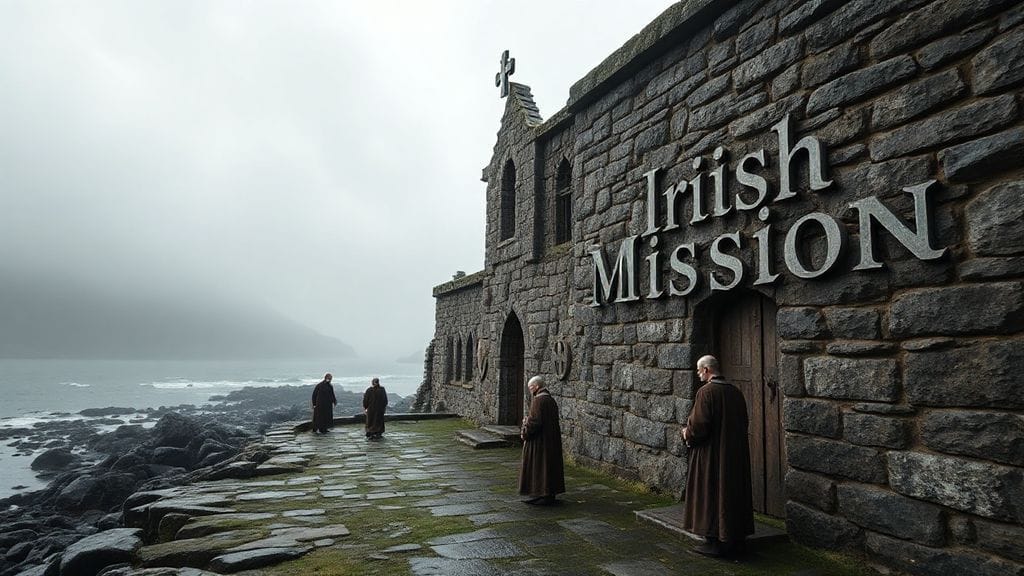
The early morning mist curled over the restless waves of the Hebridean Sea, as a small fleet of wooden boats approached the rugged coastline of Iona. The year was 563 AD, and these vessels bore not warriors or traders, but a group of determined Irish monks led by a man known to history as St. Columba. They were about to set foot on an island destined to become a beacon of spiritual awakening and cultural transformation in a land still shrouded in pagan traditions and clan rivalries.
Imagine the piercing cold wind that bit at the missionary’s faces, the scent of seaweed mingling with the earthy smell of the island’s mossy stones. The monks, having left behind the familiar green hills and monastic schools of Ireland, arrived in a hostile but promising new world: Alba, later known as Scotland, and the kingdom of Dál Riata, spanning parts of western Scotland and northeastern Ireland, were ripe for their fervent message of faith and learning. This day would set in motion a wave of religious and cultural expansion that shaped the history of Britain forever.
But who were these monks? What drove them to endure perilous sea journeys and face unknown peoples? How did their mission take root and flourish far from their homeland? This story, vivid and complex, unfolds in the heart of the early medieval age—a time seemingly cloaked in darkness, yet breaking with an astonishing light of faith, knowledge, and art, all nurtured by those tireless Irish missionaries.
Ireland’s Monastic Spirit: Roots of a Religious Renaissance
Before the journey to Iona, Ireland was already experiencing a profound spiritual awakening. Following the arrival of Christianity in the 5th century, thanks largely to figures like St. Patrick, monasticism emerged as the dominant paradigm of religious life. Unlike the Roman model centered on episcopal cities, the Irish church developed around monastic communities—self-sufficient enclaves devoted to prayer, labor, and study.
By the mid-6th century, monasticism had flourished into a uniquely Irish institution known both for intense asceticism and remarkable scholarship. Monks copied sacred texts, composed poetry and hymns, and engaged in theological reflection. Their monasteries were hubs of literacy and learning in a largely illiterate Europe. This flourishing was not merely religious but cultural, setting Ireland apart as a “light” during the so-called Dark Ages.
St. Columba, born into an aristocratic family around 521 AD, was a product of this vibrant monastic culture. Educated at the famous monastery of Clonard, he was deeply influenced by its scholastic rigor and spiritual discipline. His decision to leave Ireland and establish a community in Iona was both a continuation of this monastic tradition and a bold venture into spiritual frontier work.
The Man Behind the Mission: St. Columba’s Vision and Resolve
Columba’s story is as compelling as the mission itself. Known in Irish as Colm Cille (“Dove of the Church”), he was charismatic, learned, and fiercely determined. Facing political troubles at home—especially conflicts with rival clans—his exile was both a personal trial and a providential turning point.
According to tradition, Columba sailed to Iona with twelve companions, echoing Christ’s own circle of disciples in number and mission. His aim was twofold: to build a monastic community that imitated the ascetic ideals of Irish monasticism, and to evangelize the largely pagan peoples of Alba and Dál Riata.
Columba’s leadership style combined spiritual authority with political mediation. The monks acted not merely as preachers but as peacemakers and advisors to local rulers. His commitment to non-violence famously extended even to animal life, reflecting a holistic vision of Christian care.
The historical Columba remains enigmatic, partly shrouded in hagiographical accounts, but one thing is clear: his foundation on Iona sparked a missionary movement that extended Irish monastic influence deep into Scotland and beyond.
The World of Alba and Dál Riata: A Land Poised for Transformation
When Columba and his monks landed on Iona, they encountered a complex territorial and cultural landscape. Alba was inhabited by Picts—tribal, fierce, and attached to ancestral pagan gods and customs—while Dál Riata represented a Gaelic-Scots kingdom with close ties to Ireland. These lands were fragmented, tribal, and often violent, yet brimming with latent spiritual openness.
The coastal regions of western Scotland were crucial crossroads of trade, communication, and culture. Dál Riata itself, straddling the Irish Sea, was a bridge between island and continent, Gaelic and Pictish worlds. Into this context, the monks brought writings, relics, and spiritual discipline that would begin to reconfigure the cultural matrix.
Yet the challenge was immense: how to win hearts and minds without force? How to respect tribal identities while introducing a universal religion? The mission’s success would depend on dialogue, adaptation, and the formation of new power alliances.
Crossing the Sea: The Voyage to Iona and the Birth of a New Monastic Center
Crossing the sea in the 6th century was no small feat. The Atlantic waters around the Hebrides were treacherous—storms, sudden fogs, and uncharted rocks made voyages perilous. The choice of Iona as the monastic base, a tiny island barely two miles long, reflected both a yearning for solitude and a strategic positioning close enough to the mainland for outreach.
Iona was soon transformed from a wild, pagan land into a vibrant ecclesiastical center. The monks erected simple wooden and later stone buildings, cultivating not only spiritual life but also agriculture, crafts, and education.
While the founding moment is mythologized, archaeological evidence shows a dynamic monastic presence from the late 6th century. The island became a nexus point linking Ireland, Scotland, and Europe. From here radiated not just faith but poetry, manuscript illumination, and the earliest forms of organized scholarship north of the Alps.
Life in the Early Iona Monastery: Rituals, Scholarship, and Solitude
The day-to-day routine of Iona’s monks was dictated by the Rule and traditions of Irish monasticism. Prayer punctuated their time, with canonical hours stretching from pre-dawn through nighttime vigils. Work was balanced with study, copying biblical and classical manuscripts, scribing in the distinct Irish style characterized by elaborate illumination.
The monks embraced extreme austerity—fasting, celibacy, and silence played central roles. Yet their intellectual life flourished. Iona quickly became a repository of knowledge, whose famed scriptorium preserved and disseminated texts long lost elsewhere in Europe.
Among their great achievements was the blending of Christian spirituality with indigenous Celtic culture, creating a distinctive devotional expression that survived for centuries.
The Role of Monasticism in Shaping Early Medieval Scotland
Monastic foundations like Iona were not isolated religious communities but engines of social and political change. Their monasteries served as centers of law, literacy, and diplomacy. Clergy often acted as scribes and advisers, helping to stabilize fragile kingdoms.
The Irish monastic mission accelerated the Christianization of Scotland, helping to unite diverse peoples under a shared religious identity. This shift laid the foundations for the medieval Scottish kingdom and its cultural coherence.
Moreover, monasteries functioned as safe havens, places of refuge from warfare, and hubs for agricultural innovation, promoting economic development in remote regions.
Evangelizing a Pagan Land: Challenges and Triumphs among the Picts and Scots
The mission’s success was neither immediate nor uncontested. The Picts, known for their enigmatic painted bodies and warrior ethos, were hesitant—and sometimes hostile—to embrace foreign religion. Missionaries faced language barriers, political suspicion, and stark cultural differences.
But over decades, the monks’ persistence, combined with political alliances, gradually opened Pictish hearts to Christianity. Legends tell of miraculous conversions, healing, and peaceful reconciliations between clans mediated by the monks.
Columba himself was reputed to have had miraculous encounters with wild beasts and enemies alike, stories that exemplified a spiritual authority extending beyond mere words.
Monastic Networks: How Irish Missionaries Linked Dál Riata to Continental Europe
Iona became a hub not just in the British Isles but within a wider network connecting Ireland, Scotland, and mainland Europe. Missionaries from Iona traveled southwards into Northumbria and Mercia, and eastwards towards the Frankish Kingdom.
These movements transmitted Irish learning, theology, and artistic styles, influencing continental monasticism. The famous Lindisfarne Gospels, for example, bear the hallmarks of this Irish-Scottish tradition.
Crucially, these links helped establish a Christian Europe that was culturally diverse yet spiritually unified—an interplay between local traditions and universal faith.
The Spread of Christianity Beyond Iona: Missions to Northern Britain and Beyond
The Iona monks did not remain confined to their island. From their base, missionaries journeyed north into Orkney and Shetland and south into the Anglo-Saxon kingdoms. Their teachings contributed to the founding of new monasteries, conversion of rulers, and eventual dominance of Christianity over pagan beliefs.
Through these efforts, the Irish monastic mission seeded the religious landscape of a future Scotland and northern England, impacting social norms, laws, and even art.
Art, Culture, and Manuscripts: The Iona Legacy in Celtic Christianity
One of the most enduring legacies of the mission lies in its cultural products. The Book of Kells, perhaps the most famous illuminated manuscript in the world, is believed to have roots in this monastic tradition.
Iona became synonymous not only with religious fervor but with artistic brilliance. Celtic crosses, intricate knotwork, and illuminated Psalters blended Christian themes with native symbols, creating an aesthetic that resonated deeply across lands and centuries.
Conflict and Cooperation: Monks, Kings, and Tribes in a Changing Landscape
The monks’ mission was as much political as religious. They navigated alliances with kings who saw conversion as a path to legitimacy and unity. Yet tensions arose when religious and secular ambitions clashed.
Throughout these interactions, the monastery’s diplomatic role was vital, often arbitrating disputes and fostering peace. The alliance between monastic leaders and tribal chiefs helped stabilize a tumultuous era, setting patterns of Church-State relations lasting through the Middle Ages.
The Political Impact of Monastic Settlements in Early Medieval Britain
The Irish monastic mission shaped political boundaries by reinforcing the spread of Christianity as a unifying cultural force. Territories transformed as kingdoms like Dál Riata and later Alba adopted Christian governance, integrating canon law and ethical structures.
Monasteries became centers of royal patronage and court culture, impacting legislation and succession disputes. Their role in literacy helped early records of law and history survive, contributing to Scotland’s emerging identity.
Pillars of Faith and Learning: The Monastery as a Beacon in Dark Times
Far from the darkness that sometimes envelops the early medieval period, monasteries like Iona were shining lights. They preserved knowledge, promoted education, and offered spiritual solace amid frequent wars and famines.
Their scholarly work laid the intellectual groundwork for the Carolingian Renaissance and later scholastic developments, while their spiritual mission nurtured communities in need of hope and guidance.
Legacy and Memory: How the Irish Monastic Mission Shaped Scottish Identity
The cultural, spiritual, and political landscape shaped by the Irish monastic mission became a cornerstone of Scottish identity. Iona remains a symbol of Scottish nationhood, spirituality, and cultural continuity.
The mission’s blending of Irish and Scottish traditions created a unique cultural fabric celebrated in literature, folklore, and national memory. Even today, pilgrimages and commemorations recall Columba and his companions’ profound influence.
The Enduring Influence of Iona in Spiritual and Cultural Histories
Centuries after its foundation, Iona’s monastery inspired spiritual renewal movements, became a site of pilgrimage, and featured prominently in ecumenical dialogues.
Its artistic and theological heritage continues to influence Christian thought and Celtic studies worldwide, symbolizing resilience and the transformative power of faith across frontiers.
Conclusion
The story of the Irish monastic mission to Alba, Iona, and Dál Riata in 563 is one of courage, faith, and cultural creativity. It reminds us how a handful of determined individuals, driven by conviction and compassion, can alter the course of history. They crossed unforgiving seas, bridged linguistic and cultural divides, and cultivated a spiritual renaissance that illuminated the dark corners of early medieval Europe.
Beyond religious conversion, these monks fostered learning, peace, and unity in lands fragmented by tribal rivalry. Their legacy, embodied in the illuminated pages of manuscripts, the carved stone crosses, and the enduring memory of Iona, speaks to the power of ideas and ideals transcending borders and epochs.
In the fragile waters between Ireland and Scotland, a small island became a lighthouse of hope. It beckoned not only the faithful but seekers of knowledge and peace, a testament to the indomitable spirit of early medieval monasticism.
FAQs
Q1: Who was St. Columba and why was he important in the Irish monastic mission?
A1: St. Columba was an Irish monk and missionary leader born in the early 6th century. He founded the monastery on Iona in 563, which became a center for spreading Christianity in Scotland and beyond. His leadership, spiritual vision, and role as mediator between pagan tribes and Christian kings were crucial to the mission’s success.
Q2: What was the significance of Iona in early medieval Britain?
A2: Iona served as a spiritual, cultural, and political hub. It preserved Christian texts, fostered the spread of Christianity among the Picts and Scots, and linked Irish monasticism to continental Europe. It also influenced art and learning across the British Isles.
Q3: How did the Irish monastic mission impact the Pictish and Gaelic peoples of Alba and Dál Riata?
A3: The mission introduced Christianity, promoting peace and political stability. It helped transform tribal societies into early medieval kingdoms aligned with Christian ethics and institutions, laying foundations for Scotland’s future identity.
Q4: What cultural contributions did the monks from Iona make?
A4: They produced illuminated manuscripts like those inspiring the Book of Kells, created distinctive Celtic Christian art and architecture, and maintained centers of learning that preserved classical and biblical traditions during turbulent times.
Q5: Why was the Irish monastic model unique compared to Roman Christianity?
A5: Irish monasticism centered around monastic communities rather than episcopal cities, emphasizing asceticism, scholarship, and missionary work. This decentralized model fostered cultural resilience and adaptability on the frontier regions.
Q6: How did these monastic missions influence wider European Christianity?
A6: Through missionary journeys, scholarship, and artistic exchange, Irish monasteries like Iona linked the British Isles with continental Christian centers, contributing to theological debates, monastic reforms, and cultural renewal in Europe.
Q7: Are there archaeological remains of the original monastery on Iona?
A7: Yes, remnants of early monastic buildings, stone crosses, and artifacts have been discovered, confirming Iona’s long-standing role as a religious and cultural center from the 6th century onward.
Q8: How is the Irish monastic mission remembered today?
A8: It is commemorated through pilgrimages, historical studies, cultural festivals, and the continued spiritual life of Iona Abbey, which remains a place of worship and reflection attracting visitors worldwide.

