Table of Contents
- The Dawn of a Fragile Peace: Setting the Stage in Dublin, 1921
- Ireland Torn Apart: The Roots of Conflict and Desperation
- From Rebellion to War: The Irish War of Independence Unfolds
- The Long Shadow of Violence: The Toll on Civilians and Combatants
- Secret Talks and Shattered Trusts: The Road to Truce Negotiations
- July 11, 1921: A Day That Changed the Course of History
- The Announcement in Dublin: Hope and Uncertainty Collide
- Reactions Across Ireland and Beyond: Relief, Skepticism, and Celebration
- The Immediate Aftermath: Ceasefire Lines and Lingering Tensions
- Political Chessboard: Sinn Féin, the British Government, and the Stakes of Peace
- The Anglo-Irish Treaty Negotiations Loom: From Truce to Treaty
- The Role of International Opinion and Pressure in Shaping Outcomes
- Echoes of the Truce: The Evolution of Irish Self-Governance
- Division and Civil War: The Truce’s Unforeseen Legacy
- The Memory of the Truce in Irish Collective Consciousness
- Lessons in Peace and Conflict: Reflections a Century Later
- Conclusion: The Truce as a Testament to Hope Amidst Strife
- FAQs: Understanding the Irish Truce of 1921
- External Resource
- Internal Link
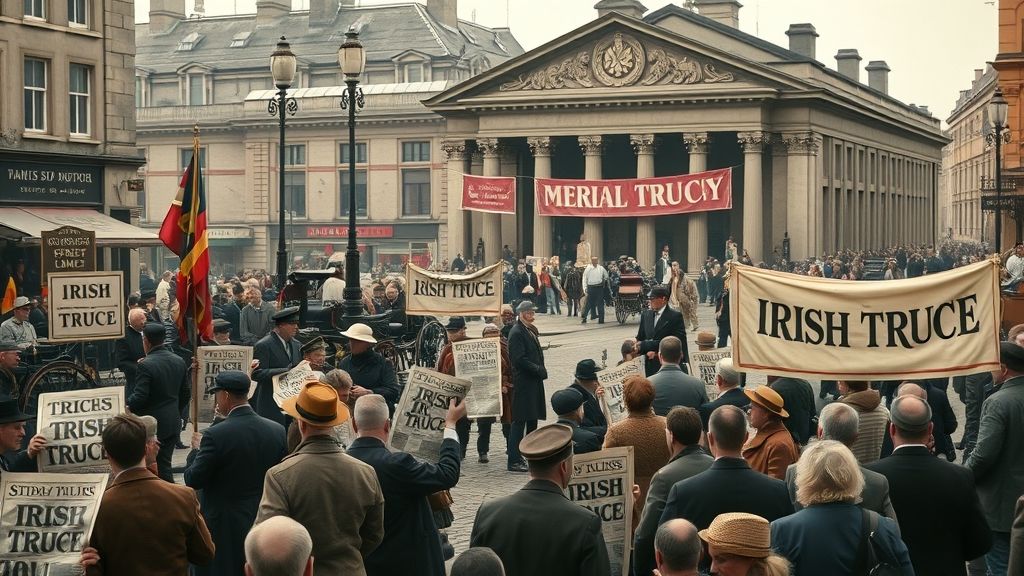
On a humid July morning in 1921, as the mist hugged the cobblestones and horse-drawn carriages clattered cautiously through Dublin’s streets, an announcement was set to ripple across Ireland and the world—a truce in the brutal Irish War of Independence. It was a moment heavy with exhaustion, relief, and trepidation. Years of guerrilla warfare, bloodshed, and shattered dreams had brought the Emerald Isle to its knees, and yet, in that fragile silence that descended with the ceasefire, lay the fragile birth of a new nation’s hope.
To truly grasp the monumental weight of the Irish Truce of July 11, 1921, one must first immerse in the tumultuous landscape of early 20th-century Ireland—a land scarred by centuries of colonial rule, torn apart by cultural and political rifts that had exploded into violent rebellion. The truce was not merely the cessation of gunfire; it was a profound pivot point, a collective breath held before the storm of peace-making and eventual partition.
Amid the smoky backrooms of London and the rugged hills of rural Ireland, unlikely dialogues began to unfold. Armed insurgents, weary soldiers, political leaders, and civilians alike navigated the uncertain territory between war and peace. What followed transformed the course of Irish history—from tormented conflict to the quagmire of civil war, yet ultimately to a hard-fought sovereignty.
This article traces the intricate tapestry surrounding the Irish Truce of 1921—the tumult, the human stories, and the high stakes of a nation teetering between despair and a dream. Step by step, we journey through the fires of rebellion to the silence of truce, capturing the raw emotions, strategic decisions, and lasting implications of that pivotal moment.
1. The Dawn of a Fragile Peace: Setting the Stage in Dublin, 1921
The streets of Dublin, once bustling with the daily hustle of commerce and culture, wore a weary mantle of suspicion and sorrow by mid-1921. Headlines splashed accounts of killings, raids, and resistance—nations often forget the human toll behind such words. But that day, July 11, dawned differently. No pistols fired. No armed patrols roamed the streets. Instead, a word passed quickly by mouth and press: the Irish War of Independence was at a halt.
At the heart of Irish aspirations was the pursuit of self-determination—a dream persistently battered by the force of imperial control. For five years, the struggle drained blood, disrupted lives, and shattered families. Yet, when the truce was announced, a cautious optimism pulsed beneath the weariness: perhaps an end was near.
2. Ireland Torn Apart: The Roots of Conflict and Desperation
The Irish conflict must be understood as a chapter in a much longer story of colonial domination, cultural suppression, and political frustration. From the Flight of the Earls to the Protestant Ascendancy, Ireland’s centuries under British rule entrenched divisions and resentment.
The early 20th century saw a swelling of nationalist sentiment, galvanized by the Home Rule movement and compounded by the trauma of the Easter Rising in 1916—a bloody insurrection that failed militarily but ignited the public’s desire for freedom. Sinn Féin, originally a minor political player, surged in influence as it staked a claim to legitimacy as the voice of Irish independence.
But Britain, intent on maintaining sovereignty over the strategic isle, leaned hard on military might. The deployment of the Royal Irish Constabulary, auxiliaries, and the infamous Black and Tans introduced brutal repression—a toxic mix that escalated violence rather than quelling it.
3. From Rebellion to War: The Irish War of Independence Unfolds
The years following 1919 saw Ireland plunged into a bitter guerrilla war—the War of Independence—waged by the Irish Republican Army (IRA) against British forces. Ambushes, reprisals, and covert operations blurred the lines between battlefield and civilian areas.
Civilians often bore the brunt, caught between armed forces on both sides. Firebombs destroyed homes; terror lurked behind every curfew. The conflict was as psychological as physical—a war fought in shadows and whispers as much as in open fields.
4. The Long Shadow of Violence: The Toll on Civilians and Combatants
Tragically, the war was not an abstract clash of ideologies, but an intimate maelstrom of suffering. Families lost fathers, brothers, and children. The wounded, often untreated and unseen, carried scars for life.
The infamous Bloody Sunday of November 21, 1920, is emblematic—a day when Michael Collins’ IRA squad assassinated British agents, only for reprisal killings at Croke Park to leave civilians dead and wounded. It was clear: the war was spiraling into a cycle of violence that consumed friend and foe alike.
5. Secret Talks and Shattered Trusts: The Road to Truce Negotiations
Despite the bloodshed, a desire for resolution simmered beneath the surface. Conversations, sometimes clandestine, began between Irish leaders and British officials. Michael Collins and Arthur Griffith on one side, British Prime Minister David Lloyd George and his cabinet on the other.
Trust was scarce. Each side suspected the other’s motives, wary of betrayals and concessions. Political pragmatism, however, demanded reconsideration; the cost of war was too high, and public opinion in Britain increasingly questioned the conflict.
6. July 11, 1921: A Day That Changed the Course of History
When the truce finally took effect on July 11, the streets of Dublin were simultaneously jubilant and tense. The ceasefire was not victory, nor surrender—it was a pause, laden with possibilities and dangers.
IRA fighters laid down arms, British troops stood down, and Dublin’s usual soundtrack of gunfire faded into an uncertain quiet. Yet behind the scenes, negotiations for a permanent settlement were only just beginning.
7. The Announcement in Dublin: Hope and Uncertainty Collide
The truce was officially declared by both republican and British officials, communicated through newspapers and radio snippets. The Irish public, exhausted yet eager, greeted the news with cautious celebrations. Families dared to believe in peace, but the scars of five years were not easily forgotten.
Leaders like Éamon de Valera navigated an uneasy balance—welcoming ceasefire as a triumph, yet wary of British demands. Supporters on both sides whispered fears of betrayal or premature concessions.
8. Reactions Across Ireland and Beyond: Relief, Skepticism, and Celebration
While Dublin celebrated, reactions elsewhere varied. Ulster, with its Protestant majority and unionist fervor, watched the truce with suspicion. British unionists feared concessions that might threaten their position.
Internationally, Irish diaspora communities—from New York to Sydney—broadcast glad tidings, organizing fundraising and lobbying efforts. The global media spotlight intensified, framing Ireland as a crucible of colonial struggle and modern nationalism.
9. The Immediate Aftermath: Ceasefire Lines and Lingering Tensions
Though guns silenced, tensions smoldered beneath. Split loyalties, old grudges, and political rivalries simmered. In some rural counties, remote skirmishes flared despite the ceasefire, fueled by personal vendettas and factionalism.
Both governments deployed diplomatic envoys while police and military forces remained on alert. The war was frozen—but not forgotten.
10. Political Chessboard: Sinn Féin, the British Government, and the Stakes of Peace
The ceasefire marked a shift from armed conflict to political negotiation. Sinn Féin, having declared an Irish Republic in 1919, sought recognition and independence.
The British government, under Lloyd George, aimed to preserve the Union but recognized the need to address Ireland’s demands in some form. The stakes were immense: would Ireland achieve home rule, autonomy, or full independence? How to reconcile competing identities and religious divides?
11. The Anglo-Irish Treaty Negotiations Loom: From Truce to Treaty
The truce opened the door for formal negotiations—culminating in the Anglo-Irish Treaty signed in December 1921. These talks were fraught, marked by compromises that satisfied none fully.
The treaty created the Irish Free State as a dominion within the British Commonwealth—a halfway house between independence and union. Yet the inclusion of an oath of allegiance to the British monarch and partition of six northern counties sparked fierce opposition.
12. The Role of International Opinion and Pressure in Shaping Outcomes
Public opinion abroad proved critical. The United States in particular, home to millions of Irish Americans, exerted diplomatic and humanitarian influence. Media coverage highlighted the human cost, swaying British politics to some extent.
The League of Nations and evolving postwar global order emphasized self-determination, adding pressure for a negotiated settlement.
13. Echoes of the Truce: The Evolution of Irish Self-Governance
Although imperfect, the truce and subsequent treaty planted seeds for Ireland’s eventual sovereignty. The Irish Free State gradually expanded its institutions, while nationalist aspirations percolated toward full republic status.
The truce delineated a boundary not just of guns but of political possibility—acknowledging the failure of violence and the potential of diplomacy.
14. Division and Civil War: The Truce’s Unforeseen Legacy
Yet peace was short-lived. The Treaty Deepened divisions within Ireland, pitting pro- and anti-treaty factions against each other, igniting a bitter civil war from 1922 to 1923.
The specter of fratricidal conflict haunted the memory of the truce, a grim reminder that the path to peace is seldom linear.
15. The Memory of the Truce in Irish Collective Consciousness
A century on, the 1921 truce remains a potent symbol. Commemorations recall the fragile ceasefire as a moment when Ireland glimpsed the possibility of peace.
Wartime diaries, folklore, and cultural narratives preserve the emotional texture—the yearning, exhaustion, and fragile hope that defined those July days.
16. Lessons in Peace and Conflict: Reflections a Century Later
The Irish Truce teaches us about the complexity of ending conflicts rooted in identity and history. It underscores negotiation’s delicate balance—involving compromises that not all actors accept.
Moreover, it highlights the human dimension of war—the daily lives suspended and shaped by political outcomes.
Conclusion
The Irish Truce of July 11, 1921, stands as a heartbeat in the tumultuous saga of a nation struggling to define itself. It was not a grand victory, nor a clean resolution, but a pause pregnant with possibility and peril.
From the smoky, war-torn streets of Dublin to the quiet farms of the countryside, the truce whispered of peace yet bore the weight of unhealed wounds. It was a testament to resilience—the stubborn refusal of a people to abandon hope amidst devastation.
History remembers this day not just as an end to gunfire, but as the fragile first step on a rocky road toward freedom and nationhood. And it reminds us that peace, though elusive, emerges from the courage to lay down arms and seek new beginnings.
FAQs
Q1: What were the main causes that led to the Irish War of Independence?
A1: The war arose from deep-rooted grievances against British colonial rule, including political disenfranchisement, cultural suppression, and economic inequality. The 1916 Easter Rising and the failure of Home Rule further galvanized nationalist movements toward armed struggle.
Q2: Who were the key figures involved in the truce negotiation?
A2: Prominent figures included Michael Collins and Arthur Griffith on the Irish side, and British Prime Minister David Lloyd George as well as other government officials. Their clandestine communications laid the groundwork for the July 1921 truce.
Q3: How did ordinary Irish citizens experience the period leading up to the truce?
A3: Civilians endured curfews, raids, violence, and pervasive insecurity. Many lived in fear, losing homes and loved ones, yet clung to hopes for peace throughout the conflict.
Q4: Why was the truce considered fragile?
A4: Despite the ceasefire, deep political divisions persisted, and trust between the parties was limited. Definition of terms and future governance remained unsettled, setting the stage for future conflict.
Q5: What was the international community’s view of the Irish conflict and truce?
A5: International opinion, especially in the US, sympathized with Irish republican aspirations and pressured Britain towards negotiation. The war was increasingly seen as untenable, influencing British policy.
Q6: What were the immediate consequences of the July 1921 truce?
A6: The truce halted open fighting, opened diplomatic channels, and allowed political negotiations that led to the Anglo-Irish Treaty. However, it also led to internal divisions and ultimately Irish Civil War.
Q7: In what ways is the 1921 truce commemorated today?
A7: The truce is remembered through public commemorations, historical exhibitions, and cultural narratives emphasizing peace efforts amidst struggle, reflecting on its role in Ireland’s journey to independence.