Table of Contents
- The Final Breath of a Victorian Giant
- Setting the Stage: England in the Mid-19th Century
- Early Life of Isambard Kingdom Brunel: The Making of a Visionary
- Brunel’s Engineering Triumphs and Unrelenting Spirit
- The Health Crisis: Signs of Decline Amid Great Achievements
- The Day That Changed London: September 15, 1859
- The Last Moments: A Glimpse into Brunel’s Final Hours
- Public Reaction: Mourning a National Icon
- Burial and Memorials: Honoring a Monumental Legacy
- How Brunel’s Death Marked the End of an Era
- The Immediate Impact on British Engineering and Industry
- Personal Stories: Family, Friends, and Colleagues Remember
- The Persistence of Brunel’s Vision in a Changing World
- Reflections on Victorian Progress and Human Fragility
- The Global Reach of Brunel’s Influence After His Passing
- Modern Commemoration and Continued Inspiration
- Lessons Drawn from the Life and Death of a Titan
- Conclusion: The Enduring Soul of Isambard Kingdom Brunel
- FAQs: Understanding Brunel’s Life, Death, and Legacy
- External Resource
- Internal Link
1. The Final Breath of a Victorian Giant
The gray London sky hung heavy with the chill of early autumn as news rippled quietly but inexorably through the city: Isambard Kingdom Brunel, the towering figure of industrial Britain, had passed away on the morning of September 15, 1859. A hush befell the buzzing streets of London, where mills clanged and locomotives thundered like the heartbeat of the empire. This was not just the death of a man; it was the closing of a chapter that had reshaped the very rails, rivers, and seas upon which a nation depended. The air was thick with grief, tinged with disbelief. How could the mind that had bent the elements to will simply cease? And yet, in his final days, surrounded by those who revered him, Brunel’s spirit flickered like a dimming beacon – fierce, determined, and human.
2. Setting the Stage: England in the Mid-19th Century
Mid-19th century England was a feverish engine of progress, a vast workshop where iron and steam reshaped society at breathtaking speed. The Industrial Revolution had thrown open doors of opportunity and peril alike. Cities swelled with new residents seeking work, and the railways knitted distant counties into a burgeoning metropolis of commerce. Yet beneath this surge of technological glory lay tension: class divides, labor unrest, and the ever-present anxiety of failure. In this crucible of ambition and uncertainty, few figures loomed larger than Isambard Kingdom Brunel—a man who had come to symbolize Victorian ingenuity and courage.
3. Early Life of Isambard Kingdom Brunel: The Making of a Visionary
Born on April 9, 1806, to the eminent engineer Marc Isambard Brunel and his wife Sophia Kingdom, Isambard’s life was steeped in the language of mechanics and bold designs from infancy. His father’s work on the Thames Tunnel—a marvel beneath London’s waters—ignited in the young Isambard an unquenchable thirst to conquer nature’s obstacles. His education, marked by brilliance mingled with impatience for convention, prepared him to defy limits. From his youth, he exhibited a restless spirit, willing to dare ideas others deemed impossible.
4. Brunel’s Engineering Triumphs and Unrelenting Spirit
Brunel’s career reads like a catalogue of milestones in engineering: the Great Western Railway, stretching from London to Bristol and beyond; the iconic Clifton Suspension Bridge, spanning Bristol’s Avon Gorge with an audacious elegance; and steamships such as the SS Great Britain, the first iron-hulled, screw-propelled ocean liner. Each project combined technical brilliance with an almost artistic flourish. Yet behind these successes lay staggering strains, battles with financial woes, personal health, and an unyielding drive that pushed him beyond human limits.
5. The Health Crisis: Signs of Decline Amid Great Achievements
By the late 1850s, Brunel’s relentless pace began to exact a heavy toll. In 1857, he suffered a severe stroke that would leave him weakened yet still famously adamant about resuming work. Despite medical warnings and his own diminishing capacity, his mind remained sharp and restless. Accounts from those close to him describe a man wrestling with corporeal frailty even as his thoughts raced on engineering blueprints and ongoing projects. His death in 1859 was not sudden but followed a period of slow decline that his stoic nature largely concealed from the public.
6. The Day That Changed London: September 15, 1859
The morning of September 15 awakened London to a quiet sorrow. Inside his London home, Brunel lay surrounded by family and friends. The air was sharp; the autumn leaves rattled against the windows as the great engineer’s breath grew shallow. Reports from his attending physicians reveal a man slipping ever closer to the eternal rest, yet conscious enough to exchange a few thoughtful words. "I do not think I shall survive very long," he reportedly confided—words that betrayed the man’s acceptance rather than fear.
7. The Last Moments: A Glimpse into Brunel’s Final Hours
Witnesses recall that Brunel’s final hours carried the poignancy of a life fiercely lived. His gaze, though weakened, held determination; his conversation turned to projects unfinished and the future of engineering. “If I could, I would build one more bridge,” he is said to have whispered. True to his nature, even in death, Brunel’s mind was captive to creation – a testament to the passion that had defined his existence.
8. Public Reaction: Mourning a National Icon
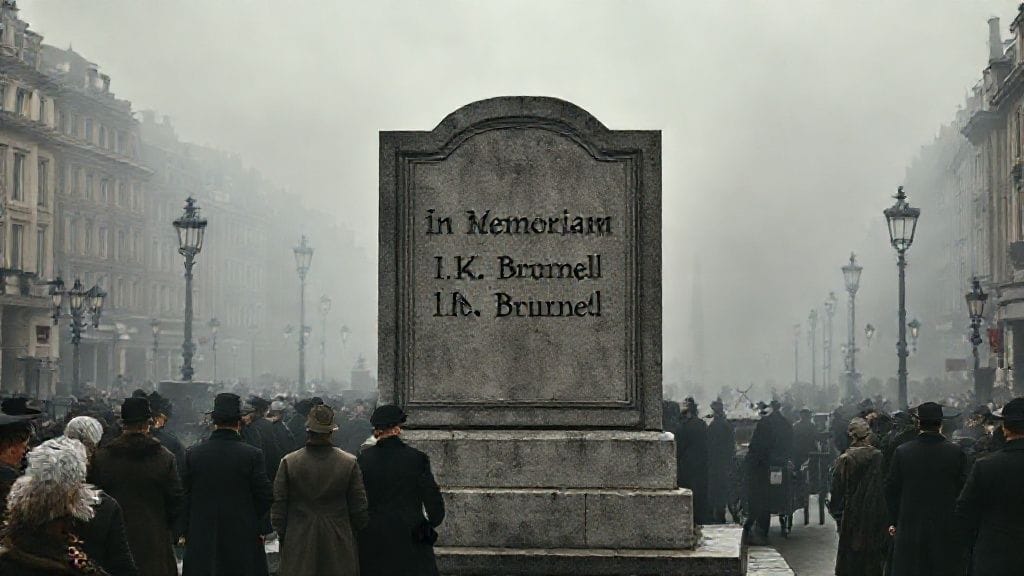
The news of Brunel’s passing spread swiftly. Newspapers paid tribute with a mixture of awe and melancholy, framing his death as a loss not merely to engineering but to the British spirit itself. Crowds gathered outside his residence, while colleagues and admirers crafted statements honoring his genius and humane character. London felt diminished; the monument of vigor and innovation was gone, leaving an aching void in the heart of the nation.
9. Burial and Memorials: Honoring a Monumental Legacy
Brunel was laid to rest in Kensal Green Cemetery, London, in a tomb befitting a man of his stature—simple yet profound. His grave became a place of pilgrimage, attracting engineers, historians, and ordinary citizens alike. Over the years, numerous statues and plaques have been erected, notably the iconic bronze statue near Paddington Station—a fitting sentinel watching over the Great Western Railway he created. These memorials serve as physical embodiments of a legacy sculpted not from marble alone, but from iron tracks and ocean waves.
10. How Brunel’s Death Marked the End of an Era
Brunel’s death symbolized more than a personal loss; it marked the end of a heroic age of Victorian engineering. His generation had dared the impossible, turning dreams into infrastructure and ambition into empire. After his passing, a more cautious, pragmatic approach to industrial development began to dominate. The fevered optimism of endless progress was tempered by the realities of economic fluctuations and social unrest. In that sense, Brunel’s life and death bookended an era of visionary risk-taking.
11. The Immediate Impact on British Engineering and Industry
The loss of Brunel sent ripples through British industry. Projects he championed temporarily faltered, and his successors faced the daunting task of upholding standards set by near-mythical engineering feats. Yet, his methodologies and innovative spirit became foundational texts in engineering education. The attention to structural integrity, aesthetics, and utility became pillars for subsequent developments in railways, shipbuilding, and architecture across the British Empire and beyond.
12. Personal Stories: Family, Friends, and Colleagues Remember
Letters and diaries from Brunel’s contemporaries reveal a man simultaneously formidable and deeply human. His wife Mary, beyond grief, chronicled his last days with tender precision. Fellow engineers spoke of his absurdly demanding work ethic but generous mentoring. Even rivals acknowledged his transformative vision. These personal anecdotes enrich the historical narrative, painting Brunel not just as legend but as a man of flesh, flawed and admirable in equal measure.
13. The Persistence of Brunel’s Vision in a Changing World
Though he passed in 1859, Brunel’s ideas lived on robustly. Later infrastructural endeavors continued to echo his daring philosophy, embracing technological progress as a forge of national identity and economic vitality. His vision of connectivity, speed, and engineering as an art form inspired countless successors in the upheavals of the late 19th and early 20th centuries, placing Britain at the forefront of global industry.
14. Reflections on Victorian Progress and Human Fragility
Brunel’s death also invites reflection on the cost of relentless ambition. His life exemplified human resilience but also the physical vulnerability that accompanies such intensity. In many ways, it exemplifies the paradox of Victorian progress: a dazzling rise propelled by human beings capable of both transcendence and profound exhaustion. The story of Brunel’s final years reminds us how closely brilliance can walk with mortality.
15. The Global Reach of Brunel’s Influence After His Passing
The ripples of Brunel’s work extended well beyond the British Isles. Colonies and emerging nations looked to his achievements as blueprints for modernization—railways in India, bridges in Australia, and harbors across Africa reflected both his methodologies and ideals. His death, while mourned domestically, marked the passing of a torch carried vigorously worldwide.
16. Modern Commemoration and Continued Inspiration
In contemporary times, Brunel’s legacy remains vibrant. Museums, including the Brunel Museum in London, and annual celebrations keep his memory alive. Students and engineers study his daring innovations as lessons in creativity and perseverance. Amid rapid technological change today, Brunel’s narrative offers a humanizing reminder: behind every great invention stands a person’s dream and determination.
17. Lessons Drawn from the Life and Death of a Titan
Brunel’s narrative is rich with instructive insights: the power of relentless optimism, the importance of interdisciplinary thinking, and the need to balance ambition with wellness. His death underscores the human cost embedded in the creations that shape civilizations. Above all, Brunel’s story encourages us to honor both innovation and the fragile lives that propel it.
18. Conclusion: The Enduring Soul of Isambard Kingdom Brunel
Isambard Kingdom Brunel’s passing on a brisk day in September 1859 was the quiet closing of a symphony that had roared with steam and iron. But though his heart ceased to beat, the pulse of his vision continues to resonate beneath London’s bridges and along its railways. Brunel faced mortality as he faced every challenge—undaunted, thoughtful, and with a mind soaring beyond his time. His death was not an end but a passage, a moment when a visionary’s mortal coil gave way to immortality in stone, steel, and the spirit of progress itself.
FAQs
Q1: What were the main causes of Isambard Kingdom Brunel’s death?
Brunel died primarily from complications related to a stroke he suffered in 1857 that left him weakened. His relentless work ethic and the medical limitations of the time contributed to his declining health leading up to September 1859.
Q2: How did Brunel’s death affect ongoing engineering projects?
Most immediate impacts involved delays and uncertainty surrounding his major ventures, such as railway expansions and shipbuilding. However, his teams and successors continued his work using the principles and standards he established.
Q3: Who were the key figures present at Brunel’s death?
Brunel was surrounded by family, including his wife Mary, close friends, and his physicians. Notable contemporary engineers, though not present at his bedside, publicly mourned his passing.
Q4: What was the public reaction in London to Brunel’s death?
The city reacted with widespread mourning and reverence. Newspapers praised his genius and contributions, and public gatherings and memorial services honored his memory.
Q5: How has Brunel’s legacy persisted internationally?
Brunel’s engineering concepts influenced infrastructure development across the British Empire and beyond, shaping railways, bridges, and maritime engineering globally.
Q6: Are there notable monuments dedicated to Brunel in London?
Yes, prominent among them is the bronze statue outside Paddington Station and the Brunel Museum in London’s Rotherhithe, each celebrating different aspects of his work.
Q7: How did Brunel’s personal life influence his professional endeavors?
His upbringing by an engineer father and marriage to Mary contributed stability and motivation. His personality—restless, driven, and visionary—fueled his professional achievements but also challenged his health.
Q8: What lessons do historians draw from Brunel’s life and death?
Historians emphasize the balance of visionary ambition with human limitation, the transformative power of engineering on society, and the emotional costs behind monumental achievements.