Table of Contents
- The Twilight of an Era: Moscow on the Eve of Ivan III’s Passing
- Ivan III: The Man Who Transformed Russia
- The Gathering Storm: Moscow’s Rise in the Late 15th Century
- Shaping a Tsardom: Ivan’s Vision and Ambition
- The Struggle for Independence from the Mongol Yoke
- Ivan’s Court: Power, Intrigue, and Reform
- The Great Stand against the Golden Horde
- The Unification of Rus’: Conquest and Diplomacy
- The Creation of the Moscow State: Institutions and Governance
- The White Stone Kremlin: A Fortress of Authority
- Relations with the West: Marriage, Diplomacy, and Rivalries
- The Church and Ivan III: Spiritual Authority Meets Political Power
- The Final Years: Trials, Legacy, and Decline of the Great Prince
- October 27, 1505: Death of a Tsar and the End of an Epoch
- The Succession Crisis: Vasili III and Continuing the Legacy
- Ivan III’s Impact on Russian Identity and Statehood
- The Cultural Renaissance under Ivan III’s Rule
- Moscow’s Transformation from Principality to Empire
- The Political and Social Ripples across Eastern Europe
- Memory and Myth: Ivan III in Russian Historiography
- A Lasting Legacy: How Ivan III Shaped Modern Russia
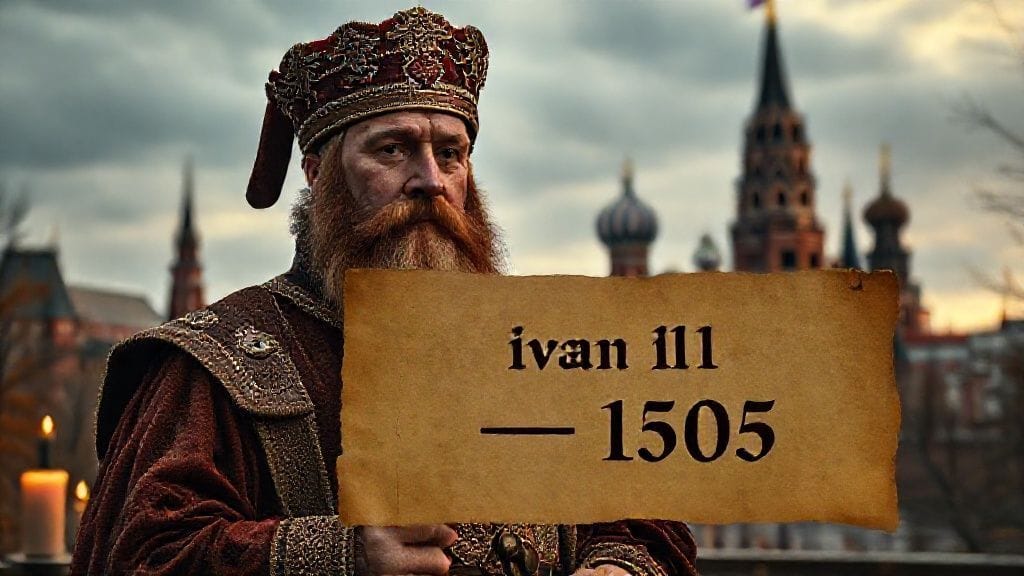
October 27, 1505, dawned cold and gray over the sprawling city of Moscow, the heart of what was no longer just a simple principality but the burgeoning center of a vast Russian Empire in the making. The air buzzed with quiet unease, whispers stirring like autumn winds through the stone courtyards of the Kremlin. For years, Ivan III had been the iron will behind Moscow’s rise—a titan among princes who had dared to challenge the once-invincible Mongol Golden Horde and forged a nation from fractious Rus’ lands. Now, as he lay on his deathbed, the city and the realm held its breath: the death of Ivan III was more than the passing of a man; it was the closing chapter of an era and the uncertain dawn of a new age.
Ivan III: The Man Who Transformed Russia
Ivan III Vasilyevich, also known as Ivan the Great, was no ordinary ruler of late medieval Rus’. When he ascended to power in 1462, Moscow was a modest principality, subdued by the shadow of the Mongol-Tatar yoke that had dominated the region for centuries. Yet under Ivan’s reign, Moscow grew from a pressure point into the undeniable pivot of East Slavic lands. His ambition was boundless, his policies decisive, and his stature mythic in the making. He was a statesman, warrior, diplomat, and architect of Russian statehood, whose reign stretched over four decades and which planted the seeds for the Russian Empire.
The Gathering Storm: Moscow’s Rise in the Late 15th Century
Ivan inherited a fragmented and fragile domain, marked by rival Rus’ princes competing for dominance and still shackled by tributary obligations to the Golden Horde. The political landscape of Eastern Europe was volatile—Poland-Lithuania to the west was expanding, the Teutonic Order was a looming military threat, and the Orthodox Church sought a protector. Ivan’s Russia was a land hungry for unity and independence. Early on, he recognized that breaking free from Mongol control was not just a distant dream but an attainable destiny.
Shaping a Tsardom: Ivan’s Vision and Ambition
Perhaps Ivan’s greatest breakthrough was his embrace and expansion of the concept of Moscow as the “Third Rome.” By marrying Sophia Paleologue, niece of the last Byzantine Emperor, in 1472, Ivan laid claim to the spiritual and temporal legacy of Byzantium. This union was more than matrimonial; it was a masterstroke in ideology, positioning Moscow as the rightful heir to Orthodox Christendom, a status that justified imperial ambitions.
The Struggle for Independence from the Mongol Yoke
For centuries, the Mongols’ Golden Horde had loomed over Rus’, exacting tribute and demanding subservience. Ivan III’s bold stance in 1480 towards Khan Akhmat culminated in the legendary standoff on the Ugra River — a confrontation that ended without warfare but with a dramatic Mongol retreat. This “Great Stand on the Ugra River” symbolized the end of Mongol overlordship and the assertion of Moscow’s sovereignty. The Mongols’ grip was broken, and with it, the political landscape of Rus’ was irreversibly altered.
Ivan’s Court: Power, Intrigue, and Reform
Behind the imposing walls of the Kremlin, Ivan consolidated power not only through military might but administrative reform. He introduced the Sudebnik, a legal code that standardized judicial processes and reinforced princely authority. His court became a hub of political intrigue, where nobles jockeyed for influence. Yet Ivan held the reins firmly, restructuring the boyar class to diminish internal opposition and centralize governance.
The Great Stand against the Golden Horde
The 1480 confrontation was a moment charged with tension. Ivan’s refusal to pay tribute was a rallying cry to the Rus’ peoples, demonstrating that the Tatars were no longer invincible overlords. The silent standoff at the Ugra River, lasting weeks with no shots fired, effectively ended Mongol domination. This event is often seen as the moment Russia’s fate as an independent state was sealed.
The Unification of Rus’: Conquest and Diplomacy
Ivan did not stop at independence; he sought unity. Through marriage alliances, conquest, and diplomacy, he absorbed rival principalities — Novgorod was incorporated after a tense campaign, Tver followed, and other Rus’ lands were brought under Moscow’s banner. This unification was painstaking but essential for forging the future Russian state. It transformed a patchwork of fragmented and often competing polities into a centralized power.
The Creation of the Moscow State: Institutions and Governance
Ivan’s reforms went beyond conquest. He restructured governance, introducing a more hierarchical system of administration. The boyars, once near-autonomous powerful nobles, were subordinated to the grand prince. Ivan’s vision shaped the apparatus of the Russian state — a fusion of autocracy, Orthodox faith, and centralized control that would define Russia for centuries.
The White Stone Kremlin: A Fortress of Authority
One of Ivan’s lasting legacies was his investment in Moscow’s architectural grandeur. The building of the white limestone Kremlin walls symbolized both defense and authority. It was a fortress but also a statement of power, marking Moscow as the seat of a rising empire. The Kremlin became the physical heart of Ivan’s Russia, a durable emblem of sovereignty.
Relations with the West: Marriage, Diplomacy, and Rivalries
Ivan navigated a complex web of Western relations. His marriage to Sophia Paleologue was a diplomatic coup, but at the same time, Moscow faced the growing power of Poland-Lithuania and the Kingdom of Sweden. Ivan had to balance diplomatic overtures with military preparedness. His reign was marked by this delicate tension, between engagement and defense.
The Church and Ivan III: Spiritual Authority Meets Political Power
The Orthodox Church played a central role during Ivan III’s reign. With Constantinople fallen to the Ottomans, Moscow posited itself as the defender of Orthodoxy. Ivan’s alliance with the church strengthened his political authority and helped legitimize his autocratic rule. The patriarchal influence and the emerging concept of Moscow as the “Third Rome” intertwined religious and imperial destinies.
The Final Years: Trials, Legacy, and Decline of the Great Prince
As Ivan aged, his rule became more cautious, even increasingly suspicious. He faced internal dissent, questions of succession, and the enormous task of governing a growing realm. His health declined, yet his influence remained immense. In these last years, the foundations he laid were solidified, though tensions simmered beneath the surface.
October 27, 1505: Death of a Tsar and the End of an Epoch
When Ivan III died on October 27, 1505, the city of Moscow mourned deeply. His death marked not only the passing of a great ruler but the definitive end of medieval Rus’. The foundations of Russian autocracy and imperial identity had been laid. His funeral was a solemn procession through the Kremlin walls, attended by nobles, clergy, and citizens alike, all aware that Russia stood at a historic crossroads.
The Succession Crisis: Vasili III and Continuing the Legacy
Ivan was succeeded by his son, Vasili III, who faced the daunting challenge of maintaining his father’s legacy. Though more pliable than Ivan, Vasili had to contend with a still-fragmented nobility and rivalries that threatened the unity that had been painstakingly achieved. The succession was smooth, but the pressure to uphold Ivan’s vision was immense.
Ivan III’s Impact on Russian Identity and Statehood
Ivan’s reign shaped not just political borders but the very idea of Russian identity. By uniting Rus’, asserting independence, and embedding the Orthodox faith within the state, he crafted a narrative of a chosen people destined for greatness. This legacy resonated through centuries, influencing Russian self-perception and politics profoundly.
The Cultural Renaissance under Ivan III’s Rule
Beyond politics and war, Ivan’s era saw a flourishing of culture. The import of Byzantine artisans, the construction of grand cathedrals, and the emergence of a distinct Russian style marked his reign. This cultural renaissance reinforced Moscow’s status as an imperial capital, fostering art, literature, and architecture that continue to echo in Russia’s heritage.
Moscow’s Transformation from Principality to Empire
Ivan’s rule was the crucible in which Moscow was forged from a modest principality into the nucleus of what would become a sprawling empire. His vision transcended the limits of his time, setting the political, religious, and cultural patterns that would characterize Russia for centuries.
The Political and Social Ripples across Eastern Europe
Ivan’s consolidation of power sent shockwaves across Eastern Europe. Neighboring powers watched Moscow’s ascent warily. The balance between Poland-Lithuania, the Teutonic Order, and the Duchy of Moscow shifted, setting the stage for future conflicts. Socially, Ivan’s policies stirred tensions but also unified diverse peoples under a single banner.
Memory and Myth: Ivan III in Russian Historiography
Over the centuries, Ivan III’s image has been interpreted and reinterpreted—sometimes as a heroic liberator, sometimes as a harsh autocrat. His place in Russian historiography is complex, shrouded in legend and ideological debates, but universally recognized as a pivotal figure.
A Lasting Legacy: How Ivan III Shaped Modern Russia
In the final analysis, Ivan III’s reign was a turning point in Russian history. Without his political genius, military defiance, and ideological boldness, the notion of Russia as a powerful, unified, and imperial state might have remained a dream. His legacy continues to shape Russia’s conception of itself and its destiny into the modern era.
Conclusion
The death of Ivan III on October 27, 1505, was not merely the end of a ruler’s life but the close of a chapter that reshaped an entire region and laid the groundwork for the Russia we know today. His forty-three years of rule bridged the medieval and early modern worlds, transforming fragmented, tributary lands into a sovereign and centralized state with imperial aspirations. Ivan’s story is one of immense ambition, profound transformation, and relentless will — a story of a man who dreamed not just of a kingdom, but a nation and an empire.
His legacy lives on not only in the stone walls of the Kremlin or the maps redrawn under his hand but in the enduring spirit of a people who saw in him the promise of greatness. Through wars fought without blood spilled, through marriages that sealed dynastic claims, and through reforms that altered governance forever, Ivan III carved a path from the shadows of the Golden Horde to the dawn of a Russian future. And though he has long departed, the echoes of his reign continue to resonate, reminding us that history is often born from the vision and courage of singular individuals.
FAQs
Q1: Why is Ivan III considered a pivotal figure in Russian history?
Ivan III transformed Moscow from a fragmented principality under Mongol suzerainty into a centralized and sovereign state, laying foundations for the Russian Empire and asserting Russia’s claim as the “Third Rome.”
Q2: What was the significance of the Great Stand on the Ugra River in 1480?
It marked the end of Mongol dominance over Rus’ territories when Ivan III refused to pay tribute to the Golden Horde, resulting in their retreat without battle—a turning point in Russian independence.
Q3: How did Ivan III’s marriage to Sophia Paleologue influence Moscow’s political ideology?
The marriage linked Moscow to the Byzantine imperial legacy, bolstering the claim of Moscow as the heir to Orthodox Christendom and enhancing Ivan’s legitimacy as ruler of a “Third Rome.”
Q4: What were Ivan III’s major reforms in governance?
He introduced the Sudebnik legal code, centralized power by reducing the influence of the boyars, and restructured the administration to strengthen princely authority.
Q5: How did Ivan III impact Russia’s relationship with neighboring states?
He expanded Moscow’s territory through conquest and diplomacy, challenged Polish-Lithuanian influence, managed tensions with the Teutonic Order, and engaged diplomatically with Western powers.
Q6: What legacy did Ivan III leave for his successors?
He left a more unified and sovereign Russian state for his son Vasili III, along with institutional and ideological frameworks that would shape Russian autocracy and imperial expansion.
Q7: How is Ivan III remembered in Russian culture and historiography?
He is often celebrated as the ‘gatherer of the Russian lands’ and a liberator from Mongol rule, though historians debate aspects of his reign; his legacy is foundational in Russian national identity.
Q8: In what ways did Ivan III’s reign influence the Orthodox Church?
Ivan aligned closely with the Church, promoting Moscow as the protector of Orthodox Christianity, which reinforced his political authority and the intertwining of spiritual and temporal power.