Table of Contents
- A Fateful Day at Kealakekua Bay: The Death of Captain James Cook
- The Man Behind the Legend: James Cook’s Ambitions and Virtues
- The Pacific Odyssey: From Europe to the Remote Islands
- The Hawaiian Encounter: First Contact and Mutual Curiosity
- The Complex Web of Hawaiian Society in the 18th Century
- The 1778 Arrival: Awe and Hospitality at Kealakekua Bay
- The Seeds of Conflict: Strains Beneath Friendly Exchanges
- The Return in 1779: Tensions Rise with Renewed Presence
- The Theft That Sparked Fury: The Longboat Incident
- The Failed Negotiations: Cook’s Attempt to Seize a Chief
- The Clash on the Shoreline: Violence Erupts in the Bay
- The Death of a Navigator: Cook’s Last Moments
- The Aftermath in Hawaii: Reverberations Among Islanders
- The British Expedition’s Response: Shock and Mourning
- Legacy of a Tragic Death: Myth, History, and Cultural Memory
- Cook’s Death and the Shifting Global Perspective on Exploration
- The Hawaiian View: Deity, Warrior, or Intruder?
- Mythmaking and Memorialization: The Multiple Faces of Cook
- The Death’s Impact on Future Expeditions and Imperial Endeavors
- Reflections on Imperial Encounters: Violence and Understanding in First Contact
- Conclusion: Remembering James Cook Beyond the Bay
- FAQs: Understanding the Complexities of Cook’s Demise
- External Resource
- Internal Link
1. A Fateful Day at Kealakekua Bay: The Death of Captain James Cook
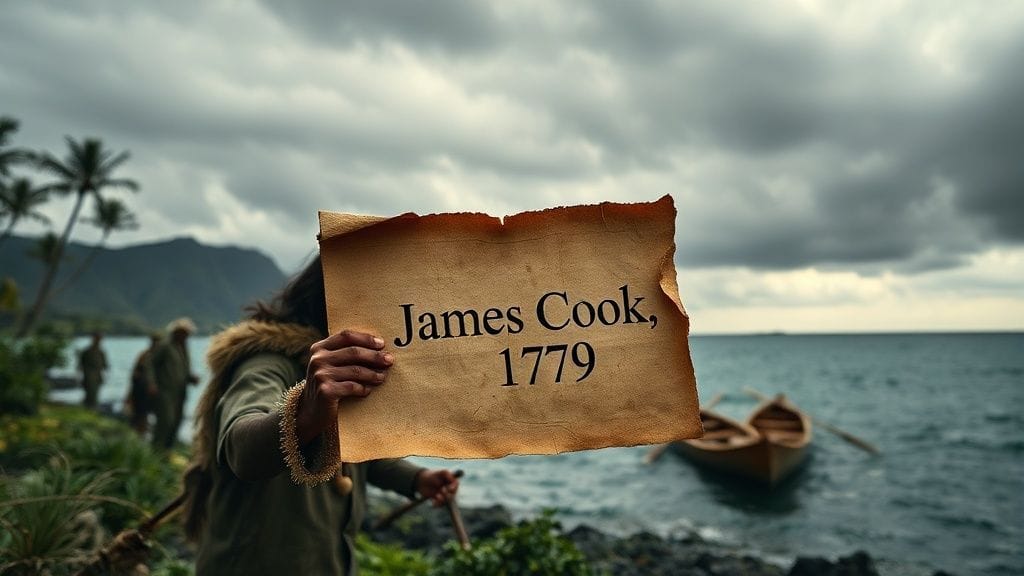
February 14, 1779, dawned over Kealakekua Bay with the gentle lapping of turquoise waves against volcanic shores, where towering cliffs overlooked a Hawaiian village cocooned in the soft warmth of tropical sun. Yet beneath this serene surface simmered tensions that would culminate in a historic and tragic confrontation. On this day, Captain James Cook—Europe’s most celebrated explorer—would meet his end, not in the cold expanses of the Arctic or amidst tempestuous Atlantic storms, but under the Hawaiian sun, in a place that he initially approached with hope and curiosity.
What began as an encounter infused with awe, cultural exchange, and reciprocal fascination turned, within days, into violent conflict culminating in Cook’s death. His demise, a symbolic rupture marking the collision of two vastly different worlds, resonates through centuries as a cautionary tale of exploration, empire, and misunderstanding.
2. The Man Behind the Legend: James Cook’s Ambitions and Virtues
Born in 1728 in the small village of Marton, England, James Cook rose from humble origins to become one of history’s most revered navigators and cartographers. A man of meticulous discipline and scientific curiosity, Cook was shaped by the Enlightenment’s spirit, a desire to map the unknown, and a belief that through exploration, humanity could expand its horizons—both geographical and intellectual.
His three great voyages of discovery opened wide the Pacific Ocean’s secrets, charting coastlines, documenting cultures, and navigating treacherous seas with unprecedented skill. Yet Cook was not merely a mapmaker; he was a complex figure embodying the contradictions of his age—an agent of empire who genuinely admired the peoples he encountered, but also a man determined to impose order and control for the benefit of Britain’s expanding reach.
3. The Pacific Odyssey: From Europe to the Remote Islands
By 1778, Cook was on his third voyage, tasked by the British Admiralty and the Royal Society to seek the fabled Northwest Passage and explore uncharted Pacific territories. Leaving England in 1776, the expedition sailed through icy seas and tropical archipelagos, from New Zealand to the enigmatic coasts of the West Coast of North America.
This voyage was marked by blending scientific inquiry—collecting botanical specimens, astronomical observations, and ethnographic notes—with the strategic interests of empire building. Cook’s meticulous journals and drawings revealed a world previously unknown to Europeans, but also unearthed the vexing realities of cross-cultural contact.
4. The Hawaiian Encounter: First Contact and Mutual Curiosity
On January 17, 1778, the two ships of Cook’s expedition anchored in Waimea Bay, on the northern coast of Kauai. The Hawaiians regarded these colossal “floating islands” with a mixture of wonder and suspicion, as their long-isolated world was suddenly breached by heavily armed white men. This was the moment when Hawaiian oral traditions and European accounts began to intertwine.
The greeting was tentative but respectful; Hawaiians offered goods and hospitality, curious about the strange visitors’ technology and customs. Conversely, Cook’s crew marveled at the vibrant Hawaiian society, the abundance of natural resources, and the unfamiliar social rituals that contrasted with Western templates.
5. The Complex Web of Hawaiian Society in the 18th Century
To understand the tensions that would later surface, it is crucial to grasp the structure and dynamics of Hawaiian society. The islands were governed by a strict hierarchy with aliʻi (chiefs), kahuna (priests), and commoners. Local deities and ancestral spirits deeply influenced daily life, and the arrival of outsiders could be interpreted through existing spiritual frameworks.
Chief Kalaniʻōpuʻu, the ruler of the Big Island during Cook’s visit, wielded immense authority, both politically and religiously, and it was his response to Cook's presence that shaped the nature of their interactions. The Hawaiian conception of reciprocity, mana (spiritual power), and kapu (taboos) framed the encounters as complex interactions far beyond mere curiosity.
6. The 1778 Arrival: Awe and Hospitality at Kealakekua Bay
Following the initial contact on Kauai, Cook returned to Kealakekua Bay in January 1779. This site, sacred to the Hawaiians, became the expedition’s main anchorage. The Hawaiian people greeted the explorers with a blend of reverence and suspicion, impressed by their technological prowess yet wary of their intentions.
The timing coincided with the Makahiki festival, dedicated to the god Lono, a time of peace and celebration. Some historians argue Cook’s ships arrived during this festival, which may have contributed to the Hawaiians perceiving Cook, and his men, as manifestations of Lono himself.
7. The Seeds of Conflict: Strains Beneath Friendly Exchanges
However, beneath the veneer of hospitality and fascination, tensions brewed. The expedition stayed longer than anticipated, straining local resources and patience. Cultural misunderstandings were rife: Europeans failed to grasp Hawaiian spiritual systems, while Hawaiians were bewildered by foreign customs like the taking of wood and fresh water without clear reciprocation.
Furthermore, illness began to affect Cook’s crew, and rumors of theft from the ships troubled relations. The balance of power was delicate, a powder keg waiting for a spark.
8. The Return in 1779: Tensions Rise with Renewed Presence
After leaving the Bay to explore further, Cook’s ships returned in February 1779, only to find a different atmosphere. The Hawaiians, once welcoming, grew more guarded. Requests and demands—forgotten or misunderstood—caused frustrations on both sides.
Cook’s determination to repair relations was strong. Yet he was also conscious of maintaining British authority and discipline. The fragile peace began to crack, foreshadowing an inevitable conflict.
9. The Theft That Sparked Fury: The Longboat Incident
The immediate catalyst for violence was the theft of one of Cook’s longboats by local Hawaiians. The boat was essential for ship operations, and its loss jeopardized progress.
In response, Cook resorted to a traditional tactic: hostage-taking. This method, common in the European age of exploration, was meant to leverage the return of stolen property by capturing a local chief, thereby compelling cooperation.
10. The Failed Negotiations: Cook’s Attempt to Seize a Chief
Cook and his men sought to detain Chief Kalaniʻōpuʻu himself to exchange for the stolen vessel. This was an audacious move, reflecting Cook’s military confidence but also a tragic misjudgment of Hawaiian customs and honor.
Kalaniʻōpuʻu initially complied, but as the attempt to detain him escalated, Hawaiian warriors gathered in defense. What followed was a tense standoff, rife with misunderstanding and alarm.
11. The Clash on the Shoreline: Violence Erupts in the Bay
The peaceful air shattered as confrontation erupted near the shore. Hawaiian spears and stones met European firearms and bayonets. In the chaos, Cook was struck and fatally wounded, reportedly stabbed in the chest.
Witnesses' accounts vary, but consensus holds that Cook attempted to retreat amid the melee, only to fall in combat. His death shocked both his crew and the Hawaiians, who then quickly abandoned the fight.
12. The Death of a Navigator: Cook’s Last Moments
Cook’s body was handled according to Hawaiian customs, reportedly treated with reverence and ritual. Some accounts suggest his remains were burned or buried, ceremonies befitting a man who had become intertwined with island spiritual beliefs.
For his crew, the loss plunged them into mourning and fear. The death of their captain destabilized the expedition, forcing an abrupt reconsideration of their presence in the islands.
13. The Aftermath in Hawaii: Reverberations Among Islanders
Hawaiians grappled with the violent rupture of their relationship with Cook’s expedition. Some regarded the event as a breaking of sacred trust, while others interpreted it within the prism of divine judgment or spiritual conflict.
Beyond the immediate, the presence of Europeans and their technology had irrevocably altered Hawaiian society’s trajectory, initiating waves of cultural and political change.
14. The British Expedition’s Response: Shock and Mourning
Cook’s surviving officers faced the task of salvaging their mission amid grief and hostility. They attempted to maintain peaceful relations, engage in trade, and prepare to depart.
The loss cast a shadow over British exploration efforts but also immortalized Cook as a heroic martyr of discovery and empire.
15. Legacy of a Tragic Death: Myth, History, and Cultural Memory
Cook’s dramatic death became a cornerstone myth in both Western and Hawaiian histories. For Britain, it reinforced the narrative of a fearless explorer cut down in a noble quest.
In Hawai‘i, however, memory is more nuanced—a tale of foreign intrusion, tragic misunderstanding, and the fraught beginnings of colonial contact.
16. Cook’s Death and the Shifting Global Perspective on Exploration
The event marked a pivotal moment in the global Age of Discovery. It foreshadowed the complexities and conflicts inevitable as European powers extended their reach into previously isolated regions.
Cook’s death became a symbol of both heroism and the dangers of cultural arrogance.
17. The Hawaiian View: Deity, Warrior, or Intruder?
Debates persist about how Hawaiians perceived Cook after his arrival. Was he truly associated with Lono, the god of fertility and peace? Or was this a European imposition on Hawaiian interpretation?
Some Hawaiians saw Cook as a powerful figure, a chief or spirit temporarily gifted with influence; others as an aggressive intruder disrupting sacred order.
18. Mythmaking and Memorialization: The Multiple Faces of Cook
Monuments and storytelling traditions in both Britain and Hawai‘i reflect divergent narratives of Cook’s life and death. Memorials in England celebrate exploration; Hawaiian commemorations emphasize cultural encounter and loss.
These evolving stories reveal the contested ways history is remembered and politicized.
19. The Death’s Impact on Future Expeditions and Imperial Endeavors
Cook’s demise warned of the perils ahead for explorers in unfamiliar cultures. Later expeditions adapted by seeking firmer alliances, better understanding indigenous societies, or asserting military dominance.
Imperial ambitions surged, often at the cost of native autonomy.
20. Reflections on Imperial Encounters: Violence and Understanding in First Contact
Cook’s death embodies the tragic intersection of two worlds—one expanding, the other defending. It teaches us about the perils of assumption, the limits of communication, and the human costs embedded in historical contact zones.
It invites reflection on how history balances conquest with respect, curiosity with fear.
21. Conclusion: Remembering James Cook Beyond the Bay
More than two centuries later, Cook’s death eludes simple interpretation. He remains a figure of great accomplishment shadowed by tragedy, a man who bridged worlds yet became their victim.
Kealakekua Bay stands as a monument to encounter itself—complex, fraught, and transformative. From this singular moment, we glean lessons about exploration’s double edge: the thrill of discovery entwined with the consequences of intrusion.
FAQs: Understanding the Complexities of Cook’s Demise
Q1: What were the main causes leading to James Cook’s death in Hawaii?
A: The death stemmed from escalating tensions over resource strain, cultural misunderstandings, and the theft of a longboat, culminating in Cook’s ill-fated attempt to capture a Hawaiian chief during negotiations.
Q2: How did Hawaiian society perceive James Cook during his visit?
A: Perceptions varied; some Hawaiians associated Cook with Lono, a deity linked to renewal and peace, especially due to his arrival during the Makahiki festival, while others saw him as a foreign intruder disrupting traditional order.
Q3: What was the significance of Kealakekua Bay in Hawaiian culture?
A: Kealakekua Bay was a sacred site linked to religious and political power. It was central to the local chiefdom’s authority and spiritual beliefs, making Cook’s prolonged presence particularly sensitive.
Q4: How did Cook’s death affect British exploration efforts?
A: The event was a psychological and operational blow but did not halt exploration. It underscored the need for more nuanced diplomacy and, sometimes, greater military preparedness in future expeditions.
Q5: In what ways is Cook’s death remembered differently in Hawaii and Britain?
A: Britain memorializes Cook as a heroic explorer and martyr; in Hawai‘i, the narrative is more ambivalent, focusing on cultural encounter, loss, and the complex legacy of colonial contact.
Q6: Were there any attempts to prevent violence before Cook’s death?
A: Yes, Cook and his officers tried negotiation and peaceful retrieval of stolen property, but differences in communication, protocol, and respect for authority led to conflict.
Q7: What can Cook’s death teach us about early encounters between Europeans and indigenous peoples?
A: It highlights the fragile nature of first contact—how misunderstandings, competing worldviews, and power imbalances often led to violence despite mutual curiosity.
Q8: Did Cook’s expedition contribute to lasting changes in Hawaiian society?
A: Yes, the arrival of Europeans introduced new goods, technologies, diseases, and political dynamics that profoundly affected Hawaiian society in the ensuing decades.

