Table of Contents
- Introduction
- Salford in the Early 19th Century
- Childhood and Family Background
- Early Education and Curiosity for Science
- Influence of John Dalton
- Brewing Business and Scientific Experiments
- Discovery of Joule’s Law
- Mechanical Equivalent of Heat
- Resistance from the Scientific Community
- Collaboration with William Thomson (Lord Kelvin)
- Experiments with Electricity and Magnetism
- Joule’s Contribution to the First Law of Thermodynamics
- Recognition and Awards
- Personality and Character
- Anecdotes from His Experiments
- Later Life and Health Issues
- Death and Memorials
- Legacy in Physics and Engineering
- Joule in Everyday Life (the Joule Unit)
- External Resource
- Internal Link
Introduction
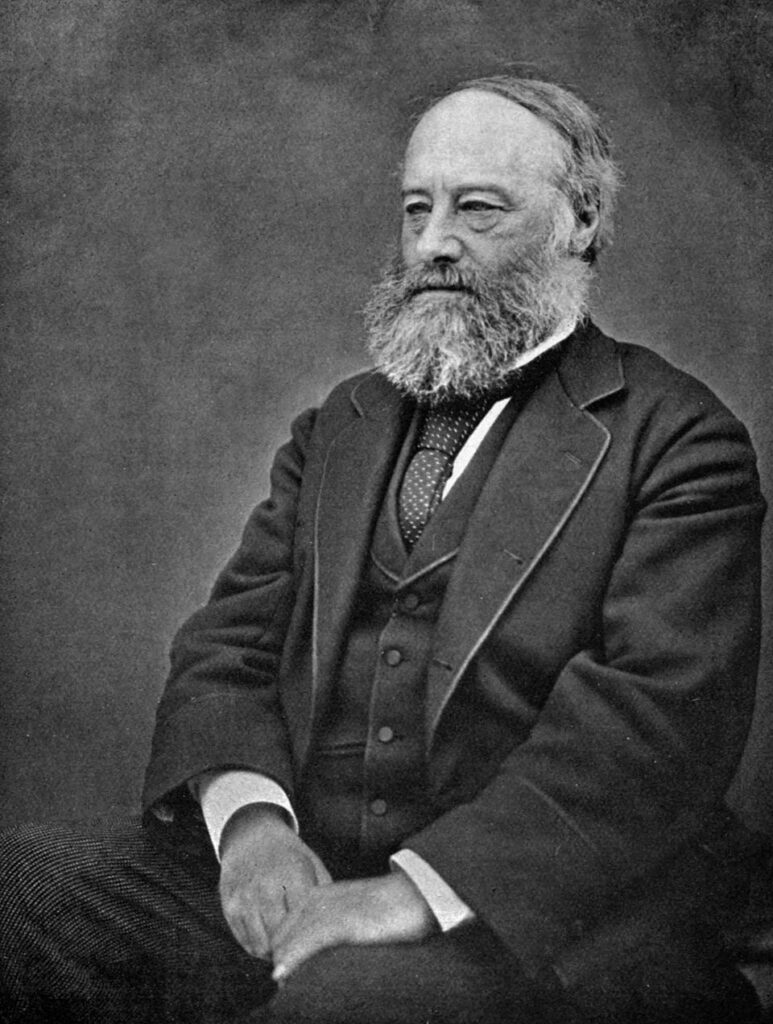
The biography of James Prescott Joule reveals the story of a modest brewer from Salford who became one of the greatest contributors to modern physics. Born on December 24, 1818, Joule’s experiments on energy and heat laid the foundations for thermodynamics. He showed that mechanical work and heat are equivalent forms of energy, a principle that still shapes science today.
Salford in the Early 19th Century
Salford, near Manchester, was a center of the Industrial Revolution. Steam engines, textile factories, and mechanical inventions filled the air with progress. This industrial setting deeply influenced Joule, giving him both inspiration and practical tools for his research.
Childhood and Family Background
Joule was the son of a wealthy brewer. Though destined to continue in the family business, his curiosity for science was irresistible. His early access to workshop tools and industrial machinery helped him set up his own experiments at a young age.
Early Education and Curiosity for Science
He was privately tutored but showed great interest in natural philosophy. Unlike many scientists of his time, Joule was largely self-taught, learning by trial and error.
Influence of John Dalton
Joule studied under John Dalton, the father of modern atomic theory, at Manchester Literary and Philosophical Society. Dalton’s atomic vision deeply shaped Joule’s scientific approach.
Brewing Business and Scientific Experiments
While managing the family brewery, Joule used equipment and resources to conduct groundbreaking experiments. It was unusual, even radical, to blend brewing with cutting-edge science.
Discovery of Joule’s Law
In 1841, Joule discovered Joule’s Law, which describes the relationship between electric current, resistance, and heat. This law remains fundamental in electrical engineering.
Mechanical Equivalent of Heat
Joule’s most famous achievement was proving that heat is a form of energy. Through meticulous experiments with falling weights and paddle wheels stirring water, he measured the conversion of mechanical work into heat—demonstrating the mechanical equivalent of heat.
Resistance from the Scientific Community
At first, his ideas faced skepticism. Many scientists still believed in the caloric theory, which treated heat as a fluid rather than energy. Joule’s precise experiments slowly convinced them otherwise.
Collaboration with William Thomson (Lord Kelvin)
Working with Kelvin, Joule helped formalize the First Law of Thermodynamics, establishing energy conservation as a universal principle.
Experiments with Electricity and Magnetism
Joule also explored electromagnetism, studying how electric currents produce heat and mechanical effects. His wide-ranging interests reinforced his reputation as a versatile physicist.
Joule’s Contribution to the First Law of Thermodynamics
Joule’s principle that “energy cannot be created or destroyed” became the cornerstone of modern physics.
Recognition and Awards
Eventually, his contributions were honored with medals, fellowships, and a pension. Yet, he remained humble, working quietly in Salford.
Personality and Character
Joule was modest, patient, and deeply religious. He saw his discoveries as uncovering divine order in nature.
Anecdotes from His Experiments
It is said that Joule, while on his honeymoon in the Alps, tried to measure the temperature difference in waterfalls to confirm his energy theories—proving his passion for science never rested.
Later Life and Health Issues
Years of tireless experiments strained his health. He struggled financially later in life, despite his fame.
Death and Memorials
James Joule died in 1889 in Sale, Cheshire. His grave bears a biblical verse and the simple yet powerful formula for his discoveries.
Legacy in Physics and Engineering
The SI unit of energy, the joule (J), immortalizes his name. Every mention of energy, from calories to kilowatts, echoes his legacy.
Joule in Everyday Life (the Joule Unit)
From electricity bills to nutrition labels, the joule is part of daily life worldwide, ensuring that James Joule’s work continues to impact humanity.