Table of Contents
- The Twilight of a Medieval Mind: Jean Gerson’s Final Days in Lyon
- The Great Schism and Its Echoes in Jean Gerson’s Life
- Seeds of Reform: Gerson’s Early Years and Intellectual Awakening
- Gerson’s Role at the University of Paris: A Voice of Conciliation
- The Council of Constance: A Crucible for Gerson’s Vision
- The Waning Influence of Scholasticism and the Rise of Devotion
- Lyon, 1429: The City on the Cusp of Change
- The Last Journey: Gerson’s Move to Lyon Amid Turmoil
- Chronicling the Final Moments: Death and Legacy in 1429
- Jean Gerson’s Writings: The Pen That Shaped Late Medieval Theology
- Mysticism and Morality: Gerson’s Impact on Spiritual Life
- Political Intrigue and Religious Reform: The Context of 1429 France
- The Legacy of Jean Gerson in the Renaissance and Beyond
- The Forgotten Revolutionary: Why Gerson Remains Underappreciated
- The Cultural and Intellectual Climate of Lyon in the Early 15th Century
- From Church Councils to Local Chapels: Gerson’s Influence on Popular Piety
- The Relevance of Gerson’s Thought in Contemporary Scholarship
- Remembering Gerson: Commemorations and Historical Memory
- Closing Reflections on the Death of a Medieval Luminary
The Twilight of a Medieval Mind: Jean Gerson’s Final Days in Lyon
In the spring of 1429, as the tides of war and faith swept across France, an aged figure lay quietly in the historic city of Lyon. Jean Gerson, the towering theologian, scholar, and reformer of the late Middle Ages, was drawing his final breath. Lyon, a bustling commercial and religious hub nestled between the Rhône and the Saône rivers, bore silent witness to the end of one of the most extraordinary intellectual journeys of medieval Christendom.
It was a time pregnant with expectation—the Hundred Years’ War was reaching a decisive and hopeful turn, and the glimmers of Renaissance humanism flickered just beyond the horizon. Yet for Gerson, the world was closing in on a lifetime devoted to unity, faith, and the delicate art of reconciling divided souls. His death was not only a personal farewell but a silent marker of an era’s fading brilliance—a last chapter in the story of medieval scholasticism and ecclesiastical reform.
Could the quiet streets of Lyon, often overshadowed by Paris or Avignon, comprehend the gravity of losing this spiritual giant? Was there, in that solemn moment, an inkling among those present of the profound transformations soon to ripple across Europe? This is the story of Jean Gerson’s final days, set against the larger canvas of faith, power, and the quest for lasting peace in a fractured world.
The Great Schism and Its Echoes in Jean Gerson’s Life
To understand the weight of Jean Gerson’s death in 1429, one must first grasp the tumultuous church politics that shaped his life. The Great Schism (1378–1417), a catastrophic division within the Catholic Church, saw rival popes in Rome and Avignon each claiming legitimacy, casting a long shadow over Christendom.
Gerson came of age intellectually amid this chaos. Born around 1363 in the humble town of Gerson near Châlons-sur-Marne, he witnessed a Church rent asunder, with Europe’s spiritual authority fragmented and weakened. Intellectuals and clergy alike grappled with how to restore unity and credibility to the Church’s mission.
This schism was more than a religious dispute; it was a crisis of legitimacy that permeated political alliances and theological debates. Gerson’s early writings and sermons reflect a profound desire to heal these divisions, advocating conciliation over conflict and emphasizing the Church’s moral responsibility to its flock.
His role evolved from student to professor to a leading voice within the University of Paris—the most prestigious intellectual center of the time—where he championed reform and ecclesiastical conciliarism: the belief that councils, rather than popes alone, held supreme authority in matters of faith.
Seeds of Reform: Gerson’s Early Years and Intellectual Awakening
Jean Gerson’s journey from provincial scholar to one of the medieval era’s foremost thinkers reveals a path shaped by both conviction and compromise. Educated at the University of Paris, he quickly distinguished himself by his mastery of theology and rhetoric, his keen interest in the pastoral care of souls, and his skepticism toward the excesses of scholastic disputation detached from lived faith.
Early in his career, Gerson became known for his advocacy of practical piety—the notion that theology should serve the spiritual health of Christians rather than idle speculation. His is an intellectual humility that resonated in a period thirsty for authenticity.
His sermons, widely circulated and highly influential, mixed scriptural exegesis with a moral urgency urging repentance and heartfelt devotion. This pastoral dimension defined much of his legacy, setting him apart from contemporaries caught in abstract theological battles.
Gerson’s Role at the University of Paris: A Voice of Conciliation
The University of Paris in the late 14th and early 15th centuries was a battleground—not just of ideas but of power between factions aligning with either Rome or Avignon. As Chancellor from 1395, Gerson wielded considerable influence, steering the university’s intellectual and moral compass.
He navigated tricky political waters with remarkable dexterity. Known for his calm demeanor and piercing insight, Gerson promoted dialogue between factions, striking a delicate balance between loyalty to papal authority and the pressing need for reform.
His theological positions often reflected this pragmatism—criticizing abuses without undermining the Church’s spiritual foundation. He was one of the first prominent voices advocating a general council to end the schism, foreshadowing his crucial role at the Council of Constance.
The Council of Constance: A Crucible for Gerson’s Vision
In 1414, the Council of Constance convened as a desperate attempt to resolve the Great Schism and confront growing heretical threats. Jean Gerson, as a leading figure representing the University of Paris, was at the heart of its debates.
The council’s achievements—deposing the multiple claimants to the papacy and electing Martin V—were monumental. Yet Gerson’s influence went beyond procedures and politics; he shaped the theological underpinnings of conciliar authority.
Moreover, he argued forcefully against the radical Lollard and Hussite movements, seeking to navigate between repression and understanding. His speeches reveal a mind wrestling with the necessity of order alongside spiritual renewal.
The council thus stands as both a climax and turning point in Gerson’s mission, a battlefield where medieval unity was fiercely contested and temporarily restored.
The Waning Influence of Scholasticism and the Rise of Devotion
By the early 15th century, the intellectual landscape of Europe was shifting. The dense, often convoluted scholastic methods that had dominated medieval universities were gradually giving way to more personal, affective spirituality.
Jean Gerson was in many ways ahead of his time. He urged a move from sterile dialectics toward heartfelt devotion and practical reform. His writings on mystical theology emphasized inner experience, humility, and a direct relationship with God.
This shift reflected broader cultural currents, as Europe approached the dawn of the Renaissance and humanism. Yet it also revealed fractures within the Church’s intellectual elite, where voices like Gerson’s presciently sought new forms of faith suitable to a changing world.
Lyon, 1429: The City on the Cusp of Change
In 1429, Lyon was a vibrant city both commercially prosperous and spiritually significant. Nestled at a crossroads of trade routes, it served as a gathering place for merchants, clerics, and thinkers.
But it was also a city living through the aftershocks of war and political upheaval. France itself, scarred by decades of conflict in the Hundred Years’ War, found new hope in the stirring of Joan of Arc, who had just begun her campaign.
Into this turbulent atmosphere came Jean Gerson in his final months—not as an actor on the world stage, but as a quiet anchor of wisdom and faith. Lyon was his place of retreat, reflection, and ultimately, his final resting place.
The Last Journey: Gerson’s Move to Lyon Amid Turmoil
Why did Jean Gerson choose Lyon for his final days? Scholars have debated this question, examining correspondence and parish records for clues.
It appears that the city’s relative stability and its importance as an ecclesiastical center provided a haven for the aging theologian. Perhaps too the proximity to powerful patrons and the university’s connections offered a space for continuing influence, albeit diminished with age and illness.
Accounts from contemporaries describe Gerson as serene and contemplative in Lyon, focusing on spiritual matters and mentoring young clerics. His departure from Paris—the epicenter of his life’s work—was symbolic of a final withdrawal from public life into profound introspection.
Chronicling the Final Moments: Death and Legacy in 1429
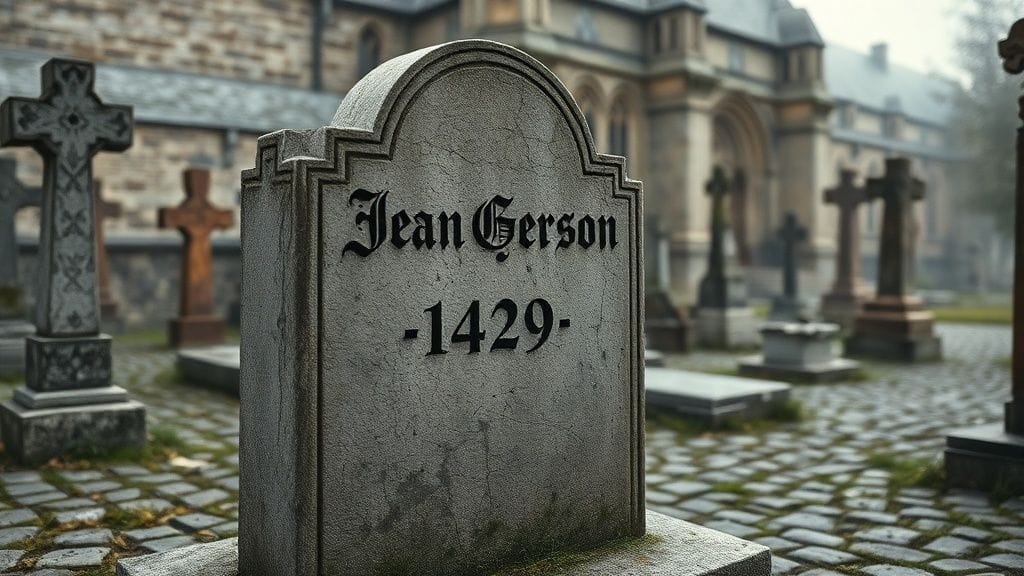
Jean Gerson passed away quietly in 1429, likely in the spring or early summer, his exact date unrecorded amid the chaos of war and plague. His death marked the end of an epoch—a farewell to one of the last great medieval theologians who sought both church unity and spiritual renewal.
Witnesses recall the simplicity of his passing, contrasting with the tumult that had defined much of his public career. His burial in Lyon was attended by a modest yet respectful gathering, reflective of his humility.
Gerson’s legacy, however, was anything but quiet. His works continued to influence thinkers across Europe, from the early humanists to later reformers seeking a Church that could reconcile tradition and change.
Jean Gerson’s Writings: The Pen That Shaped Late Medieval Theology
Perhaps Gerson’s most enduring contribution is his vast corpus of theological, devotional, and pastoral writings. Ranging from sermons and letters to mystical treatises and polemical essays, his oeuvre reflects a rich engagement with the spiritual and intellectual challenges of his time.
Works like De Consolatione Theologiae and treatises against the Hussites reveal his commitment to a theology rooted in compassion and doctrinal clarity. His sermonic style was accessible, aiming to reach souls rather than overwhelm with abstract reasoning.
It’s incredible, yes, to think how his pen helped shape late medieval thought just as Europe's intellectual dawn was breaking.
Mysticism and Morality: Gerson’s Impact on Spiritual Life
Beyond theology, Gerson is remembered as a pivotal figure in advancing Christian mysticism. He emphasized the importance of personal experience with the divine, humility, and the interior life.
His influence extended to figures like Meister Eckhart and the Devotio Moderna movement, which sought to renew piety through inward devotion rather than ritual alone.
This focus on morality and spirituality resonated deeply with laypeople and clergy alike, ensuring that his teachings endured well beyond clerical circles.
Political Intrigue and Religious Reform: The Context of 1429 France
The year of Gerson’s death was also a year of seismic political and religious shifts. France was rallying under Joan of Arc’s banner, while the Church struggled to consolidate after decades of scandal and division.
Gerson’s reformist vision, rooted in conciliarism and pastoral care, had influenced debates on how power and faith should be wielded. Yet as new forces took shape, his more moderate, reconciliatory stance was increasingly challenged by radical reformers and centralized papal authority.
This tension—a defining feature of late medieval Europe—set the stage for the Reformation a century later.
The Legacy of Jean Gerson in the Renaissance and Beyond
Although overshadowed by later figures, Jean Gerson’s legacy rippled through the Renaissance humanists and reformers. His insistence on moral integrity, conciliar governance, and heartfelt devotion laid foundational stones for shifts in theology and church politics.
Scholars today recognize him as a bridge figure: part medieval scholastic, part proto-humanist, part reformer. His death in 1429 marks not just an end, but a hinge between epochs.
The Forgotten Revolutionary: Why Gerson Remains Underappreciated
Despite his immense influence, Gerson is often relegated to footnotes in history. Perhaps his moderate positions and conciliatory tone made him less enticing than the fiery reformers who followed.
Yet understanding Gerson is crucial for grasping the complexities of late medieval religious life—a period not only of decay but also of creative renewal. His story invites us to reconsider narratives of linear progress and appreciate the nuanced struggles for faith and unity.
The Cultural and Intellectual Climate of Lyon in the Early 15th Century
Lyon’s intellectual life in 1429 was a microcosm of Europe’s broader transformations—where trade brought wealth and ideas mingled with practical demands of governance and religion.
Monasteries, universities, and guilds formed a dynamic cultural network, making the city a fertile ground for new theological and philosophical currents.
Gerson’s presence there, in his final year, reflects Lyon’s growing importance as a place not only of commerce but of reflection and intellectual exchange.
From Church Councils to Local Chapels: Gerson’s Influence on Popular Piety
While Gerson operated largely within elite theological circles, his impact reached ordinary believers through sermons and devotional texts.
He advocated reforms that touched parish life, encouraging clergy to serve with compassion and fostering lay involvement in spiritual practices.
This democratization of piety was a subtle but significant step towards the vibrant religious culture that would characterize early modern Europe.
The Relevance of Gerson’s Thought in Contemporary Scholarship
Modern historians and theologians are increasingly revisiting Gerson’s work to better understand late medieval spirituality and church politics.
His blend of pastoral care, political acuity, and mystical insight offers valuable perspectives on authority, reform, and faith—issues that remain relevant in today’s religious discourse.
Remembering Gerson: Commemorations and Historical Memory
Though not immortalized with grand monuments, Jean Gerson’s memory survives in rare manuscripts, academic lectures, and local commemorations near his birthplace and in Lyon.
Recent efforts aim to restore his rightful place among the architects of medieval and early modern religious thought, reminding us that history often hides its most enduring heroes in plain sight.
Closing Reflections on the Death of a Medieval Luminary
Jean Gerson’s passing in Lyon in 1429 was more than the end of a life—it was the closing of a chapter in the long, complex story of Church reform, spiritual renewal, and the pursuit of unity amid division.
His journey—from a provincial village to the councils that shaped Europe’s faith—speaks to the power of intellect married to compassion, of dialogue over dogma.
As the world around Lyon shifted toward new epochs of war, faith, and enlightenment, Gerson’s quiet departure reminds us of the enduring human quest to bring reason, hope, and heart together, even in the darkest of times.
Conclusion
Jean Gerson’s death in 1429 stands as a poignant marker at the crossroads of medieval and modern Europe. Through a lifetime of theological scholarship, pastoral care, and diplomatic wisdom, he sought to heal a fractured Church and nurture a deeper spirituality among believers.
His final days in Lyon encapsulate the fragility and potential of an era on the verge of transformation. Yet, amidst conflict and uncertainty, Gerson remained steadfast—a figure of humility and hope, whose legacy challenges us to consider the delicate balance between tradition and reform.
His story invites us to remember that progress is often forged in the quiet perseverance of those who dare to dream of unity, compassion, and renewal.
FAQs
Q1: Who was Jean Gerson and why is he significant?
A1: Jean Gerson (c.1363–1429) was a leading medieval theologian, chancellor of the University of Paris, and a key figure in resolving the Great Schism. He advocated conciliarism and spiritual reform, influencing both church politics and popular piety.
Q2: What was the Great Schism and what role did Gerson play in it?
A2: The Great Schism split the Catholic Church between rival papacies in Rome and Avignon. Gerson championed the authority of Church councils to restore unity and played a vital role at the Council of Constance, which ended the schism.
Q3: Why did Jean Gerson die in Lyon?
A3: Lyon was a stable, ecclesiastical center offering refuge during tumultuous times. Gerson moved there in his final years for health, safety, and the city's intellectual environment, dying peacefully in 1429.
Q4: How did Gerson’s writings influence later religious movements?
A4: His emphasis on personal devotion, morality, and church reform influenced mysticism, the Devotio Moderna, and laid groundwork for Renaissance humanism and ultimately the Protestant Reformation.
Q5: What was the significance of the Council of Constance for Gerson?
A5: The Council ended the Great Schism and addressed heresy. Gerson’s advocacy for conciliar authority was central, marking a high point in his influence on church governance.
Q6: Why is Jean Gerson relatively unknown today?
A6: Gerson’s moderate, conciliatory approach has been overshadowed by more radical reformers and the dramatic narratives of church history, but recent scholarship is restoring his significance.
Q7: What was the cultural atmosphere of Lyon in 1429?
A7: Lyon was a thriving commercial and religious hub, fertile ground for intellectual exchange and spiritual life, making it an ideal place for a thinker like Gerson in his final days.
Q8: How does Jean Gerson's death reflect broader historical shifts?
A8: His death symbolizes the passing of medieval scholasticism and the church’s old order, just as Europe moved toward Renaissance humanism, nation-states, and religious reform.