Table of Contents
- The Tense Dawn of Jerusalem’s Fall
- The Setting: Jerusalem on the Eve of Siege
- The Rashidun Caliphate Emerges from the Sands
- Byzantine Rule and Religious Frictions
- The Strategic Importance of Jerusalem
- The Arab Conquests: Momentum and Vision
- Caliph Umar ibn al-Khattab: The Architect of Expansion
- The Siege Begins: Encirclement and Negotiation
- Patriarch Sophronius: The Bishop’s Dilemma
- To Fight or to Parley: Jerusalem’s Leadership Weighs Options
- The Terms of Surrender: A City’s Fate in Ink and Honor
- The Historic Meeting: Umar’s Humble Entry into Jerusalem
- The Treaty of Umar: A Model of Conquest and Compassion
- The Religious Mosaic Under New Rule
- The Impact on Christian-Muslim Relations
- Economic and Social Transformations After the Surrender
- Jerusalem’s Global Significance Redefined
- The Memory of 637 in Islamic and Christian Tradition
- Ripple Effects: The Rashidun Caliphate’s Expansion Beyond Jerusalem
- Later Historical Perspectives on the 637 Surrender
- Conclusion: A Moment Where Worlds Converged
- FAQs: Understanding the Surrender of Jerusalem
- External Resource
- Internal Link
The Tense Dawn of Jerusalem’s Fall
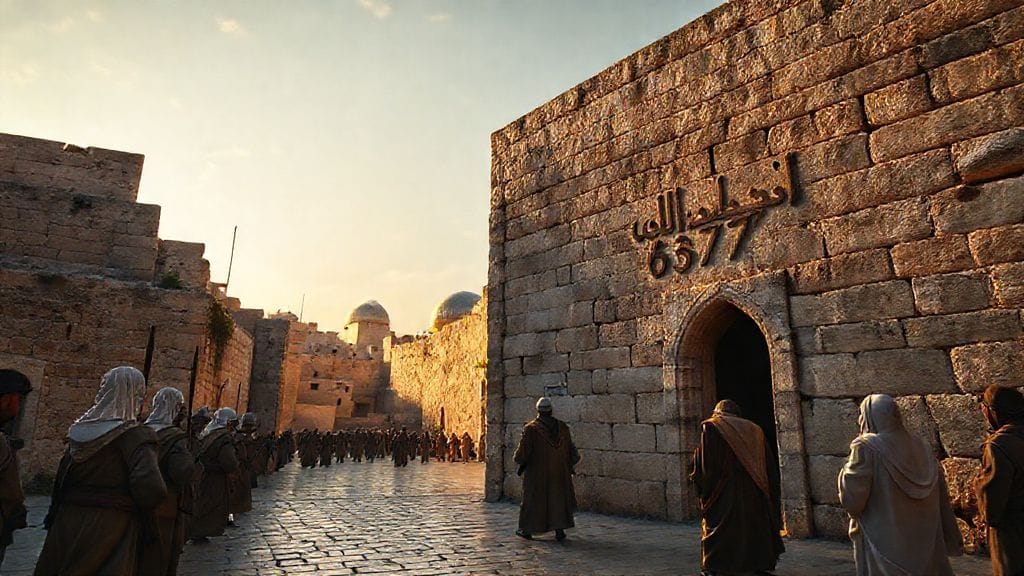
In the early spring of 637 CE, the ancient city of Jerusalem stood at a crossroads that would alter the course of history. The air, already thick with the scents of incense from countless temples, was now burdened with the anticipation of change. On one side, the formidable walls and Christian Byzantine garrison prepared to defend a city sacred beyond measure; on the other, the determined Rashidun forces—an ascendant tide of Arab-Muslim warriors—closed in, promising conquest but also transformation.
It was not merely the fall of a city but the turning of an era. Jerusalem, cradle of monotheistic faiths, epitomized centuries of religious devotion, cultural accumulation, and political struggle. As dawn broke over the city’s iconic walls, the calm façade belied the frayed nerves inside the citadel and the fervor of those beyond. No stones were yet disturbed, but the world was about to shift beneath Jerusalem’s ancient stones.
The Setting: Jerusalem on the Eve of Siege
In 637, Jerusalem was under Byzantine dominion, a city mostly Christian but still bearing the legacies of Judaism and even earlier pagan traditions. Its population was diverse: Christians, Jews, Samaritans, and a small but growing Muslim community within the region. The city’s formidable walls, rebuilt in previous centuries, stood as both symbolic and literal bastions of its strategic and religious significance. The Church of the Holy Sepulchre remained the heartbeat of Christian devotion.
But the Byzantine Empire was stretched thin. Decades of warfare with the Sassanian Persians, internal political strife, and recent losses to the Arab-Muslim armies had left Jerusalem vulnerable. The city's governor, Patriarch Sophronius, was a man torn between harsh resistance and pragmatic survival, fully aware that what was at stake was not only a military fortress but the soul of three faiths.
The Rashidun Caliphate Emerges from the Sands
From the deserts of Arabia, the Rashidun Caliphate had rapidly expanded following the death of Prophet Muhammad in 632 CE. Under leadership steeped in both spiritual zeal and political acuity, the early caliphs embarked on a transformative series of conquests that reshaped the Near East. Their forces, nimble and ideologically driven, had already secured expansive swaths of territory from the crumbling Sassanian Empire and weakening Byzantine frontiers.
The conquest of Jerusalem was more than a military objective; for the Rashidun Caliphate it symbolized a bridge between the old worlds and a new, unified Muslim polity. The city offered access not only to religious sites but to a deeper legitimacy among the monotheistic communities.
Byzantine Rule and Religious Frictions
Since Emperor Constantine’s Christianization of the Roman Empire, Jerusalem had become a shining beacon of Christian orthodoxy, his holy city for pilgrimages and imperial glory. Yet beneath the surface simmered tensions—Christian rulers had imposed restrictions on Jewish communities, and the Samaritans suffered marginalization.
The Byzantine administration, while often tolerant in policy, could not erase the fractures provoked by theological schisms and ethnic divides. The presence of various Christian sects, from Chalcedonians to Miaphysites, further complicated the religious landscape, creating fault lines that sometimes weakened the city’s unity against an external foe.
The Strategic Importance of Jerusalem
Jerusalem’s significance was multifaceted. Geographically, it was a vital node connecting coastal trade routes with inland commercial arteries. Militarily, it was a bastion controlling the Levant. Religiously, it was unparalleled: the holiest city to Christians and Jews, a place sanctified in the Qur’an as well, known as al-Quds (“The Holy”).
Control over Jerusalem meant controlling the spiritual and symbolic capital of the region. For the Rashidun Caliphate, seizing such a landmark would echo across the lands they sought to govern, offering a powerful message of divine favor and political power.
The Arab Conquests: Momentum and Vision
By 637, the Rashidun army had already secured Syria and Palestine through campaigns led by generals such as Khalid ibn al-Walid and Abu Ubaidah ibn al-Jarrah. Their military success was not just brute force—it was a blend of strategic brilliance, religious motivation, and diplomatic negotiation.
The commanders understood that outright destruction of sacred sites would alienate local populations and ignite lasting rebellions. This respect toward religious diversity, combined with a clear-cut message of justice under Islamic law (sharia), helped lay the foundations for what would be known as the Pact of Umar later.
Caliph Umar ibn al-Khattab: The Architect of Expansion
Caliph Umar ibn al-Khattab stood as a towering figure in early Islamic history. His leadership was characterized by pragmatic justice and expansionist vision meshed with humility and respect for the conquered peoples. Known for his austere character and shrewd governance, Umar oversaw the adaptation of conquered territories into the growing caliphate, establishing administrative frameworks that respected local customs while affirming Islamic preeminence.
The task of Jerusalem’s surrender was as much a political mission as a military one, and Umar’s choice to personally oversee the city's capitulation spoke volumes of his commitment to a just and moral conquest.
The Siege Begins: Encirclement and Negotiation
The Rashidun forces encircled Jerusalem, cutting off supply lines and exerting pressure without deploying the full weight of siege warfare. Patriarch Sophronius, well-versed in history and theology, knew that the city's walls could be breached eventually but also understood the catastrophic cost of prolonged fighting.
Rather than capitulating immediately, Sophronius sought negotiations that might safeguard the city's inhabitants and holy places. The siege thus unfolded concurrently with tense dialogues, punctuated by displays of military readiness and the rumor of impending conflict.
Patriarch Sophronius: The Bishop’s Dilemma
Sophronius was no mere military governor. As the spiritual leader of Jerusalem’s Christians, his role extended deep into the city’s religious life and identity. His dilemma was profound: to resist might honor Christian duty and Byzantine loyalty but possibly bring destruction and massacre to his flock; to surrender risked humiliation and loss of control over sacred sites.
Historical accounts suggest that Sophronius was personally involved in negotiations and set strict conditions to protect the sanctity of Christian worship and the safety of his people.
To Fight or to Parley: Jerusalem’s Leadership Weighs Options
As the siege dragged on, morale inside Jerusalem wavered. Food supplies dwindled, and the Byzantine prospects for relief faded with each passing day. Yet the city's leadership managed to keep hopes alive for a favorable treaty.
Behind closed doors, emissaries conveyed terms back and forth with the Rashidun camp. The urgency was tempered by mutual respect, an unusual tone in siege warfare, but fitting for a city so steeped in religious significance.
The Terms of Surrender: A City’s Fate in Ink and Honor
Eventually, after approximately six months of siege, Jerusalem agreed to terms of surrender that preserved much of the city’s autonomy and religious culture. The Pact of Umar, though formalized later, drew on these initial agreements—guaranteeing religious freedom for Christians and Jews, protection of their persons and property, and the continuation of worship, in exchange for the payment of jizya (a tax levied on non-Muslims).
These terms were revolutionary for their time, proposing a model of conquest that integrated respect and coexistence rather than destruction and expulsion.
The Historic Meeting: Umar’s Humble Entry into Jerusalem
Perhaps the most iconic moment came when Caliph Umar himself entered Jerusalem. To the surprise of many, he refused to pray inside the Church of the Holy Sepulchre, wary that this act might provoke future claims on the church by Muslims. Instead, tradition holds he prayed outside, signaling respect for the Christian site and a commitment to peaceful coexistence.
Accounts portray Umar as a man of humility and justice, setting an example for rulers to come by demonstrating restraint amid victory.
The Treaty of Umar: A Model of Conquest and Compassion
The Treaty of Umar became emblematic of Islamic policy toward "People of the Book"—Jews and Christians—within the caliphate. It codified protections, responsibilities, and rights, formalizing a relationship based on tolerance and order, albeit within a framework of Muslim political supremacy.
This model proved essential for the later administration of diverse populations in the vast Islamic empire and created a blueprint for interfaith relations in the region for centuries.
The Religious Mosaic Under New Rule
Under Rashidun rule, Jerusalem’s religious communities generally experienced a degree of autonomy unknown in previous centuries. Churches remained open; Jewish residents, previously expelled or oppressed under Byzantine law, found renewed opportunities to live and worship in the city.
The transformation was not always smooth and faced challenges, but the fundamental respect embedded in the initial surrender negotiations shaped the city’s identity as a mosaic of faiths under Islam.
The Impact on Christian-Muslim Relations
The surrender of Jerusalem in 637 was a defining moment that set the tone for Christian-Muslim relations in the medieval era. Far from being a mere military transfer, it heralded an era of cautious coexistence, friction, dialogue, and exchange. It also raised theological questions and reciprocal views—Christian chroniclers of the period documented the event with a mixture of fear, respect, and hope.
The legacy of the surrender continues to influence interfaith dynamics and historical narratives up to the present day.
Economic and Social Transformations After the Surrender
Jerusalem’s integration into the Rashidun Caliphate brought economic reorientation—trade routes were extended and secured, taxation adapted, and the city’s administrative institutions restructured to align with Islamic legal principles.
Socially, the new status quo encouraged demographic shifts, including the return of Jewish communities and the establishment of Muslim neighborhoods alongside Christian quarters. This pluralism infused Jerusalem with fresh cultural energy, even as political power centralized.
Jerusalem’s Global Significance Redefined
With its fall to the Rashidun Caliphate, Jerusalem transcended regional importance to become a key symbol in the expanding Islamic world. It evolved into a site of pilgrimage for Muslims, a spiritual nexus in the reverence of the Prophet’s Night Journey (Isra and Mi'raj), and a tangible proof of Islam’s ascendancy.
Simultaneously, the city remained a cherished locus for Christian and Jewish heritage, its complexities deepening rather than fading.
The Memory of 637 in Islamic and Christian Tradition
The events of 637 are commemorated differently in Muslim and Christian traditions. Islamic historiography often praises the conquest as a peaceful and just expansion, underscoring Umar’s wisdom and moderation. Christian accounts sometimes lament the loss yet recognize the nuanced nature of the surrender.
The memory of this surrender reverberates in pilgrimage narratives, religious texts, and later crusader histories, underscoring Jerusalem’s deep symbolic resonance.
Ripple Effects: The Rashidun Caliphate’s Expansion Beyond Jerusalem
The capture of Jerusalem was a critical stepping stone in the Rashidun Caliphate’s sweeping conquests. It facilitated further advances into Egypt and the Arabian Peninsula, consolidating Muslim rule across vast territories.
The political models and religious policies exemplified during Jerusalem’s surrender informed the caliphate’s approach elsewhere, allowing them to govern diverse populations with relative stability.
Later Historical Perspectives on the 637 Surrender
Historians through the centuries have revisited the surrender with varying lenses—from medieval chroniclers to modern scholars analyzing sources critically. Today, 637 is understood neither as a simple conquest nor as an unblemished utopia, but as a complex episode of war, negotiation, and coexistence.
This duality reflects the enduring tensions and hopes embedded in Jerusalem’s identity.
Conclusion: A Moment Where Worlds Converged
The surrender of Jerusalem to the Rashidun Caliphate in 637 is more than a page in history—it is a moment where cultures, religions, and empires collided, negotiated, and reshaped a city sacred to many. It stands as a testament to the possibilities of power tempered by justice, faith balanced with pragmatism, and change embraced with respect.
In the stones of Jerusalem’s ancient walls, one hears echoes of that tense spring six centuries after Christ. The legacy of Umar’s entry, Sophronius’s difficult choice, and the mutual understanding forged amidst siege remains a timeless narrative of how human history can pivot not only on bloodshed but on wisdom and mercy.
FAQs: Understanding the Surrender of Jerusalem
Q1: What were the main reasons behind Jerusalem’s surrender to the Rashidun Caliphate?
Jerusalem’s surrender resulted primarily from the military superiority and strategic dismantling of Byzantine defenses, alongside the city's lack of reinforcements and resources. Additionally, pragmatic negotiations, spearheaded by Patriarch Sophronius, aimed to protect inhabitants and holy sites.
Q2: Who was Caliph Umar and what role did he play in Jerusalem’s surrender?
Umar ibn al-Khattab was the second caliph of the Rashidun Caliphate. He personally oversaw Jerusalem’s surrender, respected its religious sites, and set a precedent for Islamic governance based on justice and tolerance.
Q3: What protections did Christians and Jews receive after the city's surrender?
They were granted religious freedom, protection of life and property, and the right to worship openly, in exchange for paying the jizya tax. Sacred Christian sites, like the Church of the Holy Sepulchre, remained intact and operational.
Q4: How did the surrender affect Christian-Muslim relations?
It established an early model of coexistence and legal frameworks for religious minorities within Muslim rule, although tensions remained. It influenced centuries of interfaith interactions in Jerusalem and beyond.
Q5: Why did Caliph Umar refuse to pray inside the Church of the Holy Sepulchre?
Umar feared that praying inside could be interpreted as a claim of Islamic appropriation over the church, potentially leading to future disputes. His humility symbolized respect for Christian worship sites.
Q6: How did the surrender influence the Rashidun Caliphate’s broader expansion?
Jerusalem’s capture consolidated Muslim control in the Levant, provided strategic advantages, and reinforced models of governance that facilitated further territorial expansion into Egypt and other regions.
Q7: What is the historical significance of the Pact of Umar?
Although formalized later, the Pact of Umar established guidelines for non-Muslim communities living under Muslim rule, emphasizing protection alongside limitations, thus shaping Islamic policies on religious minorities.
Q8: How is the 637 surrender remembered today?
It is remembered variably—as a peaceful conquest and founding event in Islamic history, a moment of loss and transition in Christian tradition, and a complex episode illustrating Jerusalem’s enduring religious and political significance.

