Table of Contents
- The Dawn of a New Era: The First Jet Engine Run in Rugby
- The Man Behind the Machine: Frank Whittle’s Vision
- The World on the Brink: Aviation before Jet Propulsion
- Roots of Innovation: Early 20th-Century Engineering and Aerodynamics
- The Challenges of Revolution: Technical and Financial Obstacles
- Trials in the Workshop: Designing the Powerplant of Tomorrow
- April 12, 1937: The Historic Moment Unfolds
- The Sound of Progress: Describing the First Jet Engine Run
- Reactions and Reverberations: Immediate Aftermath in Rugby and Beyond
- From Laboratory to Skies: How the First Run Paved the Way for Flight
- The Race Ignites: Jet Technology Across Borders
- Wartime Acceleration: The Jet Engine’s Role in World War II
- Frank Whittle vs. Hans von Ohain: Parallel Stories of Jet Propulsion
- The Industrial and Military Transformations Driven by Jet Power
- Cultural Ripples: How Jet Engines Captivated Imagination and Media
- Postwar Dreams and Realities: Commercial Aviation Transformed
- Conservation and Controversy: Historical Recognition and Debate
- The Technological Legacy: From Rugby to the Modern Aerospace Industry
- Remembering April 12th: Commemorations and Museums
- The Human Element: Engineers, Workers, and Communities Behind the Scenes
- Quotes from Contemporaries: Voices From the Jet Engine Revolution
- Lessons Learned: Innovation, Persistence, and the Spirit of Discovery
- The Jet Engine Today: A Continuing Story of Power and Innovation
1. The Dawn of a New Era: The First Jet Engine Run in Rugby
April 12, 1937, dawned grey over Rugby, a modest industrial town in the heart of England. Yet in this unassuming setting, something extraordinary was about to happen. The hum of machinery filled a small workshop as engineers gathered around a bulky, strange contraption — Frank Whittle’s pioneering jet engine. For the first time, controlled explosive combustion would power continuous, high-speed airflow without propellers. The deafening roar that erupted shattered years of aerodynamic convention and propelled humanity into a new age of flight.
This was more than a mechanical test. It was a triumph of imagination against doubt, a symbol of relentless innovation fueled by visionaries who dared to dream beyond the boundaries of piston engines. This first run of the jet engine was a midnight thunderclap heralding modern aviation, a single heartbeat that would centuries later still echo in the roar of modern airliners.
But this moment did not appear out of thin air. It emerged from a tangled history of technological experimentation, wariness from skeptics, and the unyielding faith of one man and his team. This is a story of grit, genius, and the transformative power of daring to think differently.
2. The Man Behind the Machine: Frank Whittle’s Vision
Frank Whittle was not a typical engineer. Born in 1907 in Coventry, England, Whittle’s fascination with flight emerged early. He joined the Royal Air Force as a cadet and spent his hours dreaming of ways to escape the limits of propeller-driven aircraft. By the early 1930s, Whittle had conceived of an engine powered by a continuous flow of compressed air ignited by fuel—an elegant idea that promised higher speeds and altitudes than ever before.
His concept was daring but controversial. The RAF and the government regarded it with skepticism, slow to fund what seemed like a quixotic endeavor. Whittle’s persistence was extraordinary. He secured a patent in 1930 and dedicated himself to turning theory into reality. Within his cramped workshop at Power Jets Ltd., he and his small team worked day and night, chasing a dream that many viewed as impossible.
Whittle’s vision was driven by a blend of technical brilliance, personal tenacity, and a profound belief that air travel could transcend its piston-powered past.
3. The World on the Brink: Aviation before Jet Propulsion
Before 1937, aviation was dominated by piston engines turning propellers. These machines had evolved far since the first Wright Brothers’ flights, but their physical limits were becoming clear. Propellers faced inefficiencies at high speeds and altitudes; combustion limitations capped power; and aircraft design was constrained by these mechanical realities.
Air forces worldwide scoured for new powerplants. Attempts at rocket propulsion and other radical designs existed but had not matured to practical use. The biplane era was giving way to sleek monoplanes, but true speed and altitude breakthroughs awaited a revolution in propulsion.
Yet, the urgency was not widely felt. The world still clung to known technologies. Whittle’s jet concept, at this moment, was a whisper among the roar of piston-driven aviation’s triumphs and disasters.
4. Roots of Innovation: Early 20th-Century Engineering and Aerodynamics
The 1920s and early 1930s were fertile ground for aerodynamic innovation. Advances in metallurgy, fuel chemistry, and turbine design stirred imaginations. Whittle’s ideas drew from existing knowledge of gas turbines, but adapting these principles to flight was unprecedented.
Other engineers explored compressors and turbines on the ground for power generation, yet the challenge of making a compact, powerful, reliable jet engine was monumental. Whittle was immersed in aerodynamics, drawing on experimental data and collaborating with universities and factory experts.
His approach was holistic —from airflow dynamics inside the combustion chamber to material heat resistance— every detail mattered. This period was marked by trial and error, frustration, but also exciting breakthroughs that built a foundation for the future.
5. The Challenges of Revolution: Technical and Financial Obstacles
Whittle’s journey was anything but smooth. The complexity of the engine design outpaced available materials technology. Bearings melted under stress, compressors failed to sustain airflow, and chambers exploded without warning. Every test presented daunting challenges demanding innovation in metallurgy, machining, and fuel delivery.
Beyond the technical, financial backing was perilous. The Great Depression gripped Britain, and military funds were scarce. The Air Ministry was cautious about investing in unproven technology. Whittle’s faith often encountered bureaucratic resistance, and at times, he was close to giving up.
His partnership with Henry Julian “Hal” Stirling, an aircraft engine manufacturer, was crucial. Together, they pushed Power Jets Ltd. to survive. Relentless testing and incremental improvements character marked this phase, transforming hope into methodical engineering progress.
6. Trials in the Workshop: Designing the Powerplant of Tomorrow
The workshop in Rugby was cramped, noisy, and volatile. Whittle and his team fashioned turbines, compressors, and combustion chambers often with makeshift tools and limited resources. Each day brought new tests, some failures spectacular, others small but critical.
The engine, named the W.1, utilized a centrifugal compressor to pull and compress air, then injected fuel to ignite and accelerate exhaust gas. This thrust pushed the engine forward without a spinning propeller attached—a startling concept.
On the cusp of success stood countless discarded parts, moments of despair, and flashing insight. Whittle’s technique was iterative; each run yielded data, and each failure was dissected. This intense period was the crucible forging modern jet propulsion.
7. April 12, 1937: The Historic Moment Unfolds
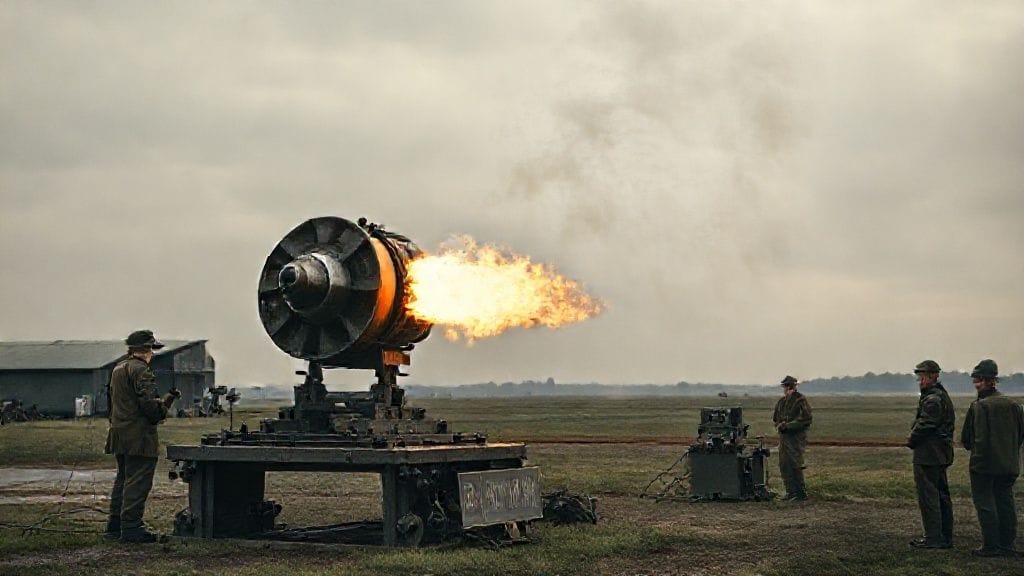
On that chilly April morning, the senses were taut with anticipation. The engine was mounted within a test rig in the Rugby Power Jets factory. Engineers stood by, many holding their breath.
At the flip of a switch, fuel ignited, and air began rushing through the compressor. Within seconds, the turbine screamed to life, thrust echoing like a thunderclap. The sound was unlike any mechanical noise before — a harsh, mesmerizing howl of raw power and possibility.
For a few minutes, the engine sustained itself. Thermometers surged, gauges danced, and Whittle smiled subtly amid the technical chaos. The test was a success — the first run of a jet engine had been achieved. It was a moment of breakthrough and danger alike, proof that the future of aviation was being reshaped.
8. The Sound of Progress: Describing the First Jet Engine Run
Witnesses described the engine’s roar as deafening yet oddly beautiful. It was “like a colossal metal beast straining with newfound life,” wrote a local newspaper. The low hum of piston engines was replaced by an alien, high-pitched scream.
In the nearby streets, the noise startled residents, some fearing explosions. Yet, those who understood glimpsed in that sound the promise of unimaginable speed and freedom above the clouds.
Whittle’s team watched instruments and the physical signs of combustion, their excitement tempered by cautious respect—the technology was new, volatile, and fragile.
9. Reactions and Reverberations: Immediate Aftermath in Rugby and Beyond
News traveled slowly, but excitement grew among engineers and military circles. Skeptics were silenced briefly by the undeniable reality: the jet engine’s first run was no hoax or fantasy.
However, official recognition lagged. Britain was still focused on existing military concerns, and the looming war demanded faster, proven solutions. Nonetheless, Whittle gained increased attention; funds rose modestly, and the development entered a new phase.
Across the ocean and continent, intelligence units noted British progress. The stage was set for a technological arms race that would define the coming years.
10. From Laboratory to Skies: How the First Run Paved the Way for Flight
Although the April 1937 test did not yet produce a flying jet aircraft, it provided the foundation. Whittle and his team refined the engine, eventually powering the Gloster E.28/39—the first British jet aircraft to take flight in May 1941.
This transition from workshop test rig to airframe was a monumental leap. The successful first run proved the concept viable and ignited further investment. The jet engine’s capability to revolutionize aviation was now clear.
11. The Race Ignites: Jet Technology Across Borders
Parallel to Whittle’s work, German engineer Hans von Ohain independently developed a jet engine, achieving his own first run in 1937. This coincidence launched a covert competition between Britain and Germany.
While nations grappled with war, the race to harness jet propulsion became fierce and secretive. Military strategists realized controlling this technology would yield unparalleled advantages.
12. Wartime Acceleration: The Jet Engine’s Role in World War II
The war pressed urgency on development. Britain launched the Gloster Meteor—the first operational jet fighter, and Germany built the Messerschmitt Me 262.
The jet engine enabled unprecedented speeds, altering dogfights, strategic bombing, and air defense. This innovation shortened the war’s climax and transformed military aviation forever.
13. Frank Whittle vs. Hans von Ohain: Parallel Stories of Jet Propulsion
Whittle and von Ohain each faced hurdles but followed distinct paths: Whittle’s work was military-focused and team-supported; von Ohain benefited from the industrial might of Germany’s Messerschmitt company.
Postwar, Whittle’s contributions were often overshadowed by von Ohain’s, especially on the continent, but both men are rightly hailed as pioneers who changed aviation history.
14. The Industrial and Military Transformations Driven by Jet Power
Jet engines demanded new manufacturing processes—higher precision metal alloys, turbine blade cooling, and more sophisticated aerodynamics.
Militaries retooled air forces, focusing on jet-ready missions. Civilian airlines began to envision commercial jet airliners, spurring the dawn of mass global air travel.
15. Cultural Ripples: How Jet Engines Captivated Imagination and Media
Newsreels, newspapers, and radio broadcasts carried stories of the “jet age.” Fiction and art began portraying jet-propelled aircraft as symbols of future utopias or dystopias.
The jet engine became a metaphor for human mastery over nature and a powerful emblem of modernity.
16. Postwar Dreams and Realities: Commercial Aviation Transformed
By the late 1940s and early 1950s, commercial jets like the De Havilland Comet emerged, revolutionizing travel by making long distances routine and accessible.
The jet engine’s first run in Rugby was not just a technical milestone but an origin point for an era of unprecedented interconnectedness.
17. Conservation and Controversy: Historical Recognition and Debate
Questions remained about the true “inventor” of the jet engine, patent rights, and national credit. Whittle struggled for adequate recognition in his lifetime.
Efforts to preserve the original W.1 engine, its test facility, and Whittle’s story have grown, embedding this history in the British technological narrative.
18. The Technological Legacy: From Rugby to the Modern Aerospace Industry
Whittle’s test laid the cornerstone for the global aerospace industry, spanning military, commercial, and space technologies.
Modern jet engines owe their lineage to those first seconds in Rugby, reminding us how a handful of pioneers can steer humankind’s destiny.
19. Remembering April 12th: Commemorations and Museums
Today, plaques and exhibits in Rugby and Britain celebrate April 12, 1937. Historic sites and aviation museums narrate the story to new generations, underscoring the power of innovation and perseverance.
20. The Human Element: Engineers, Workers, and Communities Behind the Scenes
The story is not just of Whittle but of countless engineers, machinists, test pilots, and their families who endured long hours and uncertain futures to bring the jet engine into being.
Their collective effort embodies the spirit of collaborative invention.
21. Quotes from Contemporaries: Voices From the Jet Engine Revolution
Whittle famously said, “The jet engine was born in dreams, forged in sweat, and proven in fire.” His colleague Hugh “Teddy” Petter noted, “It was like capturing lightning and taming a dragon.”
Such voices animate the story, blending human passion with technical triumph.
22. Lessons Learned: Innovation, Persistence, and the Spirit of Discovery
The jet engine’s first run teaches enduring lessons: that visionary ideas often collide with disbelief; that failure is a stepping stone; and that progress demands courage.
It reminds us the future is built by those who dare to run the engine of possibility.
23. The Jet Engine Today: A Continuing Story of Power and Innovation
Nearly a century later, jet propulsion remains at the heart of aerospace, evolving with new fuels and designs. The first run in Rugby echoes in every lifted flight, every sonic boom, and every horizon conquered.
Conclusion
The first run of the jet engine on April 12, 1937, in Rugby, UK, was a defining moment of the 20th century—a noisy, fiery herald of the future stitched deeply into the tapestry of technological progress. Beyond the roar and the heat lay a story of vision, dogged determination, and human courage to defy convention. Frank Whittle and his team did not just test a machine; they unlocked a new corporeal dream, one where humanity could rise swiftly, boldly, and transform the world below.
This milestone reminds us of the power of innovation to reshape societies and the importance of remembering those who pursue what others deem impossible. As we board modern jets that trace their ancestry to that April morning, we share in a history fueled by courage and the tireless chase of the skies.
FAQs
Q1: What exactly happened during the Jet Engine first run in Rugby on April 12, 1937?
A1: On that date, Frank Whittle’s prototype jet engine was ignited and ran successfully for the first time, demonstrating sustained combustion and thrust without a propeller, a fundamental step toward practical jet propulsion.
Q2: Why was this event so revolutionary for aviation?
A2: It marked the birth of a new kind of aircraft propulsion capable of higher speeds and altitudes, surpassing the limits of piston engines and propellers that had defined flight.
Q3: Who was Frank Whittle and what role did he play?
A3: Frank Whittle was a British RAF engineer and inventor whose vision and persistence led to the development and first run of the jet engine, pioneering a transformative technology.
Q4: How did the world respond to this breakthrough at the time?
A4: Though initially met with skepticism and limited funding, the success eventually attracted military and industrial interest, sparking international developments and competition.
Q5: How did the jet engine impact World War II?
A5: Jet engines led to the creation of faster, more powerful military aircraft, such as the Gloster Meteor and Messerschmitt Me 262, which significantly altered air combat and aviation technology.
Q6: Are there memorials or museums dedicated to the first jet engine?
A6: Yes, in Rugby and across the UK, exhibits and plaques commemorate the event and Frank Whittle’s legacy, educating the public about this milestone.
Q7: What technological challenges were overcome to make the jet engine run?
A7: Challenges included material heat tolerance, turbine blade durability, compressor efficiency, and fuel combustion stability, all of which required innovative engineering solutions.
Q8: How does the 1937 engine relate to modern jet engines?
A8: The 1937 engine was the conceptual and practical foundation; modern engines have improved efficiency, materials, and power, but fundamentally operate on the principles first proven that day in Rugby.