Table of Contents
- The Fateful Morning in Rouen: May 30, 1431
- The Maid of Orléans: From Peasant Girl to National Icon
- The Hundred Years’ War: France in Turmoil
- Joan’s Capture and Trial: A Political and Religious Theatre
- The Role of the English and Burgundians: Puppet Masters Behind the Scenes
- The Trial’s Grim Proceedings: Inquisition and Injustice
- Charges of Heresy: The Threads of a Dangerous Label
- Joan’s Defiant Spirit in the Face of Death
- The Execution at the Marketplace: Flames Consuming a Legend
- Immediate Reactions: Silence, Shock, and Sorrow
- The Political Implications for England and France
- The Rehabilitation Trial: Justice Deferred, Justice Served
- Joan’s Enduring Legacy: Symbol of National Resistance
- Cultural Reverberations: Joan of Arc in Art, Literature, and Film
- Modern Memory and Commemoration: Saints and Soldiers
- Lessons from the Maid: Heroism, Faith, and Political Power
- Conclusion: The Eternal Flame of Joan of Arc
The Fateful Morning in Rouen: May 30, 1431
The smoke from the pyre twisted into the damp morning sky of Rouen like a sinister signal flare, its dark plume swallowing the fragile light of dawn. Crowds gathered around the old marketplace, their faces etched with horror, fascination, and an uneasy reverence. Nearby, the timber frame of the city’s cathedral cast long shadows — silent witnesses to the execution of one of history’s most controversial figures. On that day, May 30, 1431, Joan of Arc, the Maid of Orléans, was consumed by flames, condemned as a heretic and witch. The crackling blaze was both an end and, paradoxically, the beginning of a legend that would ripple through centuries.
The Maid of Orléans: From Peasant Girl to National Icon
Born around 1412 in Domrémy, a modest village in northeastern France, Joan was an unlikely candidate for immortality. A peasant girl with a simple upbringing, she burst onto the stage of history armed with nothing but fierce faith and an unyielding conviction that divine voices had chosen her to drive the English from France. By the age of 17, she had lifted the siege of Orléans, breathed new life into French morale, and escorted the Dauphin Charles to his coronation as King Charles VII. Yet this meteoric rise sowed seeds of envy, political intrigue, and deadly opposition.
The Hundred Years’ War: France in Turmoil
The backdrop to Joan’s story was the Hundred Years’ War, a protracted, brutal contest between England and France over dynastic claims and territorial dominion. By the early 15th century, France was a fractured kingdom, scarred by internal divisions, the devastating Black Death, and the humiliating Treaty of Troyes (1420), which disinherited the legitimate French heir in favor of Henry V of England. The country was a tapestry of warring factions—Armagnacs, Burgundians, English occupiers—each pursuing their vision of power. Amid this chaos, hope flickered only briefly before the Maid emerged as a figure of divine intervention.
Joan’s Capture and Trial: A Political and Religious Theatre
Joan’s capture in 1430 at Compiègne by Burgundian forces allied with the English marked a turning point. Handed over to the English, she was imprisoned in Rouen, a city under English control, and subjected to a trial that was less about justice than about breaking the spell she cast over France. The trial, orchestrated by English clerics and officials, was a chilling blend of political manipulation and religious fervor aimed at stripping her of legitimacy and neutralizing her as a symbol of French resistance.
The Role of the English and Burgundians: Puppet Masters Behind the Scenes
Behind the courtroom’s veneer of legality loomed the unsavory reality of geopolitical gamesmanship. The English crown, desperate to cement control over French territories, needed to dismantle the aura surrounding Joan. The Burgundians, once allies to the French crown but turned bitter rivals, saw in Joan’s downfall an opportunity to strengthen their hand. Together, they shaped the trial’s narrative, ensuring that verdict and punishment served their strategic interests more than any genuine quest for truth.
The Trial’s Grim Proceedings: Inquisition and Injustice
From January to May 1431, Joan faced relentless interrogation by a panel of churchmen led by Bishop Pierre Cauchon, an English partisan. Records reveal a protracted trial filled with theological entanglements, coercion, and procedural abuses. Joan’s literacy was questioned, her theological knowledge tested, and her every answer scrutinized for heresy. Yet her composure, intelligence, and unwavering faith marked her testimony. Her responses unwittingly laid bare the desire of her inquisitors not to uncover heresy but to convict her at any cost.
Charges of Heresy: The Threads of a Dangerous Label
The accusations against Joan centered on claims of heresy: cross-dressing (wearing men’s clothing), claiming divine inspiration, and disobedience to ecclesiastical authority. These charges, while seemingly petty or symbolic, carried immense weight in a medieval society where the Church’s moral and legal authority governed all. Her refusal to submit fully to the Church’s demands, combined with her magnetic influence, made her a threat that transcended the battlefield. Labeling her a heretic was a tool as much as a punishment.
Joan’s Defiant Spirit in the Face of Death
Despite the grim prospects, Joan exhibited an unshakable spirit. Her trial transcripts reveal moments of profound courage and spiritual clarity. She challenged the legitimacy of her judges and proclaimed her innocence, insisting on her visions and mission. When condemned, she refused to renounce her faith or the attire that symbolized her role as a soldier. In the days leading to her execution, Joan’s quiet dignity and steadfastness transformed her from a prisoner into a martyr in the eyes of many who witnessed her ordeal.
The Execution at the Marketplace: Flames Consuming a Legend
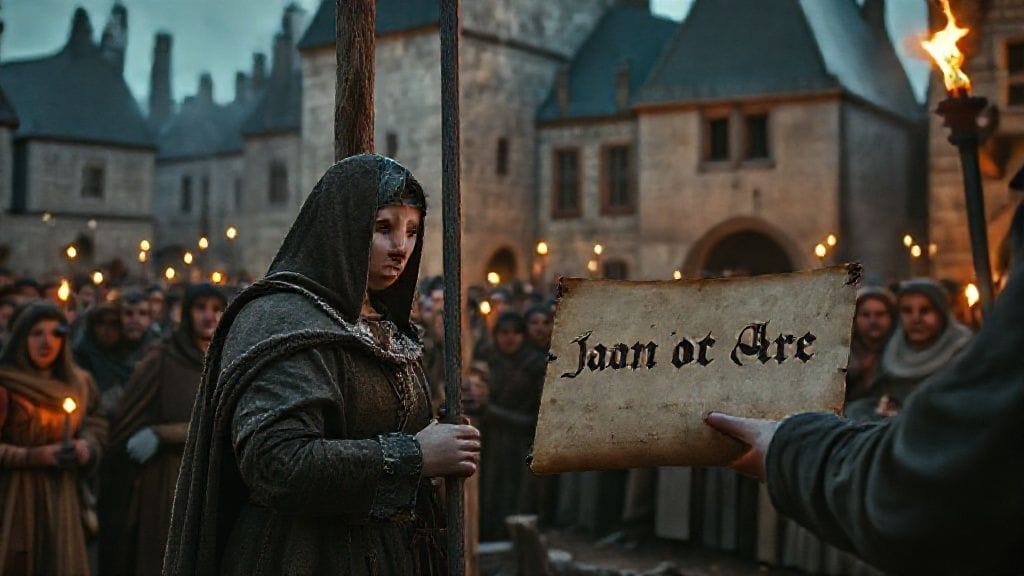
On that fateful morning, she was led to the scaffold in Rouen’s marketplace. The execution was methodical, almost cold. Bound to a stake, Joan faced the flames with prayer and singing. Witnesses later testified to her serene composure, her voice strong against the crackling fire. Her physical destruction by fire was meant to erase her influence, but the spectacle only engraved her image deeper into collective memory.
Immediate Reactions: Silence, Shock, and Sorrow
The aftermath was filled with a haunting silence. The French loyalists were devastated; the English and their allies viewed the execution as a decisive triumph. Yet, whispers of injustice and admiration for Joan’s bravery circulated quickly. Rumors emerged that her ashes were collected and scattered in the Seine to prevent relic veneration. The event left a fracture in public conscience—a tension between political expediency and moral outrage.
The Political Implications for England and France
Joan’s execution was a calculated gamble by the English crown. Temporarily, it quelled one of the most potent symbols of French resistance, yet paradoxically, it galvanized the French cause. King Charles VII, whose coronation she had enabled, distanced himself carefully, wary of the political volatility. Over time, the Maid’s martyrdom emboldened French unity and resolve, contributing ultimately to the expulsion of English forces.
The Rehabilitation Trial: Justice Deferred, Justice Served
Two decades later, in 1456, a posthumous retrial initiated by Charles VII cleared Joan of all charges. This rehabilitation declared her innocent, condemned the original trial as corrupt, and restored her reputation. The retrial was not just a legal reversal but a historic act of redemption that transformed Joan from heretic to saintly heroine, forever altering her place in history.
Joan’s Enduring Legacy: Symbol of National Resistance
Joan’s story outlived kingdoms and dynasties. She became an emblem of perseverance, faith, and the fight for sovereignty. In the centuries following her death, she was invoked by revolutionaries, monarchs, and social movements alike. The French Revolution, World Wars, and modern nationalist discourses have all found meaning in her legacy — a testament to the timeless power of individual conviction against overwhelming odds.
Cultural Reverberations: Joan of Arc in Art, Literature, and Film
Artists from Delacroix to Tchaikovsky, writers from Shakespeare to Shaw, and filmmakers from Dreyer to Besson have reinterpreted Joan’s life and death. Each portrayal reveals as much about the era of its creator as about the Maid herself. Whether as a saint, warrior, or tragic heroine, Joan’s narrative continues to inspire creative souls and captivate public imagination worldwide.
Modern Memory and Commemoration: Saints and Soldiers
In 1920, Joan was canonized by the Catholic Church, sealing her status as a saint. Her feast day is celebrated with pomp, and statues dot the French landscape. Numerous towns and institutions bear her name, while more recent scholarship reevaluates her life from feminist and historical perspectives, ensuring that Joan remains a living subject of inquiry and admiration.
Lessons from the Maid: Heroism, Faith, and Political Power
Joan of Arc’s journey from obscurity to the flames challenges modern readers to reflect on issues far beyond medieval France: the power of individual agency, the clash of faith and politics, and the fragility of justice in times of conflict. Her story compels us to examine how societies construct heroes and villains, and how courage resonates beyond the immediate moment.
Conclusion
Joan of Arc’s execution in Rouen was intended as the final act in a saga of divine visions, war, and political rivalry. Yet, the flames that consumed her body ignited a legacy that has survived the ravages of time. In her defiance and faith, Joan crystallized the hopes and passions of a nation in crisis. Her life and death beckon us to remember the complexities of history — where martyrdom and myth intertwine, where the powerless rise, and where the echoes of one simple girl’s conviction continue to challenge us all.
FAQs
1. Why was Joan of Arc executed as a heretic?
Joan was executed under charges of heresy primarily because she claimed divine guidance, wore men’s clothing, and challenged ecclesiastical authority. These behaviors were viewed as transgressive and threatening to the established Church and political order.
2. What role did the English play in Joan’s trial and execution?
The English orchestrated and controlled the trial as part of a political strategy to undermine French resistance. They influenced the ecclesiastical court and ensured Joan’s condemnation to remove her as a symbol of national unity.
3. How did Joan’s execution affect the Hundred Years’ War?
Though intended to demoralize the French, Joan’s execution galvanized French forces and national sentiment, contributing to eventual French victories and the end of English territorial claims in France.
4. Was Joan of Arc ever officially exonerated?
Yes. In 1456, about 25 years after her death, a retrial ordered by Charles VII overturned her conviction, declared her innocent, and condemned the original trial’s corruption.
5. How is Joan of Arc remembered today?
She is remembered as both a saint and a national heroine of France. Her legacy permeates culture, religion, and politics, celebrated worldwide through art, literature, and ceremonies.
6. What made Joan of Arc’s trial unique compared to others at the time?
Joan’s trial was highly politicized, conducted explicitly for the purpose of discrediting a powerful symbol of resistance rather than proving genuine heresy. It involved unprecedented trial procedures and intense propaganda.
7. Did Joan of Arc’s execution influence religious perspectives?
Her trial and execution highlighted tensions between secular and ecclesiastical powers, exposing weaknesses in Church authority and later inspiring debates about faith, martyrdom, and sainthood.
8. How does Joan’s story resonate with modern audiences?
Joan symbolizes courage, faith, and the fight against oppression. Her narrative challenges contemporary readers to consider gender roles, justice, and the power of conviction in shaping history.