Table of Contents
- A Restless Nation on the Brink of Ruin
- John Brown’s Long Road from Frontier Boy to Fanatical Abolitionist
- Bleeding Kansas and the Making of a Militant Crusader
- A Vision of War in a Quiet New England Parlor
- Financing a Revolution: The Secret Six and Northern Conscience
- Choosing Harpers Ferry: Geography, Strategy, and Delusion
- Recruiting the Raiders: Oaths, Secrets, and Family Ties
- The Night of October 16, 1859: Crossing the River into History
- Seizing the Armory: Confusion, Courage, and First Blood
- The Town Awakens: Militia, Telegraph Wires, and Trapped Idealists
- Hostages in the Engine House: A Revolution Shrinking to a Room
- Robert E. Lee, J. E. B. Stuart, and the U.S. Marines Close In
- The Final Assault: Shots, Shouts, and the Capture of John Brown
- A Nation Stares at the Scaffold: Trial, Testimony, and Martyrdom
- Echoes Across the South: Panic, Militias, and the Hardened Slave Regime
- Northern Conscience and Divided Sympathies: From Condemnation to Reverence
- From Harpers Ferry to Fort Sumter: How a Failed Raid Helped Ignite Civil War
- Memory, Myth, and Song: The Long Afterlife of John Brown’s Raid
- Conclusion
- FAQs
- External Resource
- Internal Link
Article Summary: This article tells the full, wrenching story of john brown’s raid on Harpers Ferry in October 1859, an event that shocked the United States and pushed it closer to civil war. Moving from the divided landscape of antebellum America to the dramatic hours inside the federal armory, it follows John Brown’s transformation from obscure tanner to militant abolitionist willing to die to end slavery. It recounts how john brown’s raid was conceived, funded, and disastrously executed, including the roles of his sons, his Black allies, and the “Secret Six” of Northern reformers. The narrative explores how the failed uprising, brutally crushed by U.S. Marines under Robert E. Lee, resonated in both North and South, hardening attitudes and transforming Brown into a martyr for many. It examines how John Brown’s words at his trial and on the gallows turned a bungled military action into a moral drama with national consequences. The article also looks at the broader political impact of john brown’s raid, tracing its echoes into Lincoln’s election, Southern secession, and the opening shots of the Civil War. Finally, it considers how memory, song, and historical debate have kept john brown’s raid alive in American culture, as a symbol of both righteous struggle and terrifying extremism.
A Restless Nation on the Brink of Ruin
On the evening of October 16, 1859, the American republic stood on a fault line it could hardly perceive, though the ground had been trembling for decades. Slavery, that brutal institution woven into the nation’s economic and political fabric, had turned the United States into a house divided. Congress raged over compromises carved like tourniquets onto the wounds of sectional conflict. Newspapers in Boston and Charleston hurled insults and threats across the printed page. And somewhere in this tense, electric atmosphere, an aging man with a weathered face and burning eyes prepared to cross a river and gamble everything—his life, his family, and perhaps the fate of the Union—on a single desperate stroke. That stroke would be remembered as john brown’s raid.
To understand the explosive power of that night at Harpers Ferry, Virginia, one must first step back into the larger landscape of antebellum America. The Missouri Compromise of 1820 had drawn fragile lines between free and slave states. The annexation of Texas and the war with Mexico poured vast new territories into the hands of the United States, raising the question again and again: Would these lands be slave or free? The Compromise of 1850 tried to dam the flood with new arrangements, including a harsher Fugitive Slave Act that forced even Northerners to become accomplices to human bondage. Then came the Kansas-Nebraska Act of 1854, smashing earlier limits and insisting that “popular sovereignty” would let settlers decide. Instead of calm democratic choice, however, it unleashed bloodshed on the frontier.
In this world of compromises and betrayals, ordinary Americans wrestled with extraordinary questions. Could a nation “conceived in liberty,” as some liked to say, continue to tolerate the buying and selling of human beings? Was it enough to oppose slavery with speeches and pamphlets, or did the moral enormity of the crime demand more urgent, violent action? In drawing rooms and churches, in taverns and cabins, the debate raged. But while most people argued within the boundaries of law and custom, a small minority began to conclude that only force could break the chains that shackled millions of enslaved men, women, and children.
John Brown was one of them. By 1859, he had come to believe that slavery could not be reasoned away, voted away, or prayed away. It had to be confronted with arms. The nation may not have realized it yet, but men like Brown were already living as if the Civil War had begun. Harpers Ferry would be his battlefield, a seemingly quiet riverside town that was, in reality, a powder keg waiting for a spark.
John Brown’s Long Road from Frontier Boy to Fanatical Abolitionist
John Brown did not begin life as a revolutionary. Born in 1800 in Torrington, Connecticut, he came into a United States still in its early youth, a nation of farmers and small towns, of rough roads and big dreams. His father, Owen Brown, moved the family to the Western Reserve of Ohio, a region with strong anti-slavery sentiment influenced by New England Puritanism. There, amidst frontier hardships, young John absorbed two convictions that would never leave him: a deep Calvinist faith and an equally deep hatred of slavery.
One oft-repeated story, hovering somewhere between memory and legend, describes how a young John Brown befriended an enslaved boy and was horrified by the cruelty inflicted upon him. Whether in that single moment or over many small encounters, Brown came to see slavery not as an abstract policy, but as a daily torture of real human beings. He watched, listened, and developed an almost Old Testament sense of moral outrage. The God he worshiped was not a benign observer but a judge, and Brown came to believe that he was called to be an instrument of that divine judgment.
His life was anything but steady. Brown tried his hand at multiple trades: tanner, farmer, land speculator, sheep raiser. He fathered a large family, endured the death of his first wife, and oscillated between modest successes and crushing failures. Debt haunted him. By the standards of worldly achievement, he seemed unreliable, even reckless. Yet alongside this jumble of ventures, one moral constant remained: he pledged himself utterly to the cause of the oppressed. He gave money he could ill afford to fugitives on the Underground Railroad. He opened his home to Black travelers and abolitionist speakers. As historian W. E. B. Du Bois would later write, Brown possessed “the idealism of the Puritan and the fire of the Hebrew prophet,” a dangerous combination in an era of compromise.
In the 1830s and 1840s, the abolitionist movement grew more vocal. Garrisonians demanded immediate emancipation; politicians in the Liberty and Free Soil parties maneuvered for gradual change through the ballot box. Brown listened, argued, and grew increasingly impatient. Speeches and petitions, he felt, were not enough. While his contemporaries debated legality and constitutionality, he pored over the Bible’s accounts of righteous uprisings. Brown had no love for chaos, but he believed that violence could be sanctified when deployed against an evil as monstrous as slavery.
By the early 1850s, Brown’s anger had hardened into a mission: he would dedicate the rest of his life, and if necessary the lives of his sons, to striking slavery at its heart. The path that led to Harpers Ferry did not appear overnight; it was laid slowly, stone by stone, through a lifetime of resentment, religious conviction, economic disappointment, and encounters with the enslaved and their suffering. When the Kansas-Nebraska Act tore open the West to the possibility of slavery’s expansion, Brown saw his opening, and he did not hesitate.
Bleeding Kansas and the Making of a Militant Crusader
If john brown’s raid at Harpers Ferry was his climactic act, then “Bleeding Kansas” was his apprenticeship in war. After 1854, Kansas Territory became a violent proving ground for the question that tormented the Union: would new lands be slave or free? Pro-slavery “Border Ruffians” flooded in from Missouri, stuffing ballot boxes, intimidating settlers, and attacking abolitionist strongholds. Anti-slavery migrants backed by Northern societies, including Brown’s own supporters, countered with their own organizing. Elections turned into armed confrontations. Homes and printing presses were burned. The territory resembled a low-grade civil war long before Fort Sumter.
Brown arrived in Kansas in 1855, joining several of his sons who had already settled there. What he found shocked him, though it likely confirmed his darkest fears. Pro-slavery mobs had sacked the town of Lawrence, beating residents and destroying property. To Brown, it seemed that the forces of slavery were unrestrained, sanctioned by weak federal authorities and protected by local sympathizers. If law would not curb them, he reasoned, then law must be answered with the sword.
On a dark night in May 1856, Brown and a small band of followers—including some of his own sons—struck at pro-slavery settlers along Pottawatomie Creek. Dragging men from their cabins, they executed five of them with brutal efficiency. It was not a battlefield skirmish; it was a grim, personal massacre. Brown justified it as retribution for pro-slavery violence, a necessary warning that free-state men would not lie down and die. To his enemies, it was cold-blooded murder. To some of his allies, it was a step too far. Yet in Brown’s mind, the Pottawatomie killings were a righteous blow in a war that had already begun; the line between peace and war, he thought, had been crossed long before by the slave power.
In the months that followed, Brown’s name became synonymous with militant abolitionism. He led raids, defended free-state communities, and engaged in skirmishes he interpreted as holy battles. Witnesses described him as calm under fire, his eyes glowing with a strange, fierce serenity. This was no mere hothead. He was methodical, disciplined, unbending. He believed God had chosen him to deal a mighty wound to slavery, one that would rouse the enslaved to revolt and shock the conscience of a nation.
Kansas also taught Brown grim practical lessons: how to move irregular troops, how to live off the land, how to keep secrets, and how to use surprise as a weapon. In the fields and ravines of that contested territory, he learned the value—and the limits—of guerrilla warfare. More importantly, he tested the edges of what Northern reformers were willing to endorse. Some praised his courage; others recoiled. But Brown paid attention: he saw that while many Northerners detested slavery, few were prepared to spill blood to end it. If he hoped to ignite a broader movement, he would have to force the issue, dramatize the moral crisis, and choose a target that no one could ignore.
A Vision of War in a Quiet New England Parlor
By the late 1850s, Brown’s journeys took him repeatedly to New England, far from the dusty tracks of Kansas. In parlors and lecture halls, he met the intellectual and financial elite of the abolitionist cause: ministers, writers, philanthropists. These were people whose names carried weight—people who wrote for leading newspapers, spoke in prominent pulpits, and signed checks that could sustain or starve a movement. Brown sat in their comfortable drawing rooms, his coarse clothes at odds with the fine surroundings, and spoke in measured tones about chains, whips, and corpses left on the prairie.
He told them that slavery was not merely a political issue but a cosmic affront, an organized system of kidnapping, torture, and rape. He insisted that the Slave Power—his term for the conspiratorial network of Southern planters and their Northern allies—would never relinquish its control peacefully. He laid out his increasingly bold ideas for striking at slavery’s infrastructure: raids on plantations, the establishment of fortified bases in the mountains where runaway slaves could be armed and trained, and the creation of a revolutionary government-in-exile that would direct a war of liberation. These were not idle fantasies; Brown carried maps, lists, and even a draft constitution for a new anti-slavery regime.
It’s astonishing, isn’t it? In Boston parlors lined with books and paintings, the seed of insurrection was being calmly discussed. Some listeners were unnerved; others were enthralled. Among those drawn into Brown’s orbit was a small, influential circle of men later known as the “Secret Six”: Thomas Wentworth Higginson, Theodore Parker, Samuel Gridley Howe, Franklin Sanborn, Gerrit Smith, and George Luther Stearns. They were ministers and reformers, wealthy philanthropists and radical thinkers, each already deeply involved in abolitionist struggles. Brown’s unwavering conviction and readiness to sacrifice impressed them. They opened their wallets and, more dangerously, their reputations to his cause.
Still, even among these radicals, there were limits. Brown often spoke vaguely, leaving his ultimate plans deliberately hazy. He hinted at Southern forays and mountain strongholds but tended to give reassuring assurances: this would not be a reckless massacre, he insisted, but a disciplined military campaign. Some of the Secret Six, caught up in the romance of resistance, perhaps heard what they wanted to hear. Others, like Higginson, understood more clearly that Brown was preparing for war but believed that war was coming anyway. In their minds, supporting Brown was not the act of a fanatic; it was a grim investment in an inevitable future.
Thus, in quiet New England rooms smelling of tea and pipe smoke, the path to Harpers Ferry was paved with gold and good intentions. Brown left Massachusetts not just with money but with a sense of sanction, however uneasy. The cause of racial liberation and the conscience of the North had become bound up, however indirectly, with whatever he would do next. That next step would be bolder than anyone fully grasped.
Financing a Revolution: The Secret Six and Northern Conscience
Money is the dull engine of all revolutions, and Brown understood that idealism without funding remained trapped in speeches. The Secret Six became his lifeline. They financed his travel, supplied arms, and helped him purchase a modest farm in Maryland that would serve as a staging area for his coming strike. Crates moved under false labels; letters were written in cautious, coded language. A conspiracy was taking shape, and though its exact contours remained murky, all involved understood that they were edging closer to treason in the eyes of federal law.
George Luther Stearns, a wealthy manufacturer, bought rifles—“Beecher’s Bibles,” as some called them after the famous preacher Henry Ward Beecher—ostensibly for Kansas defense but with clear potential for other uses. Brown stockpiled pikes, long bladed weapons designed not for professional soldiers but for enslaved people he hoped to arm quickly. The image is stark: a man imagining an army of once-enslaved men and women, wielding weapons crudely simple yet symbolically powerful, rising up from plantations and marching through the night toward freedom.
As Brown’s plans firmed up, some of the Six began to waver. Theodore Parker’s health declined, and he left for Europe; his direct involvement faded. Others worried that Brown’s rhetoric was outpacing reality. He spoke of thousands of slaves ready to rise at a signal, of secret networks of support in the South. But verification of these claims was thin. Still, they continued to write checks, partly out of belief, partly out of fear of what refusing him might mean—for Brown, and for their own consciences.
There is a painful irony here. Many Northern abolitionists, particularly those of means, had long insisted that the nation must confront slavery as the great moral question of its age. Yet when one of their own proposed to confront it with rifles instead of resolutions, they flinched. John Brown’s project exposed the gap between moral outrage in sermons and the material risks of rebellion. By continuing to finance him—however anxiously—they crossed a threshold that would soon haunt them in newspapers and political hearings. Their money helped load the rifles that would echo in the armory at Harpers Ferry, tying their reputations forever to john brown’s raid.
Choosing Harpers Ferry: Geography, Strategy, and Delusion
Why Harpers Ferry? On a map, the choice seems almost logical. The town, nestled where the Potomac and Shenandoah rivers meet, lay in what was then Virginia, a slave state. It housed a federal armory and arsenal, one of only a few in the entire country. The surrounding landscape rose quickly into the Blue Ridge and Allegheny Mountains, forming a rugged spine stretching through Virginia into Maryland and beyond. For Brown, peering at maps and imagining campaigns, those mountains looked like a natural fortress.
His plan was straightforward in its outline and fantastically optimistic in its details. Brown and a small “provisional army” would seize the federal armory at Harpers Ferry, capturing weapons—especially the thousands of rifles stored there. He would then send out detachments to local plantations, freeing the enslaved and inviting them to join his force. As their numbers grew, they would retreat into the mountains, establishing a base from which to launch further raids, striking plantations, liberating more slaves, and slowly extending a corridor of freedom. Over time, he dreamed, this strategy would destabilize the institution of slavery across the South, proving it vulnerable and inspiring widespread revolt.
On paper, it bore echoes of successful guerrilla struggles elsewhere: maroons in the Caribbean, mountain insurgents in Europe, even the Haitian Revolution. Brown admired the example of Toussaint Louverture, who had helped lead enslaved people in Saint-Domingue to victory decades earlier. Yet the differences between the American South of 1859 and revolutionary Haiti were profound. The enslaved population in Virginia lived under heavy surveillance; slave patrols roamed the roads, and white fears of rebellion had kept the system tightly policed since Nat Turner’s 1831 uprising. Moreover, communication networks—telegraph lines in particular—allowed information to spread far faster than in earlier eras.
Perhaps the greatest flaw lay in Brown’s assumptions about the enslaved themselves. He was right to believe that many hated their bondage and longed for freedom; firsthand accounts and later testimonies leave no doubt. But he overestimated their ability to organize spontaneously around a single call to arms, in a world where any whisper of revolt was punishable by death. Many enslaved people had families, fragile communities, precarious survivals; to gamble those on the promise of a stranger’s uprising was no simple choice. Brown’s plan depended on a rapid, massive response that may never have been realistically attainable.
Still, the logic of Harpers Ferry captivated him. A federal armory meant not just weapons but symbolic force: striking there would be striking at the national government that, in his eyes, had shielded slavery. The town’s railway links and bridges might be seized, at least briefly, buying his small force crucial time. And the surrounding mountains seemed to whisper promises of concealment and endurance. Brown convinced himself that Harpers Ferry could be the spark that set the continent ablaze. He could not see, or refused to see, how quickly the fire might be extinguished.
Recruiting the Raiders: Oaths, Secrets, and Family Ties
By 1858 and 1859, Brown’s inner circle began to crystallize. He recruited carefully, drawing on men who had fought with him in Kansas, free Black allies, and his own sons. The mixture was intimate and fragile: a band of believers bound by loyalty, ideology, and sometimes desperation. In hidden meetings in places like Chatham, Ontario—a Canadian town with a vibrant Black community—he outlined his constitutional vision for a “Provisional Government” that would guide the coming war against slavery.
In Chatham, on May 8, 1858, Brown convened a convention of both Black and white supporters. There, he presented a draft constitution that declared slavery abolished in any territory seized by his forces and laid out a structure for a revolutionary administration. Delegates debated, amended, and ultimately adopted it. Brown was elected “Commander-in-Chief” of this phantom government. It was an extraordinary moment: an aging white abolitionist receiving the endorsement of Black leaders for a quasi-state dedicated to destroying slavery by force. Yet it was also strangely disconnected from the actual balance of power in America. The federal government in Washington continued its business, oblivious to the tiny rival “government” forming in Canada.
Recruitment into Brown’s immediate fighting force involved secrecy and solemn oaths. Men swore not to reveal plans, not even to their closest friends. Many were young, in their twenties; some were adventurers or idealists seeking a cause that matched their restless spirits. Among the most important were Black raiders like Dangerfield Newby, a formerly enslaved man whose wife and children remained in bondage nearby and for whom the raid was a deeply personal mission, and Shields Green, known as “Emperor,” who had escaped slavery and chosen to stand with Brown despite other options.
Brown’s sons—Owen, Watson, Oliver, and others—became the spine of the group. They trusted their father, revered him, and in some cases shared his apocalyptic religiosity. The family dimension of the raid would later lend a haunting intimacy to the tragedy: fathers watching sons fall, brothers dying beside brothers in a dark Virginian town they barely knew.
Still, recruitment was more difficult than Brown had hoped. He envisioned dozens, even hundreds, of volunteers. In the end, fewer than two dozen followed him into Harpers Ferry. Some who had promised to come backed away, frightened by the clear illegality of the scheme or skeptical of its chances. Others simply never received clear instructions in time. The raiding party that gathered on a rented farm in Maryland in the autumn of 1859 was small, ill-supplied, and riven by uncertainty. They believed in Brown—or at least in his cause—but they could not know how quickly their world would collapse around them.
The Night of October 16, 1859: Crossing the River into History
The day of reckoning arrived quietly. On Sunday, October 16, 1859, the raiders milled about the Maryland farmhouse, restless, anxious, waiting for Brown’s final word. He seemed eerily calm, though some later recalled signs of inner turmoil. He held prayers, read from the Bible, and delivered final instructions. As evening fell, the band armed themselves with rifles, revolvers, and pikes. They slung cartridge boxes over their shoulders. The air outside grew crisp; stars emerged over the dark line of the river.
Shortly after 8 p.m., Brown gave the order to move. Leaving a few men behind to guard supplies and arms, he led a column of eighteen raiders down the dark road toward Harpers Ferry. They walked in silence, boots crunching lightly on the dirt, past sleeping farmhouses and shadowed fences. Each step carried them further from the world of law and politics and into the realm of armed insurrection. Brown, nearly sixty, marched near the front, his beard catching faint light, his expression set.
They reached the railroad bridge leading into town and moved cautiously across it, seizing the watchman before he could raise an alarm. Brown ordered that the telegraph wires be cut, hoping to delay any call for reinforcements. For a brief hour, the plan seemed to unfold as intended. Guards at the armory were overpowered; key positions were taken. The raiders captured the federal arsenal, gathering a handful of hostages and beginning to round up local enslaved men whom they urged to join the cause.
But this was only the beginning—and already the cracks were showing. Brown delayed leaving the town to head for the mountains, waiting for more enslaved people to join and for his men to gather supplies and prisoners. That delay would prove fatal. A train passing through town was halted by the raiders; a black railroad worker, Hayward Shepherd, was shot and killed in the confusion—tragically, the first casualty of a raid intended to liberate Black people from bondage. Brown allowed the train to proceed after some hours, a mercy that turned into a strategic disaster. When it reached the next telegraph station, word of the uprising flashed outward into the night. The federal government and Virginia authorities were now on alert.
Seizing the Armory: Confusion, Courage, and First Blood
In the first hours after midnight, Harpers Ferry remained largely unaware that it had become the epicenter of a rebellion. Brown’s men moved through the quiet streets, seizing key buildings and taking more hostages, including prominent local slaveholders. They positioned themselves at the armory gates and along the approaches, expecting, or at least hoping for, the arrival of enslaved people ready to fight. Brown believed his moment had come; the arsenal he had dreamed of for months lay in his hands. Crates of rifles and pikes sat waiting to be distributed to the freedom fighters he was certain would soon appear.
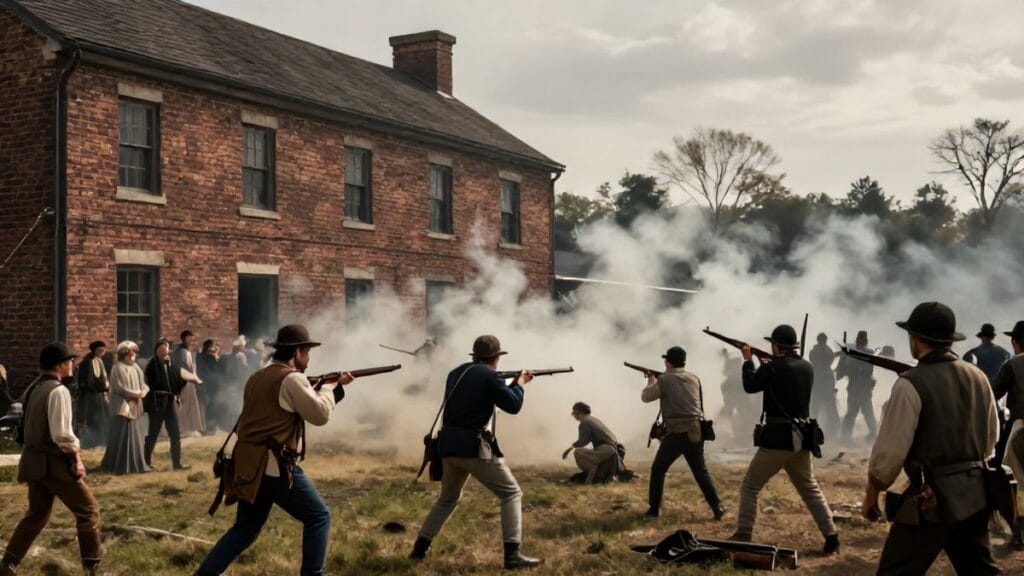
Yet the town was waking up, literally and figuratively. As dawn approached on October 17, residents noticed strange movements, armed men in unexpected places. Rumors flew: an abolitionist invasion, a slave insurrection, a band of robbers. Local militia units began to mobilize, and armed citizens crept toward the armory. Initial skirmishes erupted. Shots cracked in the morning air, ricocheting off brick and stone, shattering the sleepy sense that this was just another day in a small Virginia town.
Inside Brown’s mind, the day’s script was already diverging from his hopes. Few enslaved people had come forward; those who did were uncertain, perhaps fearful of what the morning would bring. Some were compelled at gunpoint to assist. Brown, who had imagined hundreds rallying to his banner, was instead increasingly surrounded by hostile locals and hesitant would-be allies. Still, he refused to retreat. He commanded his men to hold their positions. The armory, he told them, must not be abandoned. They would stand their ground until reinforcements—imagined and real—materialized.
As gunfire intensified, casualties mounted. Several of Brown’s men were killed or wounded in exchanges with townspeople and militia. A local mayor, Fontaine Beckham, was shot dead, inflaming white anger to a fever pitch. The raiders found themselves pressed back toward a smaller and smaller defensive perimeter. Instead of expanding outward toward the hills, Brown’s control contracted inward, like a fire trapped in a shrinking circle of fuel.
By mid-morning, the situation was dire. Militia units from neighboring towns arrived. They blocked roads and controlled higher ground. The romantic notion of a swift, decisive seizure of the armory had vanished, replaced by the grim reality of being outnumbered and outmaneuvered. Brown and several of his remaining men fell back into a brick building—the fire-engine house at the armory—dragging hostages with them. There, surrounded by thick walls and heavy doors, they made their final stand.
The Town Awakens: Militia, Telegraph Wires, and Trapped Idealists
As the sun climbed over Harpers Ferry, the town fully grasped its predicament: they were under attack by a band of armed abolitionists, some of them Black, many of them strangers. To white Virginians, raised on stories of slave rebellions and fearful always of an uprising, this was the nightmare come to life. Men snatched rifles and muskets from closets and mantels. Bells rang; messengers galloped. Telegraph messages flew to nearby cities and then on to Washington, D.C., carrying a simple but shocking message: a federal armory had been seized.
The response was swift. In Richmond and Washington, officials struggled to process the news. Was this an isolated incident or the opening move in a broader conspiracy? Could there be uprisings erupting across the South at that very moment? The panic that john brown’s raid triggered was disproportionate to the actual size of his force, but in matters of slavery, perception often outweighed fact. Southern politicians had warned for years that Northern abolitionism would one day arm the enslaved against their masters. Here, in miniature, was the prophecy made flesh.
Meanwhile, in the streets around the armory, the noose tightened. Local militias took up positions, pouring intermittent fire into the complex. Brown’s men returned shots through windows and from behind improvised barricades. Civilians were caught in crossfire; the sounds of gunfire mingled with screams, shouts, and the groans of the wounded. Smoke filled the air. The once-quiet industrial town had become a battleground, its federal buildings serving as both prize and prison.
For Brown’s followers, the psychological strain must have been immense. They had entered Virginia expecting to be pioneers of a grand liberation movement. Within hours, they found themselves portrayed as murderous invaders, pinned down by townspeople whose lives and livelihoods they had meant, however paternalistically, to transform. Some raiders slipped out, trying to reach the countryside; most were killed or captured. The dream of a march into the hills faded under the weight of disciplined, if improvised, resistance.
The federal government, alarmed by the seizure of its property and fearing wider instability, decided that local militias were not enough. Troops would be sent—specifically, United States Marines under the command of a colonel who would soon become famous for very different reasons: Robert E. Lee. With Lee came a young cavalry officer named J. E. B. Stuart. The drama inside Harpers Ferry was about to intersect with the careers of men who would, within two years, command Confederate forces against the very federal government they were now defending.
Hostages in the Engine House: A Revolution Shrinking to a Room
By the afternoon of October 17, Brown’s world had narrowed to the brick walls of the armory’s engine house. There, with a handful of remaining followers and several terrified hostages—including Colonel Lewis Washington, a grandnephew of George Washington—he waited as militiamen and, now, federal troops gathered outside. The building was sturdy, but the men inside were exhausted, low on ammunition, and wounded. Brown himself had been struck in the head by a saber or bullet fragment, leaving him bleeding and disoriented, though still conscious and defiant.
The hostages huddled together, acutely aware that their lives were bargaining chips in a rapidly deteriorating situation. Some begged for mercy; others tried to reason with Brown. They demanded to know what he hoped to accomplish, why he had brought war to their town. Brown, even under siege, spoke passionately about slavery, declaring that he had come “to free the slaves” and that he regarded his actions as obedience to a higher law than any statute of Virginia or Congress.
Outside, tempers flared. Citizens whose relatives had been killed or wounded clamored for immediate assault and execution. Militia leaders, thinking more strategically, awaited the arrival of the Marines, recognizing that storming a fortified building full of hostages required coordination and care. The presence of federal forces added another layer: this was no longer just a local affair, but a national crisis playing out on a few square yards of stone and brick.
Within the engine house, the air grew heavy. The wounded groaned; blood stained the floorboards. Some raiders questioned Brown’s decisions, especially his refusal to flee earlier when escape had still been possible. Yet even in the face of near-certain defeat, Brown refused to surrender unconditionally. He believed that his stand, however hopeless militarily, could still carry moral weight. If he could force the nation to confront the spectacle of a man willing to die to end slavery, perhaps his failure on the battlefield would become a victory in the court of conscience.
The siege dragged on. Shots occasionally pierced the walls; jeers and curses drifted in from outside. But the final act approached inexorably. Colonel Lee, upon arriving, quickly assessed the situation and prepared a decisive assault. Brown had chosen his ground, but now others would choose his fate.
Robert E. Lee, J. E. B. Stuart, and the U.S. Marines Close In
In the small hours before dawn on October 18, 1859, Colonel Robert E. Lee, temporarily recalled from leave, took command of the federal response at Harpers Ferry. The irony of his presence would become painful in hindsight: here was a Virginia-born officer in the service of the United States, preparing to crush an anti-slavery uprising, only to lead Confederate forces in defense of slavery less than two years later. At his side stood Lieutenant J. E. B. Stuart, a dashing young cavalryman who would gain fame as a Confederate raider. For now, both wore the blue of the Union, leading a detachment of U.S. Marines summoned urgently from Washington.
Lee, professional and composed, prioritized the safety of the hostages but was determined to end the standoff swiftly. He rejected suggestions to burn the engine house or use artillery that might kill those trapped inside. Instead, he chose a more surgical strike. Stuart, familiar with Brown from Kansas days, volunteered to approach the engine house under a flag of truce. Perhaps, he thought, he could talk the old warrior into surrender.
Approaching the heavy doors, Stuart called out to Brown, urging him to give up, promising that he and his men would be spared immediate execution if they complied. Brown, suspicious and proud, parleyed briefly but refused unconditional surrender. He insisted on terms that Lee would not accept, including safe conduct for his surviving men. The negotiation collapsed. Brown had one last chance to bend with circumstances, to preserve lives for another day of struggle. He chose instead to stand firm.
Lee then ordered his Marines forward. They advanced with a battering ram improvised from a ladder, under intermittent fire from the defenders. The first blow against the door failed to break it; the second splintered the wood but did not open the way. Then one of the Marines, frustrated and decisive, grabbed a heavy sledgehammer, and with a few mighty swings, shattered the door enough for men to squeeze through. What followed was brief and brutal.
The Final Assault: Shots, Shouts, and the Capture of John Brown
When the Marines burst into the engine house, chaos filled the cramped space. Brown’s men fired desperately; the attackers answered with bayonets and clubbed rifles. Smoke thickened the air; screams and curses echoed off the brick. Hostages flung themselves to the floor or pressed into corners, desperate to avoid stray bullets and thrusting steel. In those frantic seconds, the grand plans and moral debates that had led to this point were obliterated by raw survival.
Several of Brown’s followers fell in the melee. Dangerfield Newby, who had dreamed of freeing his family, had already been killed outside the day before; others now joined him in death inside the building that was supposed to be their stronghold. A Marine officer, Lieutenant Israel Greene, later recalled confronting Brown himself. In Greene’s account, he lunged at Brown with his sword, dealing him a blow that cut deeply but failed to kill. Whatever the exact sequence of strikes, Brown was gravely wounded and knocked to the floor, where Marines quickly overpowered him.
When the smoke cleared, the engine house floor was slick with blood. Several raiders were dead; others lay wounded and bound. The hostages, miraculously, had mostly survived, though shaken and enraged. Brown, bleeding and in pain, was dragged out and placed on a cot. Crowds gathered, hungry to glimpse the man who had brought such terror and confusion to their town. Some wanted him lynched on the spot. Cooler heads, including Lee and local authorities, insisted that he be held for trial. It was a fateful decision. By preserving Brown’s life for the courtroom and the gallows, they unwittingly granted him the stage he needed to transform a failed military operation into a moral spectacle of astonishing power.
The raid, in purely tactical terms, was over. Brown’s band had been killed, captured, or scattered; his dream of a mountain guerrilla war lay in ruins. Yet even as he lay wounded, John Brown remained unrepentant. Questioned by authorities, he refused to name his Northern backers or express regret for attempting to free the enslaved. He spoke calmly, even courteously, but with a steel that unnerved his interrogators. “I deny everything but what I have all along admitted,” he told Virginia’s governor soon after, “of a design on my part to free the slaves.”
In that stubborn clarity lay the seed of his legend. The guns at Harpers Ferry fell silent, but john brown’s raid was only entering its second, more far-reaching phase: the battle for national opinion.
A Nation Stares at the Scaffold: Trial, Testimony, and Martyrdom
John Brown’s trial began quickly in Charles Town, Virginia, just miles from Harpers Ferry. Authorities wanted to send a message: that armed insurrection against slavery—and against the federal government—would be met with swift, decisive punishment. The charges were grave: treason against the Commonwealth of Virginia, conspiring with enslaved people to rebel, and murder. The courtroom filled daily with spectators and reporters. Across the country, newspapers carried dispatches, and Americans who had never heard of Brown before now pored over his every word.
Despite his injuries, Brown insisted on participating in his defense, often over the objections of his court-appointed lawyers. He rejected the idea that he was a madman or a mere criminal. Instead, he framed his actions as part of a moral war against an institution that defied God and natural justice. When the court asked if he had anything to say after being found guilty, he delivered a speech that would echo through history. Calmly, he declared that he had acted “in behalf of His despised poor” and that if he had “so interfered in behalf of the rich, the powerful, the intelligent,” it would not be held a crime. He went on: “I see a book kissed here which I suppose to be the Bible, or at least the New Testament… That teaches me that all things whatsoever I would that men should do to me, I should do even so to them.”
It was a rhetorical triumph. Reporters rushed to transcribe his words. Even some who condemned his methods admitted a grudging respect for his courage and sincerity. Ralph Waldo Emerson would soon compare Brown’s hanging to the crucifixion, declaring that he would “make the gallows glorious like the cross.” Henry David Thoreau delivered a fiery defense titled “A Plea for Captain John Brown,” portraying him as a noble warrior against an unjust order. These voices did not speak for all Northerners, but they revealed how quickly john brown’s raid had moved from headline to moral parable.
In the South, the trial produced a very different reaction. There, Brown was widely seen as a terrorist and tool of Northern fanatics, proof that abolitionist rhetoric had crossed into outright warfare against Southern society. His calm demeanor and unwavering testimony only deepened the fear: if one elderly man with a handful of followers could seize a federal armory and attempt to incite slave rebellion, what might a more extensive conspiracy accomplish? Many white Southerners concluded that they lived on a powder keg, with Northern agitators determined to light the fuse.
On December 2, 1859, Brown was led to the gallows, having refused rescue attempts that might have spared his life but thwarted his martyrdom. He rode in a wagon, sitting on his own coffin, passing fields where enslaved people stood under guard, forced to witness his final journey. The atmosphere was tense but orderly; Virginia authorities were determined that this would not become a riot. They ringed the site with troops, including a young officer named Thomas J. Jackson, later famed as “Stonewall” Jackson. Among the witnesses was a still-obscure actor named John Wilkes Booth, who reportedly borrowed a militia uniform to attend. He would, in 1865, assassinate Abraham Lincoln while shouting, “Sic semper tyrannis!” The tangled web of Civil War-era violence ran, strangely, through that grim December morning in Virginia.
On the scaffold, Brown spoke little. He handed a note to a guard, predicting that “the crimes of this guilty land will never be purged away but with blood.” Moments later, the trapdoor opened, and his body dropped. John Brown was dead, but john brown’s raid had entered the realm of legend. In the North, church bells tolled; memorial services were held. In the South, militia drills intensified. A noose in Charles Town had tightened the rope around the Union itself.
Echoes Across the South: Panic, Militias, and the Hardened Slave Regime
The repercussions of Harpers Ferry in the slaveholding South were immediate and severe. The raid confirmed the darkest suspicions of white Southerners: that Northern abolitionists would stop at nothing, not even armed invasion, to destroy their social order. Newspapers, already prone to alarm, now filled their columns with reports of alleged plots, suspicious strangers, and whispered slave conspiracies. The South entered a period of sharpened paranoia.
State governments moved quickly to fortify themselves. Militias were expanded and more rigorously drilled. Laws governing the movement, education, and assembly of enslaved and free Black people grew even harsher. Any sign of discontent could now be interpreted as a prelude to another Harpers Ferry. The idea that slavery might be gradually reformed or voluntarily relinquished—always tenuous—became increasingly unimaginable to many white Southerners. To them, Harpers Ferry proved that the North harbored people willing to wade through blood to end slavery; in response, they would cling to the institution with renewed ferocity.
The South also turned its gaze northward, searching for culprits among the abolitionist elite. When evidence surfaced connecting Brown to the Secret Six and other prominent reformers, the sense of betrayal deepened. Gerrit Smith suffered a nervous breakdown; others fled or scrambled to minimize their involvement. Southern politicians seized on these revelations as proof of a sweeping conspiracy. The line between moral agitation and armed insurrection, in Southern eyes, had vanished. All abolitionist speech became suspect as potential incitement to rebellion.
At the same time, private conversations in parlors and on plantations grew darker. Planters discussed the possibility that the federal government, swayed by Northern sentiment, might eventually refuse to protect slavery. If that day came, they warned one another, secession—long a rhetorical threat—would become a necessity. Thus john brown’s raid, meant to free enslaved people by destabilizing the system, instead convinced many slaveholders that they must one day leave the Union to preserve that system. The tragic logic of escalation had begun its final spiral.
Northern Conscience and Divided Sympathies: From Condemnation to Reverence
In the North, reactions to Harpers Ferry were complex, layered, and often contradictory. Many mainstream politicians, including Abraham Lincoln, condemned Brown’s methods. Lincoln, speaking in 1859, acknowledged that slavery was wrong but argued that Brown’s attempt to spark a slave uprising was lawless and harmful to the anti-slavery cause. He stressed that Republicans sought to stop the spread of slavery through constitutional means, not violent insurrection. Newspapers in major cities echoed such sentiments, portraying Brown as a misguided zealot or outright criminal, at least in the first days after the raid.
Yet even as they criticized his tactics, many Northerners found themselves moved, even haunted, by Brown’s evident sincerity. Reports of his conduct at trial—his dignity, his composure, his insistence on the humanity of the enslaved—softened some hearts. Church pulpits wrestled with the contradiction. Could a man who had killed and plotted revolt also be a saintly figure, willing to die for the oppressed? Congregations heard sermons that praised his moral courage even as they shied from endorsing his methods. As one contemporary observer noted, the North “condemned his act and revered the man.”
Radical abolitionists, of course, had fewer qualms. To them, Brown was a hero—in Thoreau’s words, “a man of ideas and principles,” who had taken the logical next step when words and ballots proved impotent. Meetings convened to honor his memory. Poems were written. Children learned his name in households where slavery was denounced as the nation’s original sin. Over time, even some moderates found themselves uncomfortably aligning with aspects of this reverence, especially as Southern reactions grew more extreme. If the South regarded Brown as the embodiment of Northern hostility, some Northerners began to wonder if perhaps the South was right in at least one respect: the two sections did indeed stand on irreconcilable moral ground.
Out of this tension emerged one of the Civil War’s most enduring songs, “John Brown’s Body,” whose lyrics began to circulate among Union soldiers just a few years later: “John Brown’s body lies a-mouldering in the grave, / But his soul is marching on.” Set to the tune that would later adorn Julia Ward Howe’s “Battle Hymn of the Republic,” the song captured a peculiar truth: that john brown’s raid, though a military disaster, had a spiritual afterlife that marched alongside the armies of the North. Brown’s “soul,” in this metaphor, was not a ghost but an idea—the belief that slavery must be rooted out, even at the cost of great bloodshed.
Thus, in Northern cities and towns, Brown’s image slowly tilted from that of a fanatic to that of a martyr, especially after the war began. He became a symbol that allowed many Northerners to reimagine the conflict not merely as a dispute over territory or union but as a crusade against human bondage. That shift would prove crucial in sustaining the Union war effort when casualties mounted and easy victories failed to materialize.
From Harpers Ferry to Fort Sumter: How a Failed Raid Helped Ignite Civil War
In direct military terms, john brown’s raid achieved almost nothing. It freed only a handful of enslaved people; it held the Harpers Ferry armory for less than two days; it cost the lives of most of Brown’s followers, including several of his sons. But in the realm of politics and public consciousness, its impact was immense. Harpers Ferry became one of the final, decisive ruptures in the crumbling bridge between North and South.
In the 1860 presidential election, Southern politicians and newspapers repeatedly invoked Brown’s name as a warning. They accused the new Republican Party of harboring more Browns in its ranks, men who would gladly arm the enslaved and march against Southern homes. Though this was an exaggeration—most Republicans legitimately opposed such violence—it proved potent propaganda. When Abraham Lincoln won the presidency with no electoral votes from the South, many white Southerners concluded that their position within the Union was untenable. Secession conventions assembled; by early 1861, several states had left the Union to form the Confederacy.
Historians have long debated how directly Harpers Ferry led to secession and war. Slavery’s conflicts had been building for decades; many other events—the Dred Scott decision, the Kansas-Nebraska Act, the growing economic divergence between North and South—also played crucial roles. Yet it is difficult to imagine the secession crisis unfolding exactly as it did without the specter of Harpers Ferry hovering in Southern minds. John Brown had attempted to start a war in 1859 and failed. In a grim twist, his failure helped convince Southern leaders to start their own war in 1861.
Abraham Lincoln, once in office, struggled to contain the widening conflict. Initially, he framed the war as a fight to preserve the Union, not to destroy slavery. But as the fighting dragged on and the scale of the sacrifice mounted, pressure grew to define the struggle in moral as well as political terms. The Emancipation Proclamation of 1863, which declared enslaved people in Confederate-held territory free, marked a turning point. The Union now explicitly tied its cause to the end of slavery. In that sense, the Union army had, belatedly and under duress, adopted the central goal that had driven Brown to Harpers Ferry.
Of course, Lincoln’s methods differed profoundly from Brown’s. He worked through proclamations, legislation, and large-scale organized war, not through small-band guerrilla raids. But beneath those differences lay a shared recognition: that slavery could not endure if the nation were to remain true to any meaningful concept of liberty. Brown had acted on that conviction first, in miniature, with a tiny “army” at Harpers Ferry. The Union would act on it later, with millions of soldiers marching across vast battlefields. The road from the engine house to Appomattox was long and bloody, but it ran, unmistakably, through the moral terrain John Brown had staked out with his life.
Memory, Myth, and Song: The Long Afterlife of John Brown’s Raid
In the years after the Civil War, john brown’s raid passed from living memory into the realm of contested history and myth. For some, especially formerly enslaved people and their descendants, Brown remained a heroic figure—a white man who had risked everything for Black freedom at a time when few others would. Black communities named schools and organizations after him; stories of his courage were handed down alongside tales of Harriet Tubman and Frederick Douglass. Douglass himself, who had warned Brown before the raid that Harpers Ferry was “a perfect steel trap,” nonetheless came to regard him as a martyr whose blood had helped wash away slavery.
For others, particularly in the defeated but unrepentant South, Brown’s name was synonymous with treachery and fanaticism. The Lost Cause mythology that took shape after Reconstruction often portrayed the antebellum South as a land of honorable gentlemen ambushed by lawless radicals. In this narrative, Brown stood as the archetype of the violent outsider who had violated states’ rights and social order. Southern writers and politicians invoked Harpers Ferry to argue that Reconstruction policies and Black political gains were part of the same destructive impulse Brown had embodied.
Academic historians debated Brown as well. Was he a saint or a terrorist, a visionary or a madman? Early twentieth-century accounts sometimes emphasized his supposed insanity, reflecting a desire to tame or distance the radicalism he represented. Later scholars, writing amid civil rights struggles and decolonization movements, saw him more sympathetically, as an early practitioner of revolutionary anti-racism. W. E. B. Du Bois, in his 1909 biography, treated Brown as a towering moral figure, arguing that it was the society that tolerated slavery, not Brown, that was truly insane. Contemporary historians tend to occupy a middle ground, acknowledging his personal ruthlessness and strategic illusions while recognizing the profound moral clarity of his opposition to slavery.
Culture, however, often resolves such debates into simpler images. The song “John Brown’s Body” echoed through Union camps during the Civil War, later reshaped into “The Battle Hymn of the Republic,” where the line “He is trampling out the vintage where the grapes of wrath are stored” seemed to cast Brown’s mission as part of a divine crusade. In the twentieth century, writers and playwrights returned to the figure of Brown again and again. He appears as a fierce prophet in some works, a dangerous zealot in others, an enigma in most.
Even the physical site of Harpers Ferry has become a palimpsest of memory. Visitors walk the streets where Brown’s men once ran, stare at reconstructed armory buildings, and read plaques that try to do justice to the complexity of what occurred. National Park Service exhibits emphasize both the tragedy and the larger context of slavery and resistance. The engine house itself, moved and altered over time, has become a kind of shrine—not to Brown alone, but to the questions his raid still forces us to ask.
Those questions are not comfortable. When is violence justified in the pursuit of justice? How should we judge those who break laws to challenge systems we now recognize as cruel and unjust? Does the sincerity of a cause excuse the suffering it inflicts? John Brown’s life and death do not yield easy answers, but they make it difficult to avoid the questions. In a society that often prefers gradualism and compromise, he remains the unsettling figure who refused both, insisting that some evils must be met with a sword, not a speech.
Conclusion
John Brown’s raid on Harpers Ferry was a small event in scale—barely a skirmish compared to the vast battles that would soon engulf the United States—yet its reverberations were enormous. It crystallized the fears of the South, who saw in Brown a harbinger of armed Northern aggression and slave insurrection. It jolted the conscience of the North, forcing millions to confront the unsettling spectacle of a man willing to kill and die not for his own freedom, but for the freedom of others. In the courtroom and on the gallows, Brown transformed a bungled military venture into a moral drama that gripped the nation.
Historically, john brown’s raid did not topple slavery; the institution fell years later under the combined weight of military defeat and political transformation. But Brown’s actions and words helped redefine the struggle, pushing it beyond debates over tariffs and territorial balances into the realm of fundamental human rights. He exposed the emptiness of a Union that could tolerate slavery in the name of compromise, and he forced the realization—painful but necessary—that the “crimes of this guilty land” might indeed require blood to be purged.
Today, Brown’s legacy remains contested, and perhaps it should. To sanitize him as a simple hero is to overlook the lives taken in his raids and the grief left behind. To dismiss him as a madman or terrorist is to ignore the courage it took to confront an entrenched system of brutal exploitation. He stands instead as a reminder of the extremes to which moral conviction can lead, especially when legal and political avenues appear blocked. His story complicates any comforting narrative about gradual progress and peaceful reform.
In the end, the engine house at Harpers Ferry and the scaffold at Charles Town form a single arc: the path of a man who believed so fiercely in the wrongness of slavery that he accepted death as the price of resistance. Whether one views him with reverence, horror, or ambivalence, John Brown cannot be wished away. His raid forces each generation to ask how far we are willing to go, and what we are willing to risk, when confronted with injustice that seems immovable by ordinary means. The answers are never simple, but the questions endure, marching on long after the guns fell silent in that little town by the rivers.
FAQs
- What was the main goal of John Brown’s raid on Harpers Ferry?
John Brown’s primary goal was to seize the federal armory at Harpers Ferry, Virginia, and use the captured weapons to arm enslaved people in the surrounding region. From there, he intended to retreat into the nearby mountains, establish a fortified base, and wage a prolonged guerrilla campaign that would spread slave uprisings across the South and ultimately help destroy slavery. - How many men participated in the raid, and who were they?
Brown led a small force of about twenty-one men, including his own sons, several white comrades from his Kansas fighting days, and a number of Black raiders such as Dangerfield Newby and Shields Green. The group was a mix of free Black men, formerly enslaved men, and white abolitionists, most of them young and bound together by secrecy and shared idealism. - Why did the raid ultimately fail?
The raid failed for several reasons: Brown overestimated the speed and scale of support he would receive from enslaved people and local allies; he delayed leaving Harpers Ferry for the mountains, allowing local militia and federal forces time to respond; he vastly underestimated the South’s ability to mobilize quickly; and his small force was simply too outnumbered and isolated to hold the town or turn the armory into a lasting base. - How did the U.S. government respond to the raid?
Once news spread that a federal armory had been seized, the government reacted with alarm. President James Buchanan ordered U.S. Marines under Colonel Robert E. Lee to Harpers Ferry. After local militias contained the situation, the Marines assaulted the engine house where Brown and his remaining followers were holed up, captured them, and turned them over to Virginia authorities for trial on charges including treason and inciting slave insurrection. - What impact did John Brown’s raid have on the coming Civil War?
Although militarily insignificant, the raid had enormous political and psychological impact. It terrified Southern whites, who saw it as proof that Northern abolitionists would resort to violence and even armed slave revolt. It also moved Northern debates about slavery into starker moral territory. The fear and anger John Brown’s raid generated contributed to the radicalization of Southern politics, the decision to secede after Lincoln’s election, and the broader sense that peaceful compromise over slavery was no longer possible. - Was John Brown seen as a hero or a villain in his own time?
Opinions were sharply divided. Many white Southerners regarded him as a murderous fanatic and terrorist. Numerous Northerners, including moderate politicians like Abraham Lincoln, condemned his methods as unlawful and dangerous, even if they despised slavery. At the same time, radical abolitionists and some Black leaders viewed him as a martyr who sacrificed his life for the cause of freedom. Over time, especially after the Civil War, reverence for Brown grew in many Northern and Black communities, while hostility remained strong in much of the South. - What happened to John Brown’s followers after the raid?
Of the roughly twenty-one raiders, many were killed during the fighting at Harpers Ferry. Several were captured, tried, and hanged alongside Brown in Virginia. A few managed to escape and later told their stories from hiding or in exile. The fates of these men, especially the Black raiders, underscore the high personal cost of Brown’s risky and ultimately doomed venture. - How do historians today generally view John Brown and his raid?
Modern historians tend to present a nuanced view. They recognize Brown’s uncompromising opposition to slavery and his willingness to fight for Black freedom at a time when few whites would, but they also scrutinize his use of violence, his strategic miscalculations, and the human toll of his actions. Rather than labeling him simply as hero or villain, many scholars treat him as a complex figure whose life illuminates the moral and political tensions of the era leading up to the Civil War.
External Resource
Internal Link
Other Resources
- Encyclopaedia Britannica – general search for the exact subject
- Google Scholar – academic search for the exact subject
- Internet Archive – digital library search for the exact subject