Table of Contents
- The Morning of November 22, 1963: A Nation Holds Its Breath
- The Road to Dallas: Kennedy’s Campaign and Political Climate
- Dallas: A City on Edge
- The Motorcade Route: A Public Spectacle Turned Tragedy
- The Fatal Shots: Minutes That Changed the World
- Immediate Reactions: Chaos, Shock, and Grief
- The Arrest of Lee Harvey Oswald: From Suspect to Sole Accused
- The Murder of Officer J.D. Tippit: A Rising Tide of Violence
- Oswald’s Interrogation: Silence and Confusion
- The Killing of Oswald: A Nation in Disbelief
- The Warren Commission: Unpacking the Official Narrative
- Conspiracy Theories Emerge: Doubts and Alternative Accounts
- The Impact on the Kennedy Family: Personal Loss and Public Mourning
- The Nation’s Psyche: A Lost Innocence
- The Cold War Shadow: Political Repercussions at Home and Abroad
- Media and Memory: How Television Shaped the Tragedy
- The Myth and Legacy of JFK’s Presidency
- Revisiting History: New Documents and Continuing Debates
- How Dallas Changed: Urban Trauma and Remembrance
- The Enduring Symbolism of November 22
- From Tragedy to Reform: Changes in Secret Service and Security Protocols
- Global Reactions: International Mourning and Solidarity
- Artistic and Cultural Reflections: From Grief to Protest
- The Place of JFK’s Assassination in American Identity
- Looking Forward: Lessons from a Day That Defined a Generation
The Morning of November 22, 1963: A Nation Holds Its Breath
The sun climbed slowly over Dallas, Texas, that chilly November morning, casting long shadows across Dealey Plaza. The city was alive with anticipation, an electric current in the air as thousands gathered to catch a glimpse of President John F. Kennedy and his radiant young wife, Jacqueline. It was a moment bursting with promise—a president beloved by many, riding in an open convertible, waving to the crowds who cheered in adoration. Yet, beneath this celebratory veneer lurked the seeds of catastrophe. By day’s end, America’s brightest hope would lie shattered, and a nation would plunge into mourning.
The abrupt silence following the sharp report of gunfire, the stunned gasps of witnesses, the frantic rush to save a life that was already slipping away—all etched themselves indelibly into the collective memory. For many, November 22, 1963, became the very definition of tragedy. But what led to this fateful moment? How did a seemingly ordinary presidential visit become the stage for one of the most devastating assassinations in modern history?
The Road to Dallas: Kennedy’s Campaign and Political Climate
In 1963, John F. Kennedy stood at the pinnacle of his presidency, a symbol of youthful vigor and progressive ambition. Yet, his tenure was not without controversy. The Cold War pressed heavily on America’s shoulders, the threat of nuclear annihilation felt palpably close. Domestically, Kennedy’s push for civil rights reforms ignited fierce resistance, especially in the South.
Texas, a crucial battleground in the forthcoming 1964 election, became a focus for the Kennedy administration’s efforts to solidify support. Yet within Texas’s heartland roiled deep-seated resentments, ideological divisions, and political grudges. Hard-line segregationists, conservative Democrats, and a fracturing Democratic Party made Dallas a volatile place.
Kennedy’s mission was clear: to rally allies, energize voters, and project strength. But for some in Texas, his presence was less welcomed than anticipated. This mix of admiration, opposition, and tension set the stage for the grim drama that would unfold.
Dallas: A City on Edge
Dallas in the early 1960s embodied the contradictions of a rapidly modernizing America. Prosperous yet conservative, youthful yet clinging to old orders, the city was a crossroads of ideology and ambition. The local business elite, the political factions, and the fervent citizens created a social landscape that was as much a powder keg as a beacon of progress.
On the morning of the assassination, the mood was cautiously optimistic. But the undercurrents of hostility were palpable. Newspapers editorializing against Kennedy’s policies, whispers of conspiracy and dissent, and a local atmosphere charged with distrust foreshadowed the tragedy.
Despite the meticulous planning of the presidential visit, and the heavily armed security detail accompanying the motorcade, the city was unprepared for what would come.
The Motorcade Route: A Public Spectacle Turned Tragedy
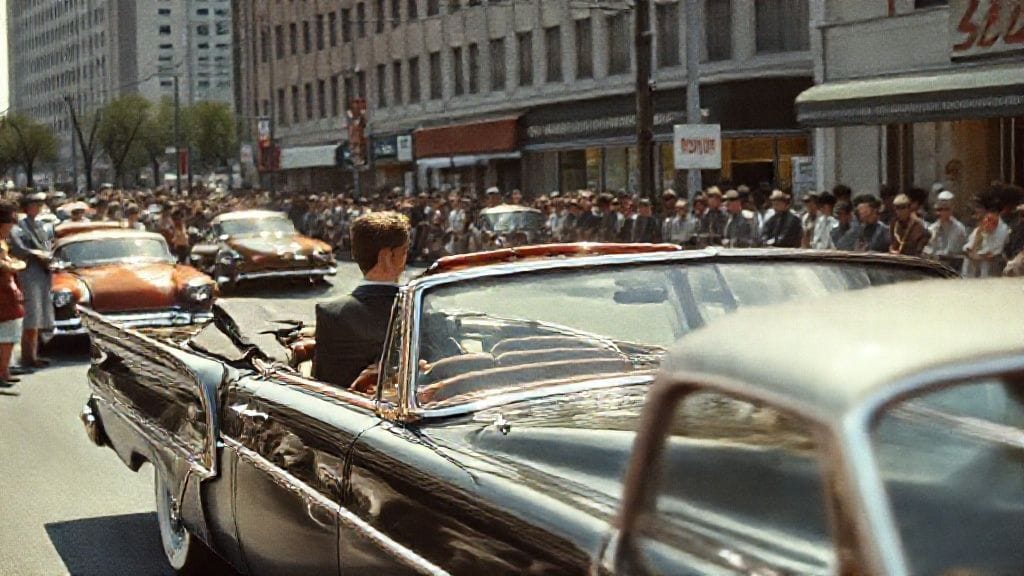
Kennedy’s motorcade wound through the downtown streets, a glittering parade set against a tapestry of cheers and waving flags. He sat beside his wife in the iconic 1961 Lincoln Continental convertible, open to the world. Texas Governor John Connally and his wife accompanied them, smiling and waving.
The route was designed for maximum visibility, a public relations masterpiece demonstrating Kennedy’s connection to the American people. But the very openness that endeared him to crowds exposed a vulnerability.
As the limousine approached Dealey Plaza, moving past the Texas School Book Depository and other key landmarks, thousands of spectators lined the streets. Few could foresee that the day's hopeful procession would morph into a crime scene.
The Fatal Shots: Minutes That Changed the World
At precisely 12:30 p.m., the sound of gunfire shattered the festive atmosphere. Witnesses recall a sudden surge of panic—glass breaking, screams, the president clutching his throat. Three shots rang out in rapid succession. Kennedy was struck in the neck and head. Governor Connally was also wounded but survived.
Chaos erupted. Secret Service agents scrambled, the limousine accelerated to Parkland Memorial Hospital, sirens blaring. The world watched in horror as news trickled in—President Kennedy was gravely wounded. The medical teams fought desperately, but by 1:00 p.m., John Fitzgerald Kennedy was pronounced dead.
Immediate Reactions: Chaos, Shock, and Grief
The news rippled across the nation with incredible swiftness. Radio broadcasts halted programming; television stations switched to breaking coverage. The joyous mood dissipated instantly into disbelief and sorrow. For many Americans, it was the first time they faced the stark reality of political violence so close to home.
President Lyndon B. Johnson, sitting a few cars behind Kennedy, was quickly sworn in aboard Air Force One, a grim ceremony shadowed by tragedy. Jacqueline Kennedy, bloodstained yet dignified, remained by her husband’s side. The country stood united in grief, grappling with the profound loss of a leader who had inspired so much hope and possibility.
The Arrest of Lee Harvey Oswald: From Suspect to Sole Accused
Amid the frenzy, law enforcement identified Lee Harvey Oswald, a former Marine with a troubled past, as the prime suspect. He was arrested shortly after the assassination for the murder of Dallas police officer J.D. Tippit, gunned down during an attempted escape.
Oswald’s background was complex: a defector to the Soviet Union who had returned to America, a man marked by erratic behavior and political dissent. For many, Oswald was an enigmatic villain, but others questioned whether he acted alone—or at all.
His quiet defiance and refusal to answer questions fueled speculation, and the official narrative began to take shape.
The Murder of Officer J.D. Tippit: A Rising Tide of Violence
Just 45 minutes after the shooting of President Kennedy, Officer J.D. Tippit was killed in a nearby neighborhood. Tippit had stopped Oswald on suspicion, an encounter that would end in fatal violence.
This murder added urgency to Oswald’s arrest and lent weight to the accusation that he was the assassin. Yet, it also intensified the atmosphere of fear in Dallas, as if the city itself had become a battleground where violence lurked behind every corner.
Oswald’s Interrogation: Silence and Confusion
Held in custody, Oswald refused to cooperate with investigators. His terse denials—“I’m just a patsy”—did little to clarify the truth. Official interrogations were marred by conflicting accounts and lack of concrete evidence.
The American public was left to wrestle with a bewildering enigma: a lone gunman or a pawn in a larger conspiracy? Media speculation soared as anonymity gave way to suspicion and rumor. The unanswered questions cast long shadows over the investigation.
The Killing of Oswald: A Nation in Disbelief
On November 24, 1963, as Oswald was being transferred to another facility, Jack Ruby, a Dallas nightclub owner with connections to local law enforcement, stepped forward and fatally shot Oswald live on television.
This shocking act stunned the nation and deepened the mystery. How had Ruby gained access to Oswald? What motives lay behind this sudden killing?
Ruby’s actions denied the nation the opportunity to hear Oswald's full testimony, feeding conspiracy theories and cynicism. To many, it felt as though justice had been interrupted.
The Warren Commission: Unpacking the Official Narrative
In the months that followed, President Johnson appointed the Warren Commission, a panel led by Chief Justice Earl Warren, charged with investigating the assassination. In 1964, the commission concluded that Oswald acted alone, firing three shots from the Texas School Book Depository.
The report, though thorough, was received with mixed reactions. Some hailed it as definitive closure, while others criticized it for inconsistencies and lack of transparency. The commission’s findings, intended to reassure a distressed nation, instead sowed seeds of doubt.
Conspiracy Theories Emerge: Doubts and Alternative Accounts
From the moment the commission declared Oswald the lone gunman, alternative narratives began to emerge. Was there a second shooter? Were intelligence agencies involved? Had organized crime or foreign entities conspired?
These questions spawned a complex web of theories, each attracting devoted adherents and skeptics alike. Documentaries, books, and debates proliferated, making the JFK assassination perhaps the most scrutinized political murder in history.
The Impact on the Kennedy Family: Personal Loss and Public Mourning
Beyond the political turmoil and national trauma stood the Kennedy family—widowed Jacqueline, children John Jr. and Caroline, and the extended clan—left to navigate unimaginable grief under the world’s spotlight.
The family’s public dignified sorrow humanized the tragedy, drawing empathy but also relentless media intrusion. The assassination effectively ended an era for the Kennedys and reshaped their legacy in profound ways.
The Nation’s Psyche: A Lost Innocence
The assassination was more than a political event—it was a psychological rupture. Americans confronted a violent reality where even their president was vulnerable. This shattered the sense of post-war optimism and safety.
The veneer of American exceptionalism was cracked. The trauma permeated the arts, culture, and politics, marking a turning point from naive idealism to a more cynical and guarded national outlook.
The Cold War Shadow: Political Repercussions at Home and Abroad
In the heart of the Cold War, Kennedy’s assassination had international ramifications. Allies and adversaries alike watched anxiously. Questions about Soviet and Cuban involvement circulated, heightening tensions.
Domestically, the event rallied support for Johnson’s subsequent policy agenda, including civil rights and Vietnam escalation, but also exacerbated political divisions.
Media and Memory: How Television Shaped the Tragedy
Television played a revolutionary role, broadcasting the assassination and aftermath live into living rooms worldwide. Walter Cronkite’s solemn announcement—“There’s nothing wrong with America that can’t be cured by what is right with America”—echoed for years.
The instant global access created a shared experience of loss and uncertainty, transforming news coverage and collective memory into intertwined forces.
The Myth and Legacy of JFK’s Presidency
Despite lasting less than a thousand days, Kennedy’s presidency became an iconic symbol of possibility, youth, and tragedy. "Camelot," as Jackie famously termed it, represented an era of charisma and hope abruptly ended.
His vision and rhetoric continued to inspire, while the manner of his death enshrined him as a martyr in American history.
Revisiting History: New Documents and Continuing Debates
Declassified files and ongoing investigations have kept the story alive. New evidence has validated some suspicions and challenged others, but definitive answers remain elusive.
Historians continue to dissect the evidence, treating the assassination as a pivotal moment demanding scrutiny, reflection, and cautious interpretation.
How Dallas Changed: Urban Trauma and Remembrance
In the aftermath, Dallas grappled with its role as the yet unwilling host of tragedy. The city undertook efforts to commemorate the event while reshaping its image, balancing remembrance and renewal.
Dealey Plaza now stands as a somber monument, inviting visitors to reflect on history’s dark turns.
The Enduring Symbolism of November 22
The date itself has become shorthand for loss, resilience, and the fragility of power. November 22 is etched in American collective consciousness as a day of reckoning, transformation, and memory.
Commemorations and scholarly work preserve its significance, encouraging generational dialogue about leadership, violence, and democracy.
From Tragedy to Reform: Changes in Secret Service and Security Protocols
The assassination exposed glaring vulnerabilities in presidential security. In response, the Secret Service underwent sweeping reforms, enhancing protection strategies that remain pivotal today.
This legacy—born from tragedy—saved future administrations, reflecting institutional learning amid sorrow.
Global Reactions: International Mourning and Solidarity
The world mourned alongside America. Leaders from Moscow to London expressed condolences, and citizens worldwide tuned in to the unfolding story.
This shared grief highlighted Kennedy’s stature as a global figure and underscored how interconnected mid-20th-century geopolitics had become.
Artistic and Cultural Reflections: From Grief to Protest
JFK’s assassination influenced literature, music, film, and art. From solemn elegies to sharp political critiques, creative responses kept trauma alive while fueling activism.
The event helped catalyze the cultural upheavals of the late 1960s, linking personal loss to broader social transformations.
The Place of JFK’s Assassination in American Identity
Ultimately, Kennedy’s death crystallized a moment of national identity formation, intertwining hopes for progress with fears of vulnerability.
It remains a touchstone for discussions about leadership, democracy, and the cost of change—an event endlessly woven into the tapestry of American self-understanding.
Looking Forward: Lessons from a Day That Defined a Generation
As history marches on, the assassination remains a solemn reminder of humanity’s fragility and resilience. It forces reflection on governance, security, the power of myth, and the enduring quest for truth.
November 22, 1963, endures — not just as a date of death, but as a catalyst for remembrance, reform, and hope.
Conclusion
On that brisk autumn day in Dallas, the world witnessed the abrupt extinguishing of a bright and hopeful flame. John F. Kennedy’s assassination was not just the violent death of a man, but the fracturing of a national dream—a piercing moment where innocence shattered and the complex realities of power, violence, and history converged.
Yet, amid the grief and uncertainty, the exercise of memory, inquiry, and artistic reflection ensures that the tragedy is neither forgotten nor reduced to a singular explanation. It remains, instead, a profound human story—a story of aspiration and loss that continues to speak to the vulnerabilities and hopes at the heart of the American experience.
The legacy of JFK challenges us to remember not only the man and his death but the ideals summoned by his life: democracy in peril, leadership tested, and a nation striving to heal and understand.
FAQs
Q1: Who was Lee Harvey Oswald, and why was he accused of killing JFK?
Oswald was a former Marine who had defected to the Soviet Union before returning to the U.S. He was arrested soon after the assassination and accused based on eyewitness accounts and his presence near the crime scene. Official inquiries concluded he was the lone assassin, but some dispute this.
Q2: What role did the Warren Commission play in the investigation?
The Warren Commission was established by President Johnson to investigate JFK’s assassination. It concluded that Oswald acted alone. Despite its comprehensive work, the report was criticized for inconsistencies, leaving room for alternative theories.
Q3: Why do so many conspiracy theories exist around JFK’s assassination?
The sudden death of a charismatic leader, Oswald’s quick murder, inconsistencies in investigations, and Cold War tensions fueled suspicions. Lack of full transparency contributed to widespread speculation involving government agencies, organized crime, and foreign powers.
Q4: How did JFK’s assassination affect the United States politically?
It marked a loss of innocence and a shift in the political atmosphere. Johnson’s presidency expanded civil rights reforms and escalated involvement in Vietnam, in part fueled by the tragic event’s national mood.
Q5: What changes in presidential security occurred after the assassination?
The assassination led to reforms in the Secret Service protocols, including enhanced protective measures for the president, more rigorous route planning, and armored vehicles.
Q6: How is November 22 remembered today?
The day is commemorated through ceremonies, historical preservation of Dealey Plaza, and continuous scholarly reflection. It serves as a somber reminder of the vulnerabilities in American history and leadership.
Q7: What was the impact of media coverage on the assassination’s public perception?
Television allowed millions to witness events live, creating a shared national trauma. Media shaped both the emotional and narrative legacy, influencing public opinion and memory.
Q8: How did the Kennedy family cope with the tragedy?
The Kennedy family faced enormous grief under the global spotlight, maintaining public dignity. Their loss personalized the event and deepened public empathy, while also ushering a new chapter in their family’s complex narrative.