Table of Contents
- The Fading Light of a Romantic Star: February 23, 1821
- John Keats: The Poet and His Burdened Soul
- England’s Literary Scene and the Shadow of Criticism
- Keats’s Final Journey: From London to Rome
- The Road to Rome: Illness, Hope, and Despair
- Arrival in the Papal States: A City of Contrasts
- Rome’s Climate and Its Promise to the Sick
- The Poet’s Last Days: Between Pain and Reverie
- Conversations with Friends: Letters and Farewells
- The Role of Joseph Severn: Guardian and Witness
- The Medical Understanding of Tuberculosis in the 19th Century
- Death on the Spanish Steps: The Poignant End
- The Immediate Aftermath: Public and Private Mourning
- Keats’s Posthumous Reputation: From Obscurity to Reverence
- The Papal States and their Role in Keats’s Final Chapter
- Artistic and Literary Legacy Sparked by the Poet’s Death
- Rome as a Shrine: Memorials and Pilgrimages through Time
- The Human Cost Behind the Legend of John Keats
- Revisiting 1821: Historical Context Beyond the Poet’s Illness
- Enduring Questions: What If Keats Had Lived?
- Keats’s Death in the Wider Romantic Movement
- Conclusion: The Eternal Breath of a Brief Life
- FAQs on John Keats’s Death and Legacy
- External Resource
- Internal Link
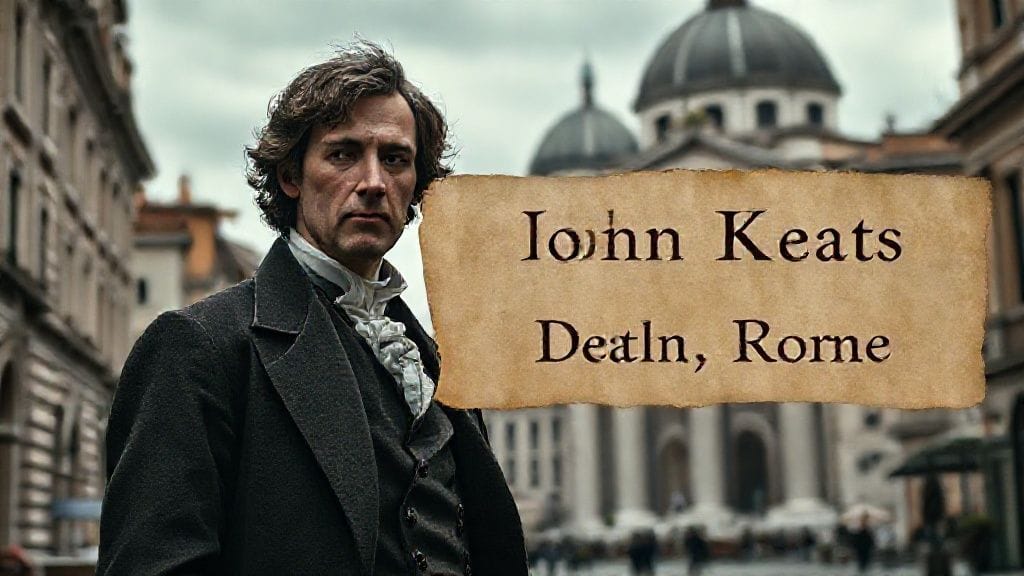
John Keats, a name forever etched in the annals of Romantic poetry, breathed his last on a cold February day in 1821. The air in Rome was tinged with the quiet weight of history and illness, and the soundscape was a mixture of church bells echoing over cobblestone streets and the muffled voices of those who knew the fragile life slipping away. It was a moment suspended between hope and despair—an end not just of a life, but of a luminous promise.
The Fading Light of a Romantic Star: February 23, 1821
On that day, the world lost one of its most tender and visionary voices. Keats, aged only twenty-five, lay in a small rented room overlooking Rome’s sprawling skyline beneath an Italian winter sky. His body, ravaged by consumption (what we now call tuberculosis), was weakening by the hour. Yet his mind still cradled images of beauty and mortal ache with ineffable grace.
It was 1821—the world still reeling from the Napoleonic era, with Europe caught between revolutionary ideals and the resurgence of old monarchies. In this turbulent sea, Keats’s gentle existence and his quiet battles embodied the human struggle against fate and oblivion.
John Keats: The Poet and His Burdened Soul
Born in London in 1795, Keats was the son of a stable keeper—a modest beginning, far from the aristocratic or scholarly origins that often preceded the great luminaries of his day. His literary career was brief but intense. Driven by a profound sensitivity to nature, beauty, and human suffering, Keats carved a path in poetry that celebrated the transitory, the momentary bursts of joy and pain that define mortal life.
But alongside his poetic genius was a body that betrayed him. The very faculties that allowed him to pen some of the most exquisite odes—Ode to a Nightingale, Ode on a Grecian Urn—were diminished each day by relentless illness.
England’s Literary Scene and the Shadow of Criticism
Keats’s life in London was marred by harsh critique. The literary establishment often scorned his work for its perceived sensual excess and lack of classical restraint. Publications such as The Quarterly Review and Blackwood’s Magazine dismissed his poems as frivolous or even vulgar.
This critical assault was more than professional—it was personal. Keats suffered bouts of depression and self-doubt, believing that his work would never be accepted or remembered. These negative reviews weighed heavily on his fragile health and spirit, yet they also fueled a restless desire to prove his artistic worth.
Keats’s Final Journey: From London to Rome
When tuberculosis was diagnosed in Keats in late 1820, there were few effective treatments. Doctors recommended a warmer climate as the only palliative measure. Italy, particularly Rome, emerged as a beacon of hope—a place where the poet’s failing lungs might find relief under gentler skies.
In September 1820, with a painful mix of hope and resignation, Keats set sail for Italy under the care of his close friend and painter, Joseph Severn. The voyage marked both a physical and symbolic departure—from bleak English winters to the sun-bathed heart of the ancient continent.
The Road to Rome: Illness, Hope, and Despair
Across the Mediterranean, Keats’s condition vacillated between fleeting improvement and devastating decline. Letters he wrote during this period reveal a man clinging to a slender thread of hope for recovery, yet increasingly aware of his mortality.
His poetic vision remained intact; amidst weakness, Keats continued to compose verses reflecting the paradox of beauty and decay. The journey was both a struggle and a final testament to his indomitable spirit.
Arrival in the Papal States: A City of Contrasts
Rome at the time belonged to the Papal States, governed by the Pope’s temporal authority. It was a city riven with contradictions—monuments to classical antiquity alongside baroque churches, crowded with pilgrims and artists yet shadowed by political tensions and decay.
For Keats, this ancient city was an alien tableau yet also a place of enchantment. The air was different, infused with scents of laurel and cypress; the sounds were unfamiliar, carrying the vibration of Latin prayers and bustling markets.
Rome’s Climate and Its Promise to the Sick
Physicians of the era believed that Rome’s mild winter air could ease consumptive symptoms. The absence of damp coldness, plus the possibility for gentle walks under the sun, promised a reprieve from the relentless torments of tuberculosis.
For Keats, these promises flickered like fragile flames. Though physically weakened, the warmth nourished his spirits and inspired a serene acceptance of fate.
The Poet’s Last Days: Between Pain and Reverie
In the small room of the Piazza di Spagna where Keats stayed, time seemed both suspended and accelerated. His breaths came ragged, his frame increasingly emaciated, but his inner world expanded.
He alternated between moments of lucid clarity and torments of fevered delirium. During lucid intervals, Keats recited poetry and shared thoughts on immortality, suffering, and beauty with Severn.
Conversations with Friends: Letters and Farewells
Keats’s correspondence from this period is suffused with tenderness and melancholy. To friends back in England, he voiced both gratitude and a quiet farewell, entrusting his poetry to their memory.
One letter to his sister Fanny resonates with poignant longing: “I feel it most when I am left alone in the silence of the room, when the world seems to be closing quietly around me.”
The Role of Joseph Severn: Guardian and Witness
Joseph Severn was more than a companion; he was Keats’s devoted caregiver, protector, and silent chronicler. The painter kept vigil through nights dense with illness, providing physical support and emotional comfort.
Severn’s letters and recollections became key testimonies to the poet’s final moments, revealing a bond forged beyond friendship—a testament to loyalty amid the shadow of death.
The Medical Understanding of Tuberculosis in the 19th Century
In Keats’s time, tuberculosis was a dreaded, poorly understood disease. Victorian medicine offered few solutions beyond climate therapy and palliative care.
The diagnosis carried a social stigma as well, often associated with poverty and contagion. For a man of delicate sensibilities like Keats, this added isolation compounded the physical suffering.
Death on the Spanish Steps: The Poignant End
Keats passed away on February 23, 1821, in his Rome lodgings near the famed Spanish Steps. His last words reportedly reflected his enduring poetic soul: “I am certain of nothing but the holiness of the Heart’s affections and the truth of Imagination.”
He died quietly, leaving behind manuscripts that soon became a literary treasure trove, largely unappreciated by his contemporaries.
The Immediate Aftermath: Public and Private Mourning
News of his death traveled slowly. Few at the time grasped the magnitude of the loss. The funeral was modest, attended mostly by Severn and a handful of friends.
Yet grief was profound, especially among those who knew the promise Keats embodied. His family mourned a young life cut short; the Romantic circle in England felt the absence keenly.
Keats’s Posthumous Reputation: From Obscurity to Reverence
Decades after his death, Keats’s work gained renewed admiration. Literary giants such as Percy Bysshe Shelley and later T.S. Eliot championed his poetry.
By the late 19th century, Keats had become a symbol of youthful talent snuffed out by fate—an icon of Romantic idealism and tragic beauty.
The Papal States and their Role in Keats’s Final Chapter
The Papal States, though politically conservative and religiously strict, unwittingly hosted this moment in literary history. Rome’s cultural and spiritual atmosphere, infused with centuries of art and faith, offered a unique backdrop to Keats’s last days.
The city became a silent witness to a young life closing amidst echoes of antiquity and sacred tradition.
Artistic and Literary Legacy Sparked by the Poet’s Death
Keats’s death inspired countless artistic tributes. Painters, musicians, and writers drew on the themes of his life and demise—beauty intertwined with suffering, the promise of immortality through art.
His death elevated his poetry from the personal to the eternal, inspiring readers across generations.
Rome as a Shrine: Memorials and Pilgrimages through Time
Today, Keats’s tomb in the Protestant Cemetery in Rome is a pilgrimage site for admirers worldwide. The olive-branch inscription—“Here lies One Whose Name was writ in Water”— serves as a humble yet profound epitaph.
Visitors retrace the steps of the poet, touching the stones where his fleeting life found its final rest.
The Human Cost Behind the Legend of John Keats
Beneath the layers of literary glory lies the intimate story of a young man battling anguish, isolation, and the relentless march of death. Keats’s life and death remind us of the fragile interplay between creative genius and human vulnerability.
The poignancy of his story is a meditation on mortality itself.
Revisiting 1821: Historical Context Beyond the Poet’s Illness
The year 1821 was marked by upheavals—the liberal revolutions incubating across Europe, Napoleon’s shadow lingering, and the slow but inexorable emergence of modern nation-states.
Keats’s death, while deeply personal, intersects with this broader historical tapestry, highlighting how art and history often weave complex narratives side by side.
Enduring Questions: What If Keats Had Lived?
One of the great tragedies of literary history is wondering what might have been. Had Keats survived, his lyrical voice could have shaped much more of Romantic poetry and beyond.
Speculation about his unrealized potential continues to fuel fascination and scholarly debate alike.
Keats’s Death in the Wider Romantic Movement
Keats’s demise echoed the fate of many Romantics—young, passionate artists often beset by illness and societal misunderstanding.
His death contributed to the mythos of the Romantic artist as tragic figure—driven by emotion, creativity, and ultimately fragile in the face of reality.
Conclusion
John Keats’s death on that February day in 1821 was not just the extinguishing of a young poet’s life but the birth of a legend. From the silent streets of Rome under a pale winter sky emerged a voice that would resonate beyond centuries—a testament to human sensitivity and artistic yearning.
His brief existence, marked by suffering and beauty alike, invites us still to contemplate the fleetingness of life and the enduring power of art. Keats reminds us how sometimes the brightest stars burn the fastest, leaving trails of light that illuminate the darkest nights.
FAQs
Q1: What caused John Keats’s death?
John Keats died of tuberculosis, then known as consumption, a widespread and often fatal disease of the lungs in the 19th century.
Q2: Why was Keats sent to Rome?
Physicians recommended a warmer, milder climate to help alleviate the symptoms of his tuberculosis, and Rome, part of the Papal States, was considered a therapeutic location for consumptive patients.
Q3: Who was Joseph Severn and what was his role?
Joseph Severn was a painter and close friend who accompanied Keats to Italy. He acted as Keats’s caretaker and provided emotional support during his final months.
Q4: How was Keats’s work received during his lifetime?
Keats faced severe criticism and neglect during his life, with many reviewers dismissing his poetry. His work gained significant recognition only posthumously.
Q5: What is the significance of Keats’s tomb in Rome?
Keats’s tomb in the Protestant Cemetery is a historical and literary pilgrimage site, marked by his poignant epitaph that reflects themes of transience and memory.
Q6: How does Keats’s death reflect broader themes in the Romantic movement?
His early death underscored the Romantic ideals of intense emotion, the fragility of life, and the tragic artist archetype prevalent among his contemporaries.
Q7: What were the medical beliefs about tuberculosis when Keats was ill?
In the early 19th century, treatments were limited; climate therapy, especially relocation to warm and dry environments, was among the few recommended palliative measures.
Q8: Has Keats’s legacy influenced modern literature and culture?
Absolutely; Keats’s poems continue to inspire readers and artists worldwide, symbolizing the fusion of beauty, existential reflection, and poetic immortality.