Table of Contents
- The Last Days of a Literary Giant
- London in the Late 17th Century: A City in Flux
- John Milton: The Life Before the End
- The Shadow of Blindness: Milton’s Final Years
- November 1674: The Quiet Passing
- A Final Farewell: Death in the Milton Household
- Burial and Immediate Reactions
- The Political and Religious Context of Milton’s Death
- Milton’s Literary Legacy at the Moment of His Passing
- The Posthumous Reputation: From Obscurity to Reverence
- The Impact on English Literature and Thought
- The Role of Milton’s Death in Shaping Restoration England’s Memory
- Milton in the Collective Consciousness: Myth and Man
- Forgotten for a Time: The 18th Century’s Shifting Tastes
- The 19th Century Rediscovery and Romantic Embrace
- Milton’s Death as a Symbol of Intellectual Resistance
- Anecdotes and Personal Accounts from Contemporaries
- How Milton’s Blindness Shaped the Final Chapter of His Life
- The Family and Friends Who Mourned Him
- Milton’s Death and the Transition of English Literary Culture
- Reflections on Mortality and Creativity: Milton’s Final Testament
- Commemorations and Memorials Through the Centuries
- Milton’s Death in Modern Scholarship and Popular Memory
- Conclusion: The End of a Voice, The Start of an Echo
The Last Days of a Literary Giant
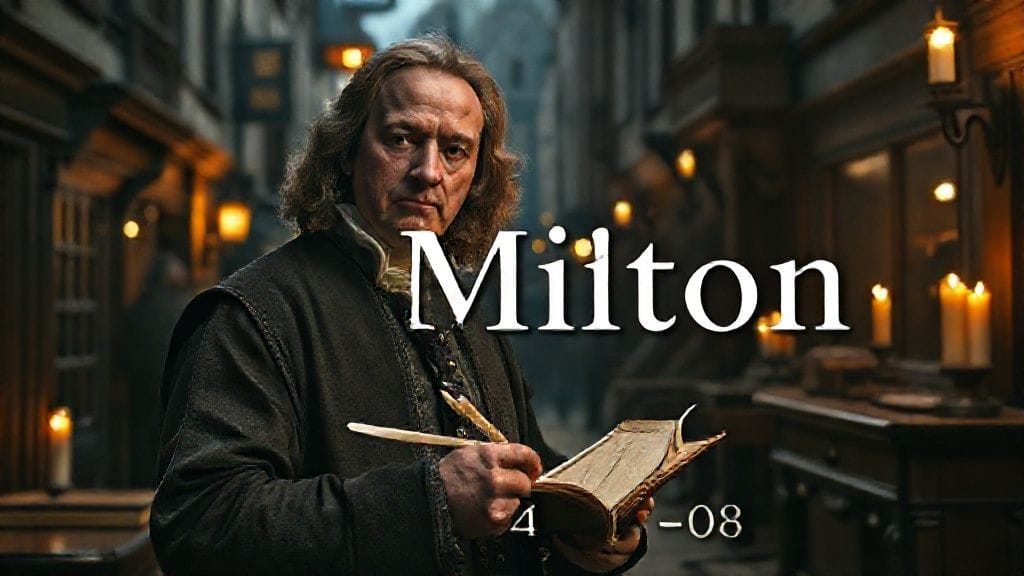
On a cold and somber November day in 1674, the city of London—its streets choked with damp and smoke—witnessed the passing of one of its most formidable souls: John Milton. The celebrated poet, polemicist, and thinker breathed his last within the modest walls of his home in the bustling capital, his departure marking the close of an epoch. He was a man whose prodigious mind soared even in the midst of blindness and political exile, whose words would continue to reverberate through centuries. But on that quiet afternoon, among flickering candles and the heavy scent of ink and parchment, John Milton’s life extinguished—leaving behind only echoes, drafts, and the lingering spirit of England’s tumultuous seventeenth century.
London in the Late 17th Century: A City in Flux
The London of Milton’s final days was a metropolis at a crossroads. The Great Fire of 1666 still haunted collective memory—charred timber and ash intermingled with new bricks and ambition. The city bustled with merchants, artists, merchants, and intrigue, recovering from decades dominated by civil war, regicide, and the uneasy Restoration of Charles II. Amid the cobbled alleys and taverns thick with gossip, political tensions simmered beneath the surface. Religious faith, the role of monarchy, and ideas of liberty were fiercely debated, often violently. The intellectual ferment that characterized Milton’s career had not dissipated with his death; if anything, it had ignited renewed sparks among his contemporaries.
John Milton: The Life Before the End
John Milton’s journey was that of a man entwined with his country’s fate. Born in 1608 in London, he rose not only through talent but also conviction. A poet whose musical prose and sharp rhetoric could inflame public opinion, Milton stood as a visionary who dared to challenge monarchs and dogma alike. His life was a tapestry woven with passions—classical learning, Puritan piety, and political fervor. He had penned Paradise Lost, the epic poem that redefined English literature; navigated the stormy seas of the English Civil War supporting the Commonwealth; and later, as his eyesight waned, dictated his masterpieces even in blindness. By 1674, he was a venerated but vulnerable figure, fragile in body but indomitable in spirit.
The Shadow of Blindness: Milton’s Final Years
The cruel onset of blindness in his late forties did not silence Milton. Instead, it reshaped his creative process and his relationships. Dependent on amanuenses—friends who transcribed his spoken words—he pursued the epic vision of redemption and human dignity. However, blindness isolated him socially and physically in a city restless with change. By his late sixties, Milton lived in near seclusion, battling both infirmity and political disfavor. This solitude became the crucible of genius and sorrow, steeped in reflections on loss, both personal and national.
November 1674: The Quiet Passing
On the 8th of November, Milton’s frail body finally succumbed. The moment passed largely unnoticed by the general public, overshadowed by London’s everyday toils and troubles. Historical accounts suggest that he died peacefully, surrounded by close family and trusted friends—an intimate coda for a man whose words had once gripped the nation’s heart. The poet’s death was more a soft eclipse than a dramatic finale, a silent surrender in a world that had grown loud and indifferent.
A Final Farewell: Death in the Milton Household
Milton’s death arose in the presence of those who loved him and respected his genius—his daughters, volunteers who had read his epic aloud in the years before, and friends loyal to his memory. The mourning was private, colored by the Anglican traditions with which Milton had complex relations, given his Puritan roots and independent religious thought. His body was prepared with a quiet dignity appropriate for a scholar, far from the pomp that would attend some deaths among the aristocracy but rich in personal affection.
Burial and Immediate Reactions
The poet was laid to rest in the Church of St Giles in the Fields, a modest resting place in the heart of London. The burial received little fanfare beyond his immediate circle. Outside literary and political those circles, the man’s death barely made a ripple amid the steady pulse of Restoration England. Yet, for those who knew Milton’s towering intellect and moral rigor, his passing commanded reverence tinged with melancholy. Early obituaries noted the loss of an uncompromising voice of conscience.
The Political and Religious Context of Milton’s Death
Milton did not die apart from the political struggles that had defined his life. His passing in 1674 coincided with a period of repositioning in England—a monarchy restored but fragile, religious tensions unresolved, and republicans displaced but not silenced. Milton’s political pamphlets and poems had fervently supported the Commonwealth and challenged royal absolutism, positioning him as a controversial figure. Though the Stuart monarchy now ruled, Milton’s ideals persisted covertly, inspiring dissenters and shaping emerging political thought.
Milton’s Literary Legacy at the Moment of His Passing
By the time of his death, Milton’s Paradise Lost had only recently been published—its reception mixed, its fame still nascent. His other works, from fiery pamphlets to personal sonnets, were still circulating primarily in manuscript form or within intellectual circles. The poet’s reputation was fragile, caught between the fading memory of Puritan republicanism and the rise of a monarchist cultural environment. Nonetheless, the profound biblical imagination and linguistic virtuosity of his opus had begun to earn a grudging respect.
The Posthumous Reputation: From Obscurity to Reverence
Yet, death did not end Milton’s story; rather, it began a slow metamorphosis. The decades following his passing saw a gradual shift from suspicion toward veneration. Scholars, publishers, and even monarchists re-examined the poet’s work, recognising the unparalleled artistry beneath its political controversies. By the eighteenth century, Milton had begun his quiet ascension as the English language’s great epic poet, his works becoming literary touchstones.
The Impact on English Literature and Thought
Milton’s death symbolized the closing of a chapter in English letters but opened another in the nation’s intellectual heritage. His influence seeped into the rise of the Enlightenment and Romanticism, his themes of liberty, fall, and redemption resonating through centuries of literature and political philosophy. Writers from William Blake to Percy Shelley found in Milton a foreshadowing of their own defiance and creativity.
The Role of Milton’s Death in Shaping Restoration England’s Memory
In the immediate Restoration era, Milton’s death helped crystallize a dichotomy in English memory. To monarchy supporters, he was a cautionary tale of rebellious excess; to republicans and dissenters, a martyr to intellectual freedom. This polarization affected how his works were published, interpreted, and remembered, shaping historical narratives of the century’s upheavals.
Milton in the Collective Consciousness: Myth and Man
Over time, the figure of Milton acquired mythic proportions. He became not just an author but a symbol—blind prophet, rebellious spirit, defender of conscience. This mythologization somewhat obscured the complexity of the man himself, whose intellectual rigor and human frailty were often simplified in popular imaginations. Yet this duality ensured his place in cultural memory, bridging fact and legend.
Forgotten for a Time: The 18th Century’s Shifting Tastes
Ironically, Milton’s death also coincided with a temporary eclipse in popularity. The eighteenth century’s neoclassical tastes and favour for order and decorum left his epic and fiery prose somewhat out of fashion. His political radicalism further alienated certain audiences. During this period, Milton was often studied more as a historical curiosity than a living influence, his works confined to libraries and salons.
The 19th Century Rediscovery and Romantic Embrace
The nineteenth century breathed new life into Milton’s legacy. The Romantics, enamored with individualism and the sublime, found in Milton a kindred spirit. Figures like Coleridge and Keats celebrated his daring imagination and moral depth. Milton’s death was reinterpreted as the passage of a visionary whose time had finally arrived—his words as relevant as ever in an age of revolution and transformation.
Milton’s Death as a Symbol of Intellectual Resistance
Milton’s passing increasingly symbolized the triumph—and tragedy—of intellectual resistance. To generations struggling against authoritarianism and censorship, he embodied the power and loneliness of the principled thinker. His death was not merely an end but a testament to the enduring strength of ideas, even when confronted by blindness, exile, and opposition.
Anecdotes and Personal Accounts from Contemporaries
Contemporary letters and memoirs offer poignant glimpses into Milton’s final days. Friends recalled his serene acceptance of death, his vivid memory absent sight, and his unwavering faith in the justice of his cause. A notable anecdote recounts how even in infirmity, Milton’s conversation sparkled with wit and conviction—a final performance before exit.
How Milton’s Blindness Shaped the Final Chapter of His Life
Blindness profoundly shaped Milton’s last years, dictating the manner and pace of his work and interaction. It necessitated reliance on family and friends, sometimes breeding frustration but also deepening bonds. His physical darkness contrasted with the luminous language still flowing from his mind—a paradox that fascinated biographers and readers alike.
The Family and Friends Who Mourned Him
Milton’s daughters, Elizabeth and Mary, stood by him to the end; their devotion replaced the distant public audience. Friends like Cyriack Skinner preserved his legacy, assisting with publications and defending his reputation. This intimate network was the immediate guardian of Milton’s memory, ensuring his words would survive the shadow of time.
Milton’s Death and the Transition of English Literary Culture
The death of Milton symbolized a threshold between Renaissance puritanical imagination and the emerging Enlightenment perspectives. His works straddled tradition and innovation, religious fervour and humanism. His passing marked a moment when English literature itself was evolving, embracing new forms while retaining the echoes of past struggles.
Reflections on Mortality and Creativity: Milton’s Final Testament
Milton’s own reflections on life, death, and creativity resonate with a poignant humanism in his later works. His meditations on mortality mirrored his personal decline, suggesting that even in the face of physical loss, the creative spirit endures. This message—spoken from the edge of darkness—became perhaps his most enduring legacy.
Commemorations and Memorials Through the Centuries
From modest parish plaques to grand statues in Westminster Abbey, Milton’s memory has been inscribed into England’s physical and cultural landscape. Each century erected its own forms of homage, reflecting contemporary values and interpretations of his life and death. These memorials testify to both changing tastes and lasting admiration.
Milton’s Death in Modern Scholarship and Popular Memory
Today, Milton’s death is studied not just as a biographical fact but as a symbolic moment encapsulating the tensions between authority and freedom, despair and hope. His image as blind prophet and epic poet continues to captivate scholars and readers, embodying the fragility and power of human creativity.
Conclusion
John Milton’s death on that November day in 1674 was no grand spectacle but a quiet parting—a man who had stormed the heavens with his verse finally returned to silence. Yet, within that silence, a universe of ideas and dreams persisted. Milton’s passing marked not the end of his voice but the beginning of its echo across history, literature, and human conscience. From the shadows of blindness and political defeat rose a monument of words that continues to challenge and inspire. His death reminds us all that true immortality is not granted by life’s length but by the depth with which one engages both the world and the soul.
FAQs
Q1: What were the main causes leading up to John Milton’s death?
Milton’s death was primarily due to natural causes associated with age and declining health, compounded by blindness which isolated him. At 66, the physical toll of years of infirmity and emotional stresses of political exile contributed to his fragile condition.
Q2: How did Milton’s blindness affect his work in his final years?
While blindness physically limited him, Milton adapted by dictating his works to assistants. This process slowed production but intensified the collaborative nature of his later writings, embedding personal resilience and creativity in adversity.
Q3: How did the political context of England influence reactions to Milton’s death?
The Restoration monarchy still viewed Milton as a controversial figure due to his republicanism and religious radicalism, leading to muted public commemoration. Nevertheless, dissenters and intellectuals mourned him as a champion of liberty.
Q4: What immediate impact did Milton’s death have on English literature?
Initially limited, Milton’s death gradually spurred increased interest in his works. He became a symbolic figure for future poets and thinkers who sought to blend political engagement with artistic innovation.
Q5: Who were the key figures mourning Milton and preserving his legacy?
Milton’s daughters Elizabeth and Mary, along with close friends like Cyriack Skinner, played pivotal roles in mourning and promoting his manuscripts and reputation after his death.
Q6: How has Milton’s death been commemorated over time?
Milton’s death has been marked by various memorials, from church plaques to statues, and scholarly works, reflecting evolving cultural appreciations and the enduring significance of his literary and political contributions.
Q7: Why is Milton often remembered as a symbol of intellectual resistance?
Milton’s life and death represent steadfast commitment to freedom of thought amid political oppression and personal hardship, making him an icon of intellectual courage and moral integrity.
Q8: How is Milton’s death viewed in modern scholarship?
Modern scholars see Milton’s death as a focal point for understanding the interplay of personal adversity, political turmoil, and literary creativity, emphasizing the resilience of his artistic spirit in the face of profound challenges.