Table of Contents
- The Final Sunset: August 17, 1850, in Boulogne-sur-Mer
- Who Was José de San Martín? A Life of Revolution and Liberty
- From Soldier to Liberator: The Early Military Career
- Crossing the Andes: The Road to Freedom for South America
- The Campaigns in Chile and Peru: Forging Nations
- San Martín’s Vision: A United Latin America?
- The Meeting with Simón Bolívar: A Historic Encounter
- Exile and Silence: The Last Years Far from Home
- Why France? The Choice of Boulogne-sur-Mer for Final Refuge
- The Atmosphere in 19th Century France: Boulogne and the World Stage
- The Deathbed: Witnesses and Final Moments
- Mourning a Liberator: Reactions in Europe and the Americas
- The Myth and Reality of San Martín’s Death
- The Journey of the Remains: From Boulogne to Buenos Aires
- Legacy and Memory: San Martín in the Global Imagination
- Political Ripples: How His Death Affected South American Independence Movements
- San Martín’s Philosophy and Its Enduring Influence
- Monuments and Memorials: Sites of Memory Spread Worldwide
- A Liberator’s Quiet Exit vs. The Storm of His Life
- Conclusion: The Death of a Hero and the Birth of a Legend
- FAQs: Parsing the Man, His Death, and His Legacy
- External Resource: José de San Martín on Wikipedia
- Internal Link: Visit History Sphere
The Final Sunset: August 17, 1850, in Boulogne-sur-Mer
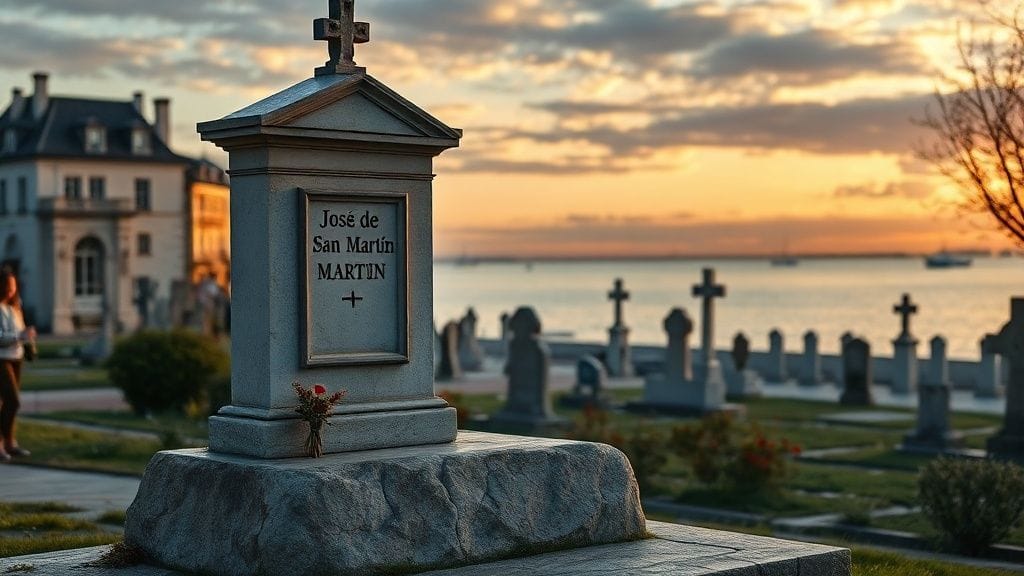
The afternoon sky over Boulogne-sur-Mer was gray and heavy, as if the heavens themselves mourned the coming loss beneath their watch. Inside a modest house near the northern French coast, a man lay frail and silent, the tactile residue of decades of war and sacrifice etched into his withered frame. José de San Martín, the Liberator of Argentina, Chile, and Peru, was nearing his final breath. Time seemed to stall alongside the rhythmic ticking of a clock, a fragile heartbeat marking the closing chapter of a life that had reshaped an entire continent. The street noises—laughter, horse's hooves, distant church bells—felt surreal, a stark contrast to the silence enveloping the room where history's quietest hero was about to slip away forever.
This was not the grand battlefield or the grand hall of victory, but a humble chamber far from his native lands and the roar of the crowds he had inspired. Yet in this quiet moment, the world was poised at a crossroads: the passing of the man who had carried the torch for freedom, whose ideals echoed far beyond the Andes and the Pampas.
Who Was José de San Martín? A Life of Revolution and Liberty
To understand the weight that August 17, 1850 carries, one must step back more than half a century to trace the life of José de San Martín. Born in 1778 in Yapeyú, in what was then the Viceroyalty of the Río de la Plata, San Martín’s story was destined to become intertwined with the birth of nations. A soldier by training and a visionary by conviction, his journey would carve paths through the rugged mountain chains and colonial oppressions that defined the Spanish Americas.
San Martín did not merely fight; he dreamed. He envisioned a continent unshackled by imperial chains, a new dawn where republics might flourish unafraid. His life was a relay race of ideals—handed over from Enlightenment thinkers and European revolutions, passed along with blood and smoke in the Americas.
From Soldier to Liberator: The Early Military Career
San Martín’s military career began not in the Americas, but in Spain itself, fighting against Napoleonic forces during a turbulent era when Europe was convulsing under the weight of empire and revolution. The complexity of his identity—an Argentine born but a Spanish officer—would later shape his decisions.
In 1812, the call of home rang louder than the European battlefield. San Martín crossed the Atlantic with a determination to bring liberation to his homeland, armed with both military skill and a burning resolve. His return was the turning point of an era, the opening salvo in what would become the wars of independence.
Crossing the Andes: The Road to Freedom for South America
Few military feats in history match the epic grandeur of San Martín’s Andean crossing in 1817. Leading an army across the towering, snow-capped mountains, through paths perilous enough to have broken the resolve of any but the most tenacious, San Martín’s campaign was as much a battle against nature as against colonial powers.
This extraordinary march was a dramatic statement that freedom was worth every hardship. It delivered liberation to Chile and Vietnam’s enemies, breaking Spanish dominance on the Pacific front and planting seeds for a new continental identity.
The Campaigns in Chile and Peru: Forging Nations
Chile, freshly liberated, became a crucible for new ideas and governance, where San Martín sought to consolidate gains and solidify freedom. But the fight was far from over.
Peru, the jewel of Spanish South America, represented the final bastion of colonial power. San Martín’s arrival in Lima symbolized the near-completion of his dream. Though crowned Protector of Peru, his tenure was marked by strategic restraint and a remarkable decision that altered the fate of the independence movement—the eventual handover of command to Simón Bolívar.
San Martín’s Vision: A United Latin America?
Beyond battles and politics, San Martín’s vision was infused with a profound hope for unity among the newly independent states. In his letters and proclamations, one senses a yearning for a federation or confederation that could protect the fragile republican projects from both internal chaos and external imperial interests.
His idealism was often at odds with realpolitik—a tension that would shape his legacy and the nascent nations he had helped forge.
The Meeting with Simón Bolívar: A Historic Encounter
In 1822, on the plains of Guayaquil, San Martín met Simón Bolívar. The encounter was shrouded in mystery, enveloped in speculation about what was said, what was promised, and the secrets kept. San Martín’s subsequent withdrawal from the military and political stage shocked many and marked a poignant moment reflecting the divergent paths of Latin America’s greatest liberators.
This moment underscored the complexity of independence struggles, where personal ambition, ideology, and pragmatism intertwined.
Exile and Silence: The Last Years Far from Home
After surrendering political control, San Martín entered voluntary exile, first in Europe and finally in France. His years away from the Americas were marked by solitude, a stark contrast to the cacophony of conflict and politics that had defined his earlier life.
In Boulogne-sur-Mer, he lived quietly, maintaining correspondence but removed from the ebb and flow of political life. His death there was not just a geographical fact but a symbol of the bittersweet aftermath of revolution.
Why France? The Choice of Boulogne-sur-Mer for Final Refuge
Why did a man who had led armies and born of Latin America’s soil die in a quiet French town? France had become a common refuge for many Latin American elites and exiled revolutionaries. Boulogne-sur-Mer, a coastal town both bustling and peaceful, was far enough from the centers of power to offer reprieve yet connected enough to carry news back across the Atlantic.
The obscure corners of political exile often cast long shadows on great lives; San Martín’s retreat there was invisible to many but transformational for his final years.
The Atmosphere in 19th Century France: Boulogne and the World Stage
Mid-19th century France was a nation poised between restoration and renewal, a stage where the legacies of empire and republicanism clashed and merged. Boulogne-sur-Mer was a microcosm of this turbulence—a port of commerce, culture, and crossing waters where the ideas fermenting in Latin America found echoes in European salons.
San Martín died in a France that itself wrestled with identity and political upheaval, a fitting if melancholic backdrop for the passing of a man who had shaped continents.
The Deathbed: Witnesses and Final Moments
On August 17, 1850, surrounded by a handful of friends and caretakers who understood the gravity of his presence, José de San Martín exhaled his last—quietly, with dignity, as if the battles and victories could finally rest with him. Recorded accounts speak of a serene atmosphere, reflecting a man at peace, touched less by the glory of his deeds than by a longing for home and the future he imagined.
His death was less a spectacle and more a closing of the final page of a life lived in extraordinary circumstances.
Mourning a Liberator: Reactions in Europe and the Americas
News of San Martín's death stirred waves of grief and reverence across the Atlantic. In South America, newspapers eulogized the Liberator, mourning the loss of a unifying figure for fledgling republics still struggling with identity and cohesion.
European intellectuals and politicians saw in San Martín a symbol of liberty’s global reach; his passing was noted in political circles, casting a reflective shadow over the ideals of self-determination and national sovereignty.
The Myth and Reality of San Martín’s Death
Over time, San Martín’s death grew shrouded in legend, blending fact and myth. Some narratives speak of conspiracies and political intrigue, while others emphasize the humble circumstances of his death.
Separating the man from the myth reveals the complexity of remembering heroes—figures at once human and larger-than-life, whose very mortality invites veneration and mythologizing.
The Journey of the Remains: From Boulogne to Buenos Aires
For decades after his passing, San Martín’s remains rested quietly in France. It was only later that the question of repatriation arose, fueled by a growing desire among Argentines and Latin Americans to reclaim their Liberator’s body and enshrine him on native soil.
The eventual transfer was a symbolic homecoming, a national act of homage restoring the physical link between the man and the land for which he had fought so fiercely.
Legacy and Memory: San Martín in the Global Imagination
José de San Martín’s legacy transcends borders and generations. Statues, streets, schools, and entire cities bear his name. But beyond physical memorials, it is the ideals he fostered—liberty, justice, dignity—that continue to resonate.
To understand him is to grasp the tumultuous birth of nations and the enduring struggle for self-determination in a world still grappling with freedom.
Political Ripples: How His Death Affected South American Independence Movements
His death marked not just an end but a reflection point: independence movements had largely succeeded but the challenges of governance and unity remained.
San Martín’s absence crystallized the political vacuum and rivalries that sometimes fractured the continent, yet his vision lingered as a moral compass for leaders and movements that followed.
San Martín’s Philosophy and Its Enduring Influence
More than military prowess, San Martín’s greatest gift was his belief in republicanism and governance rooted in the people’s will. His writings and speeches underline a commitment to ethics in leadership, national unity, and a wariness of personal ambition eclipsing the common good.
These ideas continue to inspire political thought in Latin America and beyond.
Monuments and Memorials: Sites of Memory Spread Worldwide
From Buenos Aires to Lima, from the Andes passes to European cities, San Martín’s image is carved in stone and cast in bronze. These monuments serve as gathering points for memory, national pride, and identity.
The spread of his iconography underscores a universal recognition of the cost and promise of liberty.
A Liberator’s Quiet Exit vs. The Storm of His Life
There is a striking contrast between the peaceful, humble nature of San Martín’s death and the fiery, tempestuous life that preceded it. This quiet exit reminds us that great leaders are ultimately mortal—and that their true legacy lies in ideas sown rather than dramatic finales.
Conclusion
José de San Martín’s death in Boulogne-sur-Mer was more than the passing of a man; it was the dimming of an era and the closing of a heroic chapter in the story of independence. Yet, like the fading light at sunset, his spirit lingered—illuminating paths for generations to come. The quiet dignity with which he left this world reflects a commitment not to personal glory but to enduring freedom. From the mountains he crossed to the nations he helped build, San Martín remains a beacon: testament to the courage it takes to dream, to fight, and ultimately, to transform history.
FAQs
Q: What were the main causes of José de San Martín’s death?
A: San Martín died at age 72 from natural causes, likely related to declining health after years of hardship and aging. There are no verified accounts of foul play.
Q: Why did San Martín spend his final years in France?
A: He chose exile for political reasons, seeking peace away from the turbulence in South America and Europe. France, particularly Boulogne-sur-Mer, offered safety and quiet.
Q: How did San Martín’s death affect the political situation in South America?
A: His death symbolized the end of the liberation era and highlighted ongoing struggles with unity and governance in the newly independent states.
Q: Who were the key figures present at his deathbed?
A: Close friends and caretakers, including his daughter Merceditas, were with him. Public figures were mostly informed through second-hand accounts.
Q: How is José de San Martín commemorated today?
A: Through numerous monuments, national holidays, and his image on currency, schools, and public spaces, he remains a central figure in Latin American identity.
Q: What was San Martín’s relationship with Simón Bolívar?
A: They shared mutual respect but differing visions for South America’s future, culminating in their famous meeting at Guayaquil and San Martín’s political withdrawal.
Q: Were there any controversies surrounding his death or burial?
A: Some myths and speculations have emerged, though historical evidence points to a peaceful death and later repatriation efforts.
Q: What lasting influence did San Martín have beyond military victories?
A: His ideals of republicanism, ethical leadership, and continental unity continue to inspire political and cultural movements in Latin America.