Table of Contents
- A New Dawn in Constantinople: The Passing of the Great Justinian
- The Weight of the Imperial Purple: Who Was Justin II?
- The Byzantine Empire on the Brink: Context in 565 CE
- Justinian’s Legacy: Triumphs and Troubles Left Behind
- The Ceremony of Succession: November 14, 565
- First Acts of the New Emperor: Promise and Peril
- The Challenge of Maintaining the Empire’s Borders
- Religious Strife and Political Intrigue in Justin II’s Early Reign
- Relations with the Ostrogoths and Lombards: A Shifting Balance
- The Persian Menace: Renewed Conflict on the Eastern Frontier
- The Economy Under Strain: Taxes and Troubles Brewing
- The Emperor’s Mental Decline: A Tragic Turn
- The Role of Tiberius II: Power Behind the Throne
- The Collapse of Justin II’s Ambitions and the Rise of New Powers
- The Legacy of Justin II: Between Decline and Continuity
- Constantinople in Transition: Society and Culture in the Mid-6th Century
- How Historians Remember Justin II
- Lessons from the Succession: Empire and Impermanence
- Conclusion: The Echoes of Power and Fragility
- FAQs About Justin II’s Succession and Reign
- External Resource
- Internal Link
The sun had barely risen over the golden domes and towering walls of Constantinople on November 14, 565, when a quiet yet momentous shift unfolded in the heart of the Byzantine Empire. The city that had withstood sieges, rebellions, and centuries of upheaval now prepared itself for a new ruler. Justin II, nephew and chosen heir of one of history’s most illustrious emperors, Justinian I, solemnly donned the imperial purple, stepping into a legacy both luminous and burdensome.
Behind the grand facade of the Hagia Sophia and amidst the murmurs of the populace, the weight of the empire’s future now rested on his shoulders—a colossal inheritance fraught with ambition, expectation, and unforeseen perils.
1. A New Dawn in Constantinople: The Passing of the Great Justinian
By 565 CE, Justinian I, the towering figure who had transformed the Byzantine world through sweeping reforms, military campaigns, and monumental architecture, was at the end of his life. For decades, his reign had seemed unshakable, yet even the greatest empires must pass from one generation to the next. When Justinian breathed his last, the bustling capital held its breath.
The transition to his successor—his nephew Justin II—was met with a mixture of hope and uncertainty. This was a moment charged with the emotional complexity of loss and anticipation. The old guard wondered if this new emperor could match the grandeur and genius of his uncle. The people, still inspired by the spectacle of Justinian’s reign, looked for signs of continuity—or change.
2. The Weight of the Imperial Purple: Who Was Justin II?
Inheriting the throne was no mere matter of bloodline. Justin II, born circa 520 CE, had been a trusted companion and administrator under Justinian’s rule, yet he was no mere echo of his uncle. Known for his austere piety and unyielding temperament, Justin II arrived at the palace with a reputation for integrity but also stubbornness.
Educated in the classical traditions and steeped in Christian zeal, he was determined to restore the empire’s strength without overextending its resources. But the challenges ahead were stark: growing external threats and internal fatigue demanded not only wisdom but also adaptability—and fortitude.
3. The Byzantine Empire on the Brink: Context in 565 CE
The empire that Justin II inherited was both vast and vulnerable. The golden age had been hard-won—just as Justinian had retaken large swaths of Italy, North Africa, and parts of Spain, but the cost was profound. The treasury was drained, the army fatigued, and the administration stretched thin across new frontiers.
Meanwhile, barbarian kingdoms stirred in the West, the Persian Sassanids remained an ever-present threat to the East, and religious schisms festered within the Christian population. Long-standing tensions between Chalcedonian orthodoxy and Miaphysite Christian sects were not just theological disputes but political fault lines that rippled throughout the cities and provinces.
4. Justinian’s Legacy: Triumphs and Troubles Left Behind
To understand the moment of Justin II's accession is to grasp the titanic shadow cast by Justinian I. Under his rule, the codification of Roman law—the Corpus Juris Civilis—transformed the legal landscape of Europe and the Mediterranean. Architecturally, the Hagia Sophia stood as a shining beacon to imperial grandeur and religious unity.
Yet, these achievements masked deep fractures. Costs of the wars to recover lost Western provinces had drained the economy. The bubonic plague, which ravaged Constantinople’s densely packed quarters in the 540s and 50s, continued to impair demographic growth and economic vitality. The empire had won much, but at what price?
5. The Ceremony of Succession: November 14, 565
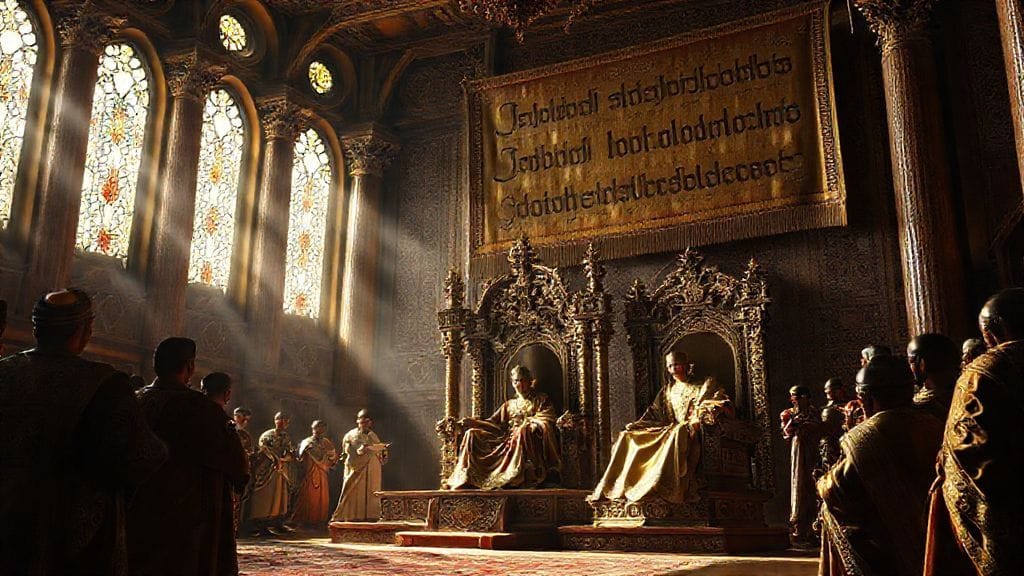
On the cold morning of November 14, the grand Hippodrome was alive with spectators and officials clad in silks. The Patriarch of Constantinople presided over the coronation ceremony that symbolized divine sanction. As Justin II was crowned, his eyes took in the boundless expanse of the city, the crowds chanting and hopeful.
The ceremony was as much a theatrical assertion of legitimacy as it was a humble vow of service. Emperors stood as both God’s chosen and mortal men. “Remember, the crown is a heavy thing,” whispered the voice of tradition, “not all who wear it survive its weight.”
6. First Acts of the New Emperor: Promise and Peril
In the weeks following his accession, Justin II made clear his desire to reassert imperial authority and restore fiscal health. Abandoning some of Justinian’s more extravagant policies, he pursed tighter control over the treasury and sought to reduce corruption in the bureaucracy.
Yet, he also faced immediate dilemmas. The Eastern frontier with the Persian Empire was tense. Justin II inherited a brittle peace, but one rooted more in exhaustion and stalemate than true reconciliation. His decisions now would test his resolve and capacity to balance diplomacy with defense.
7. The Challenge of Maintaining the Empire’s Borders
One of Justin II’s first and most daunting tasks was defending the empire’s vast and varied borders. The Balkans, Italy, and North Africa each presented distinct challenges.
The Lombards had begun pressing into Italian territories, capitalizing on local instability. Meanwhile, in North Africa, the local Moors tested imperial control. The Danube frontier remained a crucible for conflict with Slavic and Avar tribes threatening the stability of the southeastern provinces.
Holding these diverse territories required not just military might but strategic alliances and deft governance—skills that Justin II struggled to fully command.
8. Religious Strife and Political Intrigue in Justin II’s Early Reign
No Byzantine emperor could ignore the religious fervor and factionalism within the empire. Justin II was known for his orthodox zeal, keen to root out heresy and bring unity to the Christian flock.
Yet, his reign exacerbated conflicts—especially with the Monophysite populations of Egypt and Syria. His attempts to impose Chalcedonian Christianity sparked resistance, stirring rebellions that would further drain imperial resources.
At court, rival factions jockeyed for influence over the emperor, weaving a complex web of intrigue that sometimes blindsided even the most astute ruler.
9. Relations with the Ostrogoths and Lombards: A Shifting Balance
The Italian peninsula was far from stable. Though Justinian had nominally reclaimed it from the Ostrogoths, the region was far from pacified.
The Ostrogoths’ remnants retreated or assimilated while the Lombards, a relatively new Germanic power, launched incursions, carving out territories and challenging Byzantine authority. Justin II’s policies vacillated between military retaliation and attempts at negotiation, revealing the limits of imperial control over Italy.
These struggles foreshadowed the gradual erosion of Byzantine power in the West.
10. The Persian Menace: Renewed Conflict on the Eastern Frontier
Perhaps the gravest danger arose from the East. The Sassanid Empire, under King Khosrow I, had long seen Byzantine resumption in the West as a threat to its own ambitions.
The fragile peace that had endured under Justinian was shattered by Justin II’s refusal to pay tribute—war payments that Justinian had used as diplomatic tools. This audacity reignited hostilities, leading to devastating conflicts along the Mesopotamian frontier.
The struggle would drag the empire into exhausting wars, further straining its resources and endurance.
11. The Economy Under Strain: Taxes and Troubles Brewing
By the mid-560s, the empire’s economy teetered precariously. Endless wars, combined with plague and mismanagement, drained the treasury.
Justin II’s attempts to tax more aggressively and reduce expenditure were met with unrest. The urban population, already bearing the brunt of economic hardship, grew resentful.
The financial strain manifested in military desertions, revolts, and court intrigues. The emperor’s reign was marked by an increasing disconnect between imperial ambitions and material realities.
12. The Emperor’s Mental Decline: A Tragic Turn
History remembers that Justin II’s reign was marred by his tragic mental deterioration. By around 570 CE, reports describe episodes of paranoia and madness that incapacitated the emperor.
This personal collapse sent shockwaves through the imperial administration. His mental health worsened to the point that effective governance was impossible.
This dark period underscored the vulnerability not only of rulers but of empires reliant on a single figure’s health and resolve.
13. The Role of Tiberius II: Power Behind the Throne
Facing Justin II’s incapacity, a trusted general and administrator named Tiberius was elevated to co-emperor. Tiberius II Constantine assumed increasing control over the empire’s affairs, steering it through continued wars and internal strife.
His pragmatic leadership contrasted sharply with Justin II’s rigidity, providing a much-needed stabilizing force. The delicate balance between official sovereignty and practical governance shaped the latter years of Justin II’s reign.
14. The Collapse of Justin II’s Ambitions and the Rise of New Powers
Despite initial hopes, Justin II's reign symbolized the beginning of Byzantine contraction. The dream of restoring the Roman world to its ancient glory faded amid relentless pressure.
The Lombards took Italy, the Persians ravaged the East, and internal divisions scattered the imperial focus. This period marked a profound transition where the empire would have to reinvent itself, shifting from expansion to survival.
15. The Legacy of Justin II: Between Decline and Continuity
How should history judge Justin II? Not as a luminous innovator like his uncle, but as a ruler caught between the burdens of legacy and the realities of decline.
He struggled valiantly but often faltered amid the enormous challenges. His reign is a prism through which we glimpse the fragile nature of imperial power and the human cost of empire-building.
16. Constantinople in Transition: Society and Culture in the Mid-6th Century
Even amid political turbulence, Constantinople remained a vibrant hub of cultural and religious life. The city’s mosaics and churches buzzed with worshippers, philosophers debated in the streets, and merchants from far-flung lands mingled in bustling bazaars.
This dynamic urban tapestry speaks to an empire not entirely defined by politics but enlivened by the hearts and minds of its peoples.
17. How Historians Remember Justin II
The chroniclers—both contemporary and later—paint a cautious portrait. Procopius died before these years, but Theophylact Simocatta and Menander Protector provide glimpses of an emperor whose inflexibility sometimes cost dearly.
Modern historians debate whether Justin II’s difficulties were due more to personal weakness or structural pressures beyond any single ruler’s control. His reign invites reflection on how history often judges those who live in the shadows of giants.
18. Lessons from the Succession: Empire and Impermanence
The accession of Justin II reveals timeless truths about power: its ephemeral nature, the perils of hereditary rule, and the complex dance between individual agency and historical forces.
In watching Justin II navigate his inheritance, we see the limits of ambition when confronted with exhaustion, myriad enemies, and human frailty.
19. Conclusion: The Echoes of Power and Fragility
On that autumn day in 565, the crowd saw a new emperor crowned and dreamed of continuity—a new chapter for one of history’s greatest empires. Yet beneath the gold and ceremony lay fault lines that would shape the Byzantine world’s next centuries.
Justin II’s reign, with all its struggles and contradictions, embodies the eternal human drama: the quest to hold onto power, the weight of legacy, and the fragile hope that from change, resilience might emerge.
FAQs About Justin II’s Succession and Reign
Q1: Why was Justin II chosen as Justinian’s successor?
A1: Justin II was Justinian’s nephew and had served closely under him. His selection aimed to ensure dynastic continuity and maintain the legalistic and religious policies of his uncle, though his personality differed markedly.
Q2: What were the main challenges Justin II faced upon accession?
A2: He inherited vast military commitments, economic exhaustion, religious tensions, external threats from the Persians and barbarian tribes, and an empire recovering from plague and wars.
Q3: How did Justin II’s reign affect relations with the Sassanid Empire?
A3: Justin II ended the payments that Justinian had used to maintain peace, leading to renewed wars along the eastern frontier that drained resources and destabilized the region.
Q4: What led to Justin II’s mental decline?
A4: The cause is uncertain but likely a combination of stress, possible neurological disease, and the immense pressures of rulership contributed to his partial incapacitation.
Q5: Who was Tiberius II and what role did he play?
A5: Tiberius II was initially a general and Justin II’s trusted aide, later co-emperor, who effectively governed the empire after Justin II’s mental health declined, bringing a pragmatic approach to governance.
Q6: How did Justin II’s policies impact the western provinces?
A6: His inability to maintain strong military and administrative control allowed the Lombards to establish themselves in Italy, marking a gradual loss of Byzantine influence there.
Q7: What is Justin II’s historical legacy?
A7: Justin II is often seen as a transitional figure—a ruler overshadowed by his predecessor who struggled with immense problems, illustrating the fragility of imperial power.
Q8: How do modern historians view Justin II’s reign?
A8: Views are mixed. Some see him as a tragic figure overwhelmed by circumstances, others as partly responsible for the empire’s setbacks. His reign remains a subject of study for understanding the complexities of Byzantine decline and adaptation.
External Resource
Internal Link
🏠 Visit History Sphere → https://historysphere.com/

