Table of Contents
- The Awakening of Karymsky: A Fiery Prelude in Kamchatka
- Kamchatka’s Volcanic Heartbeat: Understanding the Land of Fire
- The Geological Origins of Karymsky Volcano
- Setting the Stage: Russia in the 1990s
- Early Signs: 1995 Tremors and Warnings
- February 1996: The First Plume of Smoke
- The Eruption Unfolds: Explosions Beneath the Frozen Sky
- Ash Clouds and Firestorms: The Sky Over Kamchatka Darkens
- The Scientists’ Race Against Time: Monitoring Karymsky’s Fury
- Local Communities on Edge: Life at the Brink of Disaster
- The Russian Authorities Respond: Managing Crisis in a Remote Land
- Global Eyes on Kamchatka: Satellite Imagery and International Interest
- The Environmental Toll: Forests, Wildlife, and the Volcanic Aftermath
- Aviation Chaos: Airways Disrupted by Volcanic Ash
- The Human Story: Personal Accounts from the Eruption Zone
- The Volcano’s Message: Lessons from Karymsky 1996
- After the Flames: Recovery and Resilience in Kamchatka
- Karymsky’s Place in Modern Volcanology
- The Cultural Impact: Myths, Memory, and Modern Russia
- Scientific Advances Spurred by the 1996 Eruption
- Comparing Karymsky: Other Great Eruptions of the 20th Century
- The Long Shadow of Karymsky: Ongoing Monitoring and Future Threats
- Reflecting on Nature’s Power: Karymsky as a Symbol of Volcanic Fury
- Conclusion: Fire Within the Earth, Fire Within the Human Spirit
- FAQs: Key Questions About Karymsky Volcano and Its 1996 Eruption
- External Resource
- Internal Link
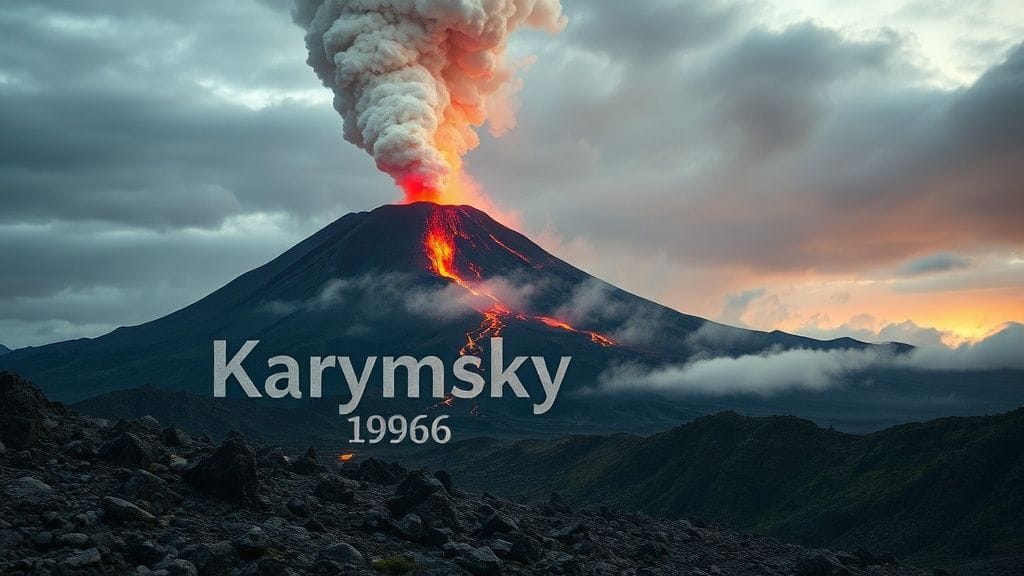
The earth trembled beneath the horizon of Kamchatka as a plume of ash tore through the cold Arctic sky, painting a grim and persistent signature across the barren landscape. In the early months of 1996, the world witnessed the eruption of Karymsky, a volcanic colossus in Russia’s far eastern wilderness, whose sudden awakening transformed a quiet geological marvel into a spectacle of terrifying natural power. This was no mere geological event; it was a dramatic unfolding on a stage where fire met ice, a confrontation between humankind and the restless forces simmering beneath the earth’s crust.
Kamchatka’s rugged terrain, dotted with steaming fumaroles and ancient lava flows, had long been a silent witness to the cycles of creation and destruction played out by volcanoes. Yet the months leading up to the eruption bore a strange tension, a sense of imminent change heralded by subtle tremors and volatile gas emissions. When Karymsky finally erupted, it was as if the land itself exhaled centuries of pressured fury — a vibrant, violent outburst that would be etched into the memory of scientists, local inhabitants, and global observers alike.
1. The Awakening of Karymsky: A Fiery Prelude in Kamchatka
The initial signs of unrest at Karymsky appeared as early as late 1995, with unusual seismic activity stirring beneath the volcano’s cone. For inhabitants of the Kamchatka Peninsula – a land sparsely populated, cloaked in boreal forests and shrouded often in mist and cold – the rumblings were a signal both feared and respected. This dormant giant, part of the Pacific “Ring of Fire,” had a history of violent outbursts, but the sheer unpredictability of volcanic eruptions kept everyone on tenterhooks.
The early tremors darkened the long winter, casting a portentous shadow over the small settlements scattered near the volcano’s base. Yet, the remoteness of the region meant that much of Karymsky’s activity remained shrouded in scientific mystery, observed primarily by satellites and the dedicated Russian volcanological expeditions who risked harsh conditions to gather data.
2. Kamchatka’s Volcanic Heartbeat: Understanding the Land of Fire
To grasp the significance of Karymsky’s 1996 eruption, one must first understand Kamchatka itself – a volcanic archipelago, a land shaped by the restless dance of tectonic plates converging beneath the Pacific Ocean. Over 160 volcanoes punctuate its landscape, many still active, earning Kamchatka the informal title of “Land of Fire.”
Karymsky is among the most active volcanoes on the peninsula and indeed in all of Russia. Its cone, steep and symmetrical, rises prominently over the wide calderas left by earlier cataclysms. Yet, beneath this imposing façade lies a story millions of years in the making: the collision and subduction of the Pacific Plate beneath the Eurasian Plate, a process responsible for the peninsula’s volatile geology. This convergence creates vast underground pockets of molten rock, pressurized with trapped gases, waiting to breach the surface.
3. The Geological Origins of Karymsky Volcano
Karymsky’s formation is a testament to the forces sculpting the Earth’s interior. It is a stratovolcano, built up through successive layers of hardened lava, pumice, and ash. This structure – typically steep and prone to explosive eruptions – grows over centuries through cycles of effusive flows and violent blasts.
Its present-day cone sits within a vast caldera, evidence of cataclysmic activity tens of thousands of years ago that transformed the region. What makes Karymsky particularly notable is its persistent activity since the midpoint of the 20th century, featuring near-constant gas emissions, steam eruptions, and intermittent explosive episodes.
4. Setting the Stage: Russia in the 1990s
The 1990s were a turbulent time for Russia, entangled in political, social, and economic upheaval following the dissolution of the Soviet Union. Far from the capital’s political struggles, Kamchatka remained a frontier – remote, underpopulated, and often left to its own devices. Infrastructure was sparse, and scientific institutions faced funding challenges during this period of transition.
Against this backdrop, the eruption of Karymsky posed unique difficulties: a natural disaster breaking out in a region with limited emergency resources, requiring coordination between scientists, local authorities, and the military in a newly restructured Russia attempting to redefine its identity.
5. Early Signs: 1995 Tremors and Warnings
Throughout late 1995, the Richter scales held hints of a brewing storm. Seismic data revealed increasing swarms of small earthquakes clustered beneath Karymsky. Gas measurements detected rising sulfur dioxide levels – a telltale sign of magma inching closer to the surface.
Local volcanologists, many affiliated with the Kamchatka Volcanological Station, were vigilant. Their reports painted a picture of intensifying unrest. Yet, predicting the timing or magnitude of an eruption remained an imperfect science. The remote location compounded delays in relaying information, adding a layer of complexity and risk.
6. February 1996: The First Plume of Smoke
The winter cold of February 1996 was suddenly pierced by a dark, curling plume floating above the crater. Witnesses observed bursts of incandescent fragments illuminating the night sky — vivid, almost surreal against the stark white snow.
The eruption was characterized by its Strombolian style — repeated moderate explosive bursts, sending lava bombs into the air, accompanied by roaring sounds that echoed through the valleys. Ash mixed with steam created towering clouds, drifting across the peninsula and beyond.
7. The Eruption Unfolds: Explosions Beneath the Frozen Sky
As days turned to weeks, the eruption’s intensity waxed and waned. Lava fountains spewed molten rock that hardened quickly upon meeting the icy air. The volcano’s voice—the deep rumbling that began beneath the earth—now had a face of visible, tangible destruction.
Researchers documented pyroclastic flows racing down the cone’s slopes, their heat capable of obliterating anything in their wake. The ashfall blanketed wide areas, forcing temporary evacuations—even though population was light, the threat was real.
8. Ash Clouds and Firestorms: The Sky Over Kamchatka Darkens
The ash plume ascended to heights exceeding 12 kilometers, injecting fine particulates into the atmosphere which disrupted daily life many miles away. Sunlight was muffled, casting a gloomy pall over the peninsula. For days, the skies maintained a charged gray hue, as the volcano seemed to hold the region in a smoky grip.
This ash cloud did not merely threaten visibility; it posed severe risks to respiratory health, agriculture, and water supplies. Officials issued warnings, while transportation routes were intermittently closed, particularly affecting air travel.
9. The Scientists’ Race Against Time: Monitoring Karymsky’s Fury
Volcanologists worked tirelessly, often in hazardous conditions, equipped with rudimentary gear and sheer resolve. Monitoring stations recorded seismic waves, gas emissions, and ground deformation, providing a vital stream of data.
Collaborations with foreign scientists flourished, utilizing satellite technology and remote sensing to paint a comprehensive picture of the eruption’s progression. These efforts were critical not only for understanding Karymsky but also for updating global volcanic hazard assessments.
10. Local Communities on Edge: Life at the Brink of Disaster
Though Kamchatka’s population was sparse—counted in thousands rather than millions—those living near Karymsky felt the eruption’s weight keenly. Indigenous peoples and settlers alike had deep connections to the land.
Daily routine was disrupted as ash covered roofs and fields, livestock was threatened, and the constant sound of the volcano instilled an anxious uncertainty. Some families evacuated temporarily, while others adapted as best they could, embodying resilience amid nature’s fury.
11. The Russian Authorities Respond: Managing Crisis in a Remote Land
Emergency management in this far-flung region was a logistical challenge. The Russian Ministry of Emergency Situations coordinated efforts to deliver aid, establish exclusion zones, and disseminate warnings.
Military units were sometimes deployed to assist with evacuations, while local governments struggled to maintain communication networks hampered by poor infrastructure. This event underscored the difficulties faced in responding to natural disasters in Russia’s vast and rugged territories.
12. Global Eyes on Kamchatka: Satellite Imagery and International Interest
The eruption attracted attention far beyond Russia. Agencies such as NASA and volcanological institutes worldwide observed Karymsky via satellite, studying ash plume dispersal and thermal signatures.
This helped validate models predicting volcanic behavior and improved early-warning protocols for aviation industry — a sector acutely vulnerable to volcanic ash hazards. The increasing globalization of scientific collaboration was on full display as the world focused on this distant but powerful eruption.
13. The Environmental Toll: Forests, Wildlife, and the Volcanic Aftermath
Kamchatka’s rich ecosystem, home to bears, salmon, and rare flora, suffered immediate and lasting impacts. Ashfall suffocated delicate vegetation and contaminated river systems.
While volcanic soils are known to be fertile in the long-term, the short-term devastation for flora and fauna was severe. Studies following the eruption traced the ecological recovery over subsequent years, highlighting both fragility and regeneration.
14. Aviation Chaos: Airways Disrupted by Volcanic Ash
Karymsky’s ash cloud posed a serious hazard to aircraft engines. Following the eruption, airlines rerouted flights, suspended services, and issued safety alerts.
Airports in Khabarovsk and beyond grappled with balancing operational needs and safety. The incident became a case study in the vulnerability of global air traffic systems to natural disasters, foreshadowing future crises like the Eyjafjallajökull eruption in 2010.
15. The Human Story: Personal Accounts from the Eruption Zone
Survivors and observers offered vivid accounts: the eerie quiet before explosions, the glow of molten rock against night skies, the choking ash in the air. Stories of community solidarity emerged, with neighbors helping each other clear ash and share resources.
An elder from a local village recalled, “We have lived with these mountains all our lives. When the fire comes, it is like the earth is speaking, and we must listen.” These narratives infuse the eruption with a deeply human dimension.
16. The Volcano’s Message: Lessons from Karymsky 1996
Karymsky’s eruption underscored the critical need for improved volcanic risk management in remote regions. It drew attention to the potential for rapid escalation and the importance of scientific vigilance.
The event highlighted that even sparsely populated areas could face significant disruption, challenging assumptions that disasters only threaten densely populated zones. It also reinforced the interconnectedness of natural phenomena and global systems.
17. After the Flames: Recovery and Resilience in Kamchatka
Post-eruption, Kamchatka entered a period of rebuilding and ecological renewal. Local authorities invested in infrastructure upgrades, scientific stations became better equipped, and community awareness campaigns improved preparedness.
Despite the trauma, the eruption fostered a renewed respect for nature’s power and the human capacity to adapt. The eventual return to a semblance of normalcy was a testament to resilience forged in adversity.
18. Karymsky’s Place in Modern Volcanology
The 1996 eruption remains one of the best-documented in Kamchatka’s recent history, contributing substantially to volcanological science. Its data helped refine eruption forecasting models and deepen understanding of subduction-zone volcanism.
Today, Karymsky is studied continuously, a sentinel volcano that teaches scientists about magma dynamics, eruption styles, and risk mitigation.
19. The Cultural Impact: Myths, Memory, and Modern Russia
Karymsky’s eruption fed into Kamchatka’s cultural tapestry, inspiring art, folklore, and community identity. The volcano is woven into narratives of danger and awe, embodying the paradox of destruction and creation.
For modern Russia, it became a symbol of both natural threat and scientific progress, reflecting broader themes of adaptation and perseverance within the nation’s evolving story.
20. Scientific Advances Spurred by the 1996 Eruption
Technological innovation in remote sensing, gas analysis, and seismic instrumentation accelerated post-eruption. Cross-border cooperation expanded, with Russian scientists collaborating internationally to improve surveillance of the Pacific’s restless “Ring of Fire.”
These advances have saved lives, informed policy, and raised public consciousness about volcanic hazards.
21. Comparing Karymsky: Other Great Eruptions of the 20th Century
While not the largest eruption of the century, Karymsky’s 1996 event shares characteristics with others—like Mount St. Helens (1980) and Pinatubo (1991)—in terms of sudden onset, environmental impact, and global ramifications.
Studying Karymsky alongside these giants offers insights into the diversity of volcanic behavior and the universal challenges posed by eruptions.
22. The Long Shadow of Karymsky: Ongoing Monitoring and Future Threats
Karymsky continues to be monitored intensively. Its volatile nature means future activity remains a serious concern. Advances in early warning systems, community preparedness, and environmental monitoring aim to reduce risks.
In a world increasingly aware of natural disasters’ impacts, Karymsky serves as a potent reminder to stay vigilant.
23. Reflecting on Nature’s Power: Karymsky as a Symbol of Volcanic Fury
The 1996 eruption encapsulates the awe-inspiring and humbling might of natural forces. It reminds us that beneath frozen landscapes can lurk immense energy, waiting to reshape the earth and our understanding of it.
Such moments challenge humanity to respect nature’s rhythm, to balance awe with preparedness.
24. Conclusion: Fire Within the Earth, Fire Within the Human Spirit
The eruption of Karymsky in 1996 was more than a geological event; it was a dramatic story of nature’s raw power intersecting with human lives in one of the planet’s most remote frontiers. It revealed the fragile balance between destruction and renewal, chaos and resilience.
From the incandescent blasts that lit the Arctic night to the quiet determination of Kamchatka’s people rebuilding afterward, the narrative of Karymsky is a human drama intertwined with Earth’s fiery heart. In reflecting on this event, we find lessons not only about volcanoes but about our ability to endure and adapt amidst the unpredictable forces that shape our world.
Conclusion
The 1996 eruption of Karymsky stands as a vivid chapter in the geological and human history of Kamchatka. Amid the stark beauty of Russia’s Far East, this natural spectacle showcased the simultaneous terror and magnificence of volcanic activity. Through hardship and uncertainty emerged progress—in scientific knowledge, disaster preparedness, and cultural meaning.
Karymsky’s fiery display was an untamed force that demanded respect, but it also inspired awe and resilience. It reminds us that beneath the surface of our planet—and beneath the surface of our regular lives—lie powerful energies that can both threaten and renew. The story of Karymsky is one of enduring passion: for understanding, for survival, and for the deep bond between humanity and the restless earth beneath its feet.
FAQs
Q1: What caused the eruption of Karymsky in 1996?
The eruption was caused by magma rising through the subduction zone where the Pacific Plate slides beneath the Eurasian Plate, triggering explosive volcanic activity at Karymsky’s stratovolcano.
Q2: How significant was the 1996 eruption compared to other volcanic eruptions?
While not the largest 20th-century eruption, it was significant for its consistent explosivity, ash dispersal, and impact on aviation and local communities. It contributed valuable data to volcanology.
Q3: Were there any deaths or injuries resulting from the eruption?
Thanks to low population density and timely evacuations, there were no reported fatalities or serious injuries directly linked to the eruption.
Q4: How did the eruption affect the environment and wildlife in Kamchatka?
The ashfall damaged vegetation, polluted waterways, and temporarily disrupted local ecosystems, though over time volcanic soils enriched the land’s fertility.
Q5: What role did scientists play during and after the eruption?
Volcanologists monitored the eruption closely, providing essential warnings, collecting data to improve forecasting, and advancing global understanding of volcanic hazards.
Q6: How is Karymsky volcano monitored today?
Modern monitoring includes seismic sensors, gas spectrometers, satellite surveillance, and collaborations with international observatories.
Q7: Has Karymsky erupted since 1996?
Yes, Karymsky remains one of the most active volcanoes in Kamchatka with ongoing intermittent eruptions since 1996.
Q8: What lessons were learned in disaster management from the 1996 eruption?
The event highlighted the importance of rapid communication, infrastructure resilience, community preparedness, and international scientific cooperation in managing volcanic crises.

