Table of Contents
- The Sudden Awakening: A Volcano Returns to Life
- The Aleutian Archipelago: A Land of Fire and Ice
- Kasatochi Island Before the Eruption: A Quiet Wilderness
- Geological Backdrop: Understanding Aleutian Volcanism
- Early Signs: The Quiet Tremors Before the Roar
- August 7, 2008: The Eruption’s Explosive Dawn
- From Ash to Apocalypse: The Immediate Aftermath
- The Sky Turns Dark: Ash Clouds and Atmospheric Impact
- Ecological Catastrophe: The Island’s Ecosystem Devastated
- Impact on Wildlife: Birds, Marine Life, and Forests Collide with Disaster
- The Human Factor: Volcano Monitoring and Aleutian Communities
- Volcanologists on the Frontline: Tracking Kasatochi’s Fury
- Satellite Eyes: Technology Reveals the Invisible
- Atmospheric Ripples: The Eruption’s Effects Beyond Alaska
- Rebirth from Ruin: The Slow Return of Life to Kasatochi
- Lessons Learned: Kasatochi’s Place in Volcanic Science
- Cultural Reflections: The Eruption in Story and Memory
- Aleutian Volcanism in a Changing Climate
- Comparing Kasatochi: Other Notable Aleutian Eruptions
- The Global Context: Aleutian Volcanoes within the Pacific Ring of Fire
- The Legacy of Kasatochi: Science, Nature, and Human Curiosity
1. The Sudden Awakening: A Volcano Returns to Life
On a clear August morning in 2008, Kasatochi Island, a remote and uninhabited volcanic outcrop in the Aleutian chain of Alaska, erupted with a violence that no one had anticipated for over a century. For thousands of years, this volcano had been a quiet sentinel in one of the most geologically active regions on Earth. Then, without warning, it roared back to life—transforming serene landscapes into an inferno of ash, lava, and devastation. The sky darkened as plumes of volcanic ash surged miles into the atmosphere, blotting out the sun, disrupting air traffic, and forever changing the island's fragile ecosystem.
This eruption was more than a geological event; it was a dramatic reminder of the Earth’s unpredictable power—an embodiment of nature’s capacity both to destroy and to renew. Witnessing Kasatochi’s awakening invites us to contemplate humankind’s relationship with wilderness and the deep forces beneath our feet.
2. The Aleutian Archipelago: A Land of Fire and Ice
Stretching nearly 1,200 miles from Alaska toward Russia, the Aleutian Islands form one of the most spectacular and perilous volcanic arcs on the planet. This chain of over 300 islands marks the frontiers of the Pacific and North American tectonic plates, where subduction zones unleash tremendous geological energy. Amidst relentless storms, icy seas, and rugged terrain, volcanoes erupt with regularity, shaping the islands’ landscapes and influencing local climate and biodiversity.
Kasatochi Island rests within this dynamic tapestry—a place seemingly carved from the very fires below the ocean floor. Remote, largely inaccessible, and uninhabited, the island remained a near-pristine natural laboratory before 2008, home to seabird colonies and lush tundra. But an alliance of natural forces—the slow movement of tectonic plates, the accumulation of magma, and centuries of silence—brewed a catastrophe waiting to unfold.
3. Kasatochi Island Before the Eruption: A Quiet Wilderness
Before its fateful eruption, Kasatochi’s modest summit rose only about 744 feet above sea level. Its landscape, a patchwork of mosses, shrubs, and sprawling seabird nesting grounds, seemed tranquil and eternal. The island served as home to tens of thousands of crested auklets, puffins, and other bird species, their calls intermingling with the Pacific winds.
The island’s geology told a story of ancient fire. Though dormant in recent memory, Kasatochi had undoubtedly erupted many centuries ago, laying down layers of lava and ash. The Aleut people, indigenous to the region, held stories and traditions around volcanic activity, yet Kasatochi itself saw no eruptions in recorded history—its last known violent awakening happened over 200 years prior.
Still, to volcanologists monitoring Alaska’s numerous active sites, Kasatochi represented a comparatively quiet volcano—one that, if it ever stirred again, might surprise them with its power.
4. Geological Backdrop: Understanding Aleutian Volcanism
The Aleutian volcanic arc is the result of the Pacific Plate diving beneath the North American Plate—a geological dance known as subduction. As one oceanic plate plunges into the Earth’s mantle, melting occurs, generating magma that rises to feed volcanoes along the arc, creating a fiery chain like pearls on a necklace.
Kasatochi is a stratovolcano—a conical volcano built from layers of hardened lava, tephra, and ash. Its eruptions can be explosive, driven by the pressure of gas-rich magma breaking violently to the surface. This region is recognized as one of the world’s most active volcanic zones, with over 40 active volcanoes in the Aleutian chain itself.
Kasatochi’s dormancy was notable. No sign of tremors or gas emissions led seismologists to consider it a significant threat—until the build-up beneath the crust defied expectations.
5. Early Signs: The Quiet Tremors Before the Roar
In late July 2008, faint seismic activities began beneath Kasatochi. Small earthquake swarms, unnoticed to the general public, signaled unrest miles beneath the island’s surface. Seismometers recorded an uptick in volcanic tremors; yet, given the Aleutian Islands’ overall seismic volatility, these events did not immediately raise alarm.
Still, volcanologists watching the data realized this was the embryonic stirrings of something greater. Magma was moving—it was changing the fragile balance underground. On the evening of August 7, minor ash emissions were detected, a harbinger to the eruption that would soon escalate rapidly beyond control.
6. August 7, 2008: The Eruption’s Explosive Dawn
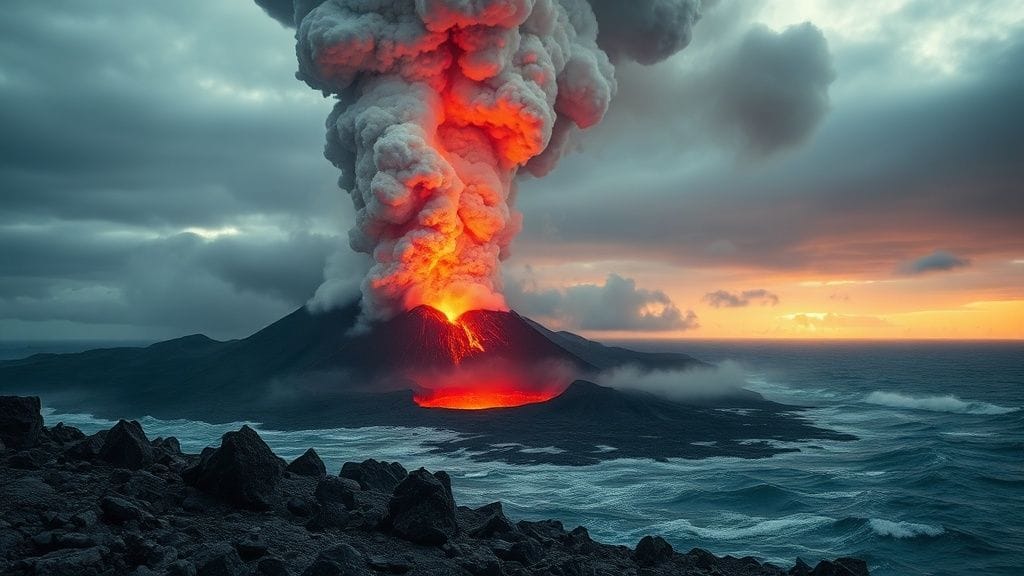
The eruption began suddenly, with no gentle prelude. At approximately 4:45 AM Alaska Time, the ground beneath Kasatochi shook violently as magma exploded through the volcano’s vent, sending a towering plume of ash, gas, and volcanic debris over 30,000 feet into the stratosphere.
The explosion ripped the summit apart, collapsing calderas and generating pyroclastic flows that cascaded down the island rocks. Ash clouds billowed like storm clouds, swallowing skies and darkening daylight as far as the Aleutians’ sister islands. Pilots diverted planes as ash hazards threatened engines thousands of miles away.
This was not a slow lava flow but a cataclysmic eruption in the style of the world’s great volcanic disasters. The violence reshaped the island in a matter of hours, turning Kasatochi into an alien landscape of ash and pumice.
7. From Ash to Apocalypse: The Immediate Aftermath
In the days that followed, Kasatochi’s environment was transformed utterly. More than 6 million cubic meters of volcanic material had been ejected. The entire island—its soil, vegetation, and beloved bird habitats—was buried beneath thick layers of ash and tephra. What once had been the vibrant greens and blues of tundra and ocean became monochrome—a picture of desolation.
Seismicity decreased, but plumes of gas continued to vent; lahars—a deadly mix of volcanic mudflows—moved down slopes into the sea. Kasatochi was effectively sterilized—a blank slate washed in gray powder and stone. Nearby islands and waters absorbed ash fallouts with varying effects, from nutrient enrichment to contamination.
8. The Sky Turns Dark: Ash Clouds and Atmospheric Impact
Kasatochi’s ash plume traveled swiftly, accelerated by high altitude winds, crossing the North Pacific. Satellite images revealed a rapidly expanding ash veil drifting eastward over the Bering Sea and Alaska mainland. The eruption injected huge quantities of sulfur dioxide and ash into the upper atmosphere, influencing atmospheric chemistry and solar radiation temporarily.
Commercial aviation was notably affected. International flights rerouted across the Pacific to avoid hazardous ash clouds that could wreck aircraft engines—demonstrating the profound interplay between natural forces and modern human systems.
9. Ecological Catastrophe: The Island’s Ecosystem Devastated
Perhaps the most poignant aftermath was ecological. Kasatochi’s biotic communities—adapted for millennia to extreme northern conditions—were obliterated overnight. Studies later confirmed near-total mortality rates among nesting seabirds, their eggs buried or crushed. The island’s marine mammals and intertidal fauna faced severe disruptions as ash altered water chemistry.
Vegetation, long-slow to recolonize Northern Pacific islands, died en masse beneath the suffocating ash. Nutrient cycles halted, soil biology collapsed. The catastrophe removed centuries of biological accumulation and replaced it with a sterile volcanic desert.
10. Impact on Wildlife: Birds, Marine Life, and Forests Collide with Disaster
Kasatochi had served as one of the world’s most important seabird nesting sites, home to tens of thousands of crested auklets and other species. The eruption destroyed the entire breeding season. Biologists described the scene as apocalyptic—bird carcasses littered the ground; feathers floated on the ash-laden wind; silence replaced the usual cries.
Marine food webs intertwined with the island’s fate. Nearby fish populations faced turbidity and chemical shifts; seals and sea lions moved to other haul-outs. Though far from human settlements, these disruptions echoed through the Aleutian ecosystem, a poignant lesson in interconnectedness.
11. The Human Factor: Volcano Monitoring and Aleutian Communities
The Aleutian Islands are sparsely inhabited, but indigenous Aleut communities and U.S. military installations rely on the region’s stability. Despite the island’s isolation, the eruption shifted contexts for safety, emergency response, and scientific priorities.
The Alaska Volcano Observatory (AVO) had installed seismic networks and remote monitoring tools that allowed rapid detection of the eruption. However, Kasatochi’s remote location limited direct human impact. The eruption reinforced the challenges scientists face in balancing early warnings with unpredictable volcanic behavior.
12. Volcanologists on the Frontline: Tracking Kasatochi’s Fury
Scientists racing to understand Kasatochi’s eruption had to rely heavily on satellite imagery, seismic data, and aerial reconnaissance. The eruption provided an extraordinary case study—rarely had a volcano with such little precursory activity exploded so suddenly and forcefully.
Teams braved harsh weather, shifting ash clouds, and logistical difficulties to collect data. Their findings contributed significantly to the understanding of submarine-influenced volcanic processes and rapid ecosystem reset—areas critical for volcanology and environmental science.
13. Satellite Eyes: Technology Reveals the Invisible
In Kasatochi’s case, satellites became essential eyewitnesses. Instruments like NASA’s MODIS and the European Space Agency’s ENVISAT tracked ash clouds and gas emissions in real-time. Such observations helped measure ash volume, plume dispersion, and atmospheric effects—informing aviation safety and climate models.
Infrared sensing also detected hot spots and lava extrusion, revealing the volcano’s morphology changes during and after the event. Technology bridged the distances, bringing Kasatochi’s fury into global scientific focus.
14. Atmospheric Ripples: The Eruption’s Effects Beyond Alaska
The massive injection of sulfur dioxide reached the stratosphere, contributing to aerosol formation that altered sunlight scattering temporarily. These aerosols can cool the atmosphere for months to years following significant eruptions, a phenomenon documented in previous volcanoes like Pinatubo.
While Kasatochi’s eruption was smaller than these giants, its atmospheric influence was non-negligible, sparking detailed climate monitoring and modeling efforts. In a warming world, understanding such volcanic feedback cycles is more urgent than ever.
15. Rebirth from Ruin: The Slow Return of Life to Kasatochi
Remarkably, within months and years after the eruption, signs of nature’s resilience began to emerge. Seabirds cautiously returned, drawn to the island’s promise of safety and food. Pioneer plant species, carried by winds and migratory birds, began to root in ash layers.
Repeated scientific expeditions documented a slow ecological succession—a foundational principle in natural recovery following catastrophic disturbance. Kasatochi became a living laboratory for studying secondary succession in extreme environments, offering hope amid destruction.
16. Lessons Learned: Kasatochi’s Place in Volcanic Science
Kasatochi challenged assumptions about volcano monitoring, dormancy, and eruption predictability. Its sudden explosion taught volcano researchers the importance of multi-parameter surveillance, integrating seismic, gas, thermal, and satellite data.
The event also expanded understanding of island biogeography and ecosystem reset—how life rebuilds after sudden geological catastrophes—and reinforced the need for international cooperation in monitoring remote volcanic hazards that can impact global aviation and climate.
17. Cultural Reflections: The Eruption in Story and Memory
Though uninhabited, Kasatochi’s eruption entered Aleut oral traditions and modern storytelling as a symbol of respect for nature’s power. It reminded residents of the fragile lives balanced on these fiery islands and their complex relationship with volcanic forces that shape their heritage.
Writers, artists, and filmmakers have since depicted these events, blending scientific fact with human narrative, ensuring Kasatochi’s explosive tale remains alive in cultural memory.
18. Aleutian Volcanism in a Changing Climate
Kasatochi raises questions about how climate change might influence volcanic activity and eruption impacts in the Aleutians. Melting glaciers, changing precipitation, and temperature shifts could alter volcanic behavior and the ecological consequences of eruptions.
Scientific communities continue to explore these intersections, linking geology with environmental and climate sciences to better prepare and protect vulnerable island ecosystems and human populations.
19. Comparing Kasatochi: Other Notable Aleutian Eruptions
Kasatochi's 2008 eruption joins a long history of explosive volcanic events in the Aleutians, notably the 1912 Novarupta eruption—the world’s largest in the 20th century—and more recent activity at Mount Cleveland and Okmok.
Comparing their scale, style, and consequences helps contextualize Kasatochi’s role in the broader volcanic theater, underscoring the Aleutians’ ongoing volatility and importance in global geological study.
20. The Global Context: Aleutian Volcanoes within the Pacific Ring of Fire
Kasatochi’s eruption is a chapter in the Pacific Ring of Fire saga—a nearly continuous string of volcanoes and earthquakes circling the Pacific Ocean. This vast zone fuels some of the planet’s most dramatic geological activity, shaping landscapes, weather, and cultures from South America to East Asia.
Studying Kasatochi not only advances local knowledge but contributes to a global understanding of subduction zone volcanism—the fiery heart of Earth’s restless crust.
21. The Legacy of Kasatochi: Science, Nature, and Human Curiosity
The 2008 Kasatochi eruption stands as a testament to Earth’s raw power and the intricate balances of life. It remains a vivid example of sudden destruction and the gradual processes of recovery. For scientists, it propelled advances in monitoring and analysis; for nature, it marked a reset moment; for humanity, a reminder of humility before the forces shaping our planet.
Kasatochi embodies the eternal dialogue between destruction and renewal—a narrative that continues as new eruptions and mysteries unfold beneath the Aleutian skies.
Conclusion
The Kasatochi eruption of 2008 was not just an isolated natural disaster; it was a dramatic testament to Earth’s unpredictability and resilience. In the remote reaches of Alaska's Aleutian Islands, a long-silent volcano awoke with a force that reverberated through the air, water, and life of the region. The event distilled the paradox of nature: it can destroy with relentless fury, yet sow the seeds of future regeneration.
As ash blanketed the island and skies darkened, the world watched how life, seemingly vanquished, would return. The echoes of Kasatochi’s eruption resonate beyond geology—they touch on the fragility of ecosystems, the ingenuity of science, and the enduring human fascination with the Earth’s mysteries.
Understanding Kasatochi deepens our awareness of the profound connections between planet, ecosystem, and people. It challenges us to remain vigilant, curious, and respectful of the forces that mold our world, reminding us that amid destruction lies the promise of rebirth.
FAQs
Q1: What caused the Kasatochi eruption in 2008?
A1: The eruption was caused by magma rising through the Earth’s crust along the Aleutian subduction zone, where the Pacific Plate dives beneath the North American Plate. Accumulated pressure led to a sudden explosive release.
Q2: How long was Kasatochi dormant before the eruption?
A2: Kasatochi had been dormant for over 200 years prior to the 2008 eruption, with no recorded activity in recent history, making the sudden eruption surprising.
Q3: What were the ecological impacts of the eruption?
A3: The eruption devastated Kasatochi’s ecosystem, killing nearly all nesting seabirds, destroying vegetation, and altering marine environments due to ash and chemical changes.
Q4: Did the Kasatochi eruption affect people living on nearby islands?
A4: Kasatochi is uninhabited, and while nearby Aleut communities were not directly endangered, ash clouds affected air traffic and raised awareness of volcanic risks in the region.
Q5: How did scientists monitor and study the eruption?
A5: Scientists relied on seismic data, satellite imagery, aerial surveys, and remote sensing technology to track the eruption and assess its impacts.
Q6: Has life returned to Kasatochi since the eruption?
A6: Yes. Over the years, seabirds returned to nesting grounds, pioneer plants colonized the ash-covered soil, illustrating nature’s resilience and ecological succession processes.
Q7: How does Kasatochi compare to other Aleutian eruptions?
A7: Kasatochi’s eruption was moderate compared to massive events like Novarupta (1912) but notable for its sudden onset and the total ecosystem collapse on the island.
Q8: What lessons has the Kasatochi eruption provided for volcanic hazard preparedness?
A8: It highlighted the need for comprehensive monitoring even of seemingly dormant volcanoes, integration of satellite and ground data, and international cooperation for managing impacts such as aviation hazards.

