Table of Contents
- A Promise Forged in the Shadow of War: August 27, 1928
- The Lingering Ghost of the Great War
- The Visionaries Behind the Pact: Kellogg and Briand
- The Global Desire for Peace After the Armageddon
- Paris: The City of Light as the City of Hope
- The Negotiations: Hope, Hesitations, and High Stakes
- The Pact’s Provisions: An Ambitious but Ambiguous Undertaking
- The Initial Reception: Applause and Skepticism Worldwide
- The League of Nations and the Pact’s Ligue de Paix
- The Pact’s Limitations: No Enforcement Mechanism
- The Pact in the Shadow of Rising Authoritarianism
- Japan’s Invasion of Manchuria and the Pact’s Trial by Fire
- The Pact and the Road to World War II: A Precarious Peace
- Cultural Ripples: How the Pact Inspired Writers and Thinkers
- The Legal Legacy: Foundations of Modern International Law
- Lessons Learned: The Pact’s Place in Diplomatic History
- Conclusion: Idealism, Reality, and the Eternal Quest for Peace
- Frequently Asked Questions (FAQs)
- External Resource
- Internal Link
A Promise Forged in the Shadow of War: August 27, 1928
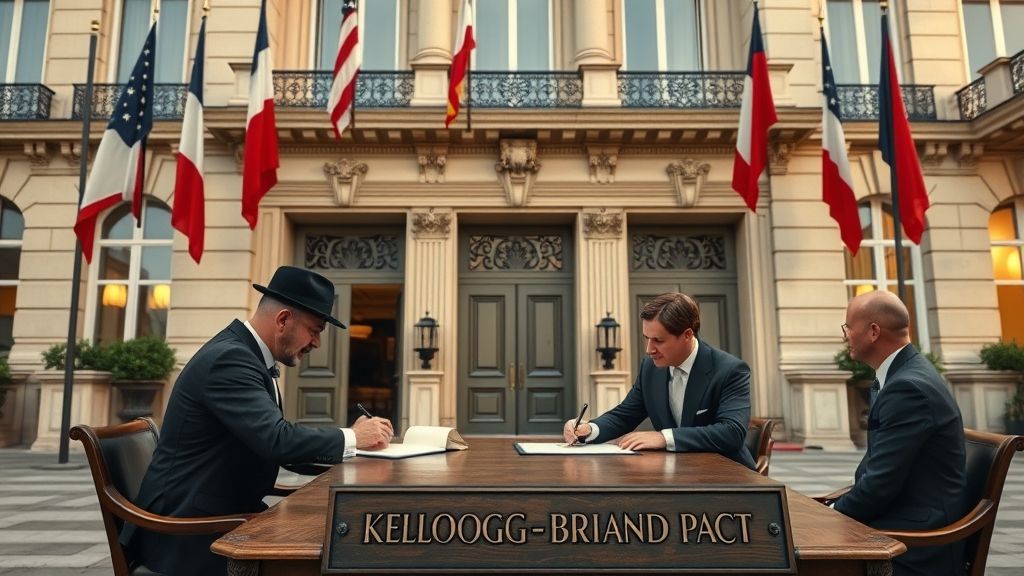
On a sweltering summer day in Paris, beneath the ornate ceilings of the Quai d'Orsay, an extraordinary ceremony unfolded. Delegates from fifteen nations gathered solemnly to inscribe their signatures on a document that would attempt to extinguish the embers of global conflict once and for all. It was August 27, 1928. The Kellogg–Briand Pact—officially the General Treaty for Renunciation of War as an Instrument of National Policy—was about to be born. This pact was more than just ink on paper; it was a beacon of hope born from the horrors of the Great War, a desperate appeal for peace in an uncertain world.
Yet, behind the grandeur and optimism lay profound questions. Could a treaty truly banish war, that primal and brutal contest between nations? The dreams of that Parisian day would soon be tested against the harshness of reality, but the story of the Kellogg–Briand Pact remains an essential chapter in humanity’s ceaseless quest for peace.
The Lingering Ghost of the Great War
The horrors of World War I had seared deep wounds into the collective psyche of the world. More than 16 million lives lost, entire cities reduced to rubble, national economies crippled, and social orders upended—this was a new kind of devastation. The "war to end all wars," as it was often called, paradoxically gave birth to an even more determined effort to prevent future carnage.
By the mid-1920s, memories of trench warfare lingered not only in the trenches of veterans but in the corridors of diplomacy. The world’s leaders faced an unmistakable imperative: to ensure that the devastation of 1914-1918 never repeated itself. Politicians, idealists, and legal minds searched for frameworks that could outlaw armed conflict and promote lasting peace, binding nations through international law rather than through fear or balance of powers.
The Visionaries Behind the Pact: Kellogg and Briand
Two towering figures embodied this urgent dream. Frank B. Kellogg, the U.S. Secretary of State known for his diplomatic acumen, and Aristide Briand, the French Foreign Minister renowned for his passionate advocacy for peace, became unlikely collaborators.
Aristide Briand had long been a peace advocate, his heart heavy with the scars of France's recent tragedies. Kellogg, a Republican politician and lawyer with a reputation for pragmatism, took a bold step by proposing to outlaw war altogether in a series of notes exchanged with France. Their synergy transformed a geopolitical necessity into a historic legal instrument.
Despite initial skepticism in Washington and Paris, both statesmen recognized that the pact, if widely embraced, could reshape global diplomacy. The idea was revolutionary: to declare war illegal as an instrument of national policy. Peace was no longer just a noble aspiration but a legal obligation.
The Global Desire for Peace After the Armageddon
The 1920s were a decade of contradictions—a rush toward modernity and economic boom shadowed by underlying tensions. Yet, a pervasive desire for stability and peace persisted globally. The ravages of war and the influenza pandemic had left deep wounds, making the prospect of another war almost unbearable.
Public opinion in many countries was intensely pacifist; citizens saw the Kellogg–Briand Pact as a hopeful sign. Poets, artists, and intellectuals embraced the pact’s promise, weaving themes of peace into their works. Mass rallies and peace movements upheld the spirit of Kellogg and Briand’s endeavor.
Meanwhile, the League of Nations, established in 1920, symbolized an early attempt at collective security. The Kellogg–Briand Pact appeared to complement these efforts, reinforcing the notion that international conflicts should be resolved through negotiation, not violence.
Paris: The City of Light as the City of Hope
Paris, still bearing the scars of German occupation and artillery bombardment, symbolized both the destruction of war and the enduring resilience of civilization. The French government chose the Quai d’Orsay, the Ministry of Foreign Affairs, as the stage for this historic signing.
The setting was dramatic: diplomats in sharp tails, clerks preparing the fragile parchment, and photographers capturing moments destined for history books. The ceremony was attended by representatives of major powers including the United States, France, the United Kingdom, Italy, and Japan.
The atmosphere mixed solemnity with cautious optimism. There was a palpable recognition that nations were venturing into uncharted diplomatic territory; the world was committing itself to renounce war, a tool that had defined nation-state relationships for centuries.
The Negotiations: Hope, Hesitations, and High Stakes
Before the day of the signing, negotiations had been intense yet conducted in a relatively short timeframe. The United States initially proposed a bilateral agreement with France, but this soon expanded into a multilateral pact, widening its scope and ambition.
Notably, the pact deliberately avoided defining what constituted “war,” leaving much open to interpretation—a diplomatic choice meant to secure broader acceptance, but one which would later fuel criticism.
Behind closed doors, several nations harbored reservations. Some military leaders suspected the pact could limit their maneuverability; others doubted the commitment of adversaries who might sign in good faith but break their word when convenient.
Still, the urgency of reinforcing international peace in the volatile interwar period outweighed such concerns. The pact was largely shaped by idealism and pragmatism entwined.
The Pact’s Provisions: An Ambitious but Ambiguous Undertaking
The Kellogg–Briand Pact was elegantly concise. At its core, it declared:
“The High Contracting Parties solemnly declare in the names of their respective peoples that they condemn recourse to war for the solution of international controversies, and renounce it as an instrument of national policy in their relations with one another.”
The Treaty called for peaceful resolution of disputes through diplomacy and condemned war as a policy tool. However, it did not specify methods for enforcement or consequences for breaches.
This ambiguity has sparked heated academic debate. Was it a grand moral statement, a legal milestone, or a naive gesture doomed to failure? Nonetheless, it marked the first time many nations collectively outlawed war in principle.
The Initial Reception: Applause and Skepticism Worldwide
Upon signing, the pact was greeted with a mixture of widespread enthusiasm and cautious doubt.
Newspapers across the globe hailed the event as a triumph of reason and humanity. The New York Times called it “a solemn declaration for peace signed in the heart of the world’s cultural capital.”
Yet diplomats in Berlin, Moscow, and Tokyo expressed reservations privately. Critics argued that without measures to prevent or punish aggression, the pact would be little more than an idealistic declaration.
Nevertheless, between 1928 and 1933, the number of signatory nations grew to over 60, including major and minor powers from every continent, affirming the pact’s symbolic global reach.
The League of Nations and the Pact’s Ligue de Paix
The Kellogg–Briand Pact did not exist in isolation. It was embedded in a broader international framework that included the League of Nations—a proto-international body envisioned to maintain peace through collective security.
Though the pact was not a League initiative, it was welcomed by its members as reinforcing the League’s mission. It acted as an "idealist supplement" to the League's more bureaucratic and procedural diplomacy.
However, the League’s structural weaknesses—lack of U.S. participation, limited military power, and dependence on unanimous decisions—meant the pact’s promise depended largely on goodwill and mutual trust.
The Pact’s Limitations: No Enforcement Mechanism
This is crucial for understanding why the Kellogg–Briand Pact ultimately failed to prevent future wars.
The treaty contained no provisions to enforce its principles. There was no international police, no binding arbitration clause, no backup military force to punish violators.
When countries acted against the pact’s spirit, there was no unified response except diplomatic condemnation. The lack of teeth rendered the document more moral appeal than legal obligation.
It would later be a sobering lesson in the limits of idealism divorced from power politics and practical enforcement.
The Pact in the Shadow of Rising Authoritarianism
Tragically, only a few years after the pact’s hopeful signing, a dark storm gathered over Europe and Asia.
The rise of totalitarian regimes—namely Nazi Germany under Adolf Hitler, Fascist Italy under Benito Mussolini, and militarist Japan—challenged the fragile postwar order.
Authoritarian leaders openly violated treaties and norms, engaging in aggressive expansionism. Their ambitions rendered the Kellogg–Briand Pact’s promises hollow in practice.
While the pact remained on paper, the world surged toward conflict once more.
Japan’s Invasion of Manchuria and the Pact’s Trial by Fire
One of the earliest glaring tests came with Japan's invasion of Manchuria in 1931.
In blatant violation of the pact, Japanese forces seized Chinese territory, unwinding years of diplomatic effort.
The League of Nations condemned the aggression but failed to enforce any meaningful sanction. The international community’s impotence demonstrated the pact’s inability to check realpolitik and military aggression.
This unfortunate episode foreshadowed the greater failure of multilateral peace efforts that would culminate in WWII.
The Pact and the Road to World War II: A Precarious Peace
Despite the grand vision, the Kellogg–Briand Pact could not prevent the outbreak of World War II in 1939.
Hitler’s invasion of Poland, Mussolini’s invasions in Africa, and expanding Japanese militarism shattered any remaining illusions about the power of legalistic pacifism alone.
Yet the pact’s legacy survived as a moral and legal touchstone in the postwar era, laying groundwork for future international norms and the United Nations Charter.
Cultural Ripples: How the Pact Inspired Writers and Thinkers
For many cultural figures, the Kellogg–Briand Pact symbolized a new age of humanism and hope.
Writers like Erich Maria Remarque, who chronicled war's brutality, saw the pact as a fragile but vital hope for a better world.
Pacifist movements drew renewed energy from the pact’s principles, staging rallies and embracing it in their art and literature.
Though the pact failed politically, it influenced the global conversation about war, peace, and human dignity.
The Legal Legacy: Foundations of Modern International Law
One of the most enduring impacts of the Kellogg–Briand Pact was its role in evolving international law.
It arguably laid the foundation for the legal prohibition of wars of aggression—an idea that would feature prominently in the Nuremberg Trials after 1945.
The pact inspired later treaties and frameworks, including the United Nations Charter's Article 2.4, which forbids the threat or use of force.
In this way, the pact’s ambitious spirit transcended its immediate failures and helped shape the postwar international order.
Lessons Learned: The Pact’s Place in Diplomatic History
Historians often view the Kellogg–Briand Pact as a paradox—a magnificent ideal marred by practical shortcomings.
While it failed to police war itself, it succeeded in delegitimizing war as an acceptable policy tool.
It exposed the tension between moral aspiration and political realities influencing diplomacy.
Above all, it remains a symbol of humanity’s persistent hope: that even in the darkest times, peace might be more than a dream.
Conclusion: Idealism, Reality, and the Eternal Quest for Peace
The Kellogg–Briand Pact reminds us that the road to peace is long, complex, and strewn with setbacks.
That August day in 1928 was a miraculous confluence of vision, will, and hope—a genuine attempt to unmake centuries of violence.
Despite its flaws and ultimate failure to prevent further wars, the pact’s spirit endures. It teaches us that peace requires not just treaties, but the collective commitment of peoples, cultures, and governments.
When nations renounce war, they reach for the best of themselves—an aspiration that is, perhaps, the most profoundly human legacy a document can hold.
FAQs
Q1: Why was the Kellogg–Briand Pact created?
A: It was created to outlaw war as an instrument of national policy following the devastation of World War I, aiming to prevent future conflicts through legal renunciation of war.
Q2: Which countries initially signed the pact?
A: Fifteen nations initially signed the pact, including major powers like the United States, France, the United Kingdom, Italy, and Japan.
Q3: What were the main limitations of the pact?
A: The pact lacked enforcement mechanisms, clear definitions of war, and provisions for sanctions, which undermined its effectiveness.
Q4: How did the pact influence international law?
A: It laid foundational principles that contributed to the development of laws against wars of aggression and influenced the United Nations Charter.
Q5: Did the Kellogg–Briand Pact prevent World War II?
A: No, the pact failed to prevent World War II, as aggressive powers violated its terms without consequence.
Q6: How is the pact remembered today?
A: It is remembered as a symbolic milestone in the quest for peace and an early attempt to codify the illegality of war under international law.
Q7: What role did public opinion play in the pact’s creation?
A: Public pacifism and widespread desire to avoid another devastating conflict pressured governments to seek peace initiatives like the Kellogg–Briand Pact.
Q8: Was the pact connected to the League of Nations?
A: While not formally part of the League, the pact complemented its mission of collective security but suffered from the League’s collective weaknesses.