Table of Contents
- The Dawn of Terror: Early Signs of Mount Kelud’s Fury
- The History of Kelud: A Volcano of Violence and Legend
- Indonesia on Edge: Geological and Cultural Context
- The Precursors: Seismic Tremors and Local Warnings
- February 13, 2014: The Sky Shatters
- Explosive Power Unleashed: Ash Clouds and Pyroclastic Flows
- Immediate Impact: Communities in Chaos
- The Human Toll: Evacuations, Injuries, and Lives Disrupted
- National Response: Government, Military, and Relief Efforts
- Regional and Global Repercussions: Flight Disruptions and Economic Shakes
- Scientific Insights: What the Kelud Eruption Taught Volcanologists
- Stories from the Ashes: Personal Accounts of Survival and Loss
- The Role of Social Media: Sharing Crisis in Real-Time
- Environmental Consequences: The Aftermath on Land and Water
- Recovery and Reconstruction: Rebuilding in a Shadowed Landscape
- The Cultural Memory of Kelud: Rituals, Myths, and Resilience
- Lessons in Disaster Preparedness: Indonesia’s Volcanic Challenges
- Mount Kelud Today: Monitoring and Living with the Threat
- Comparing Kelud 2014 with Past Eruptions: Patterns and Differences
- The Volcano’s Legacy: How Kelud Shapes East Java’s Identity
- Conclusion: Nature’s Fury and Human Fortitude
- FAQs: Everything You Need to Know about the 2014 Kelud Eruption
- External Resource
- Internal Link
On a crisp February morning in 2014, the skies over East Java blackened as Mount Kelud awoke from a long slumber. What began as faint rumbles beneath the surface quickly escalated into one of Indonesia's most dramatic volcanic eruptions in recent memory. For the residents living in the shadow of this majestic, yet menacing giant, the day unfurled like a scene from an apocalyptic vision: thick clouds of ash billowed high into the atmosphere, engulfing towns, swallowing roads, and casting the land into eerie twilight.
But this eruption was more than a natural disaster—it was a poignant reminder of the delicate dance between humans and nature, a narrative shaped by ancient geology, local culture, swift human responses, and the persistent spirit of survival. This is the story of Kelud’s 2014 eruption: a volcanic symphony of destruction and hope, where danger and resilience coexisted in the ash-streaked air.
The Dawn of Terror: Early Signs of Mount Kelud’s Fury
Long before February 2014, subtle signals whispered warnings. Kelud’s unrest had not gone unnoticed. Seismographs registered tremors beneath the earth’s crust, and locals reported minor earthquakes that rumbled through villages. The sound of deep, distant booms echoed across the slopes like a distant war drum, unsettling but not yet terrifying.
For the people of East Java, these were signs neither unfamiliar nor impossible to ignore. Experienced farmers and elders spoke of Kelud's volatile temperament, reminding their communities of the dangers that lay dormant beneath its green-clad peak. Yet, life pressed on as usual: children attended school, markets bustled, and ancient rituals carried on, offering a fragile shield of hope against an imminent, unseen menace.
The History of Kelud: A Volcano of Violence and Legend
Mount Kelud is not merely a geological formation—it is a living entity etched deeply into Indonesia’s history and mythology. Situated on the island of Java, Kelud ranks among the most active volcanoes in the archipelago. Its past eruptions have been cataclysmic, some reaching death tolls in the thousands and reshaping landscapes, economies, and societies.
Records dating back to the fifteenth century tell of great explosions, lava flows, and fiery devastation. In 1919, a particularly deadly eruption caught the world’s attention: the volcano spewed toxic gases that asphyxiated nearly 5,000 people. Yet alongside this terror, local folklore frames Kelud as a sacred mountain, home to spirits that demand respect.
This dual identity—a force of destruction and a symbol of spiritual significance—has defined the relationship between Kelud and the people of East Java. It is a volcano regarded with both fear and reverence.
Indonesia on Edge: Geological and Cultural Context
Indonesia sits precariously on the Pacific “Ring of Fire,” a belt of intense seismic activity where tectonic plates collide. The country holds more active volcanoes than any other nation—around 130—making eruptions a recurring challenge. Java, the most populous island, houses several major volcanic peaks, each active and potentially lethal.
Yet the story of Kelud’s 2014 eruption is not just about geology. It unfolds amid a complex socio-political landscape: densely populated villages nestled in fertile volcanic soils, communities economically reliant on agriculture yet acutely vulnerable to disaster, and authorities balancing rapid urbanization with risk management.
This backdrop is essential to understanding why Kelud’s awakening triggered not just environmental upheaval, but a profound human drama.
The Precursors: Seismic Tremors and Local Warnings
In the weeks leading to the eruption, seismic intensity beneath Kelud increased sharply. Instruments recorded clusters of small earthquakes—volcanic tremors indicating magma movement. Satellite images showed swelling on the volcano’s cone, a clear sign pressure was building below.
Indonesian scientists from the Center for Volcanology and Geological Hazard Mitigation worked tirelessly to monitor these changes. Alerts were raised, and early warnings broadcast to local governments and residents. Still, skepticism and a desire to continue daily routines slowed evacuation efforts.
Villagers, initially hesitant, began to witness changes: sulfurous smells, steam venting, and ash dust settling over plantations. These signs coalesced into growing anxiety, as traditions clashed with urgent necessity.
February 13, 2014: The Sky Shatters
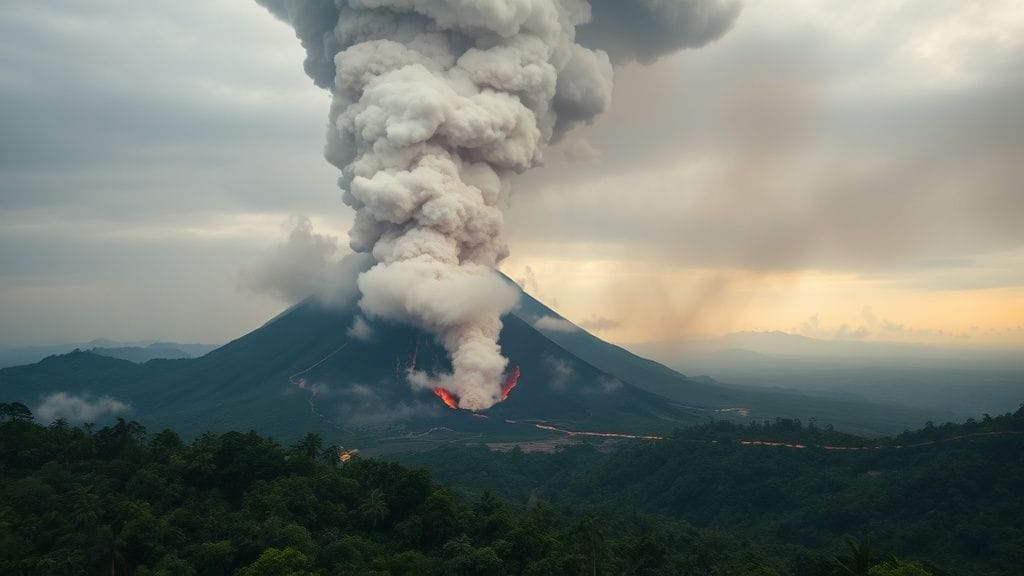
At just before 10 a.m. on February 13, the earth trembled violently beneath Mount Kelud. The volcano erupted with explosive force, ejecting a towering column of ash and smoke that soared 17 kilometers (11 miles) into the atmosphere. The sky darkened; sunlight was smothered under a choking veil of volcanic particles.
This initial blast was immediately followed by pyroclastic flows—deadly rivers of incandescent gas, ash, and rock—that surged down the slopes, obliterating everything in their path. Villages located near the crater were instantly buried under searing debris, forcing thousands into frantic flight.
The roar of the eruption could be heard tens of kilometers away, as intense tremors shattered windows and sent animals stampeding in panic.
Explosive Power Unleashed: Ash Clouds and Pyroclastic Flows
Kelud’s eruption was swift but devastating. Ash clouds spread westward, carried by high-altitude winds, blanketing cities and towns far beyond its immediate footprint. The ashfall was so intense that roads became impassable, airport operations were suspended, and infrastructures strained under the sudden burden.
Pyroclastic flows did not just scorch the mountain’s slopes—they altered landscapes, carving new paths and filling river valleys with thick deposits. The temperature of these flows was estimated above 1,000 degrees Celsius at the source, incinerating plant life and threatening any living creatures caught in their advance.
The intensity of the eruption was staggering—volcanologists later classified it as a VEI 4 (Volcanic Explosivity Index), meaning a “cataclysmic” event with significant regional impact.
Immediate Impact: Communities in Chaos
The eruption thrust thousands into an instant crisis. Towns that once thrived at the mountain’s feet were blanketed in ash, their water supplies contaminated, homes roofed by layers of volcanic dust. Visibility dropped to near zero, and the air itself became hazardous, thick with microscopic ash particles.
Evacuations quickly began, though chaos reigned in the early moments. Roads clogged with frightened families fleeing the hazardous zones; makeshift shelters sprung up for displaced persons. Schools and hospitals faced improvisation challenges as access routes were cut.
Local economies, overwhelmingly agricultural, were crippled as fertile fields lay buried beneath ash, threatening food supplies and livelihoods.
The Human Toll: Evacuations, Injuries, and Lives Disrupted
Despite warnings and preparation, the eruption claimed a human toll both physical and psychological. Official reports counted one fatality directly attributed to the volcano—attributed to an accident during evacuation. Hundreds more suffered respiratory illnesses due to ash inhalation.
Yet numbers fail to capture the full tragedy: families separated, homes lost, children traumatized by the sudden upheaval of their lives. The eruption uprooted tens of thousands, forcing them into crowded temporary shelters with uncertain futures.
Children missed school, crops withered, and economic pressures intensified the fragile balance between survival and despair.
National Response: Government, Military, and Relief Efforts
Indonesia’s government mobilized swiftly. Military units were dispatched to assist with evacuations and distribute masks, food supplies, and clean water. Health services prioritized respiratory care amid the growing silicosis threat linked to volcanic ash.
Meanwhile, scientists maintained vigilance—as ongoing ash falls posed risks of further eruptions or lahars (volcanic mudflows), especially with the approaching rainy season.
Public communication channels—radio, television, and increasingly social media—played crucial roles in disseminating timely information, helping reduce panic and coordinate rescue efforts.
Regional and Global Repercussions: Flight Disruptions and Economic Shakes
Though the eruption was centered locally, its consequences rippled outward rapidly. Ash clouds reached Jakarta and densely populated urban centers, leading to airport closures in Surabaya and Yogyakarta, affecting thousands of travelers.
International airlines re-routed flights or canceled services, costing millions and disrupting regional connectivity. Agricultural exports faced delays due to contaminated produce and damaged transport infrastructure.
Tourism in East Java plummeted temporarily, with vacationers canceling plans to visit the region widely regarded for its natural beauty.
This localized eruption, in a globalized world, demonstrated how nature’s rumblings can cascade across borders and industries.
Scientific Insights: What the Kelud Eruption Taught Volcanologists
The 2014 eruption provided a rich, if painful, opportunity for scientific study. Monitoring equipment captured pre-eruptive signals in unprecedented detail, helping refine eruption forecasting models.
Researchers noted the rapid escalation from seismic activity to eruption, emphasizing the need for heightened alert systems in similar volcanoes worldwide. The behavior of ash clouds and pyroclastic flows under prevailing winds became clearer, aiding hazard mapping.
Yet even with modern technology, uncertainty remained—a reminder of nature’s unpredictable force.
Stories from the Ashes: Personal Accounts of Survival and Loss
Amid the data and devastation lay countless individual stories. A farmer who packed his family into a small truck, fleeing through dense ash to safety. A schoolteacher who led children to shelter minutes before the eruption darkened the classroom. Elderly villagers recalling past eruptions, finding solace in tradition even as the landscape changed beyond recognition.
These human narratives paint a layered portrait of resilience and vulnerability, demonstrating how disaster touches lives uniquely yet binds communities in shared challenge.
The Role of Social Media: Sharing Crisis in Real-Time
The eruption unfolded in an era of digital interconnectivity. Social media platforms like Twitter and Facebook became vital arteries for information exchange. Photos, videos, and eyewitness reports flooded the internet, aiding both alert dissemination and emergency coordination.
Hashtags related to Kelud trended as concerned citizens worldwide followed the unfolding events. This digital chapter marked a shift from past eruptions, where news traveled slowly, underscoring the evolving role of communication in disaster response.
Environmental Consequences: The Aftermath on Land and Water
The ashfall temporarily darkened skies and buried vegetation, but its most lasting impact was on soils and waterways. Volcanic ash altered the pH of nearby rivers and lakes, affecting aquatic ecosystems. Fields covered in thick ash layers faced weeks, even months, of rehabilitation before crops could be replanted.
However, volcanic deposits also enriched soils with minerals over time—setting the stage for future agricultural renewal, a paradox of destruction and fertility.
Forests began to regrow, insects and animals returned slowly, underscoring nature’s remarkable capacity for regeneration.
Recovery and Reconstruction: Rebuilding in a Shadowed Landscape
In the months following the eruption, government agencies, NGOs, and local communities collaborated on relief and rebuilding efforts. Reconstruction of homes and infrastructure faced logistical and financial hurdles but was buoyed by communal solidarity.
Special programs aimed at restoring farmland, schools reopened cautiously, and health campaigns addressed lingering respiratory issues. Recovery was uneven and slow; scars remained visible on the land and in the hearts of affected people.
Yet these efforts embodied a determination to rise anew, to coexist with the volcano’s looming presence.
The Cultural Memory of Kelud: Rituals, Myths, and Resilience
In East Java, Kelud remains much more than a mountain. It is woven into local identity through ceremonies and stories that both honor and attempt to appease the volcanic spirit.
After the 2014 eruption, traditional rituals intensified, serving as psychological anchors for beleaguered communities. These cultural practices offered a needed counterbalance to scientific responses, bridging past and present understandings of natural disaster.
Kelud is thus a symbol of cyclical destruction and renewal—a force impossible to defeat but possible to respect.
Lessons in Disaster Preparedness: Indonesia’s Volcanic Challenges
The Kelud eruption underscored critical lessons for Indonesia, home to dozens of active volcanoes. Early warning systems improved; evacuation drills became more frequent and comprehensive; public awareness efforts ramped up.
Yet challenges remain: densely populated zones close to volcanic hazards, climate factors increasing lahar risks, and the need for sustainable land use planning.
Kelud 2014 was a stark reminder that preparation is an ongoing necessity in a land shaped by fire.
Mount Kelud Today: Monitoring and Living with the Threat
In the years since the eruption, Mount Kelud has returned to a calmer state, but it remains restive—an ever-watchful sentinel.
Advanced monitoring stations, seismic arrays, and satellite observation have increased surveillance capabilities. Scientists maintain a constant vigil, while local communities live with a wary familiarity, knowledgeable that the volcano’s next mood swing could come swiftly.
This coexistence exemplifies the delicate balance between modern science and daily life in volcanic landscapes.
Comparing Kelud 2014 with Past Eruptions: Patterns and Differences
Though violent, the 2014 eruption was less deadly than some historic blows. Its rapid evacuation protocols and timely warnings likely saved thousands of lives—a testament to progress.
Yet geologically, the event bore similarities to earlier eruptions in how magma ascended rapidly and exploded explosively. Differences emerged in ash cloud dispersal patterns influenced by wind and precipitation.
Studying these nuances enriches the broader scientific discourse on subduction zone volcanoes like Kelud.
The Volcano’s Legacy: How Kelud Shapes East Java’s Identity
More than a natural feature, Kelud defines the character and fate of East Java. Its fertile volcanic soils support crops, its slopes inspire myths, and its threat instills vigilance.
The 2014 eruption reinforced this legacy—highlighting human vulnerability and tenacity in the face of elemental power. For East Javanese communities, Kelud is both a peril and a blessing, a reminder of Earth's restless dynamism and mankind’s enduring spirit.
Conclusion
The 2014 eruption of Mount Kelud stands as a compelling chapter in Indonesia’s saga of fire and resilience. It was not simply an eruption of molten rock and ash, but a profound human experience—a collision of nature’s raw might with humanity’s courage, adaptability, and hope.
This event revealed the power of foresight and preparedness, the strength of community bonds, and the continuing dialogue between ancient traditions and modern science. It showed us the volatility beneath our feet, yet also the indomitable will to rebuild, remember, and coexist.
In Kelud’s shadow, life persists—shaped forever by ash, flame, and the unyielding pulse of the earth beneath.
FAQs
Q1: What caused the 2014 eruption of Mount Kelud?
The eruption was triggered by magma movement beneath the volcano’s magma chamber, indicated by increasing seismic activity and ground swelling. Pressure built until explosive release in February 2014.
Q2: How many people were affected by the eruption?
Tens of thousands of residents were evacuated; while the death toll was low due to timely warnings, many faced displacement, health issues, and economic hardship.
Q3: How did the Indonesian government respond?
The government quickly mobilized military and emergency services to aid evacuation, provide shelter and healthcare, and coordinate disaster relief.
Q4: What were the environmental impacts of the eruption?
Significant ashfall altered soil and water ecosystems, buried vegetation, and caused temporary air pollution, but the volcanic deposits also enriched soils for future agriculture.
Q5: How has monitoring improved since the eruption?
Advanced seismic instruments, satellite technology, and communication systems have enhanced early warning capacities, facilitating faster and safer evacuations.
Q6: Why is Mount Kelud culturally significant?
Kelud is deeply integrated into local myths and rituals, symbolizing both danger and divine power. Traditional ceremonies aim to appease the volcano’s spirit.
Q7: Were there disruptions beyond East Java?
Yes, ash clouds affected air traffic across Indonesia, causing airport closures and impacting travel and commerce regionally.
Q8: What lessons did the eruption teach about disaster management?
It highlighted the importance of early warnings, community engagement, integrated science, and the need to balance development with risk in volcanic regions.

