Table of Contents
- A February Night in Moscow: The Curtain Rises on a Dangerous Truth
- The Shadow of Stalin: Terror, Cult, and the Frozen Heart of the Soviet Union
- The Road to February 25, 1956: How Khrushchev Prepared to Break the Spell
- Inside the 20th Party Congress: Hope, Fear, and Ritual in the Great Hall
- The Closed Session Begins: Khrushchev Steps to the Podium
- Unmasking a God: The First Shocking Words of the Secret Speech
- Catalog of Crimes: Purges, Show Trials, and the Machinery of Terror
- The Cult of Personality: How Stalin Rewrote Reality and Himself
- Gasps in the Hall: Human Reactions to an Unthinkable Accusation
- From Closed Session to Whispered Legend: How the Speech Leaked
- Shockwaves Across the Communist World: Poland, Hungary, and Beyond
- Faith Shattered: Intellectuals, Workers, and the Crisis of Belief
- Khrushchev’s Gamble: De‑Stalinization and the Politics of Survival
- The Kremlin After the Confession: Resistance, Denial, and Reinterpretation
- Echoes in the West: How the Secret Speech Rewired the Cold War
- Memory, Archives, and Myths: Historians Revisit the Secret Speech
- Conclusion
- FAQs
- External Resource
- Internal Link
Article Summary: In February 1956, deep within a sealed hall in Moscow, Nikita Khrushchev delivered what would become known as khrushchev’s secret speech, a four-hour reckoning with the legacy of Joseph Stalin that shook the Soviet Union to its core. This article traces the long shadow of Stalin’s rule, the atmosphere of fear and ritual at the 20th Party Congress, and the dramatic moment when a Soviet leader publicly condemned the crimes of his predecessor. Moving chronologically, it explores the content of the speech, the stunned reactions of delegates, and the way its text leaked out to the wider world despite official secrecy. We follow the political and emotional aftershocks: uprisings in Eastern Europe, crises of faith among communists, and a reconfiguration of Cold War politics. Throughout, we situate khrushchev’s secret speech within the broader history of de‑Stalinization, showing both its audacity and its limitations. The narrative also examines how the speech has been remembered, contested, and reassessed by historians as new archives opened after 1991. Ultimately, khrushchev’s secret speech appears as both confession and calculation, a turning point when a system briefly looked into the mirror of its own violence—and then tried to decide how much of that reflection the world was allowed to see.
A February Night in Moscow: The Curtain Rises on a Dangerous Truth
On the night of February 24–25, 1956, Moscow slept under a hard winter sky. The snow on the streets had turned grey and brittle, the lamps along Kalinin Prospekt cast narrow cones of light, and in the apartments of the capital, families huddled around radios, waiting for news from the 20th Congress of the Communist Party of the Soviet Union. They expected the usual words: progress, vigilance, the looming threat of imperialism, the eternal wisdom of Lenin and Stalin. What they did not know was that, a little after midnight, behind closed doors in the Great Hall of the Kremlin, a speech was being prepared that would fracture the very mythology on which their world had been built.
Delegates from every republic and region had been summoned to a “closed session,” forbidden to bring journalists, foreign guests, or recording devices. Guards were stationed at the entrances. The atmosphere was thick with fatigue and suspense. For days they had sat through ritualistic reports and carefully choreographed applause. Now, in the early hours, something different was promised. Many of them had been loyal Party men for decades; some carried memories of underground cells under the tsar, of civil war, of hunger and reconstruction. Others owed their careers and their very survival to the man whose giant portrait hung over every Soviet podium: Joseph Vissarionovich Stalin, dead now for three years yet still omnipresent in words, statues, and songs.
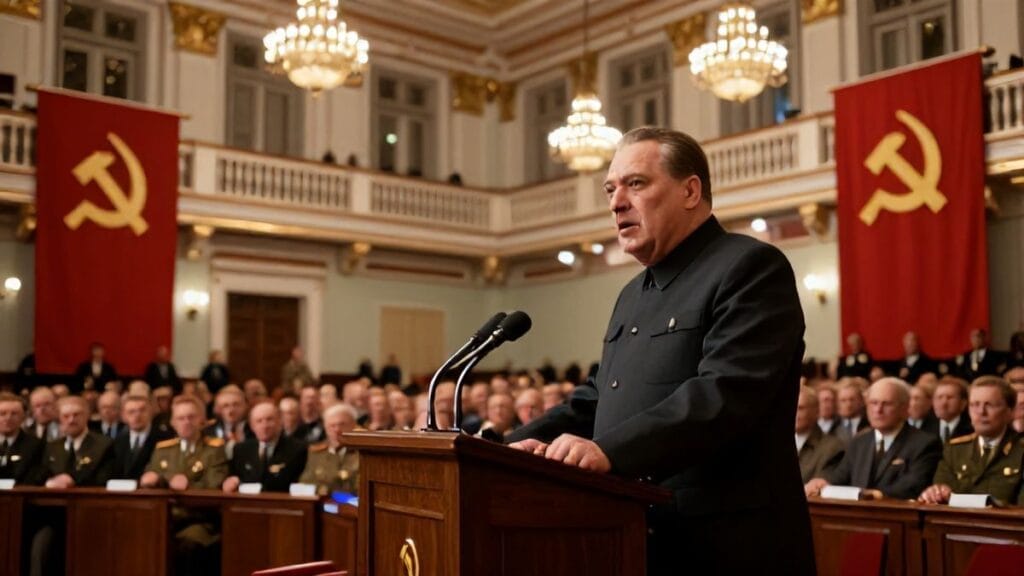
They took their seats beneath the chandeliers, the air heavy with tobacco and the whisper of wool coats. Few knew exactly what was coming. Rumors had swirled that the leadership would address “mistakes” of the past, but these could mean anything in Soviet language: a slight miscalculation in an economic plan, a vague excess in zeal. The delegates opened their notebooks with disciplined obedience. In the front row, eyes turned to the podium where Nikita Sergeyevich Khrushchev, First Secretary of the Party, prepared to do something that only weeks earlier would have seemed almost suicidal: he was about to dismantle, in front of the highest body of the Communist Party, the sacred image of Stalin.
The hall quieted. Pens poised. Coats rustled one last time. Then Khrushchev began to read from a document whose very existence was tightly guarded: the report “On the Cult of Personality and Its Consequences,” soon to be known across the globe as khrushchev’s secret speech. For nearly four hours, in a flat yet relentless voice, he would drag into the light the terror, the purges, and the lies that had sustained Stalin’s rule, while every man in the hall had to decide whether to welcome this sudden eruption of truth—or fear that it would destroy everything they had built their lives upon.
The Shadow of Stalin: Terror, Cult, and the Frozen Heart of the Soviet Union
To understand why khrushchev’s secret speech reverberated so violently, one must return to the era it sought to unmask. Joseph Stalin had governed the Soviet Union from the late 1920s until his death in 1953. Under his rule, an entire political culture had crystallized, one that fused genuine revolutionary fervor with absolute personal power. The state claimed to represent the future of humanity, yet it depended on an apparatus of surveillance and terror that could devour anyone at any time.
In the 1930s, Stalin’s Great Terror swept across the country. Hundreds of thousands of Party members, officers, managers, and ordinary citizens were arrested, interrogated, and often executed or sent to the Gulag. Officially, they were “enemies of the people,” wreckers, spies, saboteurs in league with foreign powers. In reality, many were loyal communists caught in arbitrary waves of suspicion. The purges decapitated the Red Army command before World War II, disoriented entire sectors of the economy, and left a society of survivors trained to keep their heads down, their eyes averted from the ominous black car pulling up at night.
Yet Stalin’s power did not rest solely on fear. It was wrapped in reverence. Portraits of Stalin loomed over every public building. Poems praised him as a genius of all times, songs compared him to the sun itself. Schoolchildren learned to love him as “the father of nations.” The Soviet press attributed every achievement—the electrification of remote villages, the harvest, the victory over Nazi Germany—to his guidance. History was rewritten so that Lenin appeared as the precursor and Stalin as the inevitable, flawless heir. This was the cult of personality that Khrushchev would later denounce: a quasi-religious adoration that turned a political leader into an infallible deity.
For many, this cult was not entirely cynical. Stalin presided over astounding transformations: industrialization, urbanization, mass education. He was in power when the Soviet Union endured and ultimately defeated Hitler’s invasion at the cost of more than 20 million lives. Millions of Soviet citizens genuinely believed he had saved their country and given them a future. But this belief required a brutal compromise with reality. The disappearances, the forced collectivization of agriculture that had led to catastrophic famines, the labor camps in the Far North—these things were buried beneath layers of propaganda and silence. To question Stalin too openly was to risk being branded an enemy yourself.
By the early 1950s, the system Stalin had built functioned like a machine with two gears: routine and terror. Bureaucrats filled out endless forms, five-year plans rolled forward, and citizens performed the rituals of Soviet life—May Day parades, Party meetings, elections with a single candidate. At unpredictable moments, however, the machine would seize up, grind its gears, and crush those caught between them. Stalin’s last years were marked by renewed waves of repression, such as the so‑called “Leningrad Affair” and the notorious Doctors’ Plot, in which Jewish physicians were accused of conspiring to kill Soviet leaders. When Stalin died on March 5, 1953, his apparatus was still primed for paranoia.
In that sense, khrushchev’s secret speech did not merely recount historical facts; it challenged the emotional architecture of Soviet life. The shadow of Stalin was not only institutional but psychological. For the men sitting in the Great Hall in 1956, Stalin had been their commander, their teacher, often their persecutor. To admit that this figure had been responsible for “mass repressions” and “brutal violations of socialist legality,” as the speech would put it, was to renegotiate their own pasts. It’s astonishing, isn’t it, how quickly a single speech could turn yesterday’s hero into a criminal in the archives of memory?
The Road to February 25, 1956: How Khrushchev Prepared to Break the Spell
Stalin’s death opened a struggle within the Soviet leadership, a tense dance of alliances, accusations, and strategic retreats. Initially, power was shared among several figures: Georgy Malenkov, Lavrentiy Beria, Vyacheslav Molotov, and Nikita Khrushchev. Each carried a different piece of Stalin’s legacy. Beria controlled the security organs and knew where many of the bodies were buried—literally and figuratively. Malenkov was seen as Stalin’s formal successor. Khrushchev, once a loyal subordinate involved in purges in Ukraine and Moscow, positioned himself carefully as a man of the people, boisterous and approachable.
Within months, the new leadership began cautiously dismantling the most extreme elements of Stalin’s system. Beria was arrested and executed in 1953, accused of treason and abuse of power. Some political prisoners were released, and the Doctors’ Plot was declared fabricated. Yet these early steps were not accompanied by public confession. The myth of Stalin remained broadly intact; his body lay embalmed beside Lenin in the mausoleum on Red Square, and his portraits still dominated public space.
Khrushchev’s rise was gradual. By 1955 he had outmaneuvered rivals to become the dominant figure in the Presidium (the renamed Politburo). But he understood that his power rested on a delicate foundation. The Soviet Union was exhausted, its agriculture weak, its citizens wary after decades of terror. For the system to survive and compete with the West, something had to change—not only policies but atmosphere. A thaw in political life could revive popular enthusiasm, attract talent back into the Party’s orbit, and reduce the crippling fear that stifled initiative.
At the same time, Khrushchev was haunted by the crimes he had witnessed, and in some cases helped implement. In Ukraine, he had seen the wreckage of purges and forced collectivization. He had watched comrades disappear. The secret NKVD (later MGB, then KGB) archives contained reports of fabricated trials, torture, coerced confessions. As First Secretary, he gained access to this material and began to read systematically. The more he learned, the more convinced he became that Stalin’s “cult of personality” was not an aberration on the margins of socialism but had deformed the core of Soviet rule.
Yet Khrushchev was no dissident. He did not wish to renounce Leninism or single-party rule. Rather, he sought to save them from what he regarded as Stalin’s distortions. His goal was to separate the image of socialism from the bloodstains of the Great Terror. This required a rhetorical operation of great delicacy: to condemn Stalin’s “violations of socialist legality” while preserving faith in the Party and its historic mission. It was, as one historian later put it, an attempt to perform surgery on the past without killing the patient.
Preparation for khrushchev’s secret speech began in earnest in late 1955. A commission headed by prominent Party official Pyotr Pospelov was tasked with investigating the mass repressions of the 1930s and 1940s. They combed archives, interrogated surviving officials, and assembled a damning ledger of arbitrary arrests and executions. Thousands of cases were reviewed, figures compiled. The commission’s materials were strictly classified; the fear that exposing too much could destabilize the entire system weighed heavily on the leadership.
In January 1956, as the 20th Party Congress approached, Khrushchev decided that a reckoning could no longer be postponed. The Congress, attended by some 1,400 delegates and thousands of guests, would be the perfect stage—not for public theatrics, but for an internal, controlled confession. The core Party elite would hear the truth directly. It was a gamble. Some in the Presidium, like Molotov and Kaganovich, were deeply uneasy; they had been Stalin’s closest associates. Others feared that any denunciation could ricochet back upon them. Still, a majority accepted the need to move forward. The speech drafted in Khrushchev’s name would be delivered in a special closed session at the very end of the Congress, with no foreign delegates present.
Inside the 20th Party Congress: Hope, Fear, and Ritual in the Great Hall
The 20th Party Congress opened on February 14, 1956, with pomp and ceremony. Delegates from across the Soviet Union and fraternal communist parties abroad assembled in Moscow, filling hotels, dormitories, and official residences. Banners hung in the city, red flags fluttered despite the cold, and newspapers hailed the Congress as a landmark in the “construction of communism.” The tone of public speeches was optimistic. Khrushchev presented a lengthy report on the Party’s work, emphasizing industrial growth, the expansion of education, and the promise of a brighter future. There were criticisms of “bureaucratic distortions” and references to “violations of socialist legality,” but these phrases remained elliptical, more hints than revelations.
The Congress had the rhythm of a ritual. Delegates listened, applauded, sometimes dozed. Voting on resolutions was unanimous, as always. Foreign communist leaders—Polish, Czech, French, Italian, and others—mingled in the hallways, exchanging impressions, measuring the currents within the Soviet leadership. Few sensed the storm gathering behind the scenes. The Congress, after all, had always been a stage-managed performance where the Party showed its unity and strength.
Yet behind the celebrations, subtle signs hinted at a shift. Some speakers, especially from the Soviet republics that had suffered harsh repressions, made veiled references to “past mistakes.” The press published cautious pieces about the rehabilitation of certain victims of the 1930s purges. One evening, a rumor circulated in a hotel corridor: “Khrushchev is preparing something explosive.” But rumors had always been part of Soviet life. The line between imagination and reality was blurred by secrecy.
The final official sessions of the Congress came and went. Delegates believed the work was nearly done. Then, quietly, instructions filtered out: all Soviet delegates were to remain in Moscow for an additional closed meeting. Foreign delegates were politely excluded. Security was tightened. The hall reserved for the session was heavily guarded. Members were warned not to take notes intended for publication, not to discuss what they would hear with anyone outside authorized circles. The very vocabulary—“closed,” “for internal use”—signaled danger.
On the night of February 24–25, they filed into the hall once more, but the mood was different now. The usual fanfare was absent. No orchestras, no welcoming speeches from foreign comrades. Just the murmur of hundreds of men and women, many veterans of the Party, wondering why they had been summoned in the small hours. Midnight passed. Then Khrushchev appeared, carrying a thick sheaf of papers.
The delegates knew him as a blunt, often earthy speaker, fond of jokes and vivid metaphors. But as he began to talk, it became clear that this address would be different. He announced that the subject would be the cult of personality surrounding Comrade Stalin and its grave consequences. A chill moved through the hall. The unthinkable word—“cult”—had been spoken aloud, attached not to a foreign enemy but to the man whose giant portraits had hung over every Congress for three decades.
The Closed Session Begins: Khrushchev Steps to the Podium
Khrushchev’s demeanor that night has been described in multiple recollections: focused, sober, stripped of his usual theatricality. He did not shout, he did not pound the table. Instead, he read, almost monotonously, from the prepared text. This made the content even more shocking. It was as if the bureaucracy itself were calmly testifying against its former master.
He opened with a paradox: Stalin, he said, had led the Soviet people to great victories, particularly in the Great Patriotic War, yet he had also committed grave crimes, distorting Lenin’s teachings and betraying the ideals of socialism. The cult of personality was not merely an aesthetic mistake, Khrushchev insisted, but the origin of enormous human suffering and political damage. By placing one man above the Party and the collective leadership, the system had allowed terror to flourish unchecked.
As he spoke, delegates strained to reconcile these words with their mental images of Stalin. For years, every official description of Stalin had been suffused with superlatives: “genius,” “leader of humanity,” “wise helmsman.” Now Khrushchev cited chapter and verse from internal documents, describing how Stalin personally initiated mass arrests, signed off on death lists, and refused to listen to warnings about the German invasion in 1941. The speech named names: Kirov, Bukharin, Rykov, Tukhachevsky, and many others whose reputations had been destroyed in show trials. Some of these men were once labeled fascist spies; now they were portrayed as victims of Stalin’s paranoia.
The horror was in the details. Khrushchev read figures—thousands of executions ordered in a single night, lists of Central Committee members arrested and shot, statistics of military commanders eliminated before the war. He described interrogations based on torture and forced confessions. The language, though couched in Party jargon, was unmistakably accusatory. Stalin had created an atmosphere in which honest criticism was punished as treason, and subordinates were encouraged to denounce one another to prove their loyalty.
Khrushchev’s decision to cite secret archival material gave the speech the weight of an internal indictment. This was not an enemy’s pamphlet or a Western radio broadcast, but an official report to the highest authority of the Soviet state. One delegate later recalled that as Khrushchev read out the names of executed comrades, men in the hall quietly wept. Others sat motionless, as if stone. A few, overwhelmed by the revelation that the Party itself was confessing, fainted.
Throughout the speech, Khrushchev repeated a crucial distinction: Stalin, not socialism, was to blame. The system, he argued, had strayed from Lenin’s principles under the influence of a single man’s cult. The task now was to restore “collective leadership” and “socialist legality,” to prevent the return of arbitrary terror. It was a political line carefully drawn. Khrushchev wanted to reveal enough to loosen Stalin’s grip on Soviet memory, but not so much that the entire edifice of Party legitimacy would crumble.
Unmasking a God: The First Shocking Words of the Secret Speech
The early passages of khrushchev’s secret speech were like hammer blows against a bronze statue. Khrushchev quoted Lenin’s own “Testament,” the 1922–23 document in which Lenin had warned of Stalin’s rudeness and concentration of power, suggesting that he be removed from the post of General Secretary. Lenin’s words, long suppressed, now echoed publicly—albeit within a closed hall—casting Stalin not as Lenin’s flawless heir but as a problematic choice that Lenin himself had doubted.
Then Khrushchev moved to the core allegation: Stalin had systematically violated the principles of socialist legality and Party democracy. Decisions to arrest and execute were made not on the basis of evidence, but on suspicion, whim, and personal pique. Khrushchev emphasized that many of those repressed were “old Bolsheviks,” veterans of the revolution who had devoted their lives to the cause. Their confessions in public trials had been forced through brutal interrogations. “They were innocent,” he declared, in a phrase that must have sent a shock wave through the hall.
Delegates heard, perhaps for the first time in an official setting, that the 1934 murder of Sergei Kirov, the popular Leningrad Party boss, had been exploited by Stalin as a pretext for massive purges. Thousands were executed for alleged complicity in an assassination about which, Khrushchev hinted, serious questions remained. The implication that Stalin himself might bear responsibility for—or at least have cynically used—Kirov’s death struck at the heart of an entire era’s justification.
Khrushchev described how Stalin had unjustly accused top military commanders of plotting with Nazi Germany, decimating the officer corps on the eve of war. The resulting weakness, he argued, had contributed to catastrophic Soviet losses in the early months of the German invasion. Thus, Stalin’s paranoia was not only a moral failing but a strategic disaster.
In one of the speech’s most chilling passages, Khrushchev spoke of Stalin’s orders to expand the categories of punishable “enemies” to include not just actual or suspected opponents, but entire national groups—Chechens, Ingush, Crimean Tatars, Volga Germans—deported en masse during the war to distant regions under brutal conditions. While the speech did not fully explore the genocidal dimensions of these deportations, it signaled that entire peoples had suffered due to one man’s obsessions.
The effect of these revelations cannot be overstated. For decades, the official narrative had portrayed Stalin’s terror as a defensive necessity, a response to very real conspiracies. Now, the leader of the Party himself was effectively admitting that many of these conspiracies had been fabricated. The foundations of Soviet political theology—where history advanced through the wise guidance of the leader and the infallible Party—began to crack.
Catalog of Crimes: Purges, Show Trials, and the Machinery of Terror
As the hours passed, khrushchev’s secret speech unfolded like a grim ledger. Khrushchev recounted, case by case, the destruction of nearly the entire Lenin-era leadership. Men such as Nikolai Bukharin and Alexei Rykov, once central figures in the 1920s debates about the direction of Soviet policy, had been accused in the late 1930s of espionage and sabotage. Their trials had been broadcast as proof of the Party’s vigilance. Now, Khrushchev hinted, these trials were grotesque fabrications, staged dramas in which the script was written under the pressure of torture.
He detailed the fate of the “Tukhachevsky group,” high-ranking Red Army officers accused in 1937 of plotting with the Nazis. Their executions, carried out on Stalin’s direct orders, removed some of the most capable military minds at precisely the moment when the threat from Germany was escalating. The implication was devastating: Stalin’s fear of rivals had been more important to him than the security of the state.
Beyond the famous names, the speech referenced thousands of lesser-known victims: regional Party leaders, factory directors, engineers, schoolteachers. They had been swept up in quotas for “enemies,” condemned by flimsy or fabricated evidence. Interrogators were encouraged to extract confessions by any means necessary. The NKVD, Stalin’s secret police, became a power unto itself, yet fundamentally a tool of his will.
One of the most haunting aspects of Khrushchev’s catalogue was the description of how terror penetrated the Party’s highest organs. Out of 139 members and candidate members of the Central Committee elected at the 17th Party Congress in 1934, Khrushchev noted, 98 were later arrested and shot. The very core of Party leadership had been decimated. “This was not a war against enemies,” he intimated, “but a slaughter of our own.” That line, or sentiments like it, echoed later in memoirs of those present.
The speech did not provide a complete accounting. It was selective. Khrushchev said little about the famine of 1932–33, particularly severe in Ukraine and Kazakhstan, which many historians today regard as a man‑made catastrophe resulting from forced collectivization. Nor did he fully address the Gulag system—millions of prisoners in forced labor camps. Still, within the confines of what was politically possible in 1956, his catalog of crimes went remarkably far. For many in the hall, this was the first time the scale of repression had been acknowledged from the center.
By enumerating Stalin’s decisions and linking them to concrete outcomes—executions, lost battles, deportations—khrushchev’s secret speech transformed vague anxieties into documented history. The machinery of terror was no longer an abstract rumor; it was a system with orders, signatures, and statistics. And the signature most often associated with the darkest orders, Khrushchev reminded them, was Stalin’s.
The Cult of Personality: How Stalin Rewrote Reality and Himself
Alongside the ledger of deaths, Khrushchev devoted a substantial part of his speech to the psychological and ideological dimensions of Stalin’s rule. This was more than a list of crimes; it was an analysis of how a cult of personality could arise in a supposedly collectivist, Marxist-Leninist system. The paradox fascinated later historians: how did a revolution that prided itself on scientific materialism and collective leadership end up worshipping a single man?
Khrushchev argued that Stalin himself had encouraged, and eventually demanded, hyperbolic praise. Modesty, once presented as a Bolshevik virtue, disappeared from public life. Stalin’s biography was rewritten to magnify his role in the revolution, downplaying or erasing the contributions of others. His portrait multiplied in books, offices, and city squares. Every success—from increased grain production to new subway lines—was credited personally to his genius. Criticism, however mild or factual, became ideologically suspect. Intellectual life narrowed to a single axis: loyalty to the leader.
One striking element that Khrushchev highlighted was the way Stalin intervened directly in cultural and scientific debates, oblivious to his own limitations. Nowhere was this clearer than in the infamous “Lysenko affair,” where pseudo-scientific claims about biology gained official backing, leading to the persecution of geneticists and setting Soviet science back years. Stalin’s backing of Trofim Lysenko, according to later archival research, owed much to his own ideological preconceptions and distrust of “bourgeois science.” Khrushchev’s speech alluded to such distortions as symptoms of a leader who believed himself all-knowing.
Reality itself bent around Stalin’s persona. Histories were revised; former comrades turned enemies disappeared not only from photographs but from encyclopedias. Children memorized slogans equating Stalin with the Party, the people, even the motherland. One citation from a contemporary Soviet schoolbook reads: “Stalin is our banner, our strength, our joy.” When a single human being becomes the axis around which a society’s symbols and narratives revolve, the possibility of contradiction—and thus of correction—evaporates. That, Khrushchev warned, is how catastrophes become inevitable.
In denouncing the cult of personality, Khrushchev aimed to restore the image of the Party as a collective, rational body. Leadership, he insisted, must be shared; criticism must be allowed. But the very fact that he, a single man, stood before them as the sole voice of this turning point revealed a lingering contradiction. The Soviet system was still highly centralized; the apparatus of censorship and security remained in place. The question hovering over the hall was whether such a system could truly prevent another cult from emerging—or whether Stalin’s portrait might simply be replaced by another’s, painted in softer hues but equally commanding.
Gasps in the Hall: Human Reactions to an Unthinkable Accusation
Later testimonies from those present agree on one thing: the emotional impact of the speech was overwhelming. Some delegates wiped tears from their eyes as they heard the names of friends and comrades who, for almost twenty years, had been branded traitors and enemies. Others felt dizzy, as if the floor beneath their feet had shifted. One recalled that when Khrushchev read out a particularly harrowing example of an unjust execution, a woman cried out, “Where was the Party? Where were we?” No one answered.
The hall itself reacted physically. When Khrushchev recounted how Stalin had ignored multiple intelligence warnings about the German invasion, leading to disastrous Soviet unpreparedness in June 1941, a murmur rippled through the room. Men who had fought at the front—who had watched comrades die because artillery was not in place, because planes had been destroyed on the ground—suddenly saw their sacrifices in a new light. Their grief acquired a target.
At several points, according to surviving accounts, delegates shouted questions or exclamations. One is said to have asked: “And you, Comrade Khrushchev, where were you when all this was happening?” The question struck at a painful truth: many in the leadership, including Khrushchev himself, had participated in or at least acquiesced to Stalin’s terror. The speech, for all its courage, was also an act of self-exoneration. Khrushchev answered such challenges by saying that fear had paralyzed everyone, that Stalin’s power had been absolute. It was not entirely convincing, but in that hall, at that moment, few were ready to press the issue.
Some delegates fainted. Medical staff, always present at such large gatherings, moved quietly among the rows. Others sat in stunned silence. They had built their identities on the Party’s infallibility, on the belief that any harsh measure must have been necessary for the defense of socialism. Now, the Party itself told them that many of these measures had been crimes. The cognitive dissonance was immense. A lifetime of ideological training does not yield easily to a single night of revelations.
And yet, amid the shock, there was also a sense of relief for some. Those who had quietly doubted the official narratives, who had lost relatives in the purges or heard whispered stories of unjust arrests, felt their suspicions confirmed. The state was finally acknowledging what they had known in their hearts. For them, the speech was a beginning of healing, however incomplete. “We felt as if a window had been opened after years in a sealed room,” one delegate later recalled.
From Closed Session to Whispered Legend: How the Speech Leaked
When Khrushchev finally finished speaking, around four in the morning, the hall was drained. There was no applause. The delegates filed out slowly into the dark Moscow dawn, forbidden to discuss the details of what they had just heard with anyone outside authorized circles. The document they had just listened to was classified “top secret.” Yet secrecy has its own physics, and this speech, more than most, was destined to leak.
In the weeks after khrushchev’s secret speech, summarized versions were distributed to Party organizations across the Soviet Union. Local meetings were held in factories, universities, and collective farms, where selected Party members read an abridged text. Even these internal sessions were meant to remain confidential: the speech was “for Party ears only,” not for publication. But every reading multiplied the number of people who knew its contents. Delegates wrote down fragments from memory; typists made additional carbon copies; listeners recounted, in hushed tones, the most shocking passages to their families and trusted friends.
Beyond Soviet borders, the possibilities for leakage expanded. In Eastern Europe, where Communist Parties were in power but had their own traditions and internal politics, the speech caused quiet turmoil. Polish and Hungarian leaders received the text and read it with mounting alarm. They understood that if Moscow denounced Stalin’s crimes, their own participation in local repressions could come under scrutiny. Nonetheless, they were expected to follow the new line. Summaries were circulated in their own Party ranks, further widening the circle of those who had heard at least part of the speech.
The decisive breach occurred in Poland. In March 1956, a Polish-language text of the speech reached the hands of Polish communists with contacts to the West. Through intermediaries, it found its way to Israeli intelligence. Soon, a copy—imperfect but recognizable—was on the desk of officials in Washington. On June 4, 1956, The New York Times published a full text of khrushchev’s secret speech, translated into English. The Soviet Union denounced it as a forgery, but those who had heard or read the original recognized its authenticity despite minor variations.
With that publication, the speech ceased to be an internal Party document and became a global event. Radio stations like Radio Free Europe and the BBC broadcast excerpts behind the Iron Curtain. Newspapers around the world dissected its contents. Anti-communists seized on it as proof of the inherent brutality of the Soviet system; disillusioned communists in the West read it with a mixture of horror and vindication. The fact that the condemnation of Stalin came from the very heart of the Party gave it unparalleled weight.
The Kremlin found itself caught between competing impulses: to maintain control of the narrative and to adapt to a reality in which its own confession had escaped into the wild. Official Soviet media still did not publish the full text, but references to “the cult of personality” and “Stalin’s errors” became more frequent. The Party tried to orchestrate a gradual, managed form of de‑Stalinization. But history had slipped its leash. The speech had entered the realm of whispered legend and public debate, where no directive could fully tame it.
Shockwaves Across the Communist World: Poland, Hungary, and Beyond
The immediate political aftershocks of khrushchev’s secret speech were most dramatic in Eastern Europe, where communist regimes had been installed with Soviet backing after World War II. These states—Poland, Hungary, Czechoslovakia, East Germany, Romania, Bulgaria—had their own histories of repression, purges, and imposed policies. Many local leaders were seen as Stalin’s loyal pupils. When Moscow itself began denouncing Stalin’s crimes, it opened a dangerous space: if Stalin could be criticized, why not those who had followed in his footsteps?
In Poland, where resentment against Soviet dominance ran deep, the speech contributed to a political thaw. Discussions about past abuses became more open within the Party. In June 1956, workers in the city of Poznań staged a massive strike and demonstration, protesting economic conditions and the Party’s authoritarianism. Although the immediate repression of the Poznań uprising was harsh, the broader trend toward partial liberalization continued. By October, Władysław Gomułka, a communist leader previously purged under Stalinist pressures, returned to power in Poland amid popular enthusiasm. He promised a “Polish road to socialism,” balancing loyalty to Moscow with a degree of national autonomy.
In Hungary, the effects were even more explosive. Intellectuals, students, and reformist communists seized on Khrushchev’s denunciation of Stalin to demand deeper changes: multi-party democracy, withdrawal of Soviet troops, freedom of the press. Radio programs and literary circles discussed the speech’s implications openly. The moral authority of the hardline Stalinist leadership eroded rapidly. In October 1956, a student demonstration in Budapest escalated into a nationwide uprising. Statues of Stalin were toppled; Party offices were attacked; revolutionary councils formed.
For a brief moment, it seemed that Hungary might break free of Soviet control. Prime Minister Imre Nagy, himself a communist, attempted to negotiate a path toward neutrality and political pluralism. But the Kremlin, unwilling to lose a key satellite and fearfully watching the contagion of revolt, decided to intervene militarily. In early November, Soviet tanks rolled into Budapest. The uprising was crushed with brutal force; thousands were killed, and tens of thousands fled into exile. The Hungarian Revolution of 1956 became one of the defining tragedies of the Cold War—a grim reminder of the limits of de‑Stalinization.
Elsewhere in the communist world, the speech contributed to ideological fractures. In China, Mao Zedong and the Chinese Communist Party leadership interpreted Khrushchev’s attack on Stalin as veiled criticism of their own style of rule. Mao was deeply hostile to any repudiation of a strong, charismatic leader. Over the next years, these tensions would contribute to the Sino-Soviet split, a major realignment in the global communist movement. In Western communist parties, especially in Italy and France, thousands of rank-and-file members resigned upon learning of Stalin’s crimes from the speech. Others stayed, but their faith was shaken.
Thus, the speech had a dual legacy: it spurred demands for reform and national autonomy, but also triggered violent backlash when those demands threatened the Soviet bloc’s cohesion. The contradiction was built in from the start. Khrushchev invited criticism of the past but expected loyalty to the present. Eastern Europeans, reading between the lines, asked a dangerous question: if Stalin’s terror had been a betrayal of socialist ideals, who could guarantee that Moscow’s current leadership would not betray them again?
Faith Shattered: Intellectuals, Workers, and the Crisis of Belief
Inside the Soviet Union itself, the impact of khrushchev’s secret speech unfolded more slowly but just as profoundly. It triggered a crisis of belief among different layers of society. For Party members, especially those who had joined after the war and grown up under Stalin’s shadow, the revelation that the great leader had committed egregious crimes was devastating. Many struggled to reconcile their loyalty to socialism with the acknowledgment that the system had murdered innocents under the banner of progress.
Some experienced what might be called a “double consciousness.” Outwardly, they accepted the new line: Stalin had erred, the cult of personality was wrong, and Khrushchev’s leadership would restore Leninist norms. Inwardly, doubts deepened. If the Party could lie about Stalin, what else had it lied about? If yesterday’s heroes could become traitors overnight—and then victims today—what was truth in such a system? This corrosive uncertainty did not always manifest in open dissent. More often, it took the form of quiet cynicism, a reluctance to take slogans at face value.
Among intellectuals and writers, the speech contributed to what came to be known as the “Thaw,” an era of relative cultural liberalization during Khrushchev’s rule. Censorship loosened somewhat; previously banned authors like Mikhail Bulgakov were discussed more openly; new works probed the moral ambiguities of Soviet life. Aleksandr Solzhenitsyn’s novella One Day in the Life of Ivan Denisovich, published in 1962 with Khrushchev’s approval, offered a stark yet restrained depiction of life in a labor camp—something unimaginable under Stalin. Though this came several years after the speech, the roots of such openness lay in the moment when the Party first admitted to its own crimes.
Workers and peasants reacted differently, depending on their experiences. Many had lost relatives in the purges or deportations; for them, the speech was a belated confirmation of what they already knew from painful memory. Others, especially younger generations, had internalized the image of Stalin as a benevolent father. For them, the denunciation of Stalin could feel like an attack on their childhood, on the songs and stories through which they first encountered Soviet power. Some chose to ignore or minimize the revelations, clinging to the comforting myth rather than face the trauma of disillusionment.
The psychological toll of this upheaval is hard to measure, but its outlines are visible in memoirs and oral histories. A Moscow engineer remembered sitting in a factory meeting as a Party organizer read a summary of khrushchev’s secret speech. “We were told not to take notes,” he recalled, “but the sentences carved themselves into my mind. For days afterward, I walked the streets in a daze. The statues, the slogans—they all looked different, as if their faces had shifted when I wasn’t looking.”
In some families, the speech reopened old wounds. Children learned, sometimes for the first time, that their executed grandfather had not been a “spy” or a “traitor” but a victim. Husbands and wives who had stayed silent for years about imprisoned relatives began sharing fragments of their stories. The boundaries of the speakable expanded, though cautiously. Even as the Party encouraged controlled discussion of “Stalin’s errors,” it discouraged any broader questioning of one‑party rule. The tragedy of the speech’s reception was that it allowed pain to surface without fully granting the freedom needed to process it.
Khrushchev’s Gamble: De‑Stalinization and the Politics of Survival
For Khrushchev, the secret speech was a high‑stakes gamble with multiple objectives. On one level, it was an attempt at moral and political renewal: by denouncing Stalin, he aimed to cleanse the Party, restore some measure of legality, and revive the socialist project. On another level, it was a struggle for power within the leadership. By placing the blame for the terror squarely on Stalin—and, by implication, on those closest to him—Khrushchev undercut rivals like Molotov, Kaganovich, and Malenkov, who had been more directly associated with Stalin’s inner circle.
In the short term, the gamble succeeded. Khrushchev emerged from the 20th Congress as the acknowledged leader of a new course. The Party initiated a wave of rehabilitations: former “enemies of the people” were posthumously exonerated, their Party memberships restored, their families officially cleared of suspicion. Some surviving prisoners were released from camps, though often without compensation or public acknowledgment of their suffering. Monuments to Stalin were quietly removed from certain cities; his name disappeared from institutions and towns previously named in his honor.
Policy changes followed. The security organs were restructured and placed under tighter Party control. Mass terror, of the sort practiced in the 1930s, did not return under Khrushchev. Economically, he pushed for ambitious but often chaotic reforms: investment in agriculture, the Virgin Lands campaign, modest incentives for collective farmers. Internationally, he promoted the idea of “peaceful coexistence” with the West, though this did not prevent confrontations such as the 1962 Cuban Missile Crisis.
Yet de‑Stalinization was uneven and limited. The Party never allowed a full, public airing of Stalin’s crimes, let alone a legal reckoning. The Gulag system was reduced but not abolished immediately. Many lower‑level perpetrators kept their positions or quietly retired. The underlying structures of one‑party rule, state control over media, and a powerful security apparatus remained in place. As some scholars have noted, Khrushchev wanted to change the temperature of the system, not its basic architecture.
Opposition within the leadership grew over time. Hardliners resented the humiliation of Stalin’s legacy and feared that continuous criticism of the past might undermine discipline. Others were alarmed by the social and political turbulence unleashed by the speech—especially the uprisings in Hungary and unrest in Poland. In 1957, an “anti‑Party group” within the Presidium attempted to remove Khrushchev. He survived thanks to his support in the Central Committee and the backing of key military figures. Ironically, his victory relied on some of the same centralized mechanisms he had criticized in Stalin’s time.
By the time Khrushchev himself was ousted in 1964, in a bloodless Party coup, his legacy was mixed. He had curtailed the worst excesses of Stalinism and opened space for limited criticism and cultural exploration. At the same time, his own rule was marked by volatility and contradictions. Later leaders, particularly Leonid Brezhnev, would slow or even reverse aspects of de‑Stalinization, rehabilitating Stalin as a “great statesman” while downplaying his crimes. The memory of khrushchev’s secret speech lingered as a moment when truth briefly flashed across the official narrative like lightning—illuminating the landscape, then vanishing into the clouds.
The Kremlin After the Confession: Resistance, Denial, and Reinterpretation
Within the Party elite, reactions to the secret speech were far from uniform. Some younger officials and technocrats embraced Khrushchev’s line, seeing in it a chance to modernize the system and distance themselves from the blood‑soaked 1930s. Others, particularly those who had worked closely with Stalin, felt betrayed. To them, the speech was not only an indictment of Stalin but an implicit accusation against anyone who had served loyally during his rule.
Figures like Molotov, once Stalin’s foreign minister and stalwart ally, privately defended Stalin’s record, arguing that harsh measures had been necessary under the conditions of class struggle and external threat. They saw Khrushchev’s revelations as dangerous concessions to “bourgeois propaganda.” In closed discussions, they questioned the wisdom of airing internal conflicts, fearing that it could embolden enemies abroad and at home. Even among those who acknowledged excesses, there was resistance to public humiliation of the former leader.
This internal resistance shaped how de‑Stalinization unfolded. After the initial shock, the Party leadership moved to control the narrative more tightly. The full text of the speech remained unpublished in the Soviet Union for decades; only selective quotations appeared in official literature. Public commemorations of Stalin shifted in tone but did not disappear entirely. He was increasingly remembered as the “leader in the Great Patriotic War,” with his earlier crimes gently set aside or justified as errors of an otherwise great man.
During the Brezhnev era (1964–1982), this trend continued. The Party sought stability above all, discouraging the kind of radical re‑evaluation Khrushchev had once encouraged. The phrase “cult of personality” remained in textbooks as a warning against excess, but Stalin’s image was partially rehabilitated as a symbol of Soviet strength and victory. Official histories highlighted industrialization and wartime leadership, while glossing over the terror. Discussion of the secret speech was largely confined to narrow specialist circles, and even there it was cautious.
Yet memory has its own stubbornness. In private, among families of victims and among dissidents, the revelations of 1956 could not be entirely re‑buried. Samizdat literature—underground, self‑published texts—sometimes mentioned the speech as evidence that the state itself had once told the truth before retreating into half‑lies. Activists arguing for human rights in the 1960s and 1970s pointed to the rehabilitations initiated after the speech as proof that the system recognized its own capacity for injustice, even if it tried to contain that recognition.
Thus, the Kremlin’s relationship with khrushchev’s secret speech became one of uneasy coexistence. It was too important to deny outright—the 20th Congress was officially celebrated as a turning point—yet too dangerous to fully embrace. The speech remained a kind of ghost in Soviet politics: invoked when useful, avoided when not, always reminding leaders that truth, once spoken, could not be entirely recalled.
Echoes in the West: How the Secret Speech Rewired the Cold War
Outside the socialist bloc, the impact of the speech was no less significant. For Western governments, intellectuals, and communist parties, khrushchev’s secret speech altered the landscape of the Cold War. Until 1956, criticisms of Stalinist terror, especially from anti‑communist sources, could be dismissed by sympathizers as exaggerations or hostile propaganda. Now, the Soviet leadership itself was confirming key elements of those accusations.
Western communist parties found themselves in turmoil. The French Communist Party (PCF), one of the largest and most influential in Western Europe, initially tried to minimize the speech’s significance, emphasizing Soviet achievements and insisting that errors had been corrected. But internal debates erupted; some members could not reconcile their idealized image of the Soviet Union with the horrors described in the speech. In Italy, the Italian Communist Party (PCI), more inclined toward independent thinking, used the revelations to push for a more pluralistic, nationally adapted form of communism, foreshadowing what would later be called “Eurocommunism.”
For many left‑leaning intellectuals who had defended the Soviet experiment as a necessary counterweight to capitalist exploitation, the speech triggered painful soul‑searching. Some broke decisively with communism, turning toward social democracy or more diffuse forms of radicalism. Others tried to salvage a distinction between Marxist ideals and Soviet practice, arguing that Stalinism represented a deviation from true socialism. The debates filled journals, cafes, and lecture halls from Paris to New York.
In the corridors of power in Washington, London, and Bonn, the speech confirmed worst suspicions about the brutality of the Soviet regime, but it also suggested that the system was not monolithic. A Soviet leader willing to denounce his predecessor’s crimes might also be engaged in genuine reform—or, at least, might be more flexible in foreign policy. This perception underpinned, in part, the later pursuit of détente: the idea that the Cold War could be managed through negotiation and mutual accommodation rather than constant brinkmanship.
The speech also influenced intelligence assessments. Western analysts pored over its text, looking for signs of factional struggle, clues about the balance of power in the Kremlin, and hints of future policy directions. Some interpreted the denunciation of Stalin as an admission of weakness, evidence that the Soviet system was struggling with internal contradictions. Others saw it as a tactical move to strengthen the regime by purging its most discredited elements.
Culturally, the speech fed into a broader re‑evaluation of the 20th century’s ideological experiments. As details of Nazi crimes, Soviet purges, and other state atrocities came to light, a generation of thinkers grappled with the question of how grand visions of human emancipation could lead to mass murder. The secret speech did not answer that question, but it provided crucial documentation from within one of the century’s most powerful ideological states, fueling a literature of comparative totalitarianism that would shape academic and public discourse for decades.
Memory, Archives, and Myths: Historians Revisit the Secret Speech
When the Soviet Union collapsed in 1991, the archives that had once guarded the materials behind khrushchev’s secret speech began, haltingly, to open. Historians gained access to original stenographic records, internal correspondence, and the preparatory materials of the Pospelov Commission. These sources allowed a more nuanced understanding of both Stalin’s terror and Khrushchev’s motivations.
One major finding was the extent to which khrushchev’s secret speech, while groundbreaking, was also partial and self‑serving. Khrushchev had focused heavily on the purges of the Party elite and the distortions of military policy, areas that most directly affected the leadership’s own ranks. He gave much less attention to the suffering of ordinary citizens, the mass famine of the early 1930s, or the full scope of the Gulag. Scholars like Robert Conquest and, later, Anne Applebaum and Oleg Khlevniuk used archival data to reveal a larger, more complex picture of repression than even the speech had admitted.
At the same time, research showed that Khrushchev’s own role in the terror was more significant than he had acknowledged. As Party boss in Ukraine and Moscow, he had transmitted and sometimes amplified repressive orders. He had participated in purges of local cadres, signing off on lists of those to be arrested or executed. His later denunciation of Stalin could thus be read as a combination of genuine moral revulsion and political self‑protection. By blaming everything on the “cult of personality,” he obscured the structural and collective nature of Soviet terror.
Historians also examined the international reception of the speech in more detail. Archival materials from Eastern European communist parties revealed backstage debates and tactical calculations in response to the speech, showing how local leaders tried to adapt to the new line while safeguarding their own positions. Studies of Western communist parties and intellectual circles traced how translations and partial summaries of the speech circulated, shaping debates in ways that sometimes diverged from Khrushchev’s intentions.
In Russia and other post‑Soviet states, the memory of the speech became a contested terrain. During the 1990s, there was a surge of interest in exposing the crimes of the Stalin era. Television programs, books, and exhibitions revisited the horrors of the Gulag and the purges, often invoking the secret speech as an early, if limited, breakthrough. Memorial sites and organizations, such as the human rights group Memorial, collected testimonies from survivors. The speech’s once‑secret text was now widely available, studied in schools and universities.
But as political winds shifted in the 2000s and 2010s, efforts to rehabilitate aspects of the Soviet past gained strength. Stalin’s image as a “strong leader” who had industrialized the country and won the war was emphasized in certain official narratives, especially in Russia. The darker aspects of his rule, including those highlighted by Khrushchev, were downplayed or framed as necessary sacrifices under extreme conditions. In this context, the secret speech acquired a new role: a reminder that even within the Soviet system, there had been moments when truth briefly broke through the edifice of myth.
One modern historian summarized the significance of the speech thus: “It was neither a full confession nor a mere tactical ploy. It was an imperfect act of truth‑telling by a compromised witness, delivered inside a system that could not bear too much reality.” That ambivalence continues to shape how we remember both Stalin and Khrushchev—and the millions of lives caught between their decisions.
Conclusion
In the still, wintry hours of February 25, 1956, as delegates stepped out of the Great Hall into the Moscow night, they carried with them a secret that would not stay secret for long. Khrushchev’s decision to lay bare, however selectively, the crimes of Stalin marked one of the most extraordinary episodes in modern political history: a ruling elite publicly denouncing its own former leader and, by implication, its own past. khrushchev’s secret speech did not dismantle the Soviet system, but it cracked its ideological armor, exposing the gap between its proclaimed ideals and the violence committed in their name.
The speech was at once an act of courage and of calculation. It offered partial truth, focused on the suffering of the Party elite while leaving vast regions of collective trauma in the shadows. It aimed to purify socialism by expelling the ghost of Stalin, even as many of Stalin’s institutions and habits of thought remained. Its immediate effects were both liberating and catastrophic: a thaw in culture, rehabilitations of victims, but also uprisings in Eastern Europe crushed by Soviet tanks.
Over time, the secret speech became less a document than a symbol—of the possibility and the limits of self‑critique within an authoritarian system. It demonstrated that even the most tightly controlled narratives can, under pressure, fracture from within. Yet it also showed how quickly such moments of candor can be followed by retreat, reinterpretation, and the rebuilding of more palatable myths. The path from Stalin’s cult of personality to Khrushchev’s tentative de‑Stalinization and then to later partial rehabilitations of the Soviet past traces a jagged line through the moral landscape of the 20th century.
For historians and citizens alike, the legacy of khrushchev’s secret speech poses enduring questions. How do societies reckon with crimes committed in the name of noble ideals? Can a political system that once relied on terror truly renew itself from within, or does it inevitably carry forward the seeds of future abuses? And what happens to individuals—the delegates in that hall, the millions who later read or heard fragments of the speech—when the story they have believed about their world is suddenly, irrevocably altered?
The answers are complex, unfinished, and contested. But the night of February 25, 1956, remains a touchstone in that ongoing search. In that closed session, the Soviet Union briefly turned its gaze inward and spoke, in a halting voice, about its own darkness. The echo of that confession still sounds today, a reminder that truth, even when constrained and incomplete, has a way of seeping through walls—and that once heard, it cannot entirely be unheard.
FAQs
- What was Khrushchev’s Secret Speech?
It was a four‑hour report delivered by Soviet leader Nikita Khrushchev at a closed session of the 20th Party Congress on February 25, 1956, officially titled “On the Cult of Personality and Its Consequences.” In it, he denounced Joseph Stalin’s abuses of power, the cult of personality around him, and key aspects of the Great Terror, marking a major turning point in Soviet politics. - Why was the speech kept secret initially?
The speech directly challenged decades of official propaganda that had portrayed Stalin as an infallible hero. Soviet leaders feared that full public disclosure could destabilize the regime, undermine faith in socialism, and provoke unrest at home and in Eastern Europe, so the text was restricted to internal Party circulation. - How did the speech become known in the West?
Summaries and copies of the speech circulated among Eastern European communist parties, especially in Poland. A Polish version was obtained by Western intelligence and passed to the United States; on June 4, 1956, The New York Times published an English translation, making the full content widely available despite Soviet denials. - Did the Secret Speech end political repression in the USSR?
It significantly reduced the scale of mass terror and led to many rehabilitations of past victims, but it did not end repression altogether. The one‑party system, censorship, and a powerful security apparatus remained in place, and dissent continued to be controlled, though usually with less extreme violence than under Stalin. - What impact did the speech have on Eastern Europe?
The speech helped trigger demands for reform and greater autonomy in Soviet‑controlled Eastern Europe. It contributed directly to unrest in Poland and to the Hungarian Revolution of 1956, in which calls for democratization and independence were met with a brutal Soviet military intervention. - How do historians view the speech today?
Most historians see it as a landmark in de‑Stalinization and an important, though incomplete, acknowledgment of Stalin’s crimes. They also emphasize its limitations: Khrushchev minimized his own role in the terror, focused on elite victims, and left many aspects of repression unaddressed, using the “cult of personality” as a way to blame one man rather than the entire system. - Was everything in Khrushchev’s Secret Speech accurate?
While the core claims about mass repressions, fabricated trials, and Stalin’s role in the purges are supported by archival evidence, the speech was selective and sometimes imprecise in its figures and interpretations. It highlighted certain crimes while omitting others, reflecting both the available information and Khrushchev’s political aims.
External Resource
Internal Link
Other Resources
- Encyclopaedia Britannica – general search for the exact subject
- Google Scholar – academic search for the exact subject
- Internet Archive – digital library search for the exact subject